
Question
“Community participation is the cornerstone of effective disaster management.” Analyse this statement with suitable examples from India. Also discuss the challenges to community participation and measures to strengthen it.
Detailed Solution
Communities are the first responders in any disaster, acting in the critical "golden hours" before official machinery arrives. This makes their participation central to preparedness, response and recovery, a principle now embedded in India's disaster-management framework and global agreements.
Community Participation as the cornerstone of Effective Disaster Management
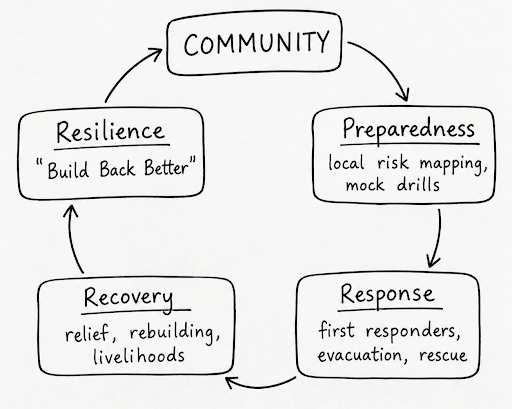
- First-responder advantage: Local people reach victims fastest, saving lives before external teams mobilise in the golden hour.
- Local knowledge: Communities best understand local hazards, safe shelters and vulnerable groups, enabling accurate risk mapping.
- Legal and global backing: The Disaster Management Act, 2005 and the Sendai Framework (2015-30) both prioritise a people-centred, bottom-up approach.
- Cost-effective resilience: Trained volunteers multiply state capacity at low cost, easing pressure on the NDRF and administration.
Indian Examples of Community-Based Disaster Management
- Odisha's zero-casualty model: Community-based early warning and mass evacuation of over a million people kept deaths minimal during Cyclone Fani (2019), praised globally by the UN.
- Aapda Mitra scheme: NDMA's flagship, now upscaled to train, equip and insure 1,00,000 volunteers across 350 disaster-prone districts as grassroots first responders.
- Kerala floods (2018): Local fishermen mobilised their boats to rescue thousands, becoming the backbone of relief operations.
- Yuva Aapda Mitra: Launched in Kerala in May 2025 across 12 districts, training youth volunteers in rescue and psycho-social care.
- Self-help groups:Kudumbashree in Kerala led community kitchens and relief coordination during floods and the pandemic.
Challenges to Effective Community Participation
- Risk illiteracy and fatalism: Low hazard awareness and an "act of god" mindset reduce preparedness and timely evacuation.
- Weak institutionalisation:Village Disaster Management Plans often remain paper documents without regular drills or funds.
- Exclusion of the vulnerable: Women, the elderly, disabled and migrants are frequently left out of planning and training.
- Resource and continuity gaps: Trained volunteers lack equipment, refresher training and incentives, causing attrition.
- Top-down mindset: Administration often treats communities as passive recipients of relief rather than active partners.
- Urban anonymity: Weak social cohesion in cities hampers the neighbourhood networks vital for response.
Targeted measures to strengthen community participation
- Institutionalise local plans: Make Village and Ward Disaster Management Plans living documents with mock drills and dedicated funds.
- Empower local bodies: Devolve disaster roles to Panchayats and urban local bodies under the DM Act with untied resources.
- Ensure inclusion: Mainstream women's SHGs, youth (NCC, NSS, NYKS) and persons with disabilities into every plan.
- Sustain volunteers: Provide insurance, refresher training and recognition, as done under upscaled Aapda Mitra.
- Leverage technology: Widely publicise the Common Alerting Protocol and mobile alerts for last-mile early warning. (eg: Sachet National Disaster Alert Portal -enables geo-targeted disaster alerts)
- Build a culture of safety: Integrate disaster education into school curricula and community awareness campaigns.
Disasters are best managed not merely for communities but by them. As the Sendai Framework affirms, resilience is built from the ground up; empowering local communities as informed, equipped and included partners is the surest foundation for a disaster-resilient India.
Last updated on Oct, 2026







