
Question
Discuss the role of aeolian processes in desertification and land degradation.
Detailed Solution
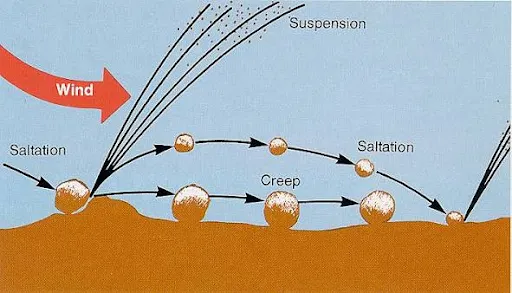
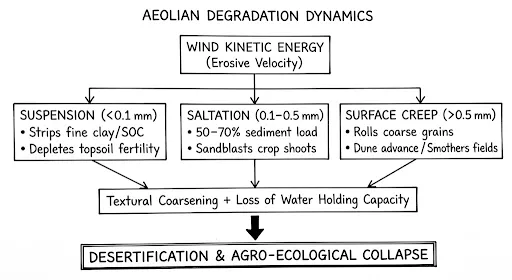
Aeolian processes, governed by wind-driven erosion (deflation/abrasion), transportation (saltation/suspension/creep), and deposition, are the primary physical drivers of land degradation in arid and semi-arid drylands, turning productive ecosystems into desertified wastelands.
Role of Aeolian Processes in Desertification and Land Degradation
- Initiates soil fertility loss: Deflation removes fine, nutrient-rich particles and soil organic carbon, exposing infertile subsoil and reducing land productivity.
- Diminishes soil moisture retention: Selective winnowing removes finer soil fractions, leaving coarse sediments that have lower water-holding capacity and intensify moisture stress.
- Converts productive land into barren surfaces: Saltation and surface creep mobilise dunes and sand sheets, burying croplands, pastures and irrigation infrastructure under shifting sand.
- Accelerates vegetation degradation: Mechanical abrasion by saltating particles damages seedlings and plant surfaces, weakening vegetation cover and exposing soils to further erosion.
- Expansion of desertification: Aeolian transport carries sand and dust into adjoining productive landscapes, extending degradation beyond the original source areas.
- Self-reinforcing degradation cycle: Loss of fertile topsoil reduces vegetation growth, while declining vegetation exposes more soil to wind erosion, thereby perpetuating desertification.
- Disrupts ecosystem functioning: Dust mobilisation removes essential nutrients from source regions and affects photosynthesis, soil chemistry and nutrient cycling in both source and deposition areas.
- Amplifies anthropogenic land degradation: Overgrazing, deforestation and unsustainable cultivation reduce protective vegetation, making exposed soils more susceptible to aeolian erosion and subsequent desertification.
Indian Context & Empirical Footprint
- According to the ISRO Desertification and Land Degradation Atlas (2021), 29.7% of India's Total Geographic Area (TGA) is undergoing degradation.
- Wind erosion accounts for ~5.46% of total degradation, concentrated in Rajasthan and Gujarat, where active sand sheets advance eastward through the Aravalli gaps toward the Indo-Gangetic plains.
Mitigation Framework
- Shelterbelts & Windbreaks: Planting multi-tier linear vegetative barriers (Khejri,Umbrella Thorn ) perpendicular to erosive winds to cut surface wind velocity.
- Dune Stabilization: Constructing checkerboard brushwood micro-windbreaks and mulching with drought-tolerant perennial grasses like Lasiurus scindicus (Sewan grass).
- Aravalli Green Wall Project: Developing a 1,400 km ecological green belt along the Aravalli range to halt the eastward march of the Thar Desert.
- Conservation Agriculture: Practicing zero-tillage, cover cropping, and stubble retention to preserve surface roughness and prevent wind deflation.
Aeolian degradation turns fragile drylands into wasteland through topsoil loss and dune advance. Meeting India's Land Degradation Neutrality pledge under UNCCD COP14 needs mechanical fixation paired with community agroforestry.
Latest UPSC Exam 2027 Updates
Last updated on Oct, 2026







