IMEC (India-Middle East-Europe Economic Corridor) is a proposed multinational connectivity initiative designed to strengthen trade, transport, energy and digital links between India, the Middle East and Europe. Announced during the G20 Summit in New Delhi on 9 September 2023, the corridor seeks to create an integrated multimodal network combining railways, ports, energy infrastructure and digital connectivity.
The IMEC initiative has both economic and strategic significance because it seeks to diversify international supply chains and provide additional connectivity between South Asia, the Gulf and Europe. Its development, however, remains closely linked to regional geopolitical and security conditions.
IMEC Overview
IMEC's full form is India-Middle East-Europe Economic Corridor, which is conceived as a transcontinental economic corridor connecting India with the Arabian Gulf and subsequently linking the Gulf with Europe.
- Rather than relying on a single mode of transportation, the proposal combines maritime shipping with railway networks and supporting road and logistics infrastructure, while also incorporating electricity, hydrogen and digital connectivity.
- The initiative was formally announced at the 2023 G20 Summit through a Memorandum of Understanding. The framework is intended to facilitate the movement of goods, energy and data across the three regions.
- It is not a legally binding international treaty.
- For India, the initiative offers the possibility of stronger access to Gulf and European markets, improved supply-chain resilience and greater integration into emerging transcontinental infrastructure networks.
IMEC Pillars
IMEC pillars provide the framework for developing an integrated corridor by combining physical infrastructure with sustainable energy solutions and digital innovation. These pillars collectively support its broader goals of connectivity, efficiency and economic integration.
- Transport Infrastructure Development: The corridor envisages modern transport infrastructure, including railway networks, ports, logistics facilities and supporting connectivity systems.
- The objective is to make cross-border movement of goods more efficient and create an integrated logistics chain.
- Sustainability: IMEC's vision incorporates renewable energy, green technologies and environmentally conscious infrastructure.
- Hydrogen and other clean-energy systems are envisaged as components of the wider corridor.
- Innovation: Digital technology, artificial intelligence and data-based systems are expected to support smart logistics, cargo tracking and efficient management of the corridor, thus complementing its physical infrastructure.


IMEC Countries
IMEC countries span South Asia, the Middle East and Europe, bringing together key economies and strategic partners along the proposed corridor.
- The original memorandum was signed by India, the United States, Saudi Arabia, the UAE, France, Germany, Italy and the European Union.
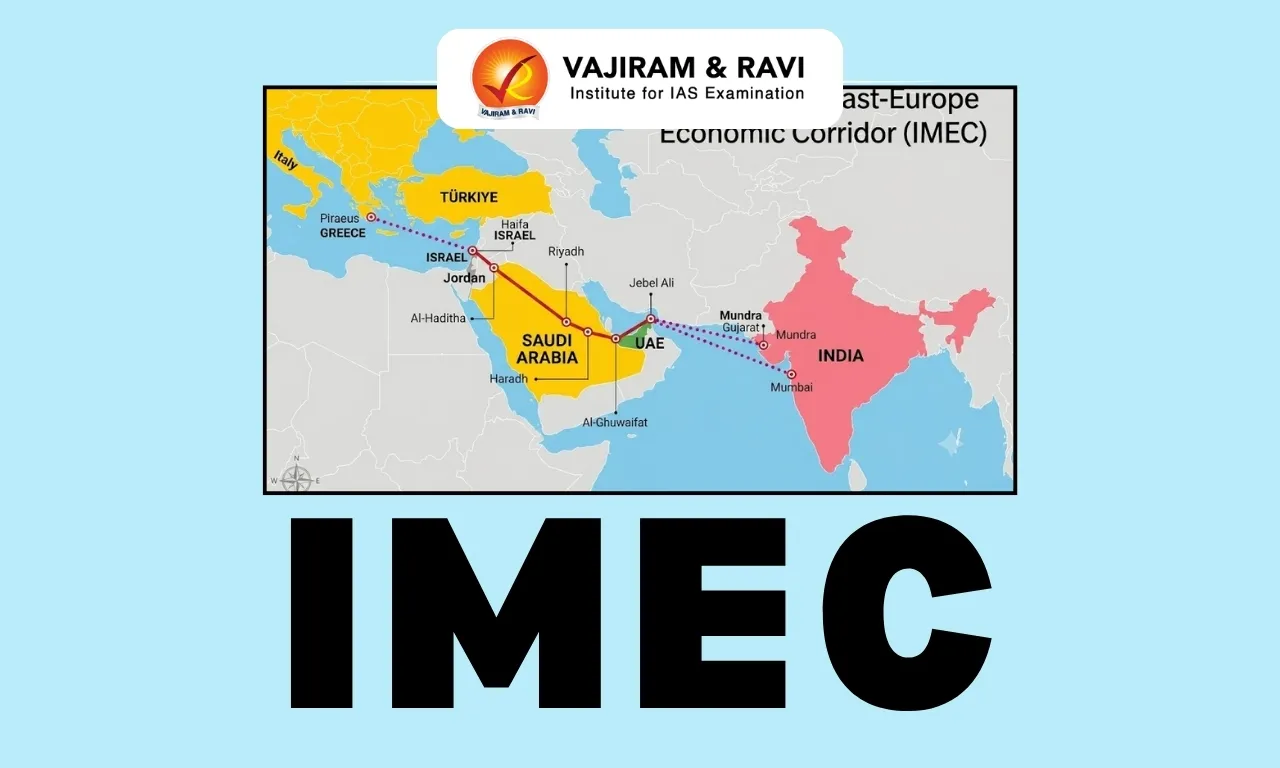
- Israel is an important geographical component of the proposed northern route, while Jordan is also strategically significant to the proposed rail alignment.
- Jordan has not signed an official agreement, although its geographical position between Saudi Arabia and Israel makes it important to the proposed route.
IMEC Corridor Structure
The proposed structure of IMEC combines several interconnected layers rather than functioning simply as a railway project.
- East Corridor: India and the Arabian Gulf are connected by the East Corridor. It will function as an essential transit and commercial route between the economies of South Asia and the Middle East.
- North Corridor: The North Corridor facilitates the efficient movement of people, products, and services between the Middle East and the European continent. It stretches from the Gulf to Europe.
- Maritime Network: Indian and Gulf ports would form important entry and exit points for cargo. Maritime shipping would connect the different sections of the corridor and integrate them with global trade routes.
- Railway Network: Railways are expected to serve as the backbone of the overland component. The objective is to move cargo across the Gulf and towards the Mediterranean more efficiently.
- Ports and Logistics Hubs: Ports would be connected with railway and logistics infrastructure to facilitate cargo transfer between maritime and land-based transportation.
- Electricity Infrastructure: The proposal includes electricity connectivity as part of its broader energy component, potentially supporting greater regional energy integration.
- Hydrogen Connectivity: Hydrogen infrastructure is envisaged as part of IMEC's clean-energy dimension, supporting the movement and development of low-carbon energy systems.
- Digital Connectivity: High-capacity fibre-optic infrastructure is expected to support data flows between India, the Gulf and Europe. This gives IMEC a digital dimension in addition to its physical transport network.
IMEC Map

IMEC Benefits
The benefits of IMEC extend beyond faster transportation, offering India opportunities to strengthen trade, diversify supply chains and deepen economic connectivity with Middle Eastern and European markets.
- Faster Trade Connectivity: The corridor could provide an additional multimodal route between India and Europe, potentially reducing dependence on longer maritime routes.
- On routes connecting India and Europe, IMEC is anticipated to cut freight times and expenses by up to 40% and 30%, respectively.
- Supply-Chain Diversification: IMEC could provide an alternative connectivity route for international trade, helping businesses reduce excessive dependence on individual maritime chokepoints.
- Greater Market Access for India: Improved connectivity with Europe could support Indian exporters by reducing logistical barriers and improving access to overseas markets.
- The Middle East Institute assessment cites estimates of a potential $22.09 billion increase in Indian exports associated with IMEC.
- Strengthening India's Global Connectivity: The corridor can enhance India's position as an important node between Asian, Middle Eastern and European markets. It also complements India's broader efforts to develop resilient international supply chains.
- Digital Connectivity: The proposed fibre-optic infrastructure could expand high-speed data connectivity between India, the Gulf and Europe. This is particularly relevant for India's expanding digital economy and growing demand for data infrastructure.
- Energy Cooperation: Electricity and hydrogen infrastructure could create opportunities for greater regional energy cooperation and support the transition towards cleaner energy systems.
- Regional Economic Integration: By connecting infrastructure and markets across multiple regions, IMEC could encourage investment, logistics development and greater economic interdependence among participating economies.
- Strategic Resilience: The corridor could provide additional options when conventional maritime routes face disruption.
- The Suez Canal blockage in 2021 and subsequent disruptions in the Red Sea demonstrated the vulnerability of concentrated global trade routes.
IMEC Challenges
The challenges of IMEC extend beyond the construction of physical infrastructure, as the corridor faces geopolitical instability, security concerns, financing constraints and coordination among multiple participating countries. These factors could influence the pace, cost and eventual viability of the proposed corridor.
- Geopolitical Instability: The wars and tensions in the Middle East have significantly affected the environment in which IMEC was conceived. The MEI argues that the corridor's original form has effectively been put on hold amid regional instability.
- Saudi-Israel Normalisation: The proposed northern route depends heavily on cooperation involving Saudi Arabia, Israel and neighbouring states. Continuing political tensions make this a major challenge for the corridor.
- Security Risks: The proposed network passes through a region exposed to conflict, maritime insecurity and geopolitical rivalry. Any disruption along one section could affect the wider multimodal chain.
- High Infrastructure Costs: Building railways, logistics hubs, ports, digital networks and energy infrastructure across several countries requires substantial investment and long-term financial commitments.
- Financing Uncertainty: The MEI's June 2026 assessment notes that firm funding commitments and construction timelines for the original corridor remain uncertain. This creates a gap between the project's strategic vision and its implementation.
IMEC Challenges for India
The challenges of IMEC for India arise from geopolitical uncertainty, security vulnerabilities, financial exposure, limited domestic economic gains and differences in regulatory frameworks across participating countries. These factors could complicate India’s ability to fully realise the corridor’s intended strategic and economic benefits.
- Geopolitical and Security Risks: The proposed IMEC route passes through a geopolitically sensitive region.
- Conflicts, instability, maritime insecurity and disruptions around critical chokepoints could affect the movement of goods and energy.
- India would therefore need alternative routes, contingency arrangements and mechanisms for maintaining supply chains during emergencies.
- Financial and Investment Risks: IMEC requires substantial long-term investment in railways, ports, energy infrastructure and digital networks.
- Cost overruns, currency fluctuations, interest-rate changes and uncertain returns could increase India's financial exposure.
- Limited Domestic Economic Gains: There is a possibility that European or other foreign companies could capture a substantial share of contracts and technology-intensive activities.
- Without appropriate policies, India may receive connectivity benefits without obtaining adequate employment, manufacturing opportunities and technology transfer.
- Greater participation of Indian MSMEs and domestic firms will therefore be important.
- Regulatory and Governance Challenges: IMEC involves several countries with different procurement rules, environmental standards, customs procedures and regulatory frameworks.
- Aligning these systems could increase project complexity and cause delays.
IMEC Way Forward
The future of IMEC will depend on converting its broad strategic vision into commercially viable, secure and coordinated infrastructure projects.
- Strengthen Political Coordination: Participating countries should maintain regular diplomatic engagement and develop mechanisms that allow economic cooperation to continue even during periods of political tension.
- Adopt a Phased Approach: Instead of waiting for the entire corridor to be completed simultaneously, partners can prioritise commercially viable sections and progressively integrate them into the larger network.
- Secure Sustainable Financing: Public financing, sovereign investment, multilateral institutions and private-sector participation guarantees, export-credit mechanisms and green bonds could help distribute the financial risks.
- They should be combined to create financially viable projects without creating unsustainable debt burdens.
- Improve Interoperability: Common standards for customs, cargo documentation, railway operations, digital systems and logistics can reduce delays at national borders.
- Develop Complementary Infrastructure: Railways should be supported by efficient ports, warehouses, logistics hubs, roads, digital systems and energy infrastructure so that bottlenecks in one component do not undermine the entire corridor.
- Strengthen Digital and Green Components: The corridor should not remain limited to physical transportation. Fibre-optic networks, renewable energy, hydrogen infrastructure and smart logistics can give IMEC greater long-term economic value.
- Ensure Regional Inclusiveness: The initiative can achieve greater resilience if its benefits extend beyond major hubs to surrounding economies and communities through investment, employment, logistics development and technology transfer.

 Last updated on Oct, 2026
→ UPSC 2027 Notification will be released on 13 January 2027 at upsconline.nic.in.
→ Asian Games 2026 are being held in Aichi-Nagoya, Japan, from 19 September to 4 October.
→ Check Nobel Prize 2026 Winners List here.
→ Download PIB PRiSM Monthly Magazine 2026 here.
→ Check UPSC Monthly Current Affairs Magazine The Recitals here.
→ Check out the latest UPSC Syllabus here.
→ Download UPSC Model Answers for Mains 2026
→ UPSC Mains Question Paper 2026 is out now for Essay & GS Paper 1, 2, 3 & 4.
→ UPSC Calendar 2027 has been released.
→ Enroll in Vajiram & Ravi’s UPSC Mains Test Series 2027 for structured answer writing practice, expert evaluation, and exam-oriented feedback.
→ Join Vajiram & Ravi’s UPSC Mentorship Program 2027 for personalized guidance, strategy planning, and one-to-one support from experienced mentors.
→ Go through the UPSC Mains Previous Year Papers to enhance your preparation.
→ UPSC has released UPSC Toppers List 2025 with the Civil Services final result on its official website.
→ Also check Best UPSC Coaching in India
IMEC FAQs
Q1. What is the India–Middle East–Europe Economic Corridor (IMEC)?+
Q2. When was IMEC announced?+
Q3. What countries are part of the IMEC initiative?+
Q4. What are the main objectives of IMEC?+
Q5. What are the current challenges facing IMEC?+
Tags: imec quest UPSC International Relations and Institutions Notes