



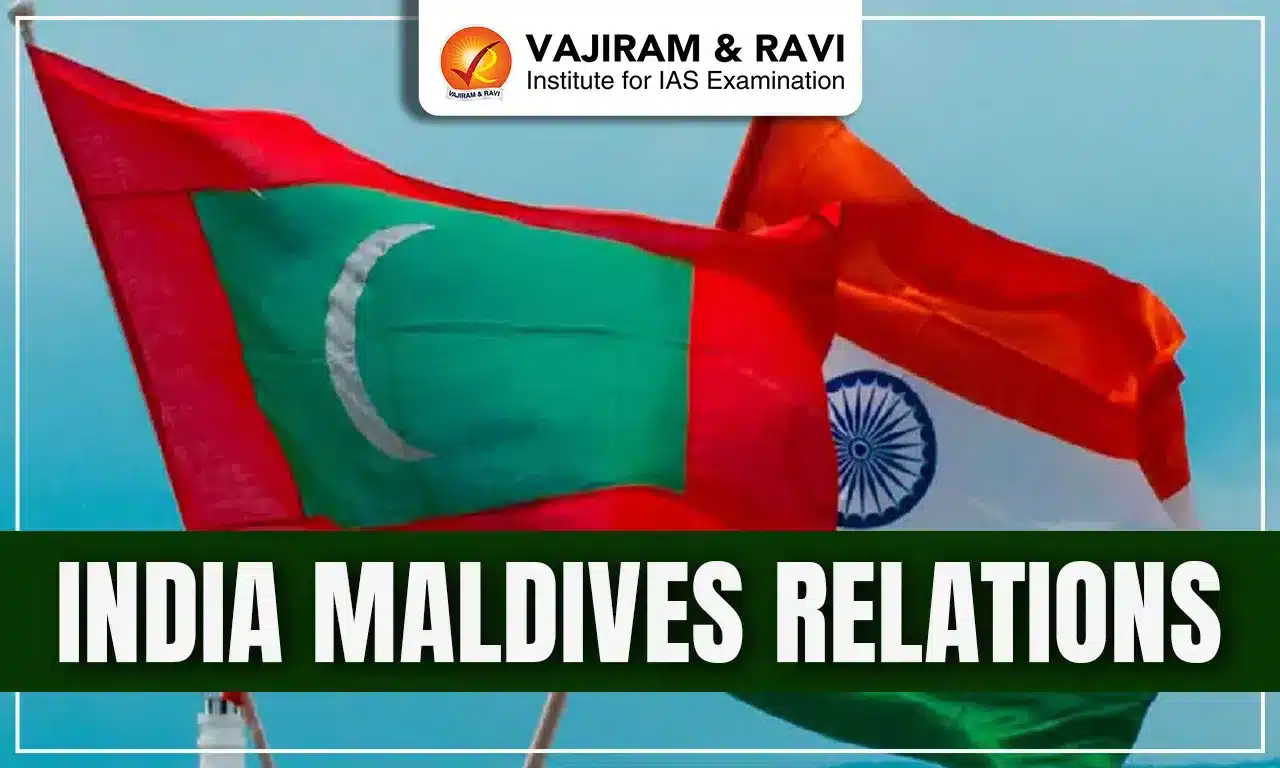
India Maldives relations are based on long-standing ties, with India playing a key role in the Maldives’ security and development. Cooperation covers defence support, crisis assistance, trade, tourism, and climate action. India has provided support during emergencies, while investments in infrastructure and digital payments have strengthened economic links.
India Maldives relations are strategically important for India’s security and trade routes in the Indian Ocean. However, challenges like China’s growing influence, political instability, climate risks, and maritime threats require sustained coordination.
India Maldives Relations History
India Maldives Relations are rooted in long-standing cultural, religious, and commercial ties, reflecting centuries of interaction as neighbours and maritime traders. These historical links laid the foundation for close and friendly relations, guided by shared strategic interests.
- Formal Diplomatic Engagement: Following the Maldives’ independence in 1965, India was among the first countries to establish diplomatic relations. This early recognition laid the foundation for enduring political cooperation and regional partnership.
- Resolution of Disputes: The 1976 Maritime Boundary Agreement resolved the Maldives’ claim in India’s favour, with the Maldives recognising Minicoy as part of India. This accord reinforced mutual respect for territorial integrity and strengthened peaceful bilateral relations.
- Comprehensive Trade Agreement: In 1981, India and the Maldives signed the Comprehensive Trade Agreement, formalising bilateral trade ties and fostering sustained economic collaboration.
- Operation Cactus (1988): Indian Armed Forces foiled a coup attempt against Maldives’ former President Maumoon Abdul Gayoom and restored stability, leading to long-term and friendly bilateral relations with the Maldives.
- Current Relationship: More recent times have seen some tensions due to the Maldives' outreach towards China and an "India Out" campaign under the current Maldivian president.
- However, in 2025, both countries made efforts to renew ties and signed cooperation agreements involving infrastructure and defence.
India Maldives Relations Recent Developments
In 2025, the Indian Prime Minister visited Malé as the chief guest for the Maldives’ 60th Independence Day, marking significant recent developments in India-Maldives relations. The Maldivian President called it a defining visit that reset ties after the 2023 political change and opened a new phase of cooperation.
- Strategic Partnership: Both countries reviewed progress on the 2024 Economic and Maritime Security Partnership, reaffirming India’s Neighbourhood First and MAHASAGAR policies.
- Cooperation was also strengthened under the Colombo Security Conclave Charter and regional forums to enhance Indian Ocean security.
- Economic Support: India extended a ₹4,850 crore Line of Credit and reduced annual debt repayments by 40%, providing crucial financial stability.
- It also initiated negotiations for a Free Trade Agreement (FTA) and a Bilateral Investment Treaty (BIT).
- Infrastructure and Connectivity: Projects such as the Greater Male Connectivity Project (GMCP), Addu City road and drainage works, community development projects, and about 3,300 social housing units were inaugurated.
- Digital Integration: Digital integration advanced through the formal launch of Unified Payments Interface (UPI), RuPay cards, and local currency trade.
- Health: India donated two Aarogya Maitri Health Cubes (BHISHM), equipped to provide emergency medical aid for up to 200 casualties.
India Maldives Relations Areas of Cooperation
India Maldives relations share a multifaceted relationship with several key areas of cooperation, critical for regional stability, maritime security, economic development, and bilateral ties.
- Security and Military Cooperation: India is a principal security partner, supporting maritime security, coastal defense, and disaster response capabilities for the Maldives.
- Both countries conduct joint military exercises, such as the Ekuverin, trilateral "Dosti" exercise with Sri Lanka.
- In 1988, India thwarted a coup attempt in the Maldives through a swift military intervention named "Operation Cactus".
- Economic Cooperation: India is a leading development and trade partner, supporting infrastructure, healthcare, and education through grants, Lines of Credit, and investments.
- Initiatives such as the Greater Male Connectivity Project, duty-free tuna exports, and visa facilitation enhance connectivity and promote economic growth.
- Political Cooperation: Political cooperation between India and the Maldives involves regular diplomatic engagement, support for democratic institutions, and collaboration in regional and multilateral forums to strengthen bilateral trust and stability.
- This is reflected in high-level visits such as the Indian Prime Minister’s 2025 trip to Malé, Joint Commission meetings, and foreign ministerial dialogues.
- Strategic Financial and Digital Cooperation: India and the Maldives share cordial financial links, with India supporting Maldivian economic development for years.
- Digital cooperation advanced in 2025 with the official launch of Unified Payments Interface (UPI) and RuPay in the Maldives.
- Both countries signed an MoU in 2024 to settle trade in their local currencies (INR–MVR), reducing reliance on the US dollar and easing bilateral trade.
- Disaster Management and Humanitarian Aid: India and the Maldives cooperate closely in disaster relief, search and rescue, and pollution control.
- Climate and Sustainability: India and the Maldives cooperate on renewable energy, climate adaptation, and disaster preparedness, with India providing financial and technical support for sustainable projects.
- Capacity Building: India plays a key role in strengthening Maldivian human and institutional capacities through higher education, teacher exchanges, scholarships, and training programmes.
- India also provides around 70% of the Maldivian National Defence Force’s training, covering joint exercises, EEZ patrols, anti-narcotics operations, medical evacuations, and humanitarian assistance.
Greater Male Connectivity Project
Greater Male Connectivity Project (GMCP) is one of the largest infrastructure projects in the Maldives and a flagship India-assisted initiative, funded through a USD 400 million Line of Credit and a USD 100 million grant from India.
- Features: The project consists of a 6.74 km bridge and causeway connecting Malé, Villingili, Gulhifalhu, and Thilafushi, featuring renewable energy-based lighting and surveillance to support sustainable development.
- Significance: The GMCP will ease travel, boost trade and tourism, support the planned Gulhifalhu Port and Thilafushi industrial zone, create jobs, and drive long-term economic growth, benefiting nearly half of the Maldivian population.





India Maldives Relations Significance
India-Maldives relations are vital for Indian Ocean security and trade, supporting India’s Neighbourhood First policy and SAGAR vision. With increasing trade, investments, and defence cooperation, economic growth and maritime safety are boosted, while tourism strengthens people-to-people links.
-
- Strategic Location: The Maldives lies barely 70 nautical miles from India’s Minicoy and about 300 nautical miles from the west coast, positioned along critical Indian Ocean sea lanes. These routes carry around 50% of India’s external trade and 80% of its energy imports, making the Maldives vital for safeguarding India’s trade and energy interests.
- Its position aligns with India’s Neighbourhood First policy and SAGAR vision.
- Strategic Location: The Maldives lies barely 70 nautical miles from India’s Minicoy and about 300 nautical miles from the west coast, positioned along critical Indian Ocean sea lanes. These routes carry around 50% of India’s external trade and 80% of its energy imports, making the Maldives vital for safeguarding India’s trade and energy interests.
- Political Stability: India Maldives relations help maintain political stability by supporting democracy and strong institutions, reducing external influence, particularly from China, and strengthening strategic, economic, and maritime cooperation.
- Countering China: India and Maldives healthy relations contribute to regional stability in the Indian Ocean. It helps counter external influences, particularly from China, and protects important sea lanes critical for trade and energy supply.
- Economic Significance: India is one of the Maldives’ largest economic partners, with trade growing from USD 300 million in 2021 to USD 548 million in 2023. Investments in infrastructure and social sectors help reduce external dependencies and promote shared growth.
- Security Cooperation: The Maldives acts as India’s frontline partner in combating piracy, trafficking, and terrorism in the Indian Ocean region. Defence collaboration through patrols and intelligence sharing reinforces maritime security and regional peace.
- Tourism: Tourism is a major contributor to the Maldives’ economy, with India being its largest source market. In 2023, Indian nationals made up a significant portion of tourist arrivals to the Maldives, with over 200,000 Indian tourists visiting the Maldives.
India Maldives Relations Challenges
India Maldives relations face several challenges, including Maldives' growing tilt to China with strategic deals, debt dependency, anti-India sentiment impacting tourism, political instability, and concerns over Indian military presence.
- Geopolitical Competition: China’s growing presence in the Maldives through infrastructure projects, such as the Sinamale Bridge and airport expansion, has increased its economic footprint.
- Political instability: Frequent changes in government and shifting foreign policy create instability. Pro-India policies often face domestic opposition, making it harder to maintain consistent cooperation.
- Anti-India Sentiments: Sections of Maldivian politics and society increasingly use anti-India rhetoric to mobilise domestic support and question India’s role in development and security.
- This has fuelled campaigns such as “India Out,” which undermine bilateral cooperation and public goodwill.
- Economic Vulnerabilities: The Maldives faces economic vulnerabilities, including high fiscal deficits and potential debt, high external debt, and concerns over debt trap diplomacy largely owed to China.
- Radicalisation: Rising religious extremism, with some Maldivians joining global terrorist groups, poses a threat of transnational terrorism and coastal security risks for India. It also creates internal instability that can spill over into the wider Indian Ocean region.
- Maritime Security Concerns: Piracy, illegal fishing, and trafficking are growing threats in the Indian Ocean. Coordinated patrols, intelligence sharing, and maritime infrastructure development are essential to ensure regional security.
India Maldives Relations Way Forward
India Maldives relations are essential for regional stability, economic growth, and maritime security in the Indian Ocean. Cooperation across security, economy, climate, and people-to-people ties can ensure a mutually beneficial partnership.
- Deepen Economic Cooperation: India and the Maldives should speed up the Free Trade Agreement (FTA), encourage Indian investments, and use local currency trade to make business easier.
- Important projects like the GMCP and undersea cables should be completed quickly to improve transport and digital connectivity and reduce reliance on other countries.
- Enhance Maritime Security: Maritime security should be strengthened with joint naval patrols, EEZ monitoring, sharing intelligence, and providing patrol vessels and drones.
- India should also use regional platforms like the Colombo Security Conclave to improve security in the Indian Ocean.
- Diplomatic and Political Engagement: Regular high-level visits, joint meetings, and Track-II diplomacy (through think tanks and academic exchanges) will build trust.
- India should handle sovereignty concerns carefully and avoid public disputes to maintain stable political relations.
- Promote People-to-People Ties: India should engage Maldivian youth, support independent media, and encourage cultural exchanges such as films, education, and skill development programs to strengthen trust and friendship.
India Maldives Relations PYQs
Question 1. Discuss the political developments in Maldives in the last two years. Should they be of any cause of concern to India? (UPSC Mains 2013)

 Last updated on March, 2026
→ UPSC Final Result 2025 is now out.
→ UPSC has released UPSC Toppers List 2025 with the Civil Services final result on its official website.
→ Anuj Agnihotri secured AIR 1 in the UPSC Civil Services Examination 2025.
→ UPSC Marksheet 2025 is now out.
→ UPSC Notification 2026 & UPSC IFoS Notification 2026 is now out on the official website at upsconline.nic.in.
→ UPSC Calendar 2026 has been released.
→ Check out the latest UPSC Syllabus 2026 here.
→ UPSC Prelims 2026 will be conducted on 24th May, 2026 & UPSC Mains 2026 will be conducted on 21st August 2026.
→ The UPSC Selection Process is of 3 stages-Prelims, Mains and Interview.
→ Prepare effectively with Vajiram & Ravi’s UPSC Prelims Test Series 2026 featuring full-length mock tests, detailed solutions, and performance analysis.
→ Enroll in Vajiram & Ravi’s UPSC Mains Test Series 2026 for structured answer writing practice, expert evaluation, and exam-oriented feedback.
→ Join Vajiram & Ravi’s Best UPSC Mentorship Program for personalized guidance, strategy planning, and one-to-one support from experienced mentors.
→ Shakti Dubey secures AIR 1 in UPSC CSE Exam 2024.
→ Also check Best UPSC Coaching in India
India Maldives Relations FAQs
Q1. What's the issue between India and Maldives?+
Q2. Does Indian rupee work in Maldives?+
Q3. What is the religion of the Maldives?+
Q4. Which country protects Maldives?+
Q5. Is Maldives bigger than Lakshadweep?+
Tags: india maldives relations