
Question
“IPMDA (Indo-Pacific Partnership for Maritime Domain Awareness) bridges the gap between India’s SAGAR (Security and Growth for All in the Region) vision and the Quad’s collective Indo-Pacific strategy.” Make a critical assessment of the statement focusing on IPMDA.
Detailed Solution
Launched at the 2022 Tokyo Summit, the Quad’s Indo-Pacific Partnership for Maritime Domain Awareness (IPMDA) integrates commercial satellite telemetry across 32 million square nautical miles to monitor dark shipping and illicit maritime activities.
IPMDA bridging SAGAR and Quad strategy
- Delivering Non-Coercive Regional Public Goods: Aligns with India’s SAGAR doctrine by offering transparent surveillance data to littoral states without military conditionality, reinforcing a cooperative regional order.
- Institutionalising India’s Maritime Leadership: Anchors the Indian Ocean architecture to Indian command nodes, advancing India’s role as a net-security provider within evolving Indo-US strategic cooperation.
a. Example: The Information Fusion Centre–Indian Ocean Region (IFC-IOR) in Gurugram functioning as the primary data-dissemination node. - Deterring Gray-Zone Maritime Coercion: Fulfills the Quad’s objective of rules-based order enforcement by stripping away anonymity from hostile maritime militias.
a. Example: Real-time tracking of vessels that deliberately disable their Automatic Identification Systems (AIS) for illicit transshipments. - Facilitating Inclusive Multi-Alignment: Enables strategic convergences with ASEAN and Pacific Island nations without forcing formal military bloc alignments.
a. Example: Formal operational linkages established with the Pacific Fusion Centre (Vanuatu) and the Information Fusion Centre (Singapore).
Structural Gaps and Constraints
- Surveillance-to-Interdiction Deficit: Generates actionable intelligence but fails to address the lack of physical interception assets among smaller partner states.
a. Example: Littoral nations like Maldives and Seychelles lack sufficient Offshore Patrol Vessels (OPVs) to apprehend flagged violators.

- Technological Dependency: Relies heavily on Western commercial constellations and software, posing long-term challenges to indigenous data sovereignty.
- Hesitation among Neutral Littorals: Southeast Asian nations remain cautious of full integration, viewing the mechanism as potential Quad-led containment.
a. Example: Reluctance among non-aligned ASEAN member states to establish direct sovereign naval data links with IPMDA. - Regional Coverage Gaps: Geographic focus remains concentrated on the Western Pacific and Eastern Indian Ocean, leaving western sea lanes vulnerable.
a. Example: India’s reliance on parallel arrangements, such as India-France maritime cooperation, to secure the South-Western Indian Ocean.
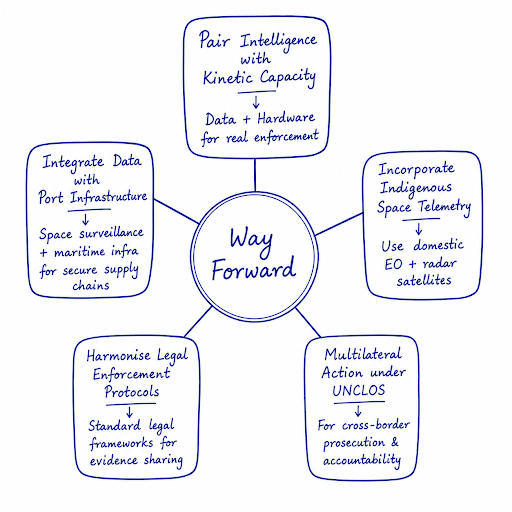
Transforming IPMDA from situational surveillance into collective interdiction capacity will firmly anchor stability, international law, and maritime security across the Indo-Pacific.
Latest UPSC Exam 2027 Updates
Last updated on Oct, 2026







