



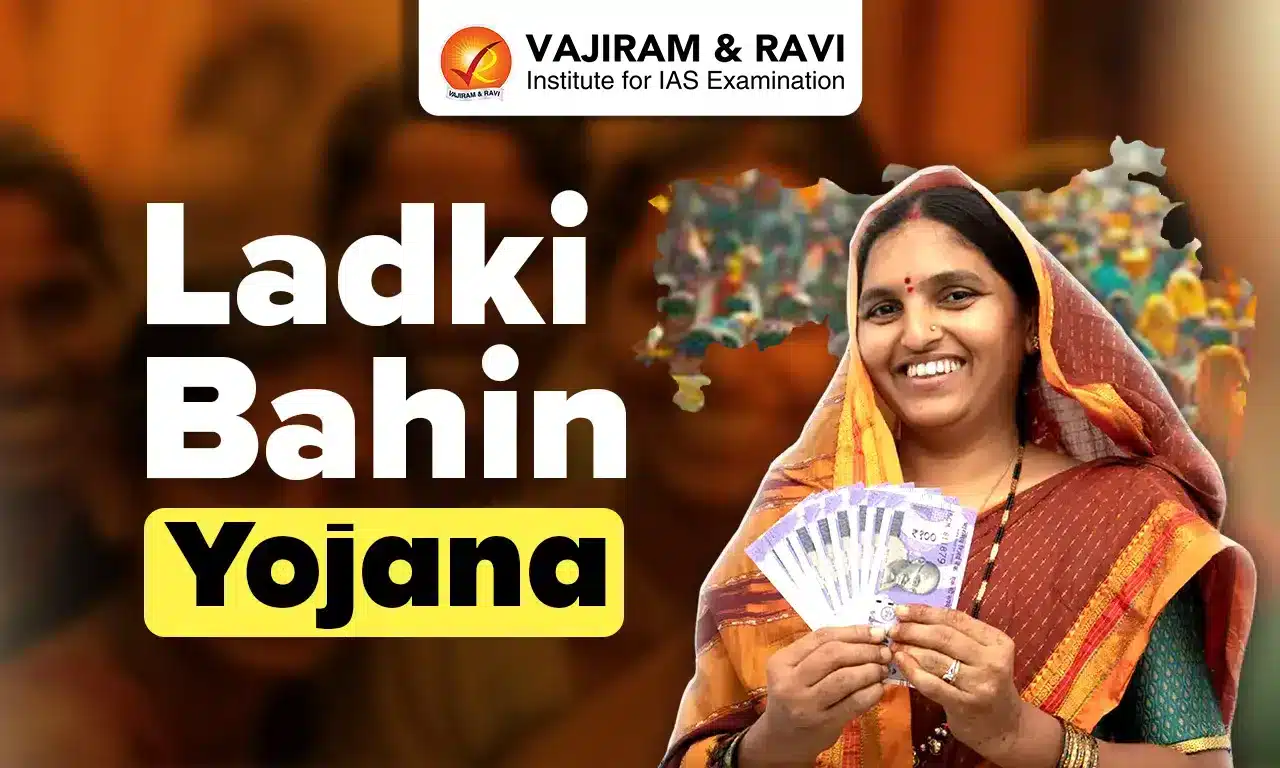
The Ladki Bahin Yojana is a landmark women-centric social welfare scheme launched by the Government of Maharashtra in mid-2024, aiming to financially empower women from economically weaker households. Under the scheme, eligible women receive a monthly direct benefit transfer (DBT) of ₹1,500 into their Aadhaar-linked bank accounts. The programme is designed to bolster health, nutrition, decision-making, and economic autonomy of women aged 21-65 years with family incomes up to ₹2.50 lakh annually. The scheme reflects the state’s push towards gender inclusive growth and economic justice.
Ladki Bahin Yojana
The Ladki Bahin scheme (officially “Mukhyamantri- Majhi Ladki Bahin Yojana”) was notified by the Women & Child Development Department of Maharashtra, with the objective of giving poor and low-income women a regular monthly stipend, thereby alleviating financial stress and enhancing their agency in households and communities. According to official district-level portals, it aims at “economic freedom to women in the state age group of 21 to 65 years, improving their health and nutrition and strengthening their decisive role in the family.”
The scheme directly credits funds via DBT and mandates criteria such as Aadhaar-linked bank account, income threshold, and residence in Maharashtra. The monthly amount of ₹1,500 translates into approximately ₹18,000 yearly, significant for low-income households.
Ladki Bahin Yojana Objectives
The key objectives of the Ladki Bahin Yojana has been listed below:
- Provide regular financial support to women in economically vulnerable situations (income ≤ ₹2.5 lakh/ year).
- Enhance women’s financial independence, enabling them to participate in family and community decision-making.
- Improve health, nutrition and general welfare of female beneficiaries and their families.
- Ensure gender equity by targeting women aged 21-65 across marital statuses (married, widowed, divorced, abandoned/ destitute) and one unmarried woman per family.
- Create a transparent and accountable delivery mechanism via Aadhaar-linked bank accounts and eKYC.





Ladki Bahin Yojana Eligibility
The Ladki Bahin Yojana eligibility focuses on ensuring that financial support reaches economically weaker women across Maharashtra’s rural and urban households.
- Resident of Maharashtra: Only women holding valid residence proof of Maharashtra are eligible to apply under this welfare scheme.
- Age Criteria (21-65 years): The applicant must be between 21 and 65 years old to ensure inclusion of working-age and dependent women.
- Annual Family Income Limit: The total annual family income should not exceed ₹2.5 lakh, verified through official government documents or certificates.
- Aadhaar-linked Bank Account: Beneficiaries must have an Aadhaar-linked bank account to receive the benefit through Direct Benefit Transfer (DBT).
- Eligible Categories: The scheme covers married, widowed, divorced, abandoned, destitute, and one unmarried woman per family.
Ladki Bahin Yojana Exclusions
To ensure fair targeting, the Ladki Bahin Yojana excludes families and individuals who already enjoy financial stability or government benefits.
- Income Tax Payers: Any family with a member who pays income tax is not eligible for the scheme.
- Government Employees and Pensioners: Regular or permanent government employees, pensioners, MPs, and MLAs are excluded from receiving benefits.
- Vehicle Ownership Restriction: Households owning a four-wheeler vehicle are considered financially stable and therefore excluded from the scheme’s benefits.
- Data Verification and eKYC: The government verifies eligibility through eKYC to ensure that only genuine beneficiaries receive assistance.
Ladki Bahin Yojana Features
The Ladki Bahin Yojana provides monthly financial support directly to women’s bank accounts, ensuring transparency and empowerment through digital delivery.
- Monthly Financial Benefit: Each eligible woman receives ₹1,500 per month directly into her Aadhaar-linked bank account through DBT.
- Festival Bonus Scheme: A special Diwali bonus was announced in October 2024, providing double payment of ₹3,000 for that month.
- eKYC Requirement: Mandatory eKYC verification ensures continued eligibility and prevents duplication of beneficiaries across multiple schemes.
- Direct Benefit Transfer (DBT) System: The DBT mechanism ensures funds are transferred without middlemen, reducing corruption and improving transparency.
Ladki Bahin Yojana Budget and Coverage
The Maharashtra government’s budget allocation highlights the large-scale vision and commitment behind the Ladki Bahin Yojana’s implementation.
- Budget Allocation: Around ₹46,000 crore was allocated for the scheme, making it one of Maharashtra’s largest welfare programs.
- Women Beneficiaries: By September 2025, over 2 crore women across Maharashtra had enrolled in the scheme successfully.
- Future Target: The government aims to cover nearly 20-30 million women in the upcoming phases of implementation.
- Inclusive Reach: The scheme targets both rural and urban women, ensuring equal access to economic support and empowerment opportunities.
Ladki Bahin Yojana Implementation Mechanism
The scheme is administered by the Maharashtra Women & Child Development Department. District-level implementation is through local tehsils, municipal bodies and women-child offices. Beneficiaries apply online via the official portal at ladakibahin.maharashtra.gov.in or through designated centres, submitting Aadhaar, bank account, residence proof, income certificate and other documents.
The DBT pathway ensures funds go directly to recipients, reducing intermediaries. eKYC updated annually to prevent misuse. Benefit disbursals began from July 2024 onward. For example, district Pune website lists the scheme date as 1 July 2024.
Ladki Bahin Yojana Impact
The scheme has enabled low-income women to receive a reliable monthly cash flow of ₹1,500, a meaningful amount for daily expense, health or education. Anecdotal reports highlight that the funds are used for children’s schooling, small business inputs, or medical costs. Moreover, inclusion of women in the banking system via Aadhaar-linking supports financial inclusion. The policy pushes women into formal financial channels.
However, the scheme has also faced significant fraud and leakage: In a report, 14,298 men received benefits meant for women, amounting to ₹21.44 crore in fraudulent disbursals in 2025. An audit estimated a total loss of about ₹1,640 crore in the first year due to ineligible enrollments (including over-aged beneficiaries, more than two women per household, vehicles owned). These early results show both promise and challenge in execution.
Ladki Bahin Yojana Challenges
Despite several perks and benefits, the Ladki Bahin Yojana faces multiple backlashes and criticism as given below. By tackling these issues, the scheme can deepen impact and maintain fiscal discipline and transparency.
- Verification & Fraud Risk: As seen, men and ineligible women received the benefits.
- Way Forward: Strengthen eKYC, cross-check Income Tax data and vehicle ownership (auth access to ITR/ vehicle databases).
- eKYC Compliance & Digital Divide: eKYC mandated within 2 months of registration, but many women lack Aadhaar/ phone/ internet.
- Way Forward: Provide on-ground camps and assistance in offline mode through local centres.
- Budgetary Sustainability: The large scale (₹46,000 crore) places pressure on state finances.
- Way Forward: Tie up benefit disbursals with performance, explore phased roll-out for sustainability.
- Targeting Accuracy: Families owning vehicles, or members earning high income, still slipped in.
- Way Forward: Regular audit, dynamic exclusion lists and inter-departmental data sharing (ITR, vehicle registry).
- Awareness & Reach: Some eligible women are unaware or unable to apply due to documentation hurdles.
- Way Forward: IEC campaigns in local languages, outreach via women’s self-help groups (SHGs) and community centres.
- Benefit Utilisation: Funds may get used for consumption rather than investment in health/education.
- Way Forward: Link scheme with women’s skill training, micro-entrepreneurship and health schemes.
- Administrative Capacity: Large volume of applications and DBT requires efficient backend systems and monitoring.
- Way Forward: Upgrade MIS, real-time dashboards, integrate audit alerts and fraud detection algorithms.
- Gender Integration: While the scheme supports women directly, broader gender ecosystem (jobs, assets) remains weak.
- Way Forward: Complement scheme with employment opportunities, asset ownership promotion and women's leadership programmes.
- Inflation & Real Value: ₹1,500 may lose real value with time/ inflation and may not cover all needs.
- Way Forward: Periodic review of cash amount, link to cost-of‐living indices, adjust accordingly.
- Retention & Drop-out: Some beneficiaries might drop out if documentation or renewal (eKYC) fails.
- Way Forward: Simplify renewal process, offer grace periods and on-line/ offline assistance to complete renewals.
Ladki Bahin Yojana Accountability
To ensure transparency and accountability, the scheme mandates annual eKYC and ties payments to bank-Aadhaar linked accounts. The government has also been given authority to access Income Tax Return data and vehicle ownership records to weed out ineligible beneficiaries.
District-level dashboards and beneficiary tracking have been set up in many places. Further, audits by the Women & Child Development Department uncovered misuse, leading to recovery actions. These steps are vital for upholding public trust and efficient use of public funds.
Ladki Bahin Yojana Current Status
As of late 2025, the scheme has crossed millions of beneficiaries and significant funds have been disbursed. The government is tightening controls, eKYC deadlines, data cross‐checks, audits, and exclusion of ineligible beneficiaries. Media reports show caution about fake websites and portal usability issues.
Next steps include integrating this scheme with other women empowerment initiatives, skill development, asset transfer, micro-credit, health insurance, and possibly increasing the monthly stipend. Periodic review of eligibility limits, income caps and inclusion criteria will be essential to keep the scheme effective as inflation and costs rise.
Ladki Bahin Yojana UPSC
In a state like Maharashtra, where women’s labour force participation and asset ownership remain lower than men, the Ladki Bahin Yojana stands out as a direct cash‐transfer measure targeted at women. It shifts welfare from men‐dominated parameters to women’s agency. By providing them with independent income, the scheme creates potential for greater bargaining power, improved health and social inclusion.
From a policy perspective, it aligns with Sustainable Development Goal 5 (gender equality) and SDG 1 (no poverty). Regular cash transfers to women have been shown globally to reduce child-marriage, improve nutrition and increase school attendance of children. The scheme thus carries both welfare and developmental significance.

 Last updated on April, 2026
→ UPSC Final Result 2025 is now out.
→ UPSC has released UPSC Toppers List 2025 with the Civil Services final result on its official website.
→ Anuj Agnihotri secured AIR 1 in the UPSC Civil Services Examination 2025.
→ UPSC Marksheet 2025 is now out.
→ UPSC Notification 2026 & UPSC IFoS Notification 2026 is now out on the official website at upsconline.nic.in.
→ UPSC Calendar 2026 has been released.
→ Check out the latest UPSC Syllabus 2026 here.
→ UPSC Prelims 2026 will be conducted on 24th May, 2026 & UPSC Mains 2026 will be conducted on 21st August 2026.
→ The UPSC Selection Process is of 3 stages-Prelims, Mains and Interview.
→ Prepare effectively with Vajiram & Ravi’s UPSC Prelims Test Series 2026 featuring full-length mock tests, detailed solutions, and performance analysis.
→ Enroll in Vajiram & Ravi’s UPSC Mains Test Series 2026 for structured answer writing practice, expert evaluation, and exam-oriented feedback.
→ Join Vajiram & Ravi’s Best UPSC Mentorship Program for personalized guidance, strategy planning, and one-to-one support from experienced mentors.
→ Shakti Dubey secures AIR 1 in UPSC CSE Exam 2024.
→ Also check Best UPSC Coaching in India
Ladki Bahin Yojana FAQs
Q1. What is the benefit amount under Ladki Bahin Yojana? +
Q2. Who is eligible for Ladki Bahin Yojana?+
Q3. What is the exclusion criteria for Ladki Bahin Yojana?+
Q4. What documentation is required for Ladki Bahin Yojana?+
Q5. How is the Ladki Bahin Yojana being misused?+
Tags: ladki bahin yojana