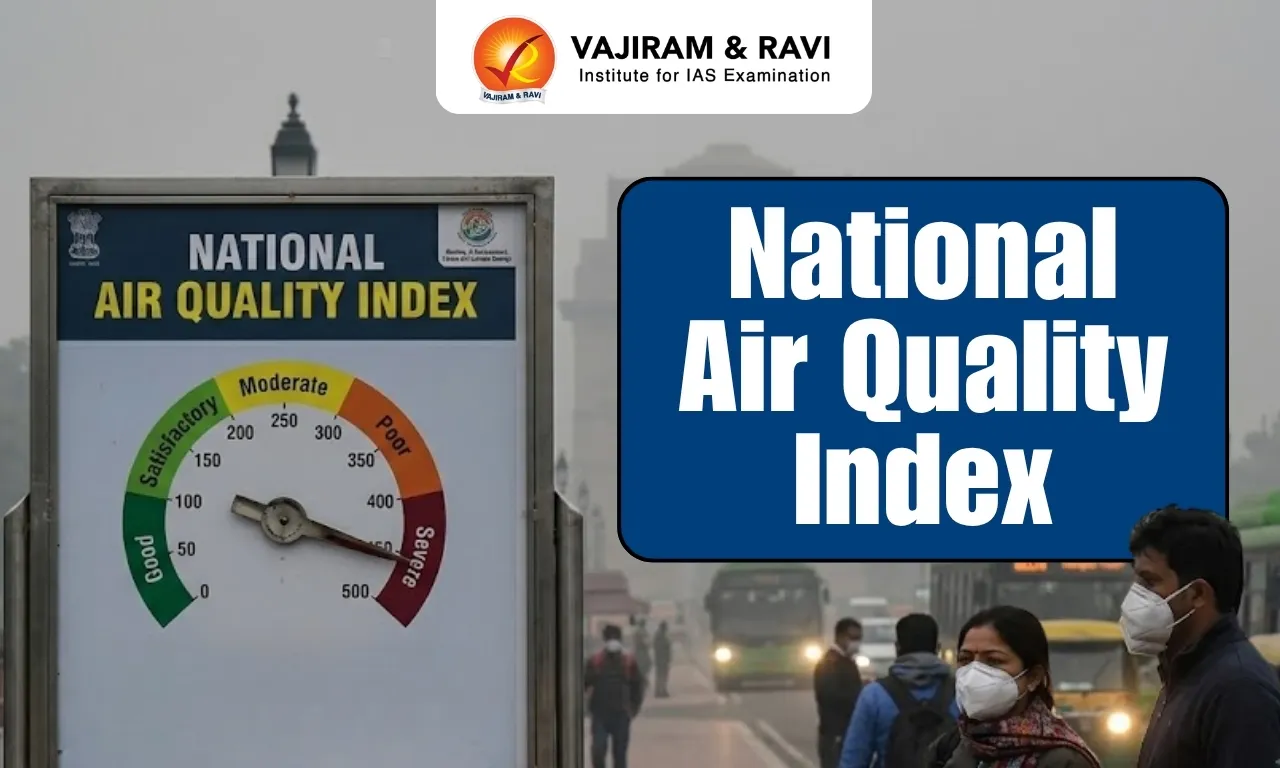
National Air Quality Index (NAQI) is a tool that reports daily air quality by converting complex pollutant data into a single value, category, and colour code, highlighting potential health effects from polluted air. AQI helps compare air quality across locations, track improvements or deterioration, and raise public awareness, especially for vulnerable groups.
In India, the Central Pollution Control Board (CPCB) issues the AQI and covers pollutants like PM10, PM2.5, NO₂, SO₂, CO, O₃, NH₃, and Pb. WHO provides global guidelines, setting strict limits for pollutants such as PM2.5 and PM10 to protect health and guide cleaner air policies.
National Air Quality Index (NAQI) Meaning
National Air Quality Index (NAQI) was launched in 2014 to make air-quality information simple, accessible and understandable to the general public. It follows the principle of “One Number-One Colour-One Description”, converting complex data on air pollutants into a single index value with a corresponding category and colour code.
- Daily reporting: Provides a simplified assessment of the daily ambient air quality.
- Pollution status: Indicates whether the air is clean or polluted and conveys the associated health risks.
- Health-oriented: Primarily reflects short-term health effects that may arise from exposure to polluted air over a few hours or days.
- Simple communication: Presents complex pollutant information in an easily understandable form, enabling citizens to assess air quality at a glance.
National Air Quality Index (NAQI) Objectives
National Air Quality Index (NAQI) aims to improve understanding and management of air quality by providing clear information for public awareness, comparison, and informed action.
- Comparison: Facilitates comparison of air-quality conditions across different cities and locations.
- Trend monitoring: Tracks improvements or deterioration in air quality over time.
- Monitoring gaps: Helps identify deficiencies in air-quality standards and gaps in monitoring systems.
- Public awareness: Keeps citizens informed about environment conditions and enables vulnerable groups to take appropriate precautions.


National Air Quality Index (NAQI) Issuing Authority
The National Air Quality Index India is released by the Central Pollution Control Board (CPCB) under the Ministry of Environment, Forest and Climate Change (MoEFCC). CPCB is responsible for monitoring and disseminating ambient air-quality information across India.
National Air Quality Index Map
The National Air Quality Index Map provides a visual representation of air-quality conditions across different cities and monitoring locations in India, using National Air Quality Index values and colour-coded categories to indicate pollution levels.
- Spatial comparison: Enables quick comparison of air-quality conditions across different locations.
- Pollution hotspots: Helps identify areas experiencing poor, very poor or severe air quality.
- Public awareness: Makes regional variations in air pollution easier for citizens and authorities to understand.
National Air Quality Index Measuring Parameters
The India National Air Quality Index measures ambient air quality using eight key pollutants and converts their concentrations into individual sub-indices; the highest sub-index determines the overall AQI for a monitoring location.
- National Air Quality Index Pollutants: National Air Quality Index considers eight major air pollutants for assessing ambient air quality:
- Particulate Matter: PM₁₀ and PM₂.₅
- Gases: NO₂, SO₂, CO, O₃ and NH₃
- Heavy metal: Lead (Pb)
- Averaging period: Uses 24-hour average concentrations for most pollutants, while CO and O₃ are assessed using an 8-hour average.
- Data requirement: A minimum of 16 hours of data is required to calculate a pollutant sub-index.
- Overall Air Quality Index: Requires data for at least three pollutants, with PM₂.₅ or PM₁₀ being one of them; otherwise, the overall Air Quality Index is considered insufficient.
- Location-specific monitoring: All eight pollutants are not necessarily monitored at every location, depending on the monitoring network.
- Pollutant-wise assessment: Individual sub-indices can be calculated and reported even when an overall AQI cannot be determined.
- Continuous monitoring: Automated monitoring stations generate real-time AQI using running-average values, reducing the need for manual intervention.
- Manual monitoring: An AQI calculator is available for manually monitored stations to calculate the index from observed pollutant concentrations.
National Ambient Air Quality Standards (NAAQS)
National Ambient Air Quality Standards (NAAQS) specify permissible concentration levels of air pollutants in ambient (outdoor) air to protect public health and the environment.
- Legal basis: The standards are prescribed under the Air (Prevention and Control of Pollution) Act, 1981.
- Prescribed by: Central Pollution Control Board (CPCB).
- Coverage: The revised NAAQS, notified in 2009, cover 12 pollutants.
National Air Quality Index (NAQI) Categories
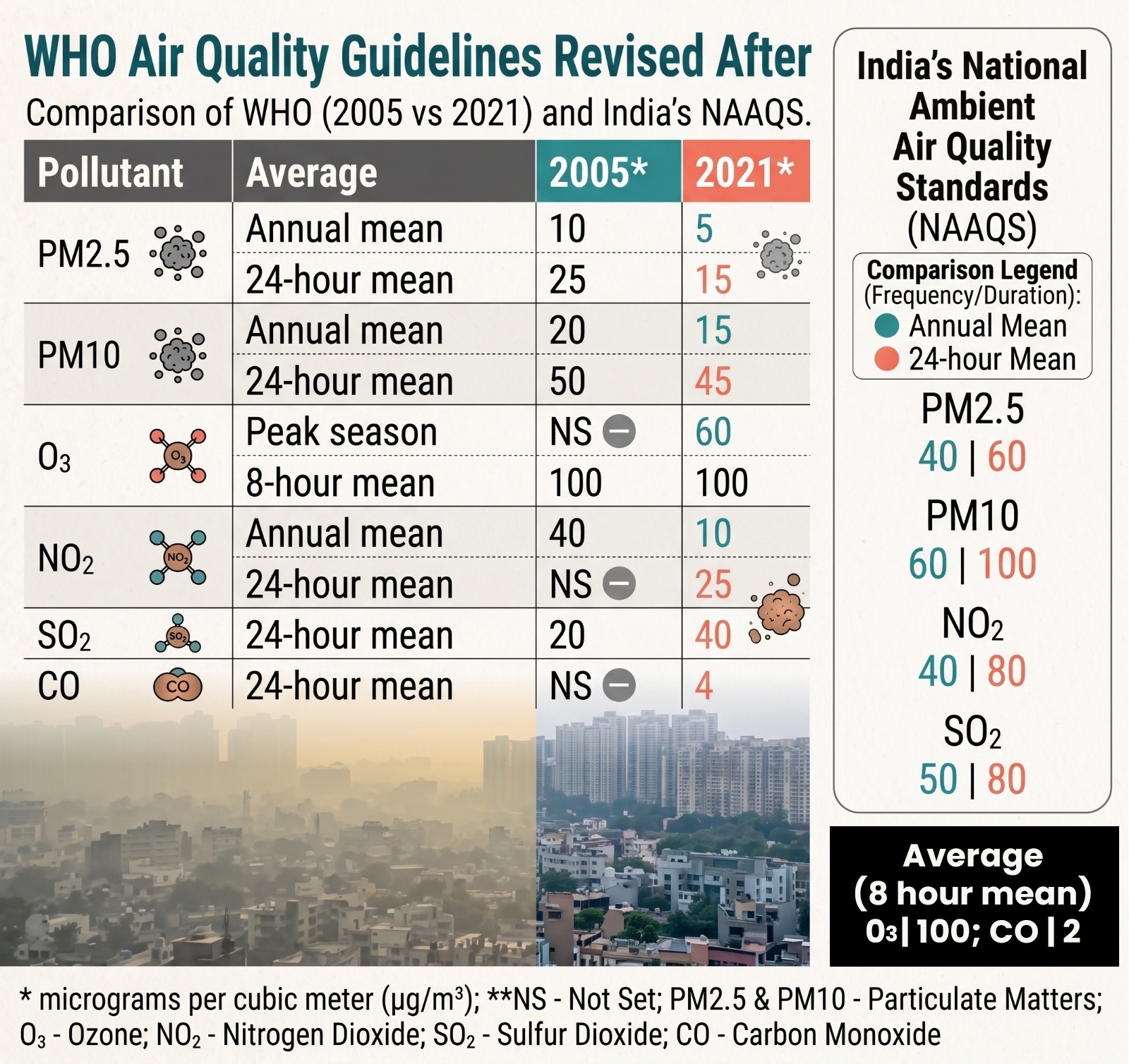
National Air Quality Index India classifies air quality into six categories based on the AQI value:
- Good (0–50): Air quality poses minimal or no health risk.
- Satisfactory (51-100): May cause slight breathing discomfort in sensitive individuals.
- Moderately Polluted (101-200): Can trigger breathing difficulties in people with lung conditions like asthma, and cause discomfort for those with heart disease, children, and the elderly.
- Poor (201-300): Prolonged exposure may lead to breathing issues and discomfort for people with heart conditions.
- Very Poor (301-400): Can cause respiratory illnesses with prolonged exposure; effects are stronger for individuals with lung or heart diseases.
- Severe (401-500): May cause respiratory problems even in healthy individuals and serious health risks for those with lung or heart conditions; difficulties may occur during light physical activity.
WHO Air Quality Guidelines
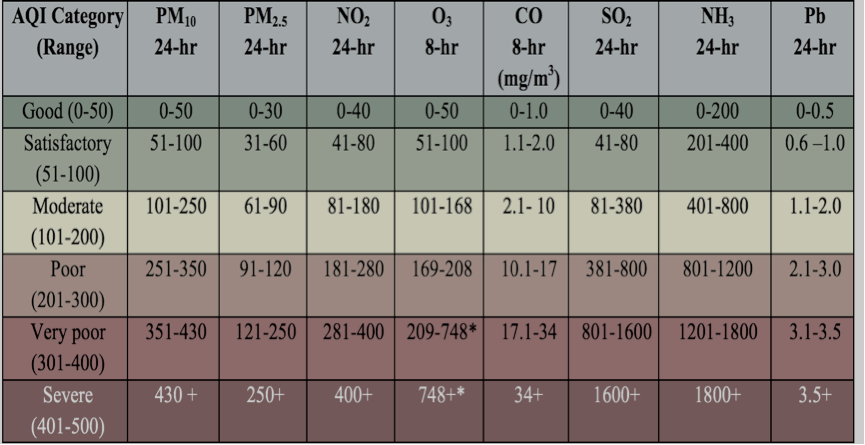
National Air Quality Index India can be compared with the World Health Organisation (WHO) Air Quality Guidelines (AQGs), which provide health-based recommendations for major air pollutants and serve as a reference for policymakers in managing ambient air pollution.
- The WHO Air Quality Guidelines (AQGs) PM2.5 recommendations:
- PM2.5: 5 µg/m³ annual mean and 15 µg/m³ 24-hour mean.
- To help areas with high pollution achieve cleaner air, the WHO sets interim targets for PM2.5 as step-by-step milestones, especially for cities and countries with severe air quality issues. These targets are:
- 35 µg/m3 annual mean, 75 µg/m3 24-hour mean.
- 25 µg/m3 annual mean, 50 µg/m3 24-hour mean.
- 15 µg/m3 annual mean, 37.5 µg/m3 24-hour mean.
- 10 µg/m3 annual mean, 25 µg/m3 24-hour mean.
- WHO recommended guideline levels for other key pollutants:
- PM10: 15 µg/m³ annual mean, 45 µg/m³ 24-hour mean
- Ozone (O₃): 100 µg/m³ 8-hour mean
- Nitrogen Dioxide (NO₂): 10 µg/m³ annual average, 25 µg/m³ 24-hour mean
- Sulphur Dioxide (SO₂): 40 µg/m³ 24-hour mean
- Carbon Monoxide (CO): 7 µg/m³ 24-hour mean
National Air Quality Index (NAQI) UPSC PYQs
Q1: Describe the key points of the revised Global Air Quality Guidelines (AQGs) recently released by the World Health Organisation (WHO). How are these different from its last update in 2005? What changes in India’s National Clean Air Programme are required to achieve revised standards? (UPSC Mains 2021)
Q2: Consider the following statements regarding mercury pollution: (UPSC Prelims 2023)
- Gold mining activity is a source of mercury pollution in the world.
- Coal-based thermal power plants cause mercury pollution.
- There is no known safe level of exposure to mercury.
How many of the above statements are correct?
(a) Only one
(b) Only two
(c) All three
(d) None
Ans: (b)
Q3: In the context of WHO Air Quality Guidelines, consider the following statements: (UPSC Prelims 2022)
- The 24-hour mean of PM2.5 should not exceed 15 µg/m3 and annual mean of PM2.5 should not exceed 5 µg/m3.
- In a year, the highest levels of ozone pollution occur during the periods of inclement weather.
- PM10 can penetrate the lung barrier and enter the bloodstream.
- Excessive ozone in the air can trigger asthma.
Which of the statements given above are correct?
a) 1, 3 and 4
b) 1 and 4 only
c) 2, 3 and 4
a) 1 and 2 only
Ans: (b)

 Last updated on Oct, 2026
→ UPSC 2027 Notification will be released on 13 January 2027 at upsconline.nic.in.
→ Check Nobel Prize 2026 Winners List here.
→ Download PIB PRiSM Monthly Magazine 2026 here.
→ Check UPSC Monthly Current Affairs Magazine The Recitals here.
→ Check out the latest UPSC Syllabus here.
→ Download UPSC Model Answers for Mains 2026
→ UPSC Mains Question Paper 2026 is out now for Essay & GS Paper 1, 2, 3 & 4.
→ UPSC Calendar 2027 has been released.
→ Enroll in Vajiram & Ravi’s UPSC Mains Test Series 2027 for structured answer writing practice, expert evaluation, and exam-oriented feedback.
→ Join Vajiram & Ravi’s UPSC Mentorship Program 2027 for personalized guidance, strategy planning, and one-to-one support from experienced mentors.
→ Go through the UPSC Mains Previous Year Papers to enhance your preparation.
→ UPSC has released UPSC Toppers List 2025 with the Civil Services final result on its official website.
→ Also check Best UPSC Coaching in India
National Air Quality Index (NAQI) FAQs
Q1. Which AQI is normal?+
Q2. Which country is ranked no. 1 for air pollution?+
Q3. What is the current national Air Quality Index in India?+
Q4. Which state is no. 1 in air pollution?+
Q5. Which city in India has 0 to 50 AQI?+
Tags: national air quality index quest UPSC Environment and Ecology Notes