



The Nobel Prize, established by Swedish inventor and philanthropist Alfred Nobel, is the world’s most prestigious recognition of excellence in fields that advance human progress, which are Physics, Chemistry, Physiology or Medicine, Literature, Peace, and Economic Sciences. Instituted through Nobel’s will in 1895, the awards honour individuals and organisations whose work has made the “greatest benefit to humankind.”
First presented in 1901, the Nobel Prizes symbolise intellectual achievement, humanitarian service, and the pursuit of global peace. From Albert Einstein’s breakthroughs in physics to Mother Teresa’s humanitarian mission, these laureates represent the spirit of innovation and compassion that the Nobel envisioned. Over the decades, the Nobel Prizes have not only celebrated outstanding contributions but have also inspired generations toward knowledge, peace, and the betterment of humanity.
Nobel Prize History
Alfred Nobel was a chemist, engineer, inventor, and businessman, and he is remembered for founding the Nobel Prize.
- In his will, Alfred Nobel decreed that his wealth should be used to recognise individuals who had “rendered the greatest service to humankind” during the preceding year.
- The prizes were to recognise exceptional contributions in the fields closest to his own work — physics, chemistry, physiology or medicine, literature, and peace.
- Following his death, it took several years to bring his vision to fruition, with the first Nobel Prizes awarded in 1901.
- In 1969, an additional award, the Sveriges Riksbank Prize in Economic Sciences in Memory of Alfred Nobel, was introduced to commemorate the 300th anniversary of Sweden’s central bank.
Alfred Nobel
Alfred Nobel was born on October 21, 1833, in Stockholm, Sweden, and died in San Remo, Italy, on December 10, 1896.

- Nobel's most popular invention is dynamite, using nitroglycerin, which he patented in 1867.
- When the St. Gotthard Tunnel in the Swiss Alps was finished in 1881 and dynamite was used extensively for the first time, he gained worldwide fame.
- In total, he had 355 patents, including a blasting cap and smokeless gunpowder.
- More than 20 countries had Nobel companies, and approximately 90 factories worldwide produced explosives of all types using his patents.





Nobel Prize Process
All of the Nobel Prizes have a similar selection process; the main divergence is who can submit a nomination.
Nobel Prize Nomination Process - Stage 1
The Nobel Committee sends nomination forms to about 3,000 people each year in September, the year before the prizes are given out.
- These people are typically well-known academics who are active in a relevant field.
- Governments, former Peace Prize winners, and current or former members of the Norwegian Nobel Committee are all contacted with questions about the Peace Prize.
- The nomination forms must be returned by the 31st of January of the award year.
- From these nomination forms and additional names, the Nobel Committee selects about 300 candidates for the prize.
- Both the names of the nominees and the fact that they are being considered for the award are kept secret.
- After a prize is given out, all nomination records are sealed for a period of 50 years.
Nobel Prize Selection Process - Stage 2
The Nobel Committee then draws up a report that incorporates the recommendations of subject-matter experts. This is provided to the prize-awarding organisations along with the list of preliminary candidates.
- The six prizes awarded are given by four organisations:
- Royal Swedish Academy of Sciences – Chemistry; Physics; Economic Science
- Nobel Assembly at the Karolinska Institute – Physiology / Medicine
- Swedish Academy – Literature
- Norwegian Nobel Committee – Peace
- A majority vote is used by the institutions to select the laureate or laureates in each field.
- The vote is immediately followed by the announcement of their decision, which cannot be challenged.
- A maximum of three laureates and two distinct works may be chosen for each award.
- The awards can only be given to individuals, except for the Peace Prize, which can be given to institutions.
- During the first two weeks of October, the awarding organisations announce the winners.
Nobel Prize Award Ceremonies - Stage 3
The award ceremonies are held on December 10, also known as "Nobel Day” due to the death anniversary of Alfred Nobel.
- The Nobel Prize award ceremony is held at the Stockholm Concert Hall in Sweden.
- Here, the Nobel Prizes for economic sciences, literature, physiology or medicine, physics, and chemistry are presented.
- For the Nobel Prize in Peace, the award ceremony takes place in Oslo and is given by the Norwegian Nobel Committee.
Nobel Prize Winners
Some of the notable Nobel Prize-winning laureates are listed below.
Albert Einstein
Albert Einstein was a German-born physicist who developed the special and general theories of relativity.
- Albert Einstein received the Physics Nobel Prize in 1921.
- His discovery of the "photoelectric effect," or the ability of metallic atoms, when exposed to light, to eject electrons, earned him the prize.

Marie Curie
Marie Curie was a Polish-born French physicist.
- Marie Curie is the only person to have won a Nobel Prize in two different sciences.
- She was also the first woman to win this prestigious award.
- She received the Nobel Prize in Physics in 1903 for her research on radioactivity, a phenomenon discovered by Henri Becquerel, and the Nobel Prize in Chemistry in 1911 for the discovery of radium and polonium and for isolating pure radium.

Linus Pauling
Linus Pauling was an American theoretical physical chemist.
- For his study of the chemical bond and its application to the structure of complex substances, Linus Pauling received the 1954 Nobel Prize in Chemistry.
- Pauling became the only winner of two unshared Nobel Prizes in 1962 after receiving the Nobel Peace Prize for his activism against nuclear weapons.

John Bardeen
John Bardeen was an American physicist who was co-winner of the Nobel Prize for Physics in both 1956 and 1972.
- He shared the 1956 prize with William B. Shockley and Walter H. Brattain for their joint invention of the transistor.
- With Leon N. Cooper and John R. Schrieffer, he was awarded the 1972 prize for the development of the theory of superconductivity.

Martin Luther King Jr.
Martin Luther King, Jr. was a minister and social activist who led the civil rights movement in the United States.
- He was awarded the Nobel Peace Prize in 1964 for his leadership in the nonviolent struggle for civil rights in the United States.
- The committee recognised his efforts to combat racial prejudice through nonviolent resistance, which helped dismantle segregation and advance the rights of African Americans.

Dalai Lama
The Dalai Lama is the spiritual leader of Tibetan Buddhism, considered to be a manifestation of the Bodhisattva of Compassion, Avalokiteshvara.
- The 14th Dalai Lama (Tenzin Gyatso) received the Nobel Peace Prize in 1989 "for promoting peaceful solutions based upon tolerance and mutual respect to preserve his people's historical and cultural heritage."

Nelson Mandela
Nelson Mandela was a South African anti-apartheid activist and politician who served as the first president of South Africa post-apartheid from 1994 to 1999.
- Nelson Mandela and Frederik Willem de Klerk shared the Nobel Peace Prize in 1993 in recognition of "their work for the peaceful termination of the apartheid regime and for laying the foundations for a new democratic South Africa."

Malala Yousafzai
Malala Yousafzai is a Pakistani activist who, while a teenager, spoke out publicly against the prohibition on the education of girls that was imposed by the Tehrik-e-Taliban Pakistan.
- She was awarded the 2014 Nobel Peace Prize for her fight for the right of every child to receive an education.

Nobel Prize 2025
The list of winners of the Nobel Prize 2025 is as below
- Nobel Prize in Physics 2025: John Clarke, Michel H. Devoret and John M. Martinis.
- Awarded “for their discovery of macroscopic quantum mechanical tunnelling and energy quantisation in an electric circuit”.
- Nobel Prize in Chemistry 2025: Susumu Kitagawa, Richard Robson and Omar M. Yaghi.
- Awarded “for the development of metal-organic frameworks”.
- Nobel Prize in Physiology or Medicine 2025: Mary E. Brunkow, Fred Ramsdell and Shimon Sakaguchi
- Awarded “for their discoveries concerning peripheral immune tolerance”.
- Nobel Prize in Literature 2025: László Krasznahorkai.
- Awarded “for his profound and visionary creations that, in the face of apocalyptic despair, reaffirm the lasting resilience of art.”
- Nobel Peace Prize 2025: Maria Corina Machado,
- Awarded for her unwavering commitment to advancing democracy in Venezuela and her steadfast pursuit of a peaceful transition from dictatorship to democratic governance.
- Sveriges Riksbank Prize in Economic Sciences: Joel Mokyr, Philippe Aghion and Peter Howitt.
- Awarded “for the theory of sustained growth through creative destruction”.
Nobel Prize Awarded Women
Between 1901 and 2025, women have received the Nobel Prize and the Economic Sciences Prize in Memory of Alfred Nobel 68 times.
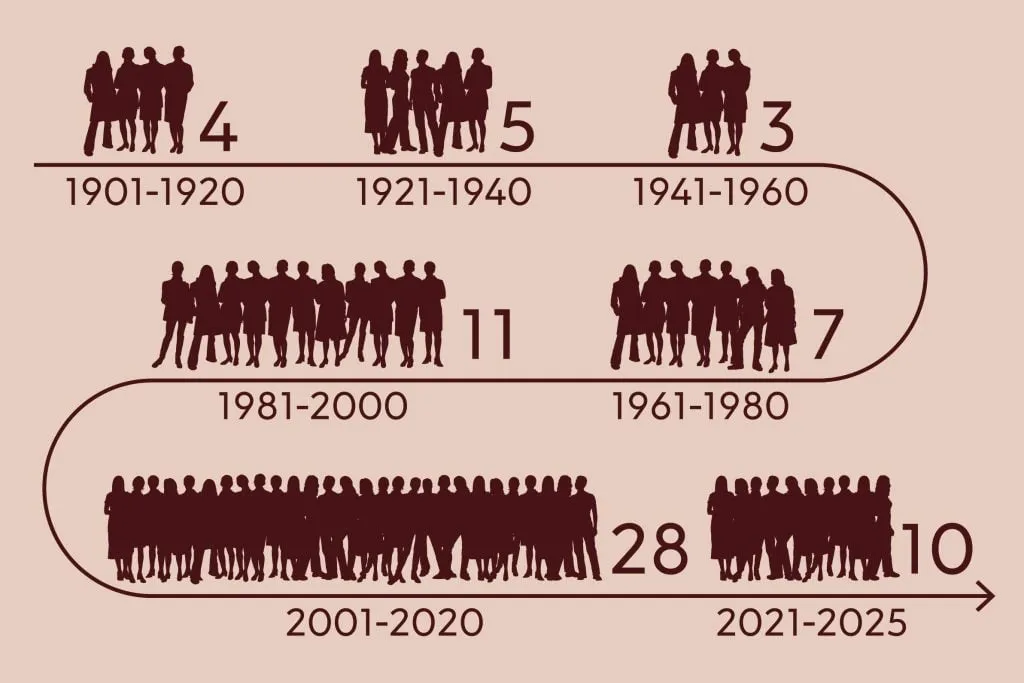
- Marie Curie was awarded twice, first with the Nobel Prize in Physics in 1903, and later in Chemistry in 1911.
- Selma Lagerlöf was named the first female Nobel laureate in literature in 1909.
- Malala Yousafzai, at just 17 years old when she received the Peace Prize in 2014, remains the youngest Nobel laureate to date.
- Among the 2025 Nobel Prize Winners, two are women laureates.
- Mary E. Brunkow and Maria Corina Machado
- The Nobel Prize 2023 were awarded to eleven laureates, including four women:
- Narges Mohammadi (Peace),
- Katalin Karikó (Physiology or Medicine),
- Anne L’Huillier (Physics) and
- Claudia Goldin (Economic Sciences).
Nobel Prize Winners of India
Several Indian scholars and thinkers have made remarkable contributions to science, literature, and peace, earning global recognition through the prestigious Nobel Prizes.
- The personalities include
- Abhijit Banerjee,
- Kailash Satyarthi,
- Venkatraman Ramakrishnan,
- V. S. Naipaul,
- Amartya Sen,
- Subramanyan Chandrasekhar,
- Mother Teresa,
- Har Gobind Khorana,
- Sir CV Raman and
- Rabindranath Tagore (the first Indian to receive).
Nobel Prize Significance
Alfred Nobel envisioned a world improved through education, science, and humanism, believing these forces could drive societal progress. To celebrate such contributions, he established a prize to honour discoveries that have brought the greatest benefit to humanity.
- Most prestigious award: The Nobel Prizes stand as the most esteemed honours in the realm of intellectual achievement, commanding a global prominence unmatched by any other award.
- Promotion of peace and humanitarian efforts: The Nobel Peace Prize is highly significant, recognising individuals and organisations for their outstanding efforts in promoting peace, resolving conflicts, and advancing humanitarian causes.
- It fosters global awareness of vital issues, encouraging united efforts toward justice and harmony while advancing social progress and human consciousness.
- Impetus to research and development: The Nobel Prize’s prestige and monetary rewards greatly influence laureates and their fields, fostering further research, innovation, and knowledge growth while drawing attention and support to vital areas of study.
- International Collaboration and Networking: The Nobel Prize ceremonies unite laureates, experts, and leaders worldwide, fostering idea exchange, collaboration, and partnerships that often lead to new research and shared advancements.
Nobel Prize Criticism
Despite being considered the most prestigious awards, the Nobel Prizes have also been criticised for several reasons, as described below.
- Criticism regarding Nobel Peace Prize: The Nobel Peace Prize has faced criticism for perceived political bias and questionable interpretations of peace.
- For instance, Barack Obama’s 2009 award was seen as premature, given his administration’s military actions in Libya, Afghanistan, Pakistan, Iraq, and Yemen.
- Similarly, Ethiopian Prime Minister Abiy Ahmed, honoured in 2019 for ending a long conflict with Eritrea, was later criticised for alleged war crimes during the Tigray conflict.
- The 1973 award to Henry Kissinger and Le Duc Tho also drew severe backlash, prompting two Norwegian Nobel Committee members to resign in protest.
- Political agenda: The Nobel Committees have faced accusations of political bias in selecting laureates and overlooking deserving candidates, with the Literature Prize often criticised for its Eurocentric focus.
- Neglected accomplishments: Mahatma Gandhi, a global symbol of nonviolence, was nominated for the Nobel Peace Prize five times between 1937 and 1948 but never received it. Although the prize was not awarded in 1948, as a tribute to his legacy.
- Although nominated for the Nobel Prize 48 times, Lise Meitner, a key contributor to the discovery of nuclear fission, never received the award.
- Many Nobel Laureates criticised the Committee when E.C.G. Sudarshan, an Indian-American physicist, was not awarded the Nobel Prize for the Glauber-Sudarshan P-representation in 2005.
- Western bias: There have also been complaints that the awards are biased towards the West because more than 80% of all winners since 1901 have come from the US, Canada, and Western Europe.
No posthumous recognition: Unlike other prestigious awards, Nobel Prizes are not awarded after death. This criterion does not give proper attention to the works of intellectuals. Sometimes the actual impact of any work takes time.

 Last updated on March, 2026
→ UPSC Final Result 2025 is now out.
→ UPSC has released UPSC Toppers List 2025 with the Civil Services final result on its official website.
→ Anuj Agnihotri secured AIR 1 in the UPSC Civil Services Examination 2025.
→ UPSC Marksheet 2025 is now out.
→ UPSC Notification 2026 & UPSC IFoS Notification 2026 is now out on the official website at upsconline.nic.in.
→ UPSC Calendar 2026 has been released.
→ Check out the latest UPSC Syllabus 2026 here.
→ UPSC Prelims 2026 will be conducted on 24th May, 2026 & UPSC Mains 2026 will be conducted on 21st August 2026.
→ The UPSC Selection Process is of 3 stages-Prelims, Mains and Interview.
→ Prepare effectively with Vajiram & Ravi’s UPSC Prelims Test Series 2026 featuring full-length mock tests, detailed solutions, and performance analysis.
→ Enroll in Vajiram & Ravi’s UPSC Mains Test Series 2026 for structured answer writing practice, expert evaluation, and exam-oriented feedback.
→ Join Vajiram & Ravi’s Best UPSC Mentorship Program for personalized guidance, strategy planning, and one-to-one support from experienced mentors.
→ Shakti Dubey secures AIR 1 in UPSC CSE Exam 2024.
→ Also check Best UPSC Coaching in India
Nobel Prize FAQs
Q1. What is a Nobel Prize?+
Q2. Which prominent Indians have received the Nobel Prize?+
Q3. Who received the first Nobel Peace Prize?+
Q4. Who received India's first Nobel Prize?+
Q5. In how many fields is the Nobel Prize awarded?+
Tags: nobel prize quest