



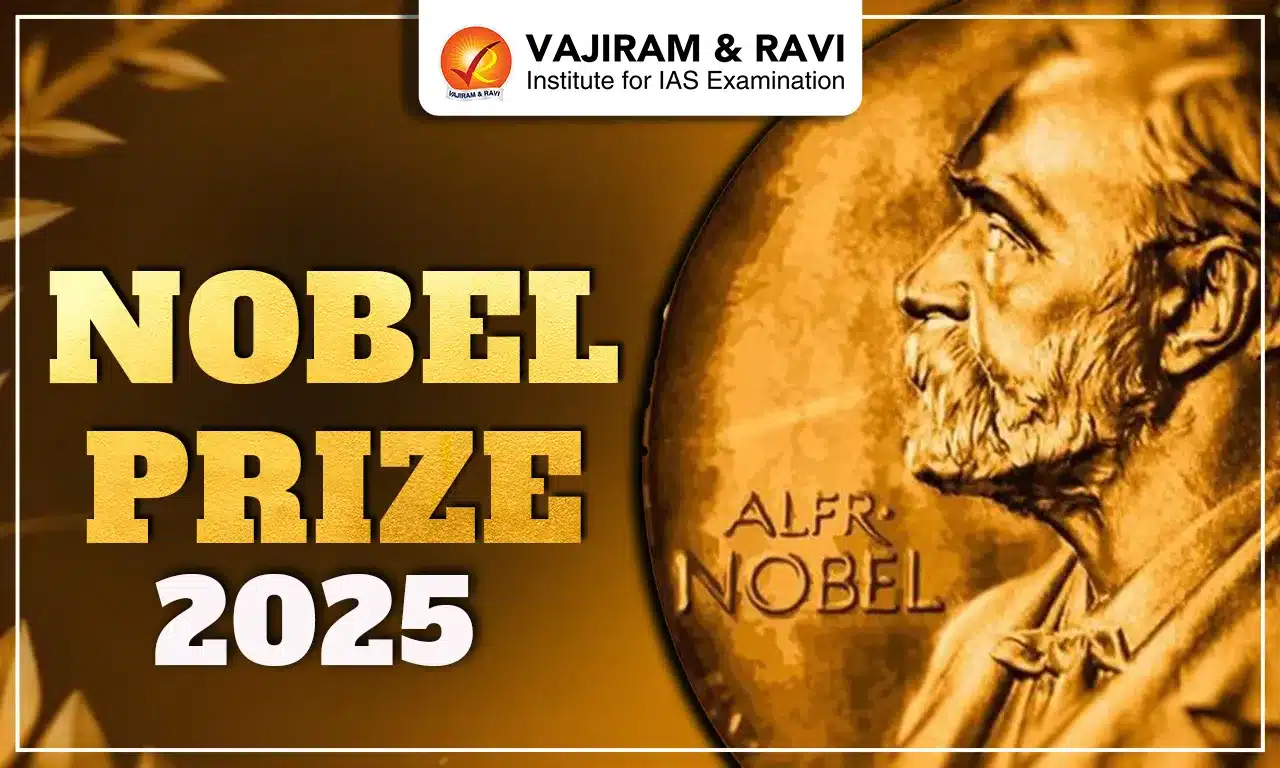
The Nobel Prize 2025 honours 14 laureates whose groundbreaking work has provided the greatest benefit to humankind across six disciplines of Physics, Chemistry, Physiology or Medicine, Literature, Peace, and Economic Sciences. From demonstrating quantum tunnelling at a macroscopic scale and developing metal–organic frameworks for sustainable solutions, to uncovering the immune system’s regulatory mechanisms, these discoveries redefine our understanding of science and society.
The literary Nobel Prize celebrates László Krasznahorkai’s visionary portrayal of human resilience amidst chaos, while the Nobel Peace Prize recognises Maria Corina Machado’s courageous fight for democracy in Venezuela. In Economic Sciences, Joel Mokyr, Philippe Aghion, and Peter Howitt illuminate the driving forces of innovation-led growth and creative destruction, offering vital insights for sustaining global progress.
Nobel Prize 2025 Winners List
Six Nobel Prizes were awarded for contributions that have brought the greatest benefit to humanity, recognising 14 laureates whose groundbreaking achievements span from quantum tunnelling to the advancement of democratic rights.
| Field | Nobel Prize Winners 2025 | Awarded For |
|
Physics |
John Clarke, Michel H. Devoret and John M. Martinis |
For their discovery of macroscopic quantum mechanical tunnelling and the energy quantisation in an electric circuit. |
|
Chemistry |
Susumu Kitagawa, Richard Robson and Omar M. Yaghi |
For the development of metal-organic frameworks. |
|
Physiology/Medicine |
Mary E. Brunkow, Fred Ramsdell and Shimon Sakaguchi |
For their discoveries concerning peripheral immune tolerance. |
|
Literature |
László Krasznahorkai |
For his powerful and visionary body of work that, amid apocalyptic darkness, reasserts the enduring strength and significance of art. |
|
Peace |
Maria Corina Machado |
For her steadfast advocacy of democratic rights in Venezuela and her determined pursuit of a peaceful shift from dictatorship to democracy. |
|
Economic Sciences |
Joel Mokyr, Philippe Aghion and Peter Howitt |
For the theory of sustained growth through creative destruction. |
Nobel Prize 2025 Physics Winners
The 2025 Nobel Prize in Physics was awarded to John Clarke, Michel H. Devoret, and John M. Martinis. They did a series of experiments showing that the strange features of the quantum world can be made real in a system large enough to hold in your hand.

Area of Research
Quantum mechanics says a particle can go straight through a barrier, a process known as tunnelling.
- But when there are lots of particles, these quantum effects become negligible.
- The Nobel laureates proved that quantum properties can be seen on a bigger scale.

- In 1984 and 1985, John Clarke, Michel H. Devoret, and John M. Martinis did experiments using an electronic circuit made of superconductors. These materials can conduct electricity without any resistance.
- The superconducting parts were separated by a thin, non-conductive layer, known as a Josephson junction.
- By carefully studying all the properties of the circuit, they could control and explore what happened when they passed a current through it.
- The charged particles in the superconductor acted like a single particle that filled the whole circuit.
- This system, acting like a single particle, started in a state where current flowed without any voltage.
- It was stuck in that state, as if behind a barrier it couldn’t cross. In the experiment, the system showed its quantum nature by escaping that zero-voltage state through tunnelling. The change was detected when a voltage appeared.
- The laureates also showed that the system acted as predicted by quantum mechanics.
- It was quantised, meaning it could only gain or lose energy in specific amounts.
Quantum Tunneling
Quantum tunnelling comes from the wave-like behaviour of matter, as described by Erwin Schrödinger in 1926.
- In classical physics, a particle can’t go over a barrier if it doesn’t have enough energy. But in quantum physics, particles act like waves that can stretch into areas that classical physics says are impossible.
- Even if a barrier is too high for a particle to go over, there’s still a chance its wave will “leak” through to the other side.
- This process is called tunnelling and explains many natural things.
- For example, tunnelling helps explain radioactive decay, where alpha particles escape from the nucleus.
- It also makes nuclear fusion possible in the Sun, where protons need to get past their repulsion.
- Tunnelling has been proven many times at the microscopic level and is used in technologies like flash memory and quantum sensors.
- But until the 1980s, physicists thought tunnelling couldn’t happen in anything bigger than an atom.





Nobel Prize 2025 Chemistry Winners
Susumu Kitagawa, Richard Robson and Omar Yaghi received the 2025 Nobel Prize in Chemistry for pioneering a novel form of molecular architecture.

Metal Organic Frameworks
In their work, metal ions act as the main parts that are connected by long organic molecules made of carbon.
- Together, these metals and organic molecules form crystals with big empty spaces inside. These types of materials are called metal–organic frameworks, or MOFs.
- By changing the parts used to build the MOFs, scientists can make them capture and store certain substances.
- MOFs can also help in chemical reactions or carry electricity.
- Metal–organic frameworks have a lot of potential, offering new possibilities for making materials with special functions.
Research
This started in 1989 when Richard Robson tried to use atoms in a new way.

- He used copper ions that had a positive charge along with a molecule that had four arms.
- Each arm ended with a part that could stick to copper ions.
- When these were put together, they formed a neat and open crystal, like a diamond with many hollow spaces inside.
- Robson quickly saw the promise of his design, but it wasn’t strong and often collapsed.
- However, Susumu Kitagawa and Omar Yaghi helped make this method more solid.
- Between 1992 and 2003, they each made big discoveries.
- Kitagawa found that gases could pass through the structure and predicted that MOFs could be made to change shape.
- Yaghi made a very strong MOF and showed that it could be designed with specific properties, giving it new and useful abilities.
- After these discoveries, chemists have created tens of thousands of different MOFs.
- Some of these could help solve some of the biggest problems facing people today, with uses such as,
- Removing PFAS from water,
- Breaking down small amounts of medicine in the environment,
- Capturing carbon dioxide or collecting water from the air in deserts.

Nobel Prize 2025 Physiology Medicine Winners
The Nobel Prize in Physiology or Medicine 2025 was given to Mary E. Brunkow, Frederick J. Ramsdell, and Shimon Sakaguchi. They were honored for their work on peripheral immune tolerance. The scientists found the immune system's special guards, called regulatory T cells, which stop immune cells from attacking the body.

Research
- In 1995, Shimon Sakaguchi made an important discovery. At that time, many scientists believed that immune tolerance happened when harmful immune cells were removed in the thymus, a process called central tolerance.
- Sakaguchi showed that the immune system was more complex than thought and found a new type of immune cell that helps protect the body from autoimmune diseases.
- In 2001, Mary Brunkow and Fred Ramsdell made another key discovery.
- They explained why a certain mouse strain was very prone to autoimmune diseases. They found that these mice had a mutation in a gene called Foxp3.
- They also showed that similar mutations in humans can cause a serious disease called IPEX.
- Two years later, Sakaguchi linked these findings.
- He proved that the Foxp3 gene controls the development of the cells he discovered in 1995.
- These cells, now known as regulatory T cells, watch over other immune cells and ensure that the immune system doesn’t attack the body’s own tissues.
- The discoveries by the three scientists started the field of peripheral tolerance.
- This has led to new treatments for cancer and autoimmune diseases. It may also help make organ transplants more successful. Some of these treatments are already being tested in clinical trials.
T-Cells
T cells, are a type of white blood cell that plays an important role in the immune system.
They are one of two main types of lymphocytes, the other being B cells. These cells help the body recognize and respond to foreign substances called antigens.
- T cells are made in the bone marrow and mature in the thymus.
- In the thymus, they grow and develop into different types, such as helper T cells, regulatory T cells, or killer T cells.
- They can also become memory T cells, which help the body remember previous infections.
- Helper T cells: They constantly move through the body. If they find an invading microbe, they signal other immune cells to attack.
- Killer T cells: These cells destroy infected cells, like those infected by viruses or bacteria. They can also kill cancer cells.
- T-cell receptors: These are special proteins on the surface of T cells.
- These act like sensors that allow T cells to check other cells for signs of infection or damage.
- Each T-cell receptor has a different shape, much like jigsaw pieces.
- These shapes are created by combining multiple genes in different ways. This means the body can make more than 1015 different T-cell receptors.

- In the 1980s, scientists learned that when T cells mature in the thymus, they go through a test that removes any T cells that recognize the body’s own proteins. This process is known as central tolerance.

Nobel Prize 2025 in Literature Winner
The Nobel Prize in Literature for 2025 is awarded to the Hungarian author László Krasznahorkai for his powerful and visionary body of work that, amid apocalyptic darkness, reasserts the enduring strength and significance of art.

- László Krasznahorkai is a master of epic writing in the Central European tradition, following the lineage of Kafka and Thomas Bernhard, distinguished by its elements of absurdism and grotesque intensity.
- Often likened to literary giants like Fyodor Dostoevsky and Herman Melville, his dystopian, absurd, and melancholic narratives reflect life in Hungary under oppression and beyond, spanning the pre- and post-Iron Curtain eras with haunting relevance to the present day.
Nobel Peace Prize 2025
The Nobel Peace Prize 2025 was awarded to Maria Corina Machado for her steadfast advocacy of democratic rights in Venezuela and her determined pursuit of a peaceful shift from dictatorship to democracy.

- Maria Corina Machado, a leading figure in Venezuela’s pro-democracy movement, stands as a remarkable symbol of civilian courage and resilience in contemporary Latin America.
- Ms. Machado has played a pivotal role in uniting a once-fragmented political opposition, bringing diverse factions together around the shared pursuit of free elections and democratic governance.
Nobel Prize 2025 Economic Sciences Winners
The Royal Swedish Academy of Sciences has decided to give the Sveriges Riksbank Prize in Economic Sciences in Memory of Alfred Nobel 2025 to Joel Mokyr, Philippe Aghion, and Peter Howitt. They were chosen "for having explained innovation-driven economic growth."
- Half of the prize was awarded to Joel Mokyr for identifying the essential conditions for long-term growth driven by technological progress, while the other half was jointly given to Philippe Aghion and Peter Howitt for their theory of sustained growth through creative destruction.

Research
This year’s winners used different approaches to answer the same question: What causes long-term economic growth?
- Joel Mokyr’s work in economic history shows that a steady stream of useful knowledge is essential. This knowledge comes in two forms:
- The first is propositional knowledge, which is a clear explanation of how things in the natural world work.
- The second is prescriptive knowledge, like practical instructions, drawings, or recipes that tell you what you need to do to make something work.
- Mokyr also argues that societies must be open to change for growth to continue.

- Philippe Aghion and Peter Howitt developed a mathematical economic model demonstrating how technological innovation drives sustained economic growth.
- Aghion and Howitt’s model explains how innovation drives economic growth through “creative destruction,” where firms invest in R&D for monopoly profits, but innovations replace old ones, balancing growth, savings, investment, and general economic equilibrium.
- Aghion and Howitt’s model reveals that an overly concentrated market structure can suppress innovation and slow economic growth.
- Balanced competition, support for displaced workers through flexicurity, and strong social mobility are crucial for fostering innovation, productivity, and sustainable economic growth.
- Mokyr, Aghion, and Howitt’s research highlights that while innovation drives growth, it also creates challenges like inequality and environmental harm.
- Sustained growth needs balanced policies, academic freedom, global knowledge sharing, and prevention of market dominance to avoid economic stagnation.

 Last updated on March, 2026
→ UPSC Final Result 2025 is now out.
→ UPSC has released UPSC Toppers List 2025 with the Civil Services final result on its official website.
→ Anuj Agnihotri secured AIR 1 in the UPSC Civil Services Examination 2025.
→ UPSC Marksheet 2025 is now out.
→ UPSC Notification 2026 & UPSC IFoS Notification 2026 is now out on the official website at upsconline.nic.in.
→ UPSC Calendar 2026 has been released.
→ Check out the latest UPSC Syllabus 2026 here.
→ UPSC Prelims 2026 will be conducted on 24th May, 2026 & UPSC Mains 2026 will be conducted on 21st August 2026.
→ The UPSC Selection Process is of 3 stages-Prelims, Mains and Interview.
→ Prepare effectively with Vajiram & Ravi’s UPSC Prelims Test Series 2026 featuring full-length mock tests, detailed solutions, and performance analysis.
→ Enroll in Vajiram & Ravi’s UPSC Mains Test Series 2026 for structured answer writing practice, expert evaluation, and exam-oriented feedback.
→ Join Vajiram & Ravi’s Best UPSC Mentorship Program for personalized guidance, strategy planning, and one-to-one support from experienced mentors.
→ Shakti Dubey secures AIR 1 in UPSC CSE Exam 2024.
→ Also check Best UPSC Coaching in India
Nobel Prize 2025 FAQs
Q1. Who got the Nobel Prize 2025 in Physics?+
Q2. Who got the Nobel Prize 2025 in Chemistry?+
Q3. Who got the Nobel Prize 2025 in Medicine?+
Q4. Who got the Nobel Prize 2025 in Literature?+
Q5. Who got the Nobel Peace Prize in 2025?+
Tags: nobel prize 2025