Question
Owing to paucity of time, a university professor generates a Ph.D. evaluation report using Artificial Intelligence and submits it with some modifications. Discuss this from the perspective of accountability and integrity.
Detailed Solution
Using AI to generate a Ph.D. evaluation report may improve efficiency, but submitting it with minimal modifications raises serious questions of professional accountability, academic integrity and ethical responsibility.
Perspective of Accountability
- Responsibility cannot be delegated: The professor remains personally accountable for the accuracy and fairness of the submitted evaluation.
- Professional judgement is non-transferable: A Ph.D. evaluation requires expert assessment of originality, methodology, evidence and scholarly contribution, which cannot be mechanically outsourced.
- Example: An AI may identify methodological weaknesses but cannot substitute the evaluator’s disciplinary expertise in judging their significance.
- Duty must prevail over convenience: Kant’s deontological ethics emphasizes performing one’s duty irrespective of convenience or consequences.
- Accountability includes procedural fairness: An evaluator owes the scholar an independent, reasoned, and unbiased assessment since the report can determine academic progression.
- Example: A superficial AI-generated report may unfairly influence the decision to award or reject a doctorate.
- Institutional trust must be preserved: Academic evaluation is a position of epistemic authority making integrity essential for institutional credibility.
- Example: Repeated dependence on unverified AI reports can undermine confidence in the university’s doctoral evaluation system.
Perspective of Integrity
- Breach of academic honesty: Presenting AI-generated intellectual work substantially as one’s own creates a misrepresentation of authorship.
- Conflict between efficiency and integrity: Paucity of time explains the action but does not ethically justify it expediency cannot replace duty.
- Erosion of trust: Academic institutions function on epistemic trust; fabricated or insufficiently scrutinized evaluation weakens the credibility of the entire doctoral system.
- Violation of fiduciary duty: The evaluator occupies a position of trust and epistemic authority, requiring independent judgment.
- Virtue ethics perspective: Aristotle’s integrity, honesty and practical wisdom (phronesis) demand that professional competence be exercised rather than merely simulated.
- Transparency deficit: If AI assistance is permissible under institutional rules, its use should be disclosed and critically supervised, rather than concealed.
AI use is not inherently unethical
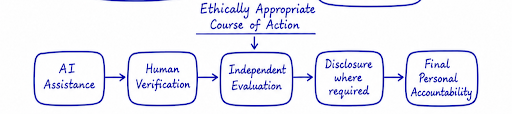
- AI may be used for grammar, formatting, literature organisation or preliminary checks.
- The professor should independently verify facts, originality, methodology and conclusions.
- Institutional guidelines should clearly define permissible AI use and require disclosure where appropriate.
- Sensitive thesis material should be protected from unauthorised disclosure, reflecting confidentiality and data responsibility.
Technological aids must remain subordinate to human conscience to ensure efficiency never corrupts the meritocratic foundations of knowledge.
Latest UPSC Exam 2027 Updates
Last updated on Oct, 2026