Question
Ravi is a senior police officer with vast experience in riot control and cyber-policing. Since one year, he has been the Superintendent of Police (SP) of a district with a history of frequent rioting.
Last year, Ravi had sought installation of an AI enabled software for predictive policing. This system has been operational for approximately six months. This new system employs advanced algorithms for capturing the biometric data of persons in a crowd and swiftly relating it to a data library. This has enabled the police to identify the persons involved in various crimes.
The system has identified an immigrant and low-income neighbourhood as a centre for gang violence and drug trafficking. Aided by this AI analysis, the local police has focused its patrolling, preventive detentions and establishing checkpoints. Consequently, public order and law enforcements has visibly improved.
Last week, some community leaders, civil rights lawyers and human rights activists visited Ravi’s office. They submitted a memorandum that the new system is faulty as it is based on incorrect historical data caused by social biases and discriminatory policing. The memorandum also alleges that the increased surveillance has created a climate of tension amongst residents. This feeling is aggravated by the fact that the residents are not aware of the data noted against their names.
(a) What are the ethical issues including biases involved in the use of AI in data-driven policing?
(b) Place yourself in Ravi’s role and discuss the alternatives available. Justify the action that optimises compliance with ethics.
Detailed Solution
Recent debates over facial recognition and predictive policing (Jantar Mantaar protest) highlight a conflict between administrative efficiency and constitutional values of privacy, algorithmic fairness, and non-discrimination.
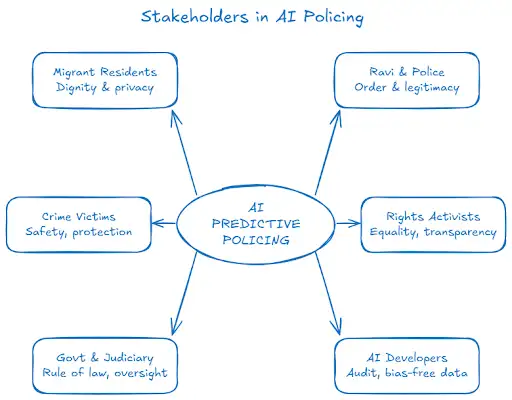
(a) Ethical Issues and Biases in Data-Driven AI Policing
- Historical data bias: AI trained on discriminatory historical policing data may reproduce past prejudices through a feedback loop.
- Algorithmic bias: The system may disproportionately identify certain communities because socioeconomic or demographic patterns become proxies for criminality.
- Violation of privacy: Mass biometric surveillance can infringe the individual's informational privacy and autonomy.
- Lack of transparency: Residents are unaware of what information is stored against them, undermining procedural fairness and accountability.
- Threat to presumption of innocence: Predictive policing risks treating people as potential criminals based on probabilities rather than actual conduct.
- Accountability deficit: It becomes difficult to determine responsibility when an AI-generated prediction results in wrongful detention or harassment.
- Chilling effect: Constant surveillance can create fear and discourage legitimate assembly, expression and interaction.
(b) Alternatives available to Ravi
- Continue the system unchanged
|
Merits |
Demerits |
|
|
- Immediately suspend the AI system
|
Merits |
Demerits |
|
|
- Retain the system with safeguards and independent audit
|
Merits |
Demerits |
|
|
I would choose Option 3, but initially place a temporary restriction on high-risk applications, particularly automated identification leading directly to detention or coercive action.
I would undertake the following measures:
- Conduct an independent algorithmic audit of the training data, accuracy and false-positive rates.
- Introduce human-in-the-loop decision-making, ensuring that no detention or coercive action is based solely on an AI prediction.
- Apply data minimisation and purpose limitation to biometric information.
- Establish mechanisms through which residents can access, correct and challenge erroneous data.
- Constitute an independent oversight group comprising police officials, legal experts, technologists and community representatives.
- Periodically assess whether particular communities are being disproportionately targeted.
- Complement predictive policing with community policing and conventional intelligence, rather than treating algorithmic predictions as conclusive evidence.
Ethical justification
- Kantian ethics: Every resident must be treated as an end in themselves, not merely as a data point or means to achieving crime statistics.
- Utilitarianism: Ravi must maximise overall welfare; therefore, genuine crime reduction should be retained, but not at the cost of systematic harm to an entire community.
- Rawlsian justice: A fair system would protect the least advantaged from disproportionate burdens; socioeconomic disadvantage cannot become a proxy for criminality.
- Aristotle's virtue ethics: Practical wisdom, justice and temperance require Ravi to avoid both technological absolutism and complete rejection of useful innovation.
- Constitutional morality: Four-fold proportionality test (Legitimacy, Suitability, Necessity, and Balancing) laid down in Justice K.S. Puttaswamy (Retd.) v. Union of India treats individuals as moral agents possessing inviolable rights.
- Proportionality principle: Surveillance should have a legitimate aim, be necessary and effective, and impose no greater intrusion than required to achieve public safety.
"Technology is a useful servant but a dangerous master." — Christian Lous Lange.
In modern policing, technological curiosity must remain subordinate to human dignity, justice and responsible state power.
Last updated on Oct, 2026