Question
"Tundra regions are ecologically fragile but economically important." Examine this statement critically.
Detailed Solution
The Tundra is a cold, treeless landscape found primarily along the Arctic margins of North America, Greenland, Europe, and Russia, as well as at high mountain elevations as alpine tundra. Their role as both a global climate regulator and resource frontier creates a significant development–conservation dilemma.
Ecological fragility of tundra regions
- Extremely Slow Ecological Recovery: The harsh climate and low temperatures severely restrict plant growth and soil formation.
a. Example: Vegetation recovery in high-Arctic and high-elevation sites requires over 30 years. - Highly Vulnerable Biodiversity: The highly specialized flora and fauna cannot rapidly adapt to changing temperatures and invasive species.
a. Example: A decline in foundational vegetation like lichens has contributed to a 50% drop in global migratory caribou and reindeer populations over the last two decades. - Climate Feedback Loop: Thawing permafrost releases trapped organic carbon as carbon dioxide and methane, triggering a vicious cycle of accelerated global warming.
a. Example: Globally, permafrost is estimated to contain 1,700 billion metric tons of carbon, which is roughly three times the amount currently in the atmosphere. - Rise of Peatland Wildfires: Drying permafrost creates highly combustible underground peatlands that are difficult to extinguish.
a. Example: "Zombie fires" in the Siberian Tundra.
Economic importance
- Massive Mineral and Energy Resources: The biome is a strategic repository of conventional energy and critical industrial metals.
a. Example: The US Geological Survey (USGS) estimates the Arctic circle holds 13% (90 billion barrels) of the world’s undiscovered oil and 30% of its undiscovered natural gas. - Hydrocarbon frontier: Arctic tundra and adjoining continental shelves contain major oil and natural-gas reserves.
a. Example: Alaska's North Slope, Russia's Yamal region and Norway's Arctic energy sector. - Transformative Maritime Routes: Retreating sea ice is unlocking shorter, highly profitable global trade routes that bypass traditional chokepoints.
a. Example: Retreating sea ice is improving seasonal accessibility of the Northern Sea Route, potentially shortening maritime connectivity between Europe and East Asia. - Expansion of the Blue Economy: Warming waters are shifting marine boundaries, creating lucrative commercial fishing opportunities previously blocked by ice.
- Growing strategic importance: Resources and emerging sea routes have increased the geopolitical significance of the Arctic for Russia, the US, Canada, and Nordic states.
Critical examination
- Self-Destructive Infrastructure: Economic expansion is paradoxically destroying its own foundation through permafrost degradation.
a. Example: Over 70% of current Arctic infrastructure, including pipelines, roads, and mining towns, is at high risk of structural collapse due to thawing ground. - Sidelining of Conservation Mandates: Strategic competition between Arctic states has frequently stalled the Arctic Council's ability to enforce binding conservation treaties.
- Marginalization of Indigenous Rights: The push for economic expansion frequently prioritizes state and corporate interests over traditional inhabitants.
- Amplified Industrial Disasters: Resource extraction in extreme, frozen climates makes disaster response and environmental cleanup nearly impossible.
a. Example: The 2020 Norilsk diesel spill released 20,000 tons of oil into local rivers.
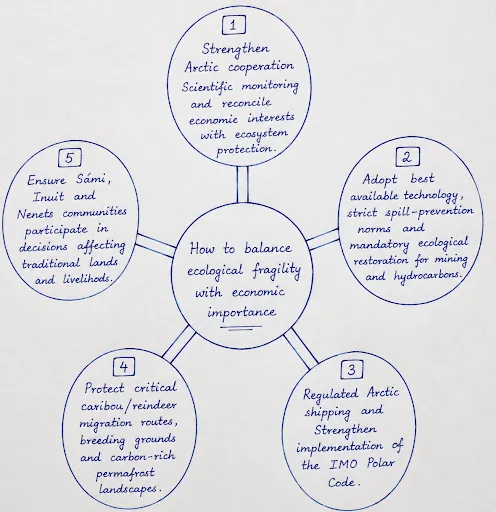
Tundra is not a barren frontier but a sensitive ecological infrastructure; its economic potential can endure only when development remains within its ecological carrying capacity.
Latest UPSC Exam 2027 Updates
Last updated on Oct, 2026