



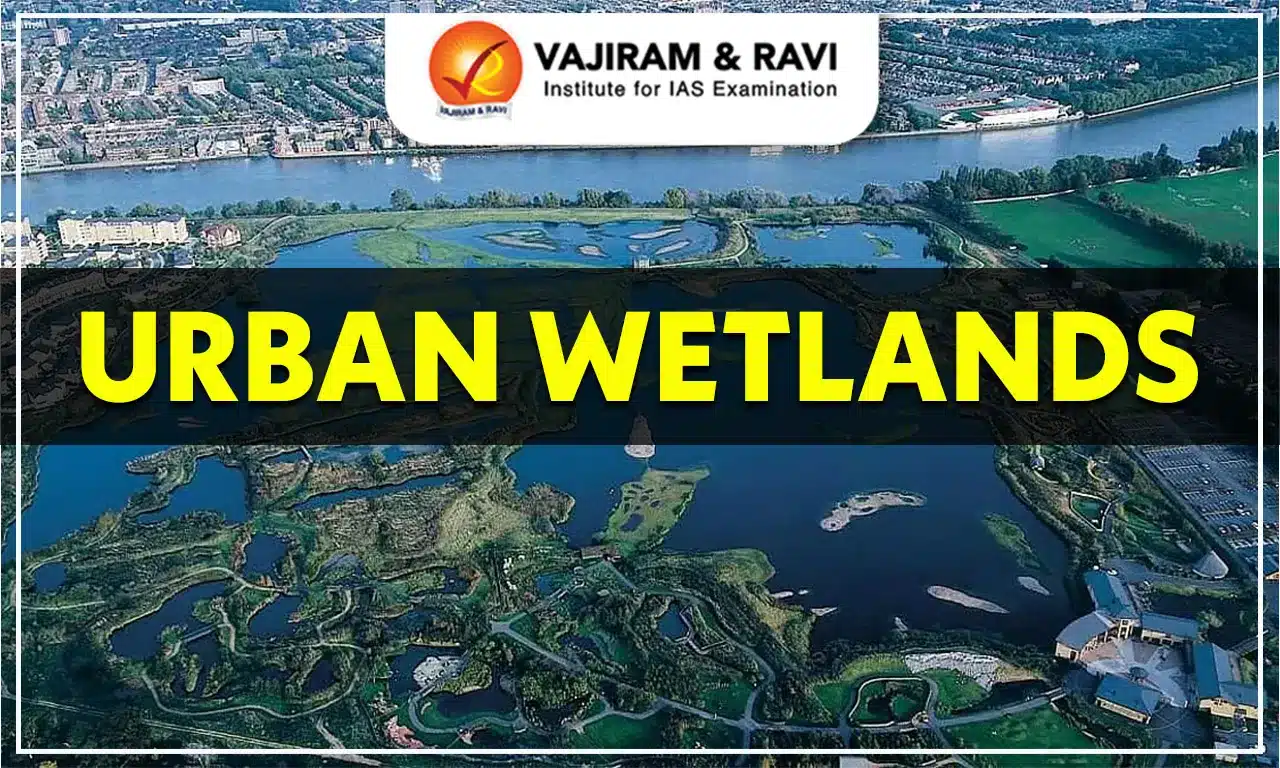
Urban wetlands are vital ecosystems that regulate water flow, support biodiversity, and provide environmental benefits. These wetlands help in flood control, water purification, and climate regulation. However, rapid urbanization has led to significant wetland losses in major Indian cities, with Chennai losing 90%, Mumbai 71%, and Bengaluru 56%.
Urban wetlands conservation efforts include the Wetlands (Conservation and Management) Rules, 2017, the Ramsar Convention, and the National Wetlands Conservation Programme (NWCP). Sustainable measures like desilting, fencing, and community participation are crucial for their protection.
What is Urban Wetland?
Urban Wetlands are land areas flooded with water, seasonally or permanently. These wetlands are found in and around cities or their suburbs. They include rivers and their flood plains, lakes, swamps, and coastal variants such as salt marshes, mangroves, and coral reefs.
- Urban wetlands serve as natural Green-Blue Infrastructure (GBI), supporting biodiversity and essential ecological functions.
- They are often referred to as a “city’s kidneys” and “biodiversity library” due to their role in water filtration and habitat preservation.
State of Urban Wetlands
According to estimates by Wetlands International South Asia, nearly 30% of India's natural wetlands have been lost in the past three decades. Major cities have seen significant wetland losses:
- Chennai: 90% lost due to unplanned urbanization.
- Mumbai: 71% lost to construction and pollution.
- Ahmedabad: 57% lost due to rapid urban expansion.
- Hyderabad: 55% lost due to inefficient waste management and unchecked development.
- Bengaluru: 56% lost due to infrastructure development.
- Vadodara: 30.5% lost due to encroachment and construction.
- Delhi-NCR: 38% lost due to eutrophication and urban expansion





Importance of Urban Wetlands
The importance of urban wetlands lies in their role in filtering pollutants, regulating water quality, and mitigating floods while supporting livelihoods through fisheries and eco-tourism. A comprehensive explanation is provided below:
- Natural Water Management: Wetlands act as “nature’s kidneys,” filtering pollutants, regulating water quality, and storing excess rainwater.
- Flood Control: Wetlands naturally absorb excess rainwater, reducing urban flooding risks. Coastal wetlands, like mangroves, also act as barriers against storm surges.
- Drinking Water Recharge: These ecosystems help replenish groundwater by filtering rainwater and reducing harmful runoff, ensuring a clean and steady water supply.
- Water Filtration & Pollution Control: Wetlands act as natural filters, removing pollutants and treating wastewater, improving overall water quality in urban areas.
- Air Quality Improvement: The high moisture content in wetlands helps regulate temperature and humidity, creating a more livable urban environment.
- Enhancing Human Well-Being: Wetlands provide green spaces for recreation and relaxation, promoting mental and physical health in urban settings.
- Economic & Livelihood Support: Wetlands sustain fisheries, provide raw materials, and boost eco-tourism, creating economic opportunities for local communities.
Challenges to Urban Wetlands
Challenges to Urban Wetlands arise from encroachment, pollution, climate change, and weak policies, leading to habitat loss and ecological decline. The following are key challenges faced by urban wetlands:
-
- Expansion & Encroachment: Rapid urbanization leads to wetland conversion into built-up areas, reducing their ecological functions.
- Pollution & Waste Management Issues: Industrial waste, untreated sewage, and urban runoff degrade wetland ecosystems.
- Climate Change: Rising temperatures and unpredictable weather patterns increase wetland degradation risks.
- Development v/s Conservation: Lack of integrated planning results in wetlands being sacrificed for infrastructure projects
- Disruption by invasive species: Like Prosopis juliflora disrupts native biodiversity, reducing wetland productivity and increasing water loss, necessitating removal for ecosystem recovery.
- Damming and water abstraction: Disrupt wetlands by altering flow and sediment balance, impacting ecosystems like Keoladeo Ghana, Loktak, Chilika, and Vembanad Kole.
- Awareness & Policy Gaps: Limited public understanding and weak enforcement of wetland conservation policies hinder protection efforts.
Urban Wetlands Conservation Measures
India has implemented various legal frameworks and initiatives like Wetlands (Conservation and Management) Rules, 2017, and the Ramsar Convention to protect urban wetlands. The following are the key measures taken for the conservation of urban wetlands:
-
- Wetlands (Conservation and Management) Rules, 2017: Replaced the Wetlands (Conservation and Management) Rules, 2010 to strengthen legal protection. It defines wetlands to include marshes, lakes, ponds, oxbow lakes, riverine wetlands, tanks, lagoons, and mangroves.
- It restricts activities such as industrial discharge, encroachment, and solid waste dumping.
- Wetland City Accreditation Scheme: The Wetland City Accreditation (WCA) is a voluntary Ramsar Convention initiative that recognizes cities for conserving and promoting the sustainable use of urban and peri-urban wetlands.
- Indore and Udaipur are India's first two cities to achieve Wetland City Accreditation (WCA) under the Ramsar Convention.
- National Plan for Conservation of Aquatic Ecosystem (NPCA), 2023: It aims to halt wetland degradation and promote sustainable management. It encourages a cross-sectoral approach to integrate wetlands into broader urban and environmental planning.
- National Mission for Clean Ganga (NMCG), 2021: It developed a toolkit for urban wetland management, focusing on local stakeholder participation. It encourages GIS and remote sensing for mapping and protecting city wetlands.
- Census of Water Bodies (2018-19, Published 2021): It was conducted by the Ministry of Jal Shakti alongside the Sixth Minor Irrigation Census. It documented 24.2 lakh water bodies, classifying them based on ownership and encroachment.
- It provided critical data for urban wetland conservation planning.
- National Wetlands Conservation Programme (NWCP): Initiated to identify and conserve wetlands across India. It provides financial and technical assistance for wetland conservation efforts.
- Ramsar Convention: Ramsar Sites in India are wetlands of international importance designated under the Ramsar Convention. The Ramsar Convention is an international treaty for the conservation and sustainable use of wetlands.
- As of February 2025, India has 89 Ramsar Sites, the highest number in South Asia.
- Wetlands (Conservation and Management) Rules, 2017: Replaced the Wetlands (Conservation and Management) Rules, 2010 to strengthen legal protection. It defines wetlands to include marshes, lakes, ponds, oxbow lakes, riverine wetlands, tanks, lagoons, and mangroves.
- State-Level Urban Wetland Protection Initiatives:
-
- East Kolkata Wetlands Management Action Plan (EKWMAP): Integrated management approach for sewage treatment and wetland protection.
- Mumbai Climate Action Plan (MCAP): Recognizes wetlands' importance but lacks a defined roadmap.
Urban Wetlands Way Forward
Urban Wetland Conservation includes desilting, recharge puddles, fencing, community participation, government collaboration, and CSR incentives to ensure sustainability.
- Desilting and contouring: Improve water retention capacity by removing excess silt, reshaping lake beds, and building dual embankments to enhance flood resilience.
- Recharge puddles (baby ponds): They increase groundwater recharge rates, ensuring year-round water availability for sustaining urban wetlands and supporting biodiversity.
- Fencing and controlled access prevent encroachments, reduce pollution risks, and allow responsible public usage while preserving urban wetland ecosystems.
- Inter-Departmental collaboration: It ensures regulatory support, demarcation, and infrastructure protection by engaging municipal corporations, district administrations, and water resource departments.
Urban Wetlands UPSC PYQs
Q1. If a wetland of international importance is brought under the ‘Montreux Record’, what does it imply? (UPSC Prelims 2014)
(a) Changes in ecological character have occurred, are occurring, or are likely to occur in the wetland as a result of human interference.
(b) The country in which the wetland is located should enact a law to prohibit any human activity within five kilometers from the edge of the wetland.
(c) The survival of the wetland depends on the cultural practices and traditions of certain communities living in its vicinity and therefore the cultural diversity therein should not be destroyed.
(d) It is given the status of ‘World Heritage Site.’
Ans: (a)
Q2. What is wetland? Explain the Ramsar concept of ‘wise use’ in the context of wetland conservation. Cite two examples of Ramsar sites from India. (UPSC Prelims 2018)
| Other Related Posts | |
| Coral Reefs | Ramsar Sites in India 2025, |
| Mangroves | Urban Wetlands |
| MISHTI Scheme | |

 Last updated on March, 2026
→ UPSC Final Result 2025 is now out.
→ UPSC has released UPSC Toppers List 2025 with the Civil Services final result on its official website.
→ Anuj Agnihotri secured AIR 1 in the UPSC Civil Services Examination 2025.
→ UPSC Marksheet 2025 is now out.
→ UPSC Notification 2026 & UPSC IFoS Notification 2026 is now out on the official website at upsconline.nic.in.
→ UPSC Calendar 2026 has been released.
→ Check out the latest UPSC Syllabus 2026 here.
→ UPSC Prelims 2026 will be conducted on 24th May, 2026 & UPSC Mains 2026 will be conducted on 21st August 2026.
→ The UPSC Selection Process is of 3 stages-Prelims, Mains and Interview.
→ Prepare effectively with Vajiram & Ravi’s UPSC Prelims Test Series 2026 featuring full-length mock tests, detailed solutions, and performance analysis.
→ Enroll in Vajiram & Ravi’s UPSC Mains Test Series 2026 for structured answer writing practice, expert evaluation, and exam-oriented feedback.
→ Join Vajiram & Ravi’s Best UPSC Mentorship Program for personalized guidance, strategy planning, and one-to-one support from experienced mentors.
→ Shakti Dubey secures AIR 1 in UPSC CSE Exam 2024.
→ Also check Best UPSC Coaching in India
Urban Wetlands FAQs
Q1. What is an urban wetland?+
Q2. What are the roles of urban wetlands?+
Q3. What is the significance of urban wetlands?+
Q4. Which is the maximum area under wetland in India?+
Q5. What is an example of a wetland?+
Tags: urban wetlands