Loktak Hydroelectric Project

Loktak Hydroelectric Project

Loktak Hydroelectric Project Latest News

Head of Project at NHPC Ltd. and recently appointed General Manager (Electrical) called on the Manipur Governor and briefed him about the operational challenges faced by the Loktak Hydroelectric Project.

About Loktak Hydroelectric Project

  • It is a 105 MW hydropower project. 
  • It is located in Manipur.
  • It is constructed on the Loktak Lake, the largest freshwater lake in Northeast India.
  • It has been developed in a single phase. 
  • The project construction commenced in 1971 and subsequently entered into commercial operation in 1983.
  • A major component of the project is the Ithai barrage – which acts as an artificial reservoir to ensure sufficient volumes of water for the project.
  • The project is currently owned by NHPC Limited (erstwhile National Hydroelectric Power Corporation).
  • The power generated from the project is sold to Assam Power Distribution under a power purchase agreement for a period of 35 years, starting from 2016.

Source: IT

Loktak Hydroelectric Project FAQs

Q1: The Loktak Hydroelectric Project is located in which Indian state?

Ans: Manipur

Q2: What is the installed capacity of the Loktak Hydroelectric Project?

Ans: 105 MW

Q3: The Loktak Hydroelectric Project became operational (entered commercial operation) in which year?

Ans: 1983
Coelacanth

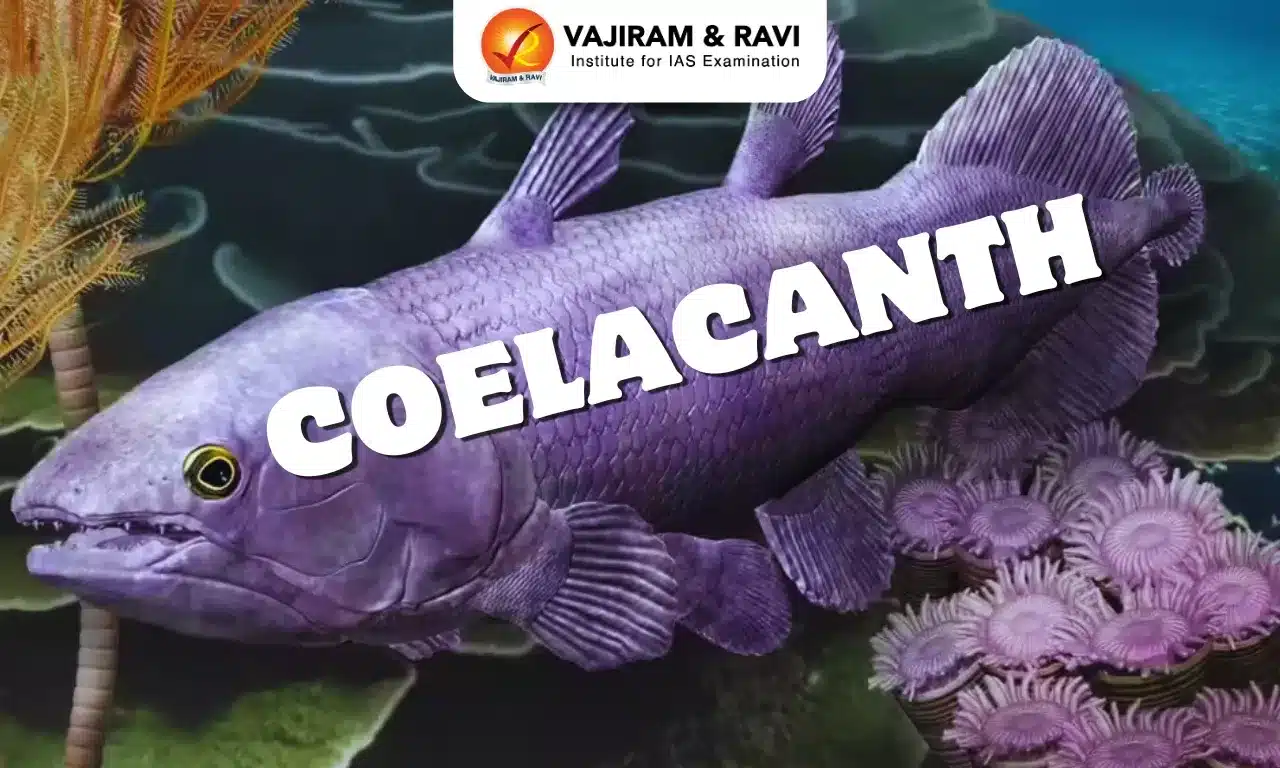
Coelacanth

Coelacanth Latest News

Paleontologists in China have described a new species of the coelacanth genus Whiteia on the basis of two fossilized specimens.

About Coelacanth

  • The Coelacanth is a prehistoric, lobe-finned fish (belonging to the order Coelacanthiformes) that was once thought to be extinct for about 66 million years, until it was rediscovered alive in 1938 off the coast of South Africa.
  • It is often called a “living fossil.”
    • The earliest coelacanth fossils date back as far as the Devonian period, approximately 420 mya. 
    • At one time coelacanths were a large group comprising about 90 valid species that were distributed worldwide in both marine and freshwaters. 
  • At present, there are two living species of coelacanth, the West Indian Ocean coelacanth and the Indonesian coelacanth. 
  • These fish live in deep saltwater environments and can grow to be nearly 2 meters long.
  • They have fleshy, limb-like fins that are internally supported by bone. 
  • Their fins are also paired and move in a synchronized pattern similar to four-limbed animals.
  • As one of the last lobe-finned fish, coelacanths have numerous characteristics unique among living fish. 
    • Among them is the presence of a special electrosensory organ in the snout called the "rostral organ." 
    • This organ is filled with a gel and enables the coelacanth to sense low-frequency electrical signals and "see" in the dark.
    • Another is a joint or "hinge" in the skull that allows the front portion of the braincase to swing upwards, greatly enlarging the gape of the mouth.

Source: SCI

Coelacanth FAQs

Q1: The Coelacanth belongs to which order of fishes?

Ans: Coelacanthiformes

Q2: The earliest fossils of Coelacanths date back to which geological period?

Ans: The earliest coelacanth fossils date back as far as the Devonian period, approximately 420 mya.

Q3: How many living species of Coelacanth are known today?

Ans: At present, there are two living species of coelacanth, the West Indian Ocean coelacanth and the Indonesian coelacanth.

National Seeds Corporation

National Seeds Corporation

National Seeds Corporation Latest News

Recently, the Union Minister for Agriculture & Farmers’ Welfare and Rural Development, inaugurated National Seeds Corporation’s state-of-the-art seed processing plant at Pusa Complex, New Delhi.

About National Seeds Corporation

  • It was established in 1963 to undertake production of foundation and certified seeds. 
  • It is under the administrative control of the Department of Agriculture & Farmer’s Welfare, Ministry of Agriculture and Farmer's Welfare.
  • It is a Schedule ‘B’ – Mini Ratna Category-I Company, fully owned by the Government of India.

Functions of National Seeds Corporation

  • It has been playing a pivotal role in producing and supplying quality seeds to farmers across the country.
  • It plays a key role in the implementation of various schemes of the Govt. of India like National Mission on Oil Seed and Oil Palm (NMOOP)”, “National Food Security Mission (NFSM)” and “Mission for Integrated Development of Horticulture (MIDH).
  • It provides technical support to the seed producing agencies including State Seed Corporations.
  • It is the nodal agency for the implementation of the Central Sector Scheme to create infrastructure facilities for establishment of processing plants and storage godowns in different states in the private sectors.
  • The SAARC seed bank maintained by NSC with the grant in aid of the Govt. of India holds a larger quantity of seeds of different crops & varieties.

Source: PIB

National Seeds Corporation FAQs

Q1: What is the primary objective of the National Seeds Corporation?

Ans: To produce and distribute high-quality seeds

Q2: Under which ministry does the National Seeds Corporation operate?

Ans: Ministry of Agriculture and Farmers Welfare

SJ-100

SJ-100

SJ-100 Latest News

The Hindustan Aeronautics Limited (HAL) and Russia’s United Aircraft Corporation (UAC) recently signed a Memorandum of Understanding for production of civil commuter aircraft SJ-100.

About SJ-100

  • It is a new generation short-haul jet aircraft of Russian origin. 
  • Earlier called the Sukhoi Superjet 100, it originally was designed by the now-merged Russian aircraft company Sukhoi Civil Aircraft.
  • It is a twin-engine, narrow-body aircraft. 
  • The aircraft is primarily used for commercial purposes.
  • As on date, over 200 SJ-100 aircraft have been manufactured.
  • The aircraft are being operated by more than 16 airlines across the world, nine of them being from Russia.
  • It is capable of accommodating 103 seats and has a flight range of 3,530 kilometres.
  • The aircraft has been touted as having low operating costs for airlines.
  • It can operate at extreme weather conditions, from -55 degrees Celsius to +45 degrees Celsius.

SourceTH

SJ-100 FAQs

Q1: What is SJ-100?

Ans: It is a new generation short-haul jet aircraft.

Q2: The SJ-100 aircraft belongs to which country of origin?

Ans: Russia

Q3: What is the approximate maximum flight range of the SJ-100 aircraft?

Ans: 3,530 km

Rehabilitation Council of India

Rehabilitation Council of India

Rehabilitation Council of India Latest News

Recently, the Rehabilitation Council of India (RCI) has announced a sweeping set of reforms designed to bring transparency, efficiency and inclusivity to the rehabilitation ecosystem across the country. 

About Rehabilitation Council of India

  • It is a statutory body established by an Act of Parliament.
  • Background: It was set up as a registered society in 1986. In September 1992 the RCI Act was enacted by Parliament and it became a Statutory Body on 22 June 1993. 
  • Mandate: To regulate and monitor services given to persons with disabilities, to standardise syllabi and to maintain a Central Rehabilitation Register of all qualified professionals and personnel working in the field of Rehabilitation and Special Education.
  • Nodal Ministry: Ministry of Social Justice & Empowerment

Objectives of Rehabilitation Council of India

  • To regulate the training policies and programmes in the field of rehabilitation of persons with disabilities
  • To bring about standardization of training courses for professionals dealing with persons with disabilities
  • To maintain Central Rehabilitation Register for registration of professionals/ personnel
  •  The Council also prescribes minimum standards of education and training for 16 categories of professionals and personnel allocated to RCI.
  • To recognize the national institutes and apex institutions on disability as manpower development centres.
  • The Council also prescribes minimum standards of education and training for 16 categories of professionals and personnel allocated to RCI.

Source: PIB

Rehabilitation Council of India FAQs

Q1: What is the primary objective of the Rehabilitation Council of India?

Ans: To regulate and standardize training programs for rehabilitation professionals.

Q2: What type of body is the Rehabilitation Council of India?

Ans: Statutory body

Koyla Shakti Dashboard

Koyla Shakti Dashboard

Koyla Shakti Dashboard Latest News

The Ministry of Coal is set to launch “Koyla Shakti”, a Smart Coal Analytics Dashboard in New Delhi.

About Koyla Shakti Dashboard

  • It is a smart coal analytics Dashboard that will serve as a unified platform for real-time monitoring and analysis of coal sector operations. 
  • It serves as a centralized digital platform integrating data from multiple stakeholders, including:
    • Coal producing companies and private miners
    • Central Ministries and Departments such as Coal, Railways, Power, Finance, Ports, Shipping & Waterways, and Road Transport & Highways
    • State Departments managing coal production (E-khanij platforms)
    • Power generation companies and other industrial coal consumers
    • Port authorities and private coal-handling terminals
  • Objectives: To strengthen operational efficiency, promote transparency, and enhance coordination across the coal supply chain.

Key Features of Koyla Shakti Dashboard

  • Unified Visibility:  Integration of diverse data sources into a single, comprehensive interface.
  • Real-Time Monitoring: Continuous tracking of coal production, dispatch, and logistics operations.
  • Data-Driven Decision Making: Analytical tools to support evidence-based policy formulation and management decisions.
  • Incident Response: Timely alerts and notifications enabling faster resolution of operational challenges.
  • Standardization: Uniform metrics and reporting formats ensuring consistency across departments.
  • Operational Efficiency: Simplification of monitoring and reporting, minimizing manual errors.
  • Scalability: Provision for integration with future digital systems and additional data sets.
  • Transparency and Accountability: Enhanced visibility of performance indicators for all stakeholders.
  • Policy Planning and Forecasting: Analytical insights to support demand forecasting and strategic planning.

Source: PIB

Koyla Shakti Dashboard FAQs

Q1: What is the primary objective of the Koyla Shakti Dashboard?

Ans: To promote transparency and accountability in the coal sector

Q2: Who will benefit from the Koyla Shakti dashboard?

Ans: Both policymakers and industry stakeholders

Doctrine of Merger

Doctrine of Merger

Doctrine of Merger Latest News

In a judgment clarifying the limits of the doctrine of merger, the Supreme Court of India recently observed that the doctrine of merger is not a doctrine of rigid and universal application.

About Doctrine of Merger

  • It is a common law doctrine founded on the principle of maintenance of decorum and propriety in the functioning of Courts and Tribunals and preserving the sanctity of the justice delivery system. 
  • The underlying logic being that there cannot be more than one decree or operative order governing the same subject matter at a given point of time. 
  • It provides that when an appellate court passes an order, the order passed by the lower court is merged with that order.
  • The doctrine is not recognized statutorily but is a statement of judicial propriety and seeks to instill discipline in the functioning of subordinate adjudicating authorities, whether judicial, quasi-judicial, or administrative.
  • The applicability of the doctrine of merger entails the existence of a decision of a subordinate court/forum against which a right of appeal/revision before a superior forum/authority exists, which has been exercised and which has either modified, reversed or affirmed the decision of the subordinate authority. 
  • The consequence of such an act would be that the decision of the subordinate authority shall merge with that of the superior forum, which only shall sustain, be operative and capable of being enforced. 
  • The essence of the doctrine of merger is that it is only the decisions of the appellate, revisional, or higher authority that subsist, and the order under challenge ceases to have an independent existence.
  • The doctrine solves the issue of which order must be enforced and given importance if there are multiple orders passed by both subordinate and superior courts on a single issue.
  • It is not a doctrine of universal or unlimited application. It will depend on the nature of the jurisdiction exercised by the superior forum and the content or subject matter of the challenge.

Source: LB

Doctrine of Merger FAQs

Q1: The Doctrine of Merger is primarily related to which field?

Ans: Judicial proceedings

Q2: What is the legal effect of the Doctrine of Merger?

Ans: Lower authority’s order ceases to have an independent existence.

Q3: Is the Doctrine of Merger universally applicable in all cases?

Ans: It is not a doctrine of universal or unlimited application.

Cloud Seeding

cloud seeding

Cloud Seeding Latest News

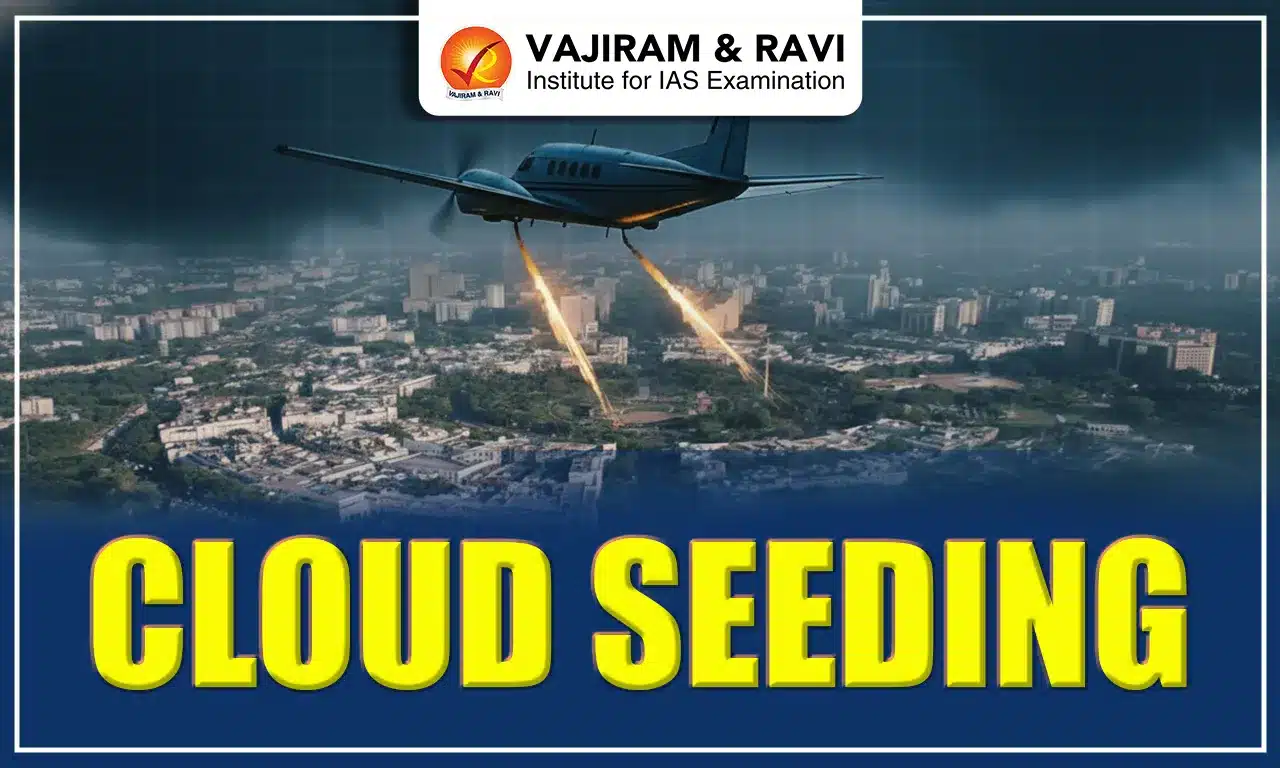
Recently, a small aircraft known as the Cessna 206H conducted a cloud seeding trial in Delhi amid the recent spike in air pollution. 

About Cloud Seeding

  • It is a weather-modification technique used to modify suitable clouds with ‘seed’ particles to increase rainfall.
  • To induce rain artificially, clouds are usually injected with salts like silver iodide, potassium iodide, or sodium chloride, which is the ‘seed’.
  • These salts are expected to provide additional nuclei around which more cloud droplets can form.
  • They are dispersed into the cloud either using aircraft or through generators on the ground.

Meteorological Requirements for Cloud Seeding

  • Sufficient moisture: The target clouds must contain an adequate amount of water vapour and liquid water to be condensed into precipitation.
  • Cloud characteristics: Clouds targeted for seeding must have sufficient vertical thickness. For example, some cloud-seeding projects require clouds to be at least 1 kilometre thick.
  • Favourable winds:  Wind direction must transport the seeding material toward the intended area and wind speed must not be so high that it prevents clouds from growing tall or blows the seeding agents away from the target zone.
  • Vertical air currents: Clouds with strong vertical updrafts are considered ideal because they help disperse the seeding agents and promote cloud development. 

Source: IE

Cloud Seeding FAQs

Q1: What is the primary purpose of cloud seeding?

Ans: To enhance precipitation

Q2: What is the mechanism by which cloud seeding enhances precipitation?

Ans: By introducing nucleating agents to facilitate droplet formation

Karakoram Wildlife Sanctuary

Karakoram Wildlife Sanctuary

Karakoram Wildlife Sanctuary Latest News

Recently, a proposal of redrawing the boundaries and expanse of the Karakoram wildlife sanctuary in Ladakh was received by the central government.

About Karakoram Wildlife Sanctuary

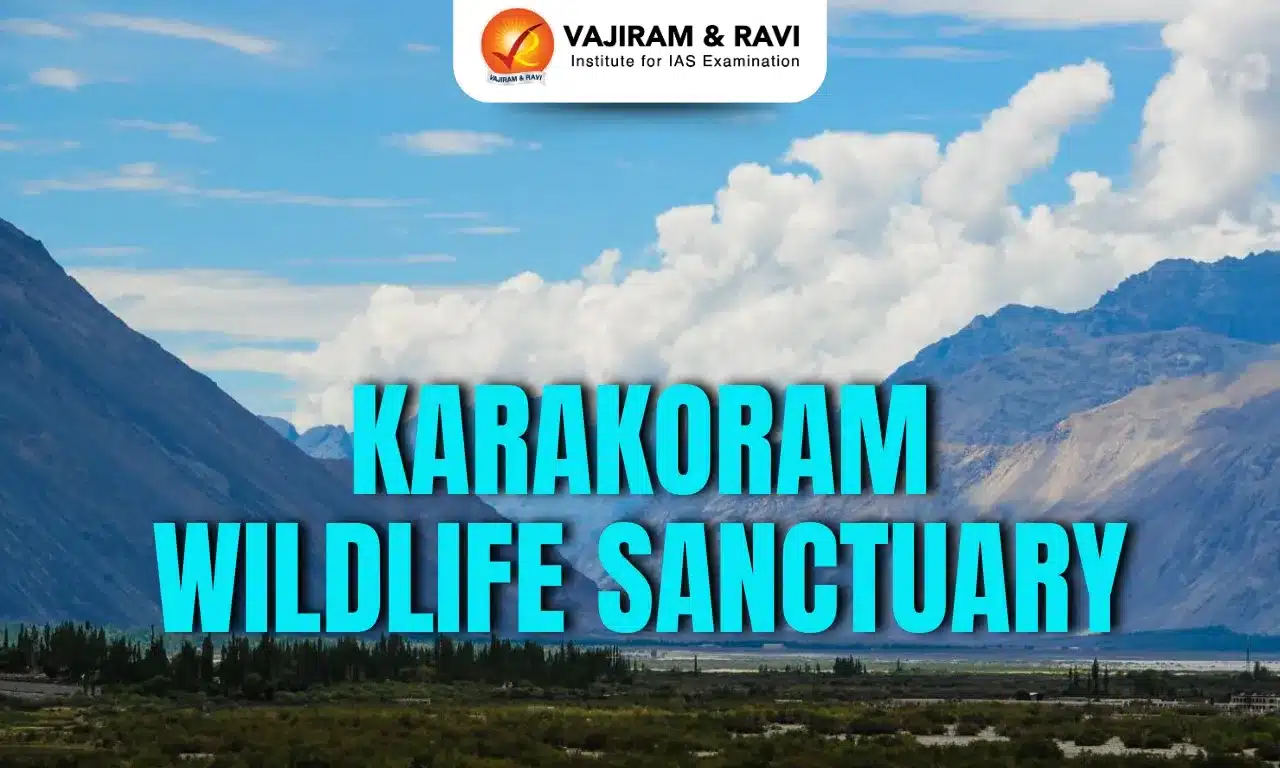
  • Location: It is located in the union territory of Ladakh along the territory’s border with Jammu and Kashmir.
  • It is situated just to the north of Hemis National Park and to the east of Deosai National Park.
  • Terrain: It is well known for its diverse landscape, featuring snow-covered peaks, alpine fields, and deep ravines.
  • Climatic condition: The average temperature during the warmest month is lower than 0 degrees Celsius in some heights and remains below 10 degrees Celsius in other parts.
  • Major Peaks: Major peaks within this Wildlife Sanctuary include Saltoro Kangri, Saser Kangri I, and K12.
  • Rivers: Shyok and Nubra Rivers are the major water sources of this sanctuary.
  • Vegetation: It is rich in alpine vegetation, medicinal plants, cold desert flora, endemic and rare species, and glacier vegetation.
  • Fauna: Ural, the argali, Tibetan gazelle, Siberian ibex, the bharal (blue sheep), and the snow leopard, Tibetan antelope (chiru) and Bactrian cameletc.
  • Flora: It comprises broad-leaved shrubs namely the Rosia webbiana, Ephedra, Caragianae and several other bushes.

Source: ET

Karakoram Wildlife Sanctuary FAQs

Q1: Where is the Karakoram Wildlife Sanctuary located?

Ans: Ladakh

Q2: What type of climate does the Karakoram Wildlife Sanctuary have?

Ans: Cold desert climate

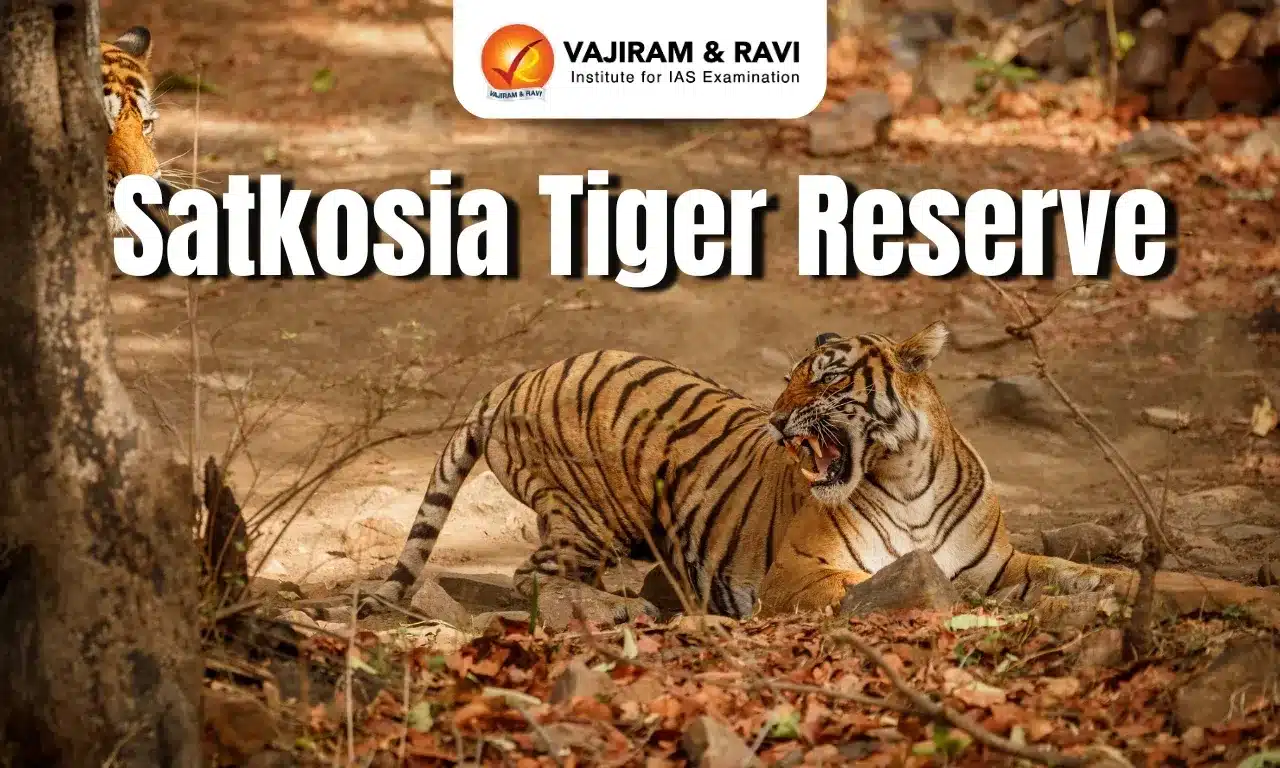
Satkosia Tiger Reserve

Satkosia Tiger Reserve

Satkosia Tiger Reserve Latest News

In the wake of allegations that village relocation in the Satkosia Tiger Reserve has not been carried out properly, the Odisha Human Rights Commission (OHRC) has asked the Forest and Revenue departments and the Angul collector to submit all records in this connection.

About Satkosia Tiger Reserve

  • It is located in the heartland of Odisha and spread over four districts, viz. Angul, Cuttack, Boudh, and Nayagarh.
  • Spanning 1,136.70 sq. km, the reserve encompasses the Satkosia Gorge Sanctuary and Baisipalli Wildlife Sanctuary, divided by the Mahanadi River. 
  • The area is also a part of the Mahanadi Elephant Reserve.
  • It is the meeting point of two biogeographic regions of India, the Deccan Peninsula and the Eastern Ghats, contributing immense biodiversity.
  • Landscape
    • The terrain is hilly with moderate to steep slopes and narrow valleys. 
    • The average elevation of the terrain varies between 37 m and 932 m, with the lowest point being at Katrang and the highest point being at Sunakhania.
  • Vegetation: The forest vegetation comprises North Indian tropical moist deciduous forests and Moist peninsular low-level sal.
  • Flora:
    • The main tree species is sal, which grows in gregarious formations.
    • Other associate species are Asan (Terminalia alata), Dhaura (Anogeissus latifolia), Bamboo (Dendrocalamus strictus), and Simal (Bombax ceiba).
  • Fauna:
    • The flagship species among the fauna include tiger, leopard, elephant, spotted deer, sambar, chowsingha, barking deer, bison, wild dog, sloth bear, jackal, giant squirrel, and porcupine.
    • It is the natural habitat of two endangered species, viz., the freshwater crocodile and the gharial.

Source: NIE

Satkosia Tiger Reserve FAQs

Q1: Satkosia Tiger Reserve is locate in which state?

Ans: Odisha

Q2: Satkosia Tiger Reserve includes which two wildlife sanctuaries?

Ans: Satkosia Gorge Sanctuary and Baisipalli Wildlife Sanctuary

Q3: Satkosia Tiger Reserve lies at the meeting point of which two biogeographic regions of India?

Ans: Deccan Peninsula and Eastern Ghats

Dyslexia

Dyslexia

About Dyslexia: 

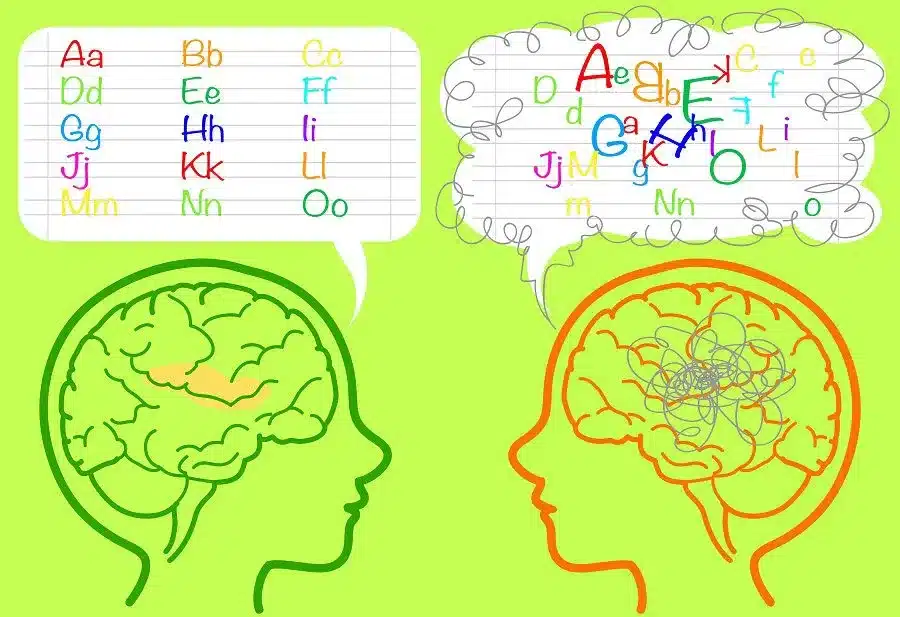
  • It is a learning disorder that involves difficulty reading due to problems identifying speech sounds and learning how they relate to letters and words (decoding).
  • It is also called a reading disability, dyslexia is a result of individual differences in areas of the brain that process language.
  • It is not due to problems with intelligence, hearing or vision. 
  • It is often misunderstood as the ‘slow-learner syndrome’.
  • The exact cause of dyslexia isn’t clear. However, several clues hint at how and why most cases happen.
    • Genetics: It is highly genetic and runs in families. A child with one parent with dyslexia has a 30% to 50% chance of inheriting it.
    • Differences in brain development and function: Research shows people with dyslexia have differences in brain structure, function and chemistry.
    • Disruptions in brain development and function: Infections, toxic exposures and other events can disrupt fetal development and increase the odds of later development of dyslexia.
  • Specific Learning Disabilities, including dyslexia, were officially recognized under the Rights of Persons with Disabilities Act of 2016, which mandates equal opportunities in education, employment, and other aspects of life.
  • The National Education Policy 2020 reinforces this mandate, emphasizing inclusive education from foundational to higher education levels. NEP 2020 reforms focus on early identification, teacher capacity building, and providing necessary support and accommodations to students.

Q1: What is Autism spectrum disorder (ASD)?

Autism spectrum disorder (ASD) is a developmental disability caused by differences in the brain. People with ASD may behave, communicate, interact, and learn in ways that are different from most other people.

News: Rashtrapati Bhavan, Parliament light up in red to raise awareness about dyslexia

Enquire Now