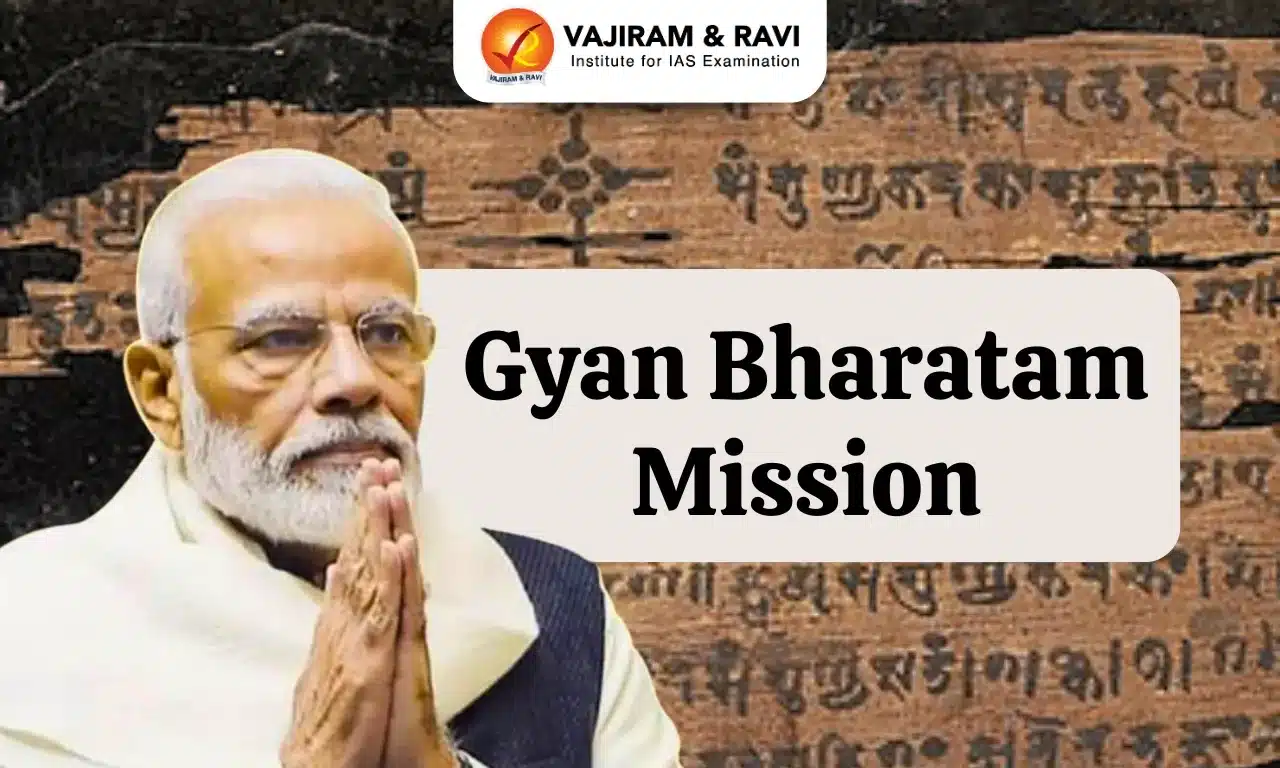
PM Modi to Launch Gyan Bharatam Mission: Reviving India’s Manuscript Legacy

PM Modi to Launch Gyan Bharatam Mission: Reviving India’s Manuscript Legacy

Gyan Bharatam Mission Latest News

  • Prime Minister Narendra Modi will launch the revamped National Manuscripts Mission, which was announced in the Union Budget earlier this year, on June 9.

Introduction

  • India’s rich heritage of ancient knowledge is on the verge of a transformative revival with the launch of the revamped National Manuscripts Mission. 
  • Scheduled to be inaugurated by Prime Minister Narendra Modi on June 9, 2025, the initiative, now named Gyan Bharatam Mission, seeks to digitise, conserve, and make accessible over one crore manuscripts scattered across the country. 
  • This mission is envisioned as a national endeavour to safeguard India’s intellectual legacy and create a centralised, structured approach to knowledge preservation.

About the National Manuscripts Mission (NMM)

  • The National Manuscripts Mission (NMM) was initially launched in 2003 as a programme under the Indira Gandhi National Centre for the Arts (IGNCA). 
  • Despite the scale of its mandate, it did not scale up as expected due to institutional and operational constraints.
    • The NMM has so far prepared metadata for 52 lakh manuscripts.
    • About 3 lakh manuscripts have been digitised.
    • Only 1.3 lakh manuscripts have been uploaded online, and just 70,000 are currently accessible to the public.
  • A key reason behind the limited public access is the lack of a clear access policy, particularly with private manuscript owners who control nearly 80% of India’s manuscript collection.

Revamp into Gyan Bharatam Mission

  • The Union Government, in its 2025 Budget, significantly increased the financial allocation for the manuscripts initiative, from ₹3.5 crore to ₹60 crore. 
  • This move aims to address the scale of the challenge and integrate modern technology into the preservation ecosystem.
  • The Gyan Bharatam Mission will take a comprehensive approach by:
    • Surveying and documenting manuscripts lying with institutions, private collectors, museums, and libraries.
    • Digitising and conserving rare and fragile folios.
    • Setting up an autonomous institution to oversee the programme.
  • The revamped mission will no longer be a subset of IGNCA but will have a standalone structure, allowing for greater efficiency and agility.

Addressing the Challenges

  • Despite NMM’s two-decade-long journey, several gaps remain:
    • A large number of manuscripts remain with private owners unwilling to share due to unclear policies.
    • Digitisation efforts have lagged behind, with only a fraction of manuscripts made available online.
    • There is also limited awareness of India’s manuscript wealth among younger generations.
  • The new mission aims to address these by creating:
    • Incentive frameworks for private collectors.
    • A robust access and copyright policy.
    • Centralised and open digital repositories.
    • Preventive conservation of fragile folios across repositories.
  • Over the past 21 years, preventive and curative conservation has been conducted for over 9 crore folios.

Strategic and Cultural Significance

  • The Gyan Bharatam Mission comes at a time when India is actively investing in civilisational narratives, language revitalisation, and heritage infrastructure. 
  • By focusing on manuscripts, this mission bridges cultural pride with contemporary digital access. 
  • It also supports the broader ‘Viksit Bharat’ vision by reclaiming and repurposing India’s traditional knowledge systems for future generations.

Gyan Bharatam Mission FAQs

Q1. What is the Gyan Bharatam Mission?

Ans. It is a revamped initiative to conserve, digitise, and make accessible over one crore Indian manuscripts.

Q2. When will the Gyan Bharatam Mission be launched?

Ans. The mission will be launched by Prime Minister Narendra Modi on June 9, 2025.

Q3. How much budget has been allocated for the revamped mission?

Ans. The allocation has been increased from ₹3.5 crore to ₹60 crore in the Union Budget 2025.

Q4. Why are many manuscripts not accessible to the public?

Ans. Due to the lack of a clear access policy and limited participation from private owners, most manuscripts are not publicly available.

Q5. What is the long-term vision of the mission?

Ans. The mission aims to establish a national digital repository and promote access to India's traditional knowledge for scholars and citizens.

Source : TH
India Imposes Trade Curbs on Bangladesh Exports to North-East

Trade Curbs on Bangladesh Exports to North-East

India Bangladesh Trade Restrictions Latest News

  • India has imposed restrictions on Bangladeshi exports to North-East India and overseas. 
  • This move appears to be a response to Bangladesh’s continued use of non-tariff barriers that hinder Indian exports to Bangladesh.

Bilateral Trade Relation Between India and Bangladesh

  • In Financial Year 2023-24, India and Bangladesh's total bilateral trade reached $14.01 billion. 
  • India's exports to Bangladesh amounted to $12.05 billion, while Bangladesh's exports to India were $1.97 billion. 
  • India is Bangladesh's second largest trading partner in Asia and Bangladesh is India's largest trade partner in South Asia. 

India Imposes Restrictions on Bangladeshi Exports

  • India has announced new restrictions on Bangladeshi products being exported to North-East India and beyond, in a move widely seen as a reciprocal response to Bangladesh’s persistent non-tariff barriers on Indian exports.

Scope of the Restrictions

  • The Directorate General of Foreign Trade issued a notification specifying:
    • Restrictions apply across all Land Customs Stations (LCSs) and Integrated Check Posts (ICPs) in Assam, Meghalaya, Tripura, and Mizoram.
    • LCS Changrabandha and Fulbari in North Bengal are also included to prevent re-routing of goods through the Siliguri Corridor.
  • Products affected include:
    • Readymade garments
    • Wooden furniture
    • Plastic and PVC goods
    • Fruit-flavoured and carbonated drinks
    • Baked goods, snacks, and confectionery
    • Cotton yarn, among others.

Exempted Items and Routes

  • Certain categories are exempted from restrictions:
    • Fish, LPG, edible oil, and crushed stone
    • Exports to Nepal/Bhutan transiting through India
    • Readymade garments can still be imported via Kolkata and Nhava Sheva seaports.

Background and Trigger

  • The decision follows remarks by Bangladesh's interim government head Muhammad Yunus in Beijing, where he described North-East India as “landlocked” and Bangladesh as its “only guardian to the ocean.” 
  • India interpreted this, along with persistent trade restrictions, as a disregard for mutual trade balance.

Existing Transit Framework and Disparities

  • There are 11 land transit points in the Northeast for trade with Bangladesh: 3 in Assam; 2 in Meghalaya; 6 in Tripura.
  • India had allowed Bangladeshi goods to transit through all land ports and seaports without restrictions.
  • Bangladesh, however, continued to restrict Indian exports through LCSs and ICPs bordering the region.
    • Yarn exports from India via land ports were stopped from April 13.
    • Indian rice exports have been banned through Hili and Benapole ICPs since April 15.
    • Indian exports face rigorous inspections upon entry into Bangladesh.
    • Bangladesh’s policies have restricted Northeast India’s market access, limiting it to primary agricultural goods.

India’s Rationale and Concerns

  • According to Indian officials:
    • Bangladesh continues to restrict Indian exports via land ports, especially those bordering the North-East, despite earlier bilateral agreements.
  • North-East India’s industrial growth suffers due to:
    • High transit charges by Bangladesh
    • Lack of reciprocal access to Bangladeshi markets
    • Over-dependence on Bangladeshi imports
    • Port restrictions are meant to support local manufacturing and ensure a level playing field for Indian industries.

India’s Position

  • India asserts that Bangladesh cannot cherry-pick trade benefits and must engage in fair, reciprocal trade practices. 
  • While open to dialogue, Delhi insists that Dhaka must create a constructive atmosphere for engagement.

Conclusion: India’s Strategic Pushback

  • India views these actions as damaging to the manufacturing sector in the Northeast, creating a one-sided dependency.
  • To promote 'Atmanirbhar Bharat' and support local manufacturing, India is imposing port restrictions on Bangladeshi exports through all LCSs and ICPs in Assam, Meghalaya, Tripura, and Mizoram.
  • The move aims to ensure fair trade practices and protect regional industrial growth.

India Bangladesh Trade Restrictions FAQs

Q1. Why did India impose restrictions on Bangladesh exports?

Ans. India responded to persistent non-tariff barriers imposed by Bangladesh, impacting Indian exports and market access, especially in the North-East.

Q2. Which products face export restrictions from Bangladesh?

Ans. Restrictions cover garments, plastic goods, furniture, carbonated drinks, baked items, and cotton yarn, among others.

Q3. Are any Bangladeshi exports exempted from Indian restrictions?

Ans. Yes, fish, LPG, edible oil, crushed stones, and garments through Kolkata and Nhava Sheva ports are exempted.

Q4. What triggered India’s recent trade move against Bangladesh?

Ans. It followed Bangladesh's remarks calling North-East India "landlocked" and ongoing trade restrictions on Indian goods.

Q5. What’s India’s strategic goal behind the restrictions?

Ans. India aims to boost local manufacturing, promote fair trade, and counter regional dependency on Bangladeshi imports.

Source: TH | IE | FE

Public Safety Act (PSA)

Public Safety Act (PSA)

Public Safety Act Latest News

Jammu & Kashmir Police have recently invoked the Public Safety Act against 23 individuals in Srinagar, citing their involvement in subversive activities and threats to national security and public order.

About Public Safety Act

  • The Jammu & Kashmir Public Safety Act, 1978 (Act No. VI of 1978), is a preventive detention law originally enacted by the J&K State Legislature and now applicable to the Union Territory of Jammu & Kashmir. 
  • Its primary objective is to empower authorities to detain individuals to prevent actions prejudicial to the security of the state or maintenance of public order.

Public Safety Act Key Provisions

  • Detention Without Trial: The PSA permits authorities to detain individuals without formal charges or a trial, even if they are already in custody or recently granted bail.
  • No Right to File Bail Application: Detainees under the PSA cannot seek bail or appoint a lawyer to represent them, leaving them with limited legal representation options.
  • Limited Legal Remedies: The only way to challenge a PSA detention is through a habeas corpus petition filed by the detained person’s relatives in higher courts.
  • Re-Detention Possibility: Even if a PSA detention order is quashed by the High Court or Supreme Court, the government can issue a fresh detention order.
  • Discretionary Powers: The District Magistrate who issues the detention order is legally protected, as the PSA considers such actions done “in good faith.”
  • Section 8 of the PSA: It broadly defines grounds for detention, including promoting enmity, instigation, or any acts threatening public harmony, with final decisions left to district authorities.
  • No Distinction Between Offences: The PSA allows detention for up to one year for disturbing public order and two years for activities harmful to state security.

Public Safety Act FAQs

Q1. What do you mean by Public Safety Act?

Ans. The Public Safety Act is a law that allows authorities to detain people without trial to prevent threats to public order or state security.

Q2. What is the public safety bill in India?

Ans. The public safety bill refers to laws like the Jammu & Kashmir Public Safety Act or National Security Act, which enable preventive detention for maintaining public safety.

Q3. What is Section 13 of the Public Safety Act 1978?

Ans. Section 13 requires authorities to inform detainees of the reasons for their detention within 5 to 10 days, but can withhold details if it is against public interest.

Q4. What was the purpose of public safety?

Ans. The purpose of public safety is to prevent acts that threaten the security of the state or disturb public order.

SourceIE

Coral Reefs

Coral Reefs

Coral Reefs Latest News

Scientists at the University of California San Diego developed SNAP-X, a bio-ink enhancing coral larvae settlement by 20x, offering a breakthrough for reef restoration amid climate threats.

About Coral Reefs

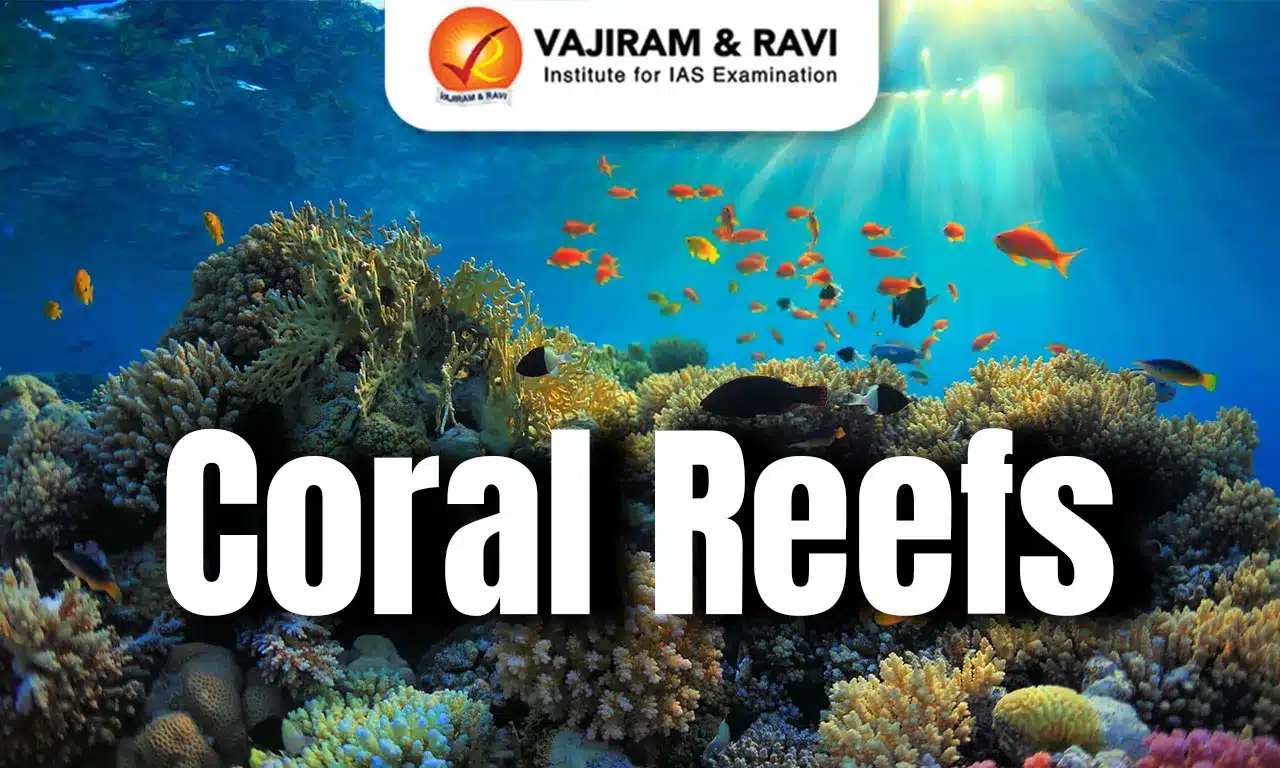
  • Coral reefs are marine ecosystems built by groups of coral polyps bound together by calcium carbonate. These vibrant habitats flourish in warm, clear, and shallow waters of tropical regions.
  • Notable examples include the Great Barrier Reef and India’s Gulf of Mannar and Lakshadweep.
  • Coral reefs offer crucial benefits, such as providing food, shielding coastlines, and supporting local economies through tourism and fishing.
  • Types of Coral Reefs:
    • Fringing Reefs: Found close to shorelines, separated from land by shallow lagoons. Most common type.
    • Barrier Reefs: Located farther offshore, separated from land by deeper, wider lagoons. The Great Barrier Reef in Australia is the largest example.
    • Atolls: Ring-shaped reefs that encircle a lagoon, often formed on sinking volcanic islands. Common in the Indian and Pacific Oceans.

Conditions Required for Coral Reef Formation

  • Stable, Warm Water: Temperatures typically around 20°C, found in tropical regions between 30°N and 30°S.
  • Shallow Depths: Usually up to 55 meters deep, allowing sufficient sunlight for photosynthesis.
  • Clear, Low-Nutrient Saltwater: Essential for light penetration and coral health.
  • Minimal Pollution: Corals are highly sensitive to chemical and sediment pollution.
  • Abundant Plankton: Provides food for coral polyps.

Coral Reefs FAQs

Q1. What are called coral reefs?

Ans. Coral reefs are underwater structures made by colonies of tiny animals called coral polyps held together by calcium carbonate.

Q2. What is coral reef and its importance?

Ans. Coral reefs are diverse underwater ecosystems that protect coastlines, support fisheries, and are vital for marine biodiversity and local economies.

Q3. What are the three types of coral reefs?

Ans. The three main types are fringing reefs, barrier reefs, and atolls.

SourceEurasia Review

World Food Prize 2025

World Food Prize 2025

World Food Prize Latest News

Brazilian scientist Mariangela Hungria recently won the 2025 World Food Prize for her pioneering work in reducing the use of chemical fertilisers and developing biological seed and soil treatments to boost crop yields and nutrition.

About World Food Prize

  • It is an international award recognizing the achievements of individuals that have advanced human development by improving the quality, quantity, or availability of food in the world.
  • It is also known as the Nobel Prize for Food and Agriculture.
  • It recognizes contributions in any field involved in the world food supply, such as food and agriculture, science and technology, manufacturing, marketing, nutrition, economics, poverty alleviation, political leadership, and the social sciences.
  • The Prize was founded in 1986 by Dr. Norman E. Borlaug, recipient of the 1970 Nobel Peace Prize. 
  • It is now administered by the World Food Prize Foundation with support from numerous sponsors.
  • It is a $500,000 award formally presented at the Laureate Award Ceremony in mid-October, on or around World Food Day, in conjunction with the Borlaug Dialogue international symposium in Des Moines, Iowa, USA.
  • M.S. Swaminathan was named the first World Food Prize Laureate, receiving the award in 1987 for developing and spearheading the introduction of high-yielding wheat and rice varieties into India during the 1960s.

World Food Prize 2025

  • Brazilian microbiologist Mariangela Hungria is the winner of the 2025 World Food Prize for her work with biological seed and soil treatments.
  • Hungria's research enables crops to utilize soil bacteria for nutrients, increasing yields and reducing the need for synthetic fertilizers.

World Food Prize FAQs

Q1. Who founded the World Food Prize in 1986?

Ans. It was founded in 1986 by Dr. Norman E. Borlaug, recipient of the 1970 Nobel Peace Prize. 

Q2. Who won World Food Prize first?

Ans. M.S. Swaminathan was named the first World Food Prize Laureate, receiving the award in 1987.

Q3. Who won the 2025 World Food Prize?

Ans. Brazilian microbiologist Mariangela Hungria is the winner of the 2025 World Food Prize for her work with biological seed and soil treatments.

SourcePRINT

E-Passports

e-Passports

E-Passports Latest News

India has joined over 120 nations in issuing biometric e-passports, offering enhanced security, faster immigration, and global compliance.

About e-Passports

  • An e-passport (electronic or biometric passport) is an upgraded version of the traditional passport. It combines a conventional booklet with an embedded Radio Frequency Identification (RFID) chip and antenna in the back cover. 
  • This chip securely stores the holder’s personal and biometric data, including:
    • Name, date of birth, passport number, and other demographic details
    • Biometric facial data and fingerprints
    • Digital signature for secure authentication
  • Security Features of E-Passports
    • RFID Chip & Antenna: Stores encrypted personal and biometric data, making unauthorized access or tampering extremely difficult.
    • Basic Access Control (BAC): Stops unauthenticated access to the chip by restricting scanning equipment to only authorized devices.
    • Passive Authentication (PA): Authenticates stored information and identifies tampering.
    • Extended Access Control (EAC): Introduces an additional layer of security to biometric data such as fingerprints.
    • Public Key Infrastructure (PKI): Digitally signs the data, ensuring authenticity and preventing forgery or unauthorized data changes.
  • Benefits of E-Passports
    • Enhanced Security: Strong protection against forgery, duplication, and identity theft due to encrypted biometric data and digital signatures.
    • Faster Immigration: Automated e-gates and digital verification reduce manual checks and waiting times at airports.
    • Global Acceptance: Compliance with International Civil Aviation Organization (ICAO) standards ensures smooth travel and easier visa processing worldwide.
    • Privacy: New e-passports no longer print the residential address on the last page; it is stored digitally and accessible only to authorised officials.

E-Passports FAQs

Q1. Is the e-passport launched in India?

Ans. Yes, India has started issuing e-passports to its citizens.

Q2. What is an e-passport?

Ans. An e-passport is a passport with an embedded electronic chip that securely stores your personal and biometric details.

Q4. What is the cost of e-passport in India?

Ans. The cost is ₹1,500 for a 36-page passport and ₹2,000 for a 60-page passport for adults.

SourceTOI

Type 2 Diabetes (T2D)

Type 2 Diabetes (T2D)

Type 2 Diabetes Latest News

The CBSE has directed affiliated schools to establish “Sugar Boards” to monitor and reduce sugar consumption among students primarily to lower the risk of Type 2 diabetes and obesity in children.

About Type 2 Diabetes

  • T2D, the most common type of diabetes, is a disease that occurs when your blood glucose, also called blood sugar, is too high. 
    • Blood glucose is your main source of energy and comes mainly from the food you eat. 
    • Insulin, a hormone made by the pancreas, helps glucose get into your cells to be used for energy. 
    • In T2D, your body doesn’t make enough insulin or doesn’t use insulin well.
    • Too much glucose then stays in your blood, and not enough reaches your cells.
  • Type 2 diabetes may be caused by a combination of factors:
    • Being overweight or having obesity
    • Not being physically active
    • Genetics and family history
  • How common is T2D?
    • Researchers estimate that T2D affects about 6.3% of the world’s population.
    • T2D most commonly affects adults over 45, but people younger than 45 can have it as well, including children.

Type 2 Diabetes Symptoms

  • Many people with type 2 diabetes have no symptoms at all. 
  • If you do have them, the symptoms develop slowly over several years
  • They might be so mild that you do not notice them. 
  • The symptoms can include:
    • Increased thirst and urination
    • Increased hunger
    • Feeling tired
    • Blurred vision
    • Numbness or tingling in the feet or hands
    • Sores that do not heal
    • Unexplained weight loss

Type 2 Diabetes Treatment 

  • Treatment for T2D involves managing your blood sugar levels. 
  • Many people are able to do this by living a healthy lifestyle. 
  • Some people may also need to take diabetes medicines, which may include pills or medicines you inject under your skin, such as insulin. 

Type 2 Diabetes FAQs

Q1. What is the type 2 diabetes?

Ans. It is a disease that occurs when your blood glucose, also called blood sugar, is too high. 

Q2. Which organ is responsible for producing insulin?

Ans. Pancreas

Q3. Is type 2 diabetes lifelong?

Ans. Type 2 diabetes is a lifelong (chronic) disease.

SourceFE

AIM-120C-8 AMRAAM

AIM-120C-8 AMRAAM

AIM-120C-8 AMRAAM Latest News

The recent approval by the United States to sell AIM-120C-8 Advanced Medium-Range Air-to-Air Missiles (AMRAAMs) to Turkey has triggered serious concerns in India.

About AIM-120C-8 AMRAAM

  • AIM-120C-8 Advanced Medium Range Air-to-Air Missile (AMRAAM) is a highly advanced beyond-visual-range air-to-air missile (BVRAAM) with surface-to-air missile (SAM) capabilities. 
  • It was developed by Raytheon Technologies, one of the leading United States defense contractors.
  • Developed to engage and destroy enemy aircraft at extended ranges, the AIM-120 has become a cornerstone of modern air combat. 

AIM-120C-8 AMRAAM Features

  • Designed for deployment from fighter aircraft such as the F-16, F-15, F/A-18, and newer platforms like the F-35, the missile has a range exceeding 160 kilometers under optimal launch conditions.
  • Measuring approximately 12 feet in length with a diameter of seven inches, the missile weighs around 356 pounds and is powered by a solid-fuel rocket motor capable of propelling it to speeds exceeding Mach 4, or roughly 3,000 miles per hour.
  • The missile’s guidance system is a sophisticated blend of active radar, inertial navigation, and GPS correction, enabling it to operate independently after launch, a feature known as “fire-and-forget.”
  • It also incorporates a two-way data link, which allows real-time updates to the missile’s trajectory, enhancing its accuracy against maneuvering targets. 
  • Its active radar seeker is designed to detect stealthy aircraft with low radar cross-sections, while advanced electronic countermeasures ensure resilience against jamming attempts. 
  • The missile carries an 18.1-kilogram high-explosive blast fragmentation warhead, optimized for destroying enemy aircraft and drones with a proximity fuse that triggers at the optimal moment.
  • It has the ability to engage multiple targets beyond visual range, even in contested electronic environments.

AIM-120C-8 AMRAAM FAQs

Q1. What does AMRAAM stand for?

Ans. Advanced Medium Range Air-to-Air Missile

Q2. Who developed the AIM-120C-8 AMRAAM?

Ans. It was developed by Raytheon Technologies, one of the leading United States defense contractors.

Q3. What is the approximate range of the AIM-120C-8 AMRAAM under optimal launch conditions?

Ans. Over 160 kilometers

SourceFP

Border Security Force (BSF)

Border Security Force

Border Security Force Latest News

As cross-border tensions flared along the western front amid escalations from Pakistan, the Border Security Force (BSF) emerged not just as India’s first line of defence—but also its sharpest, standing tall alongside the armed forces. 

About Border Security Force

  • Known as the First Line of Defence of Indian Territories, BSF is a primary border-guarding organisation of India.
  • BSF is one of the seven Central Armed Police Forces (CSPFs) of the Union of India under the administrative control of the Ministry of Home Affairs. 
  • It was raised in the wake of the 1965 War on 1 December 1965, "for ensuring the security of the borders of India and for matters associated therewith. 
  • Role
    • The primary role of BSF is to protect the country's land borders during peacetime and prevent transnational crime
    • They help the Indian Army during wartime as they are familiar with local people and topography. 
  • Currently, BSF is deployed at the Indo-Pakistan International Border, the Indo-Bangladesh International Border, and Line of Control (LoC) along with the Indian Army, and in Anti-Naxal Operations.
  • Logo: 
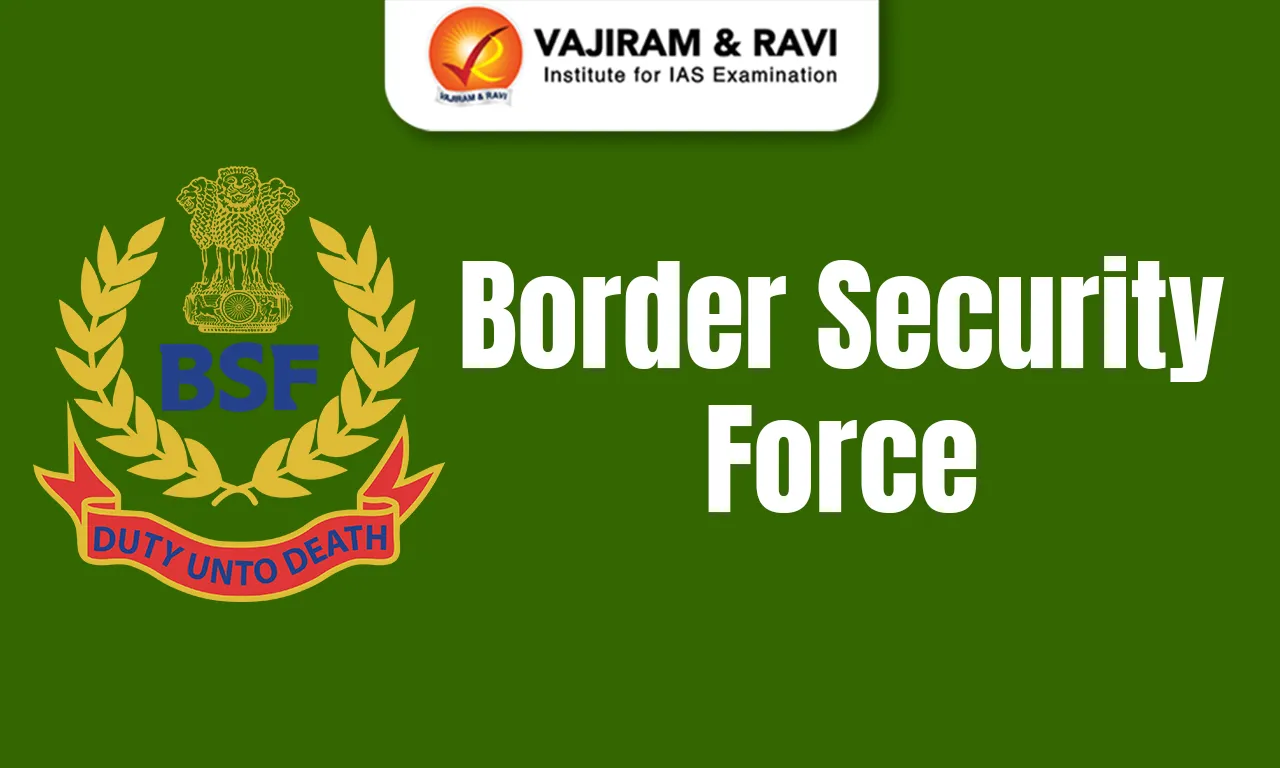
    • The Logo of BSF has two spikes of grainsembracing the National Emblem of India, and the typeface BSF. 
    • The motto of BSF, “DUTY UNTO DEATH” is placed at the bottom. 
  • BSF currently stands as the world's largest border guarding force with 186 battalions and 2.57 lakh personnel including an expanding air wing, marine wing, artillery regiments, and commando units.
  • The BSF has a separate camel and dog wing that lets them expand their reach into varied terrain such as the India-Pakistan border in the Rann of Kutch.
  • BSF is the only CAPF to have its own Air Wing, Marine Wing, and artillery regiments, which support the General Duty Battalions in their operations. 
  • The force also maintains a Tear Smoke Unit (TSU), which is unique in India. The TSU is responsible for producing tear gas munitions required for the Anti-Riot Forces.
  • BSF has been given powers of arrest, search, and seizure under various Acts. “These Acts include Passport Act 1967, Passport Act (Entry into India) 1920, Customs Act, NDPS Act and Arms Act. 
  • The head of the BSF is known as the Director General (DG), and he should be an officer from Indian Police Services (IPS).

Border Security Force FAQs

Q1. When was the Border Security Force (BSF) officially established?

Ans. It was raised in the wake of the 1965 War on 1 December 1965, "for ensuring the security of the borders of India and for matters associated therewith. 

Q2. Under which ministry does the Border Security Force (BSF) function?

Ans. Ministry of Home Affairs

Q3. What is the motto of the BSF?

Ans. "Duty Unto Death"

SourceN18

GRAIL Mission

GRAIL Mission

GRAIL Mission Latest News

NASA's GRAIL mission recently unveiled significant differences between the moon's nearside and farside, attributing them to tidal deformation and varied volcanic activity.

About GRAIL Mission

  • Gravity Recovery and Interior Laboratory (GRAIL) is a NASA lunar mission launched in 2011.
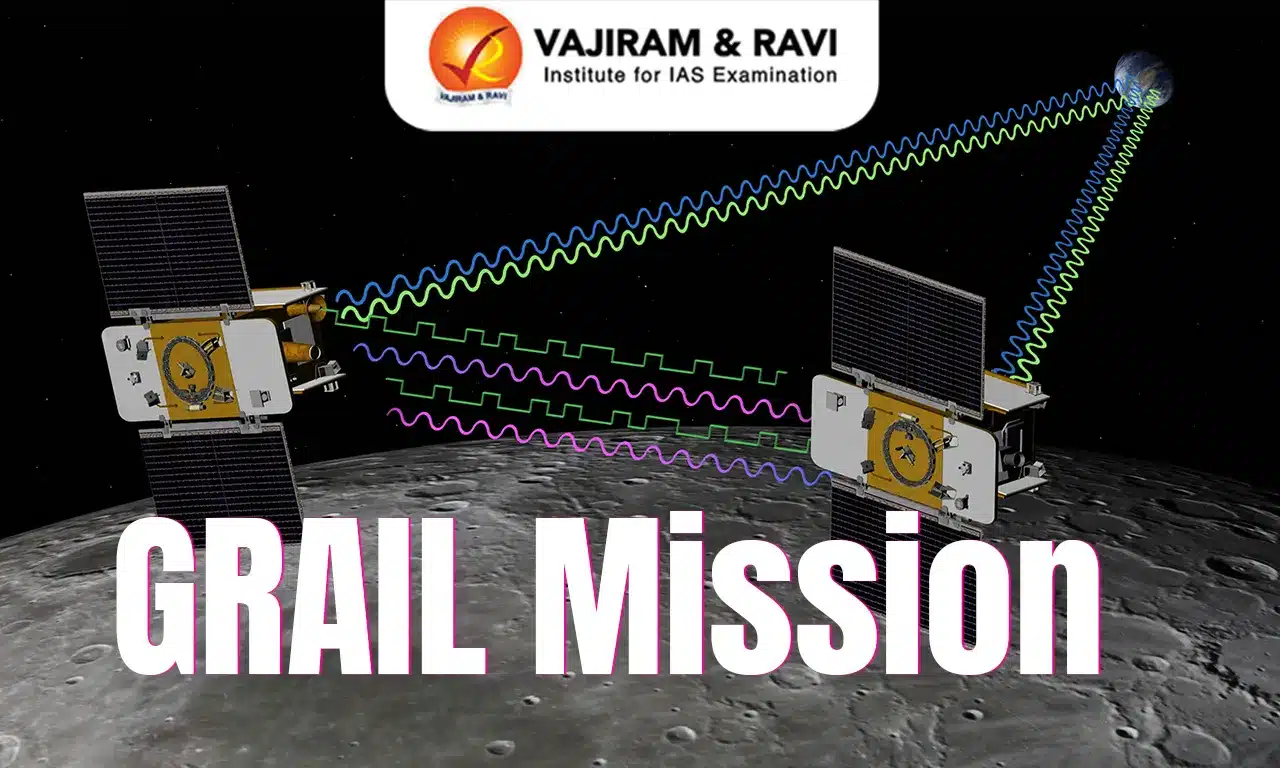
  • It consisted of two robotic spacecraft, Ebb and Flow, which orbited the moon to create the most detailed gravitational map of the lunar surface to date. 
  • The mission's primary goal was to measure variations in the moon’s gravitational field, providing critical insights into its internal structure and geological history. 
    • The GRAIL mission achieved this by precisely measuring the distance between the two spacecraft as they orbited the moon. 
    • Even tiny changes in this distance, caused by variations in the moon’s gravitational pull, provided data about the moon’s interior composition, crust thickness, and subsurface anomalies. 
    • This approach has proven crucial for understanding the forces that shaped the moon’s contrasting hemispheres.
  • GRAIL discovered that the Moon’s crust was more porous and not as thick as previously supposed. 
  • It also discovered long linear features called “dikes” that were evidence of the Moon’s expansion by a few kilometres early in its history.
  • Recent Findings: It unveiled significant differences between the moon's nearside and farside, attributing them to
    • Tidal deformation and gravitational asymmetry: 
      • The lunar nearside flexes slightly more than the farside during its elliptical orbit around Earth, a phenomenon known as tidal deformation. 
      • This difference in flexibility is primarily driven by Earth’s gravitational pull, which exerts a greater influence on the side facing our planet.
    • Volcanic activity and heat distribution: 
      • The moon’s nearside was once more volcanically active than the farside with vast plains of basaltic rock known as "mare." 
      • This volcanic activity concentrated heat-producing, radioactive elements like thorium and titanium in the nearside mantle, resulting in a significant temperature difference between the two hemispheres, creating a long-term thermal imbalance that has shaped the moon’s geology over billions of years.
    • Crustal thickness and surface composition: The nearside crust is significantly thinner than the farside crust, allowing magma from the moon’s interior to more easily reach the surface in the past, leading to extensive lava flows. 

GRAIL Mission FAQs

Q1. What was the primary objective of the GRAIL mission?

Ans. To measure variations in the Moon’s gravitational field.

Q2. Why does the Moon’s nearside have more volcanic activity than the farside?

Ans. Its crust is thinner, allowing magma to escape.

Q3. What were the names of the two robotic spacecraft used in the GRAIL mission?

Ans. Ebb and Flow

SourceTOI

Gyan Bharatam Mission

Gyan Bharatam Mission

Gyan Bharatam Mission Latest News

Prime Minister Narendra Modi will launch the revamped National Manuscripts Mission-now restructured as the “Gyan Bharatam Mission”-on June 9, 2025.

About Gyan Bharatam Mission

  • The Gyan Bharatam Mission is a comprehensive national initiative under the Ministry of Culture, Government of India, dedicated to the systematic survey, documentation, conservation, and digitisation of India’s vast manuscript heritage.
  • The mission builds upon and revamps the earlier National Mission for Manuscripts (NMM), which was established in 2003 and functions under the Indira Gandhi National Centre for the Arts (IGNCA).
  • Objective of Gyan Bharatam Mission
    • To survey, document, conserve, and digitize over one crore (10 million) manuscripts housed in academic institutions, museums, libraries, and private collections across India.
    • To create a National Digital Repository of Indian Knowledge Systems, making ancient wisdom accessible to researchers, students, and the public worldwide.

Key Features of Gyan Bharatam Mission

  • Massive Coverage: Targets more than one crore manuscripts, making it the largest manuscript preservation initiative in India’s history.
  • Digital Repository: Establishment of a centralized, accessible digital platform for India’s traditional knowledge systems, enabling AI-driven archiving, metadata tagging, and translation tools.
  • Collaboration: Active engagement with academic institutions, museums, libraries, private collectors, and international organizations for research, preservation, and dissemination.
  • Modern Conservation: Adoption of advanced scientific techniques for restoration, preservation, and digitization, including AI and 3D imaging.
  • Budgetary Support: Budget allocation for the mission increased from ₹3.5 crore to ₹60 crore, with a total outlay of ₹482.85 crore for 2024-31.
  • Public Access: Manuscripts will be made accessible for academic research, education, and public knowledge, both nationally and globally.

What are Manuscripts?

  • A manuscript is a handwritten document crafted on materials like paper, bark, or palm leaves, which is at least 75 years old and holds notable scientific, historical, or artistic importance.
  • For example, the Bakhshali manuscript, dating back to the third or fourth century BCE, is an ancient Indian text on mathematics written on birch bark.
  • Research has revealed that the Bakhshali manuscript features the earliest known instance of the mathematical symbol 'zero'.

Gyan Bharatam Mission FAQs

Q1. What is the Bharatam mission?

Ans. The Bharatam mission, called the Gyan Bharatam Mission, is a government initiative to survey, document, and conserve India’s manuscript heritage.

Q2. What is the primary objective of the Gyan Bharat mission?

Ans. Its main objective is to preserve, document, and make accessible over one crore Indian manuscripts.

Q3. How many manuscripts will be covered under the Gyan Bharatam mission?

Ans. The mission will cover more than one crore (10 million) manuscripts.

Q4. What is the budget of the manuscript mission?

Ans. The budget has been increased to ₹60 crore for the mission.

SourceTH

India’s Legal Gaps in Tackling Cyberbullying and Online Abuse

Default Image

Cyberbullying Laws in India Latest News

  • In the wake of the Pahalgam terror attack, Himanshi Narwal, widow of Navy Lieutenant Vinay Narwal, faced severe online abuse after appealing for peace and rejecting anti-Muslim sentiment. 
  • Similarly, Foreign Secretary Vikram Misri was trolled for announcing a ceasefire understanding with Pakistan, leading him to lock his X (formerly Twitter) account. 
  • These incidents highlight how anonymous online trolls often target individuals who challenge dominant narratives. 
  • To address this growing menace, regulatory reforms are needed to ensure accountability and curb impunity in digital spaces.

Rise of New-Age Cybercrimes

  • Modern cybercrimes such as cyberbullying, stalking, hate speech, and doxxing have become rampant. 
  • Doxxing—publicly revealing private information like addresses or phone numbers—often leads to real-world harassment and threats.

Disproportionate Impact on Women and Minorities

  • Research indicates that online abuse frequently targets women and minorities, often driven by coordinated political motives. 
  • The abuse can escalate to rape and death threats, highlighting the gravity of the issue.

Gaps in India’s Legal Framework

  • India lacks a specific law to address online hate speech and trolling. 
  • Instead, it relies on general provisions under the Bharatiya Nyaya Sanhita (BNS), 2003, and the Information Technology (IT) Act, 2000
  • Key relevant sections include:
    • BNS: Section 74 (outraging modesty), 75 (sexual harassment), 351 (criminal intimidation), 356 (defamation), and 196 (promoting enmity).
    • IT Act: Section 66C (identity theft), 66D (impersonation), and 67 (obscene content).

Structural Limitations and Need for Reform

  • Legal experts argue that while the framework is partially functional, it fails to address collective online harassment or sustained abuse that isn't clearly obscene or threatening. 
  • Laws like stalking under BNS are gender-specific and don’t account for mob-led digital abuse. 
  • Provisions like defamation or intimidation require proof of threat or reputational damage, which are often inadequate in the fast-paced, anonymous world of online trolling.

India’s Legal Tools

  • In India, Section 69A of the IT Act allows the government to block online content in the interest of public order, national security, or foreign relations. 
  • Non-compliant platforms risk losing safe harbour protection under Section 79, which otherwise shields them from liability for user content.

Concerns Over Online Censorship

  • Experts caution that these provisions, especially Section 69A, are being misused for censorship. 
  • The Supreme Court’s 2015 Shreya Singhal judgment upheld Section 69A but required transparent procedures and reasons for takedowns — a principle often violated, as seen after the Pahalgam attack, when over 8,000 accounts were blocked without proper explanation.

Legal Pushback and Lack of Clarity

  • X has legally challenged the government’s use of Section 79(3)(b), which lacks a clear definition of “unlawful acts” and has no review mechanism, unlike Section 69A. 
  • The lawsuit argues that procedural safeguards are being bypassed.

Reconsideration of Safe Harbour

  • India's Ministry of Information and Broadcasting is now reconsidering the continuation of safe harbour protections for platforms, citing the growing challenge of combating fake news and disinformation.

Doxxing and Associated Challenges

  • In February 2023, the Delhi High Court ordered X (formerly Twitter) to remove tweets that exposed the personal and professional information of a woman who had criticized Uttar Pradesh CM. 
  • Despite acknowledging privacy violations, the court ruled that the act did not amount to doxxing, as the information was already publicly available.

Doxxing Not a Statutory Offence—Yet a Privacy Threat

  • Experts highlight that doxxing poses a serious threat and violates the right to privacy. 
  • Although it is not a statutory crime in India, civil remedies under tort law may still be pursued.

Legal Ambiguity Over ‘Publicly Available’ Data

  • The Digital Personal Data Protection (DPDP) Act, 2023 excludes personal data from its protection if the data is “publicly available.” 
  • However, this term remains undefined, leaving room for misinterpretation and potential misuse.

Risk of Cybercrimes Due to Legal Loopholes

  • The vague definition of “publicly available data” in the DPDP Act can enable cybercrimes like doxxing. 
  • In the digital age, even fragmented pieces of data across platforms can be easily aggregated to target individuals, raising serious privacy and safety concerns.

Other Challenges

  • Enforcement Remains the Weakest Link
    • Experts agree that poor enforcement, not the absence of laws, often prevents victims from receiving justice. 
    • Government directives are swiftly implemented, but ordinary users reporting harassment rarely receive timely redress.
  • Gendered Abuse and Institutional Apathy
    • According to experts, victims of gender-based online abuse face disbelief and victim-blaming. 
    • With minimal institutional support and public awareness, legal options become a last resort, leading to psychological and legal trauma.
  • Legal and Structural Barriers to Justice
    • Analysts highlighted critical challenges like anonymity of offenders, jurisdictional complexity, and inadequate cybercrime training. 

Cyberbullying Laws in India FAQs

Q1. Why is cyberbullying rising despite existing laws?

Ans. Current laws are outdated, vague, and poorly enforced, allowing online abuse to persist unchecked.

Q2. What legal provisions currently address online abuse in India?

Ans. Sections from BNS and IT Act cover defamation, intimidation, obscene content, and identity theft, but remain insufficient.

Q3. What is doxxing, and is it illegal in India?

Ans. Doxxing involves disclosing private data online; it's not yet a statutory crime but violates privacy rights.

Q4. What challenges hinder enforcement of cyber laws?

Ans. Lack of training, jurisdictional issues, anonymity, and institutional apathy make justice difficult for cyber abuse victims.

Q5. Are social media platforms held accountable for content?

Ans. Under Section 69A and 79 of the IT Act, platforms can lose protection if they ignore takedown directives.

Source: TH

Enquire Now