Bitcoin Hits $110K as GENIUS Act Boosts Crypto Confidence

Bitcoin GENIUS Act

Bitcoin GENIUS Act Latest News

  • Bitcoin has surged past the $110,000 mark for the first time, driven by renewed investor optimism following the progress of a major crypto bill in the U.S. Senate — the GENIUS Act (Guiding and Establishing National Innovation for US Stablecoins). 
  • The bill, which focuses on regulating stablecoins, gained bipartisan support, with some Democrats who initially opposed it now backing the measure.
  • This legislative progress is expected to benefit crypto businesses, boosting market confidence.
  • There are, however, concerns of conflict of interest, as Trump and Melania, both active in the crypto space and involved with meme coins, could personally gain from the bill's impact on the crypto market.

GENIUS Act

  • The GENIUS Act primarily aims to regulate stablecoins—cryptocurrencies pegged to stable assets like the U.S. dollar. 
  • It marks a significant policy shift, especially by allowing big tech companies to issue stablecoins.

Key Provisions of the Bill

  • Mandatory Compliance: Issuers must adhere to anti-money laundering (AML) and anti-terrorism laws, along with privacy regulations under existing banking norms.
  • Full Reserve Requirement: Stablecoins must be backed 1:1 by fiat currency or high-quality liquid assets.
  • Separation of Funds: Issuers must keep reserves separate from operational funds.
  • Transparency & Audits: Regular third-party audits and public disclosures of reserves are mandatory.

Political & Ethical Concerns

  • Some lawmakers have raised concerns about the Trump family's involvement in crypto for personal gain and lack of oversight. 

Broader Implication

  • The act is seen as the first major federal step to bring stability and accountability to the rapidly growing crypto sector, while also legitimizing the role of stablecoins in the U.S. economy.

Criticism of the GENIUS Act

  • Inadequate Consumer Protections
    • It fails to offer consumers the same level of protection as traditional payment systems. 
    • Experts argued that the Act falls short of minimum safeguards required for stablecoin users.
  • Risks of Illicit Use and Financial Instability
    • Stablecoins are already involved in over 60% of unlawful crypto transactions. 
    • Rapid growth without robust safeguards could expand their use in illicit activities and threaten financial stability.
  • Conflict of Interest and Political Favoritism
    • Concerns were raised over potential conflicts of interest, particularly with President Trump’s personal involvement in the crypto sector. 
    • Experts accused the bill of enabling favoritism, such as tariff exemptions and political appointments, in return for purchasing Trump’s crypto tokens.
  • Big Tech Involvement and Regulatory Loopholes
    • Critics argue the bill’s provisions allowing Big Tech firms to issue stablecoins would erode the long-standing separation between banking and commerce. 
    • Although amendments were introduced to require regulatory approval, analysts maintained that the final version contains loopholes that could be exploited, thereby undermining competition, privacy, and market stability.

Bitcoin GENIUS Act FAQs

Q1. What caused Bitcoin to surge to $110K?

Ans. The U.S. Senate’s support of the GENIUS Act boosted investor confidence, driving Bitcoin to an all-time high.

Q2. What is the GENIUS Act?

Ans. It’s a bipartisan bill that regulates stablecoins and allows tech firms to issue them under strict financial safeguards.

Q3. Who benefits from the GENIUS Act?

Ans. Crypto businesses and tech firms gain legal clarity, though critics warn of benefits to Trump-affiliated crypto interests.

Q4. What are the bill’s key provisions?

Ans. It mandates full reserves, AML compliance, fund separation, and third-party audits for stablecoin issuers.

Q5. What criticisms does the GENIUS Act face?

Ans. Critics argue it lacks consumer protections, invites Big Tech overreach, and enables potential Trump-related conflicts of interest.

Source: IE | RW

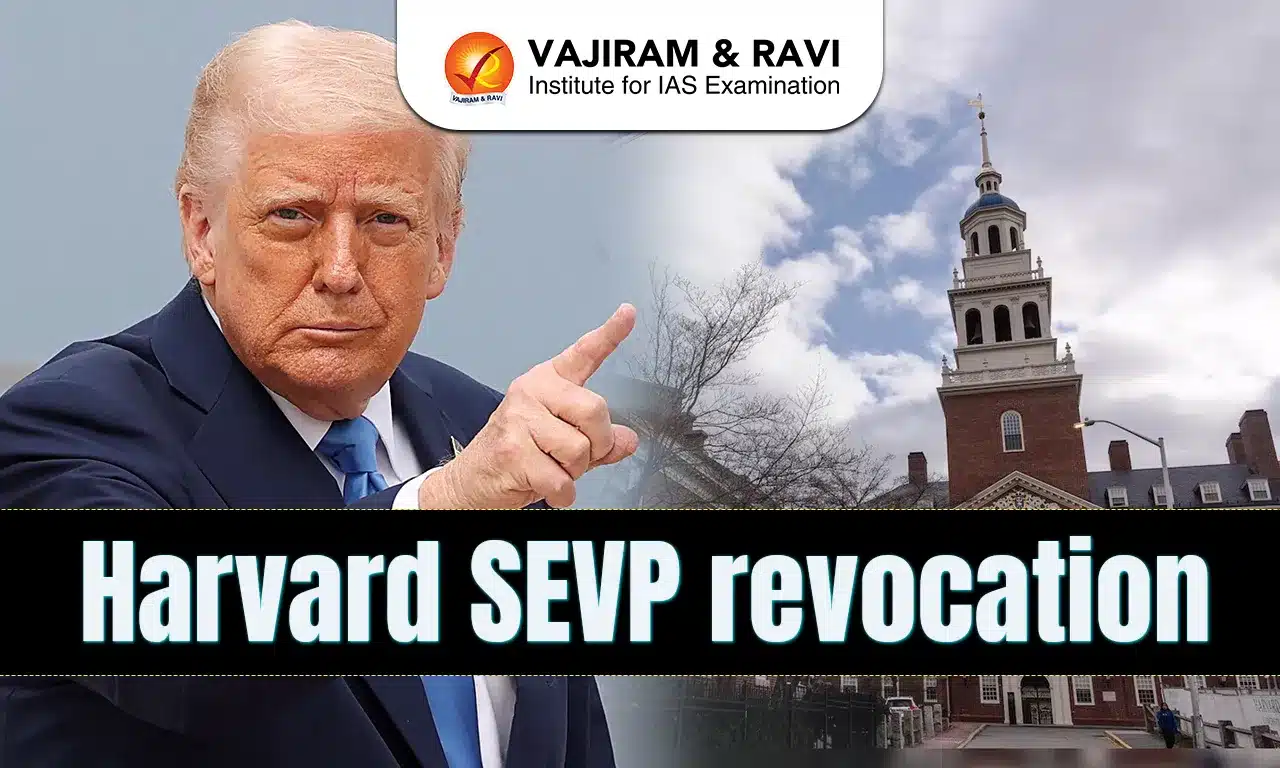
Trump Blocks Harvard’s International Admissions: SEVP Certification Revoked

Harvard SEVP revocation

Harvard SEVP Revocation Latest News

  • A US federal judge temporarily blocked the Trump administration’s move to revoke Harvard University’s ability to enrol international students, just a day after the policy was announced. 
  • Harvard called the Trump administration’s decision unconstitutional and warned of its severe impact on the university and its global student body. The conflict began when Harvard refused the administration’s demands to alter its hiring, admissions, and curriculum policies.

Student and Exchange Visitor Program (SVEP)

  • SEVP (Student and Exchange Visitor Program) certification, issued by the U.S. Department of Homeland Security (DHS), allows educational institutions to enrol international students holding F-1, M-1, or J-1 visas.
    • The F-1 visa is for students attending accredited U.S. colleges or universities, or studying English at an accredited institute. 
    • The M-1 visa is for students enrolled in non-academic or vocational programs. 
    • The J-1 visa is for exchange visitors participating in educational and cultural exchange programs.
  • Without SEVP certification, institutions cannot issue Form I-20 — a crucial document required for international students to obtain and maintain legal student status in the U.S.

Revocation of Harvard’s SEVP Certification: Reasons and Allegations

  • Allegations by the DHS
    • The U.S. Department of Homeland Security (DHS) accused Harvard of:
      • Creating an “unsafe” environment for Jewish students
      • Promoting “pro-Hamas sympathies”
      • Implementing “racial” diversity, equity, and inclusion (DEI) policies
      • Allegedly coordinating with the Chinese Communist Party
  • Official Statement by DHS
    • As per the Homeland Security, enrolling international students is “a privilege, not a right”.
    • Harvard lost its SEVP certification for “failing to adhere to the law.”
  • Conditions for Reinstatement
    • DHS gave Harvard 72 hours to comply with six conditions, demanding:
      • Records of illegal, violent, or threatening activity by non-immigrant students over the past five years
      • Evidence of any deprivation of rights involving non-immigrant students
      • Disciplinary records of all non-immigrant students
      • Audio/video footage of protest activity involving non-immigrant students
    • These demands aim to assess Harvard’s compliance with federal regulations regarding campus safety and foreign student oversight.

Impact on Harvard’s International Students

  • Students Currently Affected
    • The decision impacts 6,793 international students currently enrolled at Harvard. 
    • If the restraining order is lifted, these students may be forced to transfer to other U.S. institutions or leave the country.
  • Visa and Departure Rules
    • F-1 visa holders typically have a 60-day grace period after completing their studies.
    • J-1 visa holders are granted 30 days.
    • If student status is terminated due to a violation, departure may be required immediately.
  • Uncertainty Around Grace Period
    • It is unclear how much time DHS would allow Harvard students to transition. Experts believe those graduating soon may be granted some leeway.
  • Future Admissions Blocked
    • With SEVP certification revoked, DHS may deny visas to students intending to enroll at Harvard, effectively halting new international admissions.

Impact on Harvard University

  • Major Financial Loss
    • International students are a key revenue source for Harvard, paying higher tuition and fees without federal aid. 
    • For the 2024–25 academic year, each student contributes approximately $82,866. 
    • With 6,793 international students, the estimated annual revenue from them is around $562 million.
  • Growing International Presence
    • Over the last four years, the number of international students at Harvard has grown by 26.75%. 
    • As of September 2024, students came from 146 countries, with China, Canada, and India accounting for 40% of the total international student population.
  • Broader Economic Impact
    • Beyond Harvard, international students significantly benefit the U.S. economy. 
    • As per a report, in 2023–24, they contributed approximately $43.8 billion through tuition, fees, and living expenses.

Why the Trump Administration Is Targeting Harvard and Other Elite Universities

  • Executive Order on Campus Free Speech
    • In March 2025, President Trump signed an executive order on campus free speech — which he deemed a “historic action to defend American students and American values” that have “been under siege” on campuses.
  • Campus Protests as a Trigger
    • The order followed nationwide student protests against Israel’s war in Gaza, which the administration claimed led to harassment of Jewish students, prompting federal intervention.
  • Long-Standing Conservative Grievances
    • The administration’s actions also stem from deeper ideological tensions. 
    • For decades, conservatives have accused elite universities of:
      • Promoting liberal bias and marginalising conservative voices
      • Overemphasising diversity, equity, and inclusion (DEI) initiatives
      • Acting as strongholds of “wokeness” that conflict with traditional American values
  • Wider Crackdown on Elite Institutions
    • Harvard is not alone. Other prestigious universities like Brown, Cornell, and Columbia have also faced scrutiny, reflecting a broader conservative effort to reshape higher education policies and culture.

Harvard SEVP Revocation FAQs

Q1. Why did Trump revoke Harvard’s SEVP certification?

Ans. DHS cited unsafe campus conditions and political concerns, including Harvard’s refusal to change policies on diversity and hiring.

Q2. What is SEVP certification?

Ans. It allows U.S. universities to enroll international students and issue I-20 forms required for visa and legal student status.

Q3. How are international students affected?

Ans. They risk deportation or forced transfers if Harvard’s certification is permanently revoked, affecting visa and legal status.

Q4. What’s the financial impact on Harvard?

Ans. Harvard stands to lose around $562 million annually from 6,793 international students if SEVP is not reinstated.

Q5. Why is the administration targeting Harvard?

Ans. Long-standing conservative resentment over liberal bias, DEI policies, and recent pro-Palestine campus protests triggered federal scrutiny.

Source: IE | IE | HT

INSPIRE Scheme

INSPIRE Scheme

INSPIRE Scheme Latest News

Research scholars across India have raised concerns over non-receipt of INSPIRE fellowships funded by the Department of Science and Technology (DST) for periods ranging from 8 to 13 months.

About INSPIRE Scheme

  • The INSPIRE Scheme (Innovation in Science Pursuit for Inspired Research) is a flagship initiative of the Department of Science and Technology (DST), Ministry of Science and Technology.
  • It was launched in 2008 with a vision to build a critical human resource base that can strengthen India’s Science & Technology and R&D ecosystem.
  • Unlike competitive scholarship schemes, INSPIRE does not conduct any entrance examinations. It instead relies on merit-based identification through existing academic performance metrics.

What is the INSPIRE Fellowship?

  • The INSPIRE Fellowship is a component of the DST’s INSPIRE (Innovation in Science Pursuit for Inspired Research) scheme, launched in 2008 to promote research careers in basic sciences.
  • The scheme aims to nurture talent and attract top-performing students to scientific research rather than more lucrative careers in engineering, IT, or finance.
  • Annually, about 1,000 scholars are selected for the fellowship based on academic merit and the quality of their research proposals.

Eligibility for INSPIRE Fellowship

  • Must be a first-rank holder in postgraduate courses in science, applied sciences, or engineering, OR
  • An INSPIRE scholar with at least 70% aggregate marks through UG and PG and previously in the top 1% of Class XII board exams or top performers in national level exams like IIT-JEE.
  • screening committee evaluates the research proposal before awarding the fellowship.

Key Features of the INSPIRE Scheme

  • Implemented by DST with a total outlay of ₹1,979 crore in the 11th Plan and ₹2,200 crore in the 12th Plan.
  • Aims to build a human resource base in basic and natural sciences.
  • Comprises three components:
    • SEATS (Scheme for Early Attraction of Talent) – For school students to foster interest in science.
    • SHE (Scholarship for Higher Education) – For undergraduate and postgraduate science students.
    • AORC (Assured Opportunity for Research Careers) – Includes INSPIRE Fellowships and Faculty Awards.

INSPIRE Scheme FAQs

Q1: What does INSPIRE stand for?
Ans: INSPIRE stands for "Innovation in Science Pursuit for Inspired Research", a flagship scheme by the Department of Science & Technology (DST), Government of India.

Q2: What is the objective of the INSPIRE Scheme?
Ans: The scheme aims to attract talented students to science from an early age and nurture future scientific manpower for research and innovation.

Q3: What are the major components of the INSPIRE Scheme?
Ans: The scheme has three components: (1) INSPIRE Award (for school students), (2) Scholarship for Higher Education (SHE), and (3) INSPIRE Fellowship (for doctoral studies).

Source: TH

Alicella gigantea

Alicella gigantea

Alicella gigantea Latest News

New findings reveal that the rare giant shrimp gigantea is widespread, occurring in 59% of the world’s oceans.

About Alicella gigantea

  • Alicella gigantea is a giant amphipod crustacean that can grow up to 34 cm in length, making it one of the largest deep-sea amphipods ever recorded.
  • It was long considered extremely rare, with few sightings since its discovery. A major early sighting involved a 28 cm specimen at 5,304 m depth in the North Pacific, but it remained unidentified for years.

Taxonomy and Habitat

  • Amphipods are shrimp-like crustaceans with over 10,000 known species, commonly found in a wide range of aquatic environments.
  • A. gigantea thrives in deep-sea zones, including:
    • Abyssal depths (3,000–6,000 m), and
    • Hadal zones (>6,000 m).
  • It was found at depths up to 6,746 m in areas such as the Murray Fracture Zone in the North Pacific.

Global Distribution and Dataset

  • The new research compiled 195 records of A. gigantea from 75 locations across the Pacific, Atlantic, and Indian Oceans, covering 15 different seafloor features.
  • This data establishes A. gigantea as a globally distributed species, not a localised rarity.
  • The Pacific Ocean emerged as the species’ most significant habitat, with 75% of its seafloor area falling within the suitable depth range for the species.

Alicella gigantea FAQs

Q1: What is Alicella gigantea?
Ans: Alicella gigantea is a species of deep-sea amphipod, known for being among the largest amphipods ever recorded, found in the deepest parts of the ocean, including the Mariana Trench.

Q2: How deep is the habitat of Alicella gigantea?
Ans: This species lives at depths of 6,000 to 10,000 meters, making it one of the deepest-dwelling amphipods known to science.

Source: PHY

Binary Star System

Binary Star System

Binary Star System Latest News

A large team of astronomers and astrophysicists affiliated with several institutions in China recently discovered a binary star system, where one of the stars is a millisecond pulsar and the other is made mostly of helium.

About Binary Star System

  • A binary star is a system of two gravitationally bound stars that orbit a common center of mass called a barycenter. 
  • Stars in a binary system do not necessarily have the same mass, size, or brightness. 
  • The larger star of a binary couple is called the primary star, while the smaller one is known as the secondary star or the companion star.
  • Binary stars are double stars, but not all double stars are binary stars. 
    • This is because some double stars comprise two stars close enough in the sky over Earth to appear as a single point of light, but they are actually vastly separated in space and not part of a gravitationally bound binary system–these are called optical doubles.
  • Unlike the sun, the vast majority of stars have a binary partner. It is estimated that around 85% of stars exist in binary star systems or systems with three or more stars. 
  • Binary star systems can also include systems containing a normal star and a stellar remnant, an object that forms when a star runs out of the fuel for nuclear fusion and collapses under its own gravity. 
    • These dense and compact star "corpses" can include white dwarfs, neutron stars, and black holes. 
    • Especially ancient binary systems can contain two stellar remnants orbiting each other. 
  • In some binary systems, the stars are so close together that they exchange material. This mass transfer occurs when the radius of one star is not much smaller than the orbital separation between the stars.

Binary Star System FAQs

Q1: What is a binary star system?

Ans: It is a system of two gravitationally bound stars that orbit a common center of mass called a barycenter. 

Q2: What is the common center of mass around which binary stars orbit called?

Ans: Barycenter

Q3: When can mass transfer occur between stars in a binary system?

Ans: When the radius of one star is not much smaller than the orbital separation between the stars.

SourcePHYS

Asian Productivity Organisation (APO)

Asian Productivity Organisation (APO)

Asian Productivity Organisation Latest News

India has formally assumed the Chairmanship of the Asian Productivity Organization (APO) for the 2025-26 term during the ongoing 67th Session of the Governing Body Meeting of the organisation.

About Asian Productivity Organisation

  • It is a regional intergovernmental organization established in 1961 to increase productivity in the Asia-Pacific region through mutual cooperation. 
  • The APO contributes to the sustainable socioeconomic development of the region through policy advisory services,acting as a think tank, and undertaking smart initiatives in the industry, agriculture, service, and public sectors.
  • The APO is shaping the future of the region by assisting member economies in formulating national strategiesfor enhanced productivity and through a range of institutional capacity-building efforts, including research and centers of excellence in members. 
  • It is nonpoliticalnonprofit, and nondiscriminatory.
  • APO membership is open to countries in Asia and the Pacificthat are members of the United Nations Economic and Social Commission for Asia and the Pacific (UN ESCAP). 
  • The current membership is 21 economies, comprising Bangladesh, Cambodia, Republic of China, Fiji, Hong Kong, India, Indonesia, Islamic Republic of IranJapan, Republic of Korea, Lao PDR, Malaysia, Mongolia, NepalPakistan, Philippines, Singapore, Sri Lanka, Thailand, Türkiye, and VietnamIndia is a founding member of APO.
  • These countries/economies support each other in their productivity drives in a spirit of mutual cooperation by sharing knowledge, information, and experience and coordinate with the APO through the designated national productivity organizations (NPOs).
  • Headquarters: Tokyo, Japan
  • Organisational Structure:
    • APO is composed of the governing body, the NPOs, and the secretariat, which is headed by a secretary-general. 
    • The Governing Body is the APO's highest decision-making authority and meets annually to set the organisation's strategic direction, approve major proposals, and review Secretariat performance.

Asian Productivity Organisation FAQs

Q1: When was the Asian Productivity Organisation (APO) established?

Ans:1961

Q2: What is the highest decision-making authority within the APO?

Ans: The Governing Body is the APO's highest decision-making authority and meets annually.

Q3: Where is the headquarters of the Asian Productivity Organization?

Ans: Tokyo, Japan

SourceNOA

RBI Dividend

RBI Dividend

RBI Dividend Latest News

The Reserve Bank of India (RBI) has approved the transfer of a ₹2.69 lakh crore surplus to the Union Government as dividend for the financial year 2024-25.

What is a Dividend in Public Finance?

  • dividend refers to a portion of profits returned by a corporation or institution to its shareholders; in the case of the RBI, the Government of India is the sole shareholder.
  • Dividends are a non-tax revenue source for the government and help in bridging fiscal deficits.
  • RBI dividends are governed by the Reserve Bank of India Act, 1934 and are subject to approval by the RBI Central Board.
  • Dividend Yield measures the return from dividends relative to the stock price, calculated as:
    • Dividend Yield = (Annual Dividend per Share) / (Current Market Price of Share)
  • Although private dividends require shareholder approval, RBI’s transfer is a policy-based institutional mechanism.

Why Did RBI Earn Higher Surplus in 2024-25?

  • The higher surplus in 2024-25 is attributed to:
    • Increased sale of foreign exchange reserves, especially in January 2025, when the RBI was the top seller among Asian central banks.
    • Higher interest income from investments in government securities and foreign assets.
    • Gains from forex transactions amid volatility in global markets.
  • This is 27% higher than the ₹2.10 lakh crore dividend transferred in the previous year (2023-24), indicating a sharp rise in RBI’s earnings.
  • The transferable surplus was calculated as per the Revised Economic Capital Framework (ECF), approved on May 15, 2025.
  • The ECF determines how much surplus RBI can safely transfer while keeping enough capital to absorb financial shocks.

RBI Dividend FAQs

Q1: What is the RBI Dividend?
Ans: RBI Dividend refers to the surplus profit that the Reserve Bank of India transfers to the Central Government, after meeting its operational expenses and contingency provisions.

Q2: Under what legal provision does RBI transfer dividends?
Ans: The transfer is made under Section 47 of the RBI Act, 1934, which mandates that any surplus from RBI's operations be transferred to the Government.

Source: TH

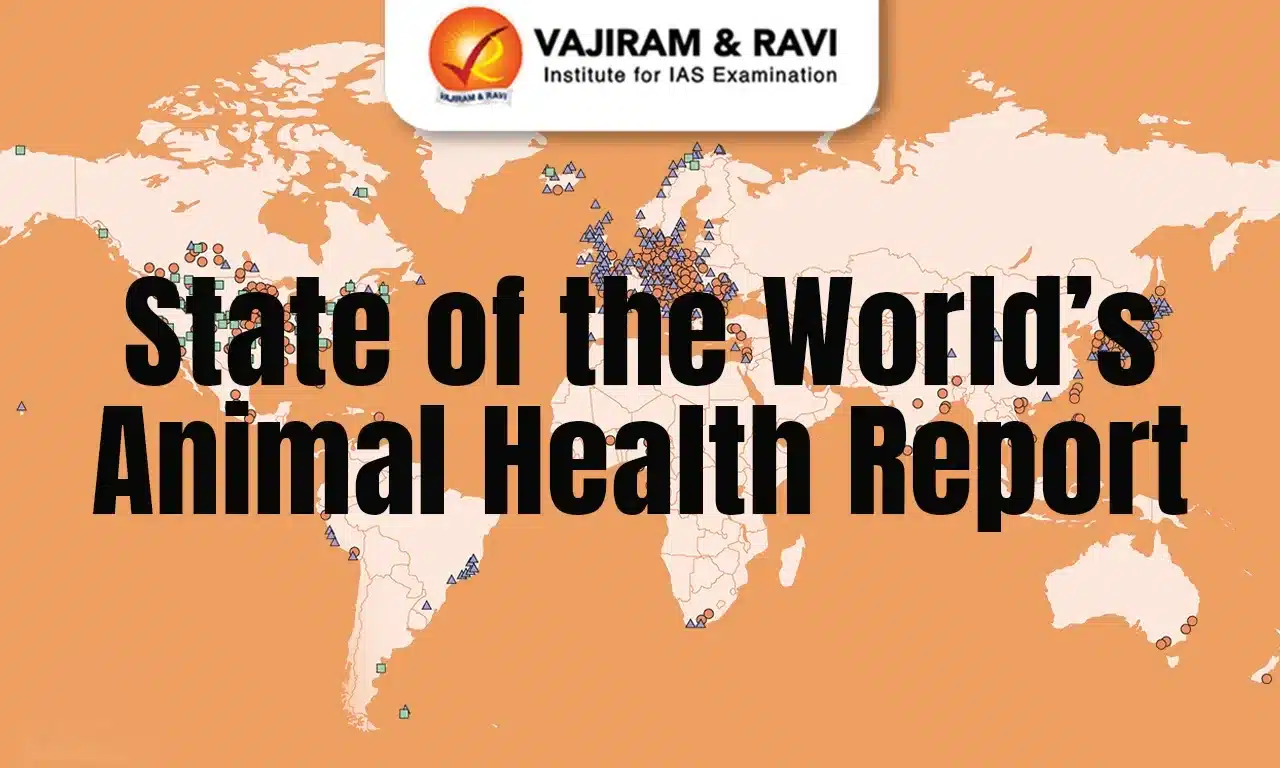
State of the World’s Animal Health Report

State of the World’s Animal Health Report

State of the World’s Animal Health Report Latest News

Infectious animal diseases are spreading to previously unaffected regions and species, with nearly half (47 percent) capable of zoonotic transmission according to the inaugural State of the World’s Animal Health report released by the World Organisation for Animal Health (WOAH) recently.

About State of the World’s Animal Health Report:

  • It is released by the World Organisation for Animal Health (WOAH).
  • It provides the first comprehensive review of animal disease trends, risks, and challenges, from the uptake and availability of vaccines to the use of antibiotics in animals.

Highlights of the State of the World’s Animal Health Report:

  • Infectious animal diseases are spreading to previously unaffected regions and species, with nearly half (47 percent) capable of zoonotic transmission.
  • Bird flu, or high pathogenicity avian influenza (HPAI), which has caused the culling or loss of more than 630 million birds in the last two decades, was one of several animal diseases to affect new areas last year.
  • Peste des petits ruminants (PPR), which has traditionally affected sheep and goats in developing countries, has re-emerged in Europe while African swine fever (ASF) reached Sri Lanka, travelling more than 1,800 km from the nearest outbreaks.
  • In 2024, there were a further 3,517 cases of Bluetongue, an insect-borne virus that spreads among livestock, in 23 countries, while Germany experienced its first outbreak of foot-and-mouth disease since 1988.
  • In Mexico, vets reported the first case of New World screwworm, a parasitic fly whose larvae eat the flesh of warm-blooded animals. The disease has also re-emerged in Nicaragua. 
  • Almost half of the WOAH-listed diseases notified to WOAH between 2005 and 2023 were considered a threat to human health with zoonotic, or animal-to-human infection, potential.
  • The report cited climate change and increased trade among the factors influencing the spread and prevalence of animal diseases. 
  • Many are preventable through a combination of vaccination, improved hygiene, and biosecurity measures, but the report noted that access to animal vaccines remains uneven around the world.
  • The report also emphasised the importance of disease prevention for reducing the need for antibiotic treatment andlimiting the development of drug-resistant diseases.
  • By 2050, antimicrobial resistance (AMR) is projected to cause livestock losses that jeopardise the food security of two billion people and result in a US$ 100 trillion economic loss if urgent action is not taken.
  • Antimicrobial use, including antibiotics, in animals fell five percent between 2020 and 2022, with use in Europe seeing the biggest decline of 23 percent, followed by Africa at 20 percent. 
  • However, one in five countries continues to use antimicrobials as growth promoters, which is discouraged by WOAH.

What is the World Organisation for Animal Health (WOAH)?

  • The WOAH, formerly known as the Office International des Epizooties (OIE), is an intergovernmental organization that focuses on improving animal health worldwide. 
  • It was founded in 1924 in response to rinderpest outbreaks in livestock. 
  • It was renamed as WOAH in 2022 to reflect its global role in animal health. 
  • WOAH’s primary objective is to protect the health of animals and to ensure a safe and fair trade in animals and animal products worldwide, by ensuring transparency in the global animal disease situation and by publishing health standards for international trade. 
  • WOAH is recognised as a reference organisation by the World Trade Organization (WTO) for international standards relating to animal health and zoonoses. 

State of the World’s Animal Health Report FAQs

Q1: Who releases the "State of the World’s Animal Health Report"?

Ans: World Organisation for Animal Health (WOAH)

Q2: What percentage of infectious animal diseases have zoonotic potential according to the report?

Ans: 47%

Q3: Which highly contagious disease has caused the culling of over 630 million birds in the last two decades?

Ans: High Pathogenicity Avian Influenza (HPAI)

SourceDTE

Bharat Seva Kendra (BSK)

Bharat Seva Kendra (BSK)

Bharat Seva Kendra Latest News

The Chamber of Commerce and Industry of India (CCI India) recently said Bharat Seva Kendra (BRK) is helping to bridge the urban-rural divide by bringing essential services at the doorstep of every citizen.

About Bharat Seva Kendra

  • It is a nationwide initiative launched by the Chamber of Commerce and Industry (CCI) of India.
  • It is aimed at providing various government services and benefits to villagers in India.
  • These centers serve as a one-stop solution for accessing government schemes, services, and information in rural areas.
  • Designed as a grassroots movement, BSK is backed by a network of 2.5 lakh sarpanches and 6.5 lakh BSK Sarthis. 
  • These individuals will act as on-ground facilitators, linking rural citizens directly with welfare schemes related to financial aid, healthcare, education, employment, digital empowerment, and agriculture.
  • At the core of the initiative is the goal of cutting down bureaucratic delays by offering a single-window platform for government programs. 
  • A key feature of BSK is its emphasis on digital inclusion. 
    • Equipped with modern infrastructure, these centers offer digital literacy programs, enabling villagers to interact with technology and avail themselves of e-governance services seamlessly. 
  • By working closely with both central and state governments, BSK aims to streamline service delivery and eliminate the barriers that often prevent rural citizens from benefiting from welfare schemes.

Chamber of Commerce and Industry (CCI) India

  • CCI India is a national-level autonomous business organization with clear objectives for the business expansion through policy advocacy, business matchmaking, and making the environment conducive for the investors.
  • It is the voice of India's business and industry. 
  • From influencing policy to encouraging debate, engaging with policymakers and civil society, CCI India articulates the views and concerns of industry. 
  • It serves its members from the Indian private and public corporate sectors and multinational companies, drawing its strength from diverse regional chambers of commerce and industry across states.
  • It acts as a catalyst for global companies to expand their business and smoothen operations in India and vice versa through joint ventures and market intelligence.

Bharat Seva Kendra FAQs

Q1: What is the primary objective of the Bharat Seva Kendra (BSK) initiative?

Ans: Providing government services and welfare schemes to rural citizens.

Q2: Who launched the Bharat Seva Kendra (BSK) initiative?

Ans: Chamber of Commerce and Industry (CCI) India

Q3: What is the main role of sarpanches and BSK Sarthis in the Bharat Seva Kendra initiative?

Ans: Acting as facilitators linking citizens with welfare schemes.

SourceTH

Enquire Now