Draft Space Activities Bill Finalised

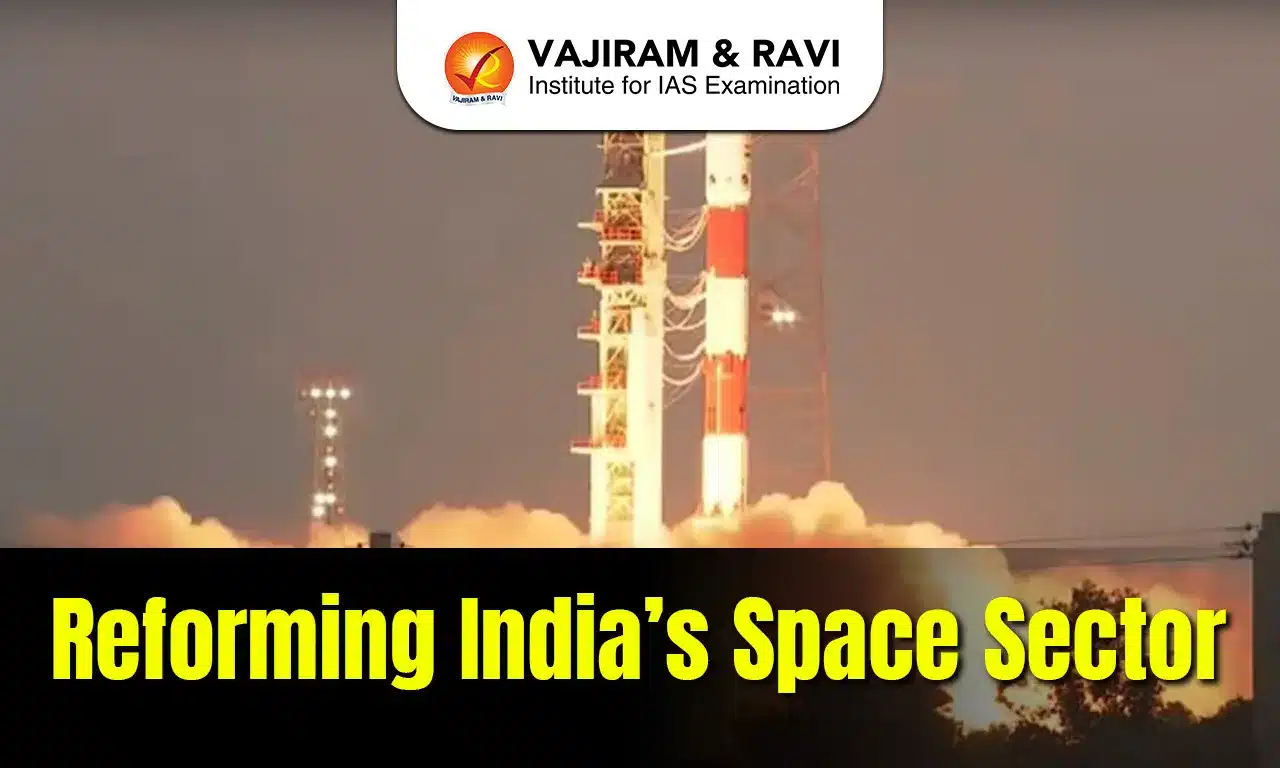
Reforming India’s Space Sector

Reforming India’s Space Sector Latest News

  • India is finalising a new Space Activities Bill, aimed at establishing a legal framework for private participation in the space sector and granting statutory authority to IN-SPACe (Indian National Space Promotion and Authorisation Centre). 
  • The bill reflects evolving needs in the wake of increasing private sector involvement and international obligations

Background and Need for the Bill

  • Previous attempts and policy evolution:
    • First draft in 2017: Circulated for public comments but not finalised or introduced in Parliament.
    • IN-SPACe: Established in 2020 to promote private participation.
    • Indian Space Policy 2023: Outlines roles and responsibilities of different entities in the Indian space sector.
  • Current developments: The new draft bill, which is now ready for circulation among stakeholder ministries, integrates past suggestions and addresses the growing complexity of private space activities.

Purpose and Key Objectives of the Draft Bill

  • Statutory empowerment of IN-SPACe:
    • Currently, IN-SPACe operates without statutory authority.
    • The bill will provide legal backing for authorisation and regulation of private space companies.
  • Regulatory necessity:
    • India, being party to international treaties (like the Outer Space Treaty, 1967), is accountable for all space activities under its jurisdiction.
    • Proliferation of private players necessitates legislation to regulate space activities.

Provisions and Changes in the Draft Bill

  • Revised from 2017 version:
    • Earlier provisions have been amended based on industry feedback.
    • These include - 
      • 3-year imprisonment and Rs 1 crore fine for offences such as carrying out a space activity without a license, furnishing false information, or polluting the outer space.
      • Any intellectual property right created in outer space would belong to the government.
    • The bill now reflects a more enabling, industry-friendly framework.
  • Insurance for space assets:
    • Currently, the cost of insuring space assets and space activities is very high, making them unaffordable for upcoming start-ups.
    • The bill aims to include provisions for accessible and affordable insurance, critical for start-ups and new entrants.

Economic Goals and Projections

  • India’s space economy targets:
    • Current space economy: $8.4 billion (2022).
    • Target for 2033: $44 billion, with $11 billion from exports.
  • Significance of the bill: It is seen as a catalyst for growth and investment in the space sector.

Consultation and Approval Process

  • After the internal consultation with the stakeholder ministries, the draft bill will be sent for a wider consultation to different ministries and then shared with the general public
  • The final draft will go to the minister in-charge, which is the Prime Minister (PM) in this case. 
  • Once it is approved, it will go to the cabinet and then the parliament

State-Level Initiatives

  • Decentralised space manufacturing: Aim is to set up 4-5 manufacturing hubs initially, with IN-SPACe’s guidance.
  • State policies and specialisation:
    • Three states have released their own space policies - Tamil Nadu (focus on launch vehicles), Gujarat (focus on satellites and payload), and Karnataka (general hub due to the existing ecosystem in Bengaluru). 
    • IN-SPACe is also in talks with Maharashtra and possibly other states to set up such manufacturing hubs.

Conclusion

  • The new draft Space Activities Bill represents a crucial legislative advancement towards modernising India’s space governance, unlocking private sector potential, and meeting global responsibilities. 
  • It promises to make India a major player in the global space economy by fostering innovation, investment, and regulatory clarity.

Reforming India’s Space Sector FAQs

Q1. What is the primary objective of the new draft Space Activities Bill in India?

Ans. The primary objective is to provide a comprehensive legal framework for regulating private sector participation in India's space sector and to grant statutory powers to IN-SPACe.

Q2. Why is a legal framework necessary for space activities in India despite the Indian Space Policy 2023?

Ans. A legal framework is necessary to fulfill India’s international treaty obligations and ensure accountability for space activities conducted within its jurisdiction.

Q3. How does the draft bill address the concerns of the private space industry regarding insurance?

Ans. The bill includes provisions to enable accessible and affordable insurance for high-value space systems, a key demand of private players.

Q4. What role will state governments play under the new space ecosystem proposed in the bill?

Ans. State governments will establish space manufacturing hubs with specialisations, supported by incentives from the Centre through IN-SPACe.

Q5. What are the economic targets associated with India’s space sector as envisioned in the draft bill?

Ans. The bill supports India’s ambition to grow its space economy to $44 billion by 2033, including $11 billion in exports.

Source: IE
PM Modi Urges States to Act as ‘Team India’ at NITI Aayog Meet

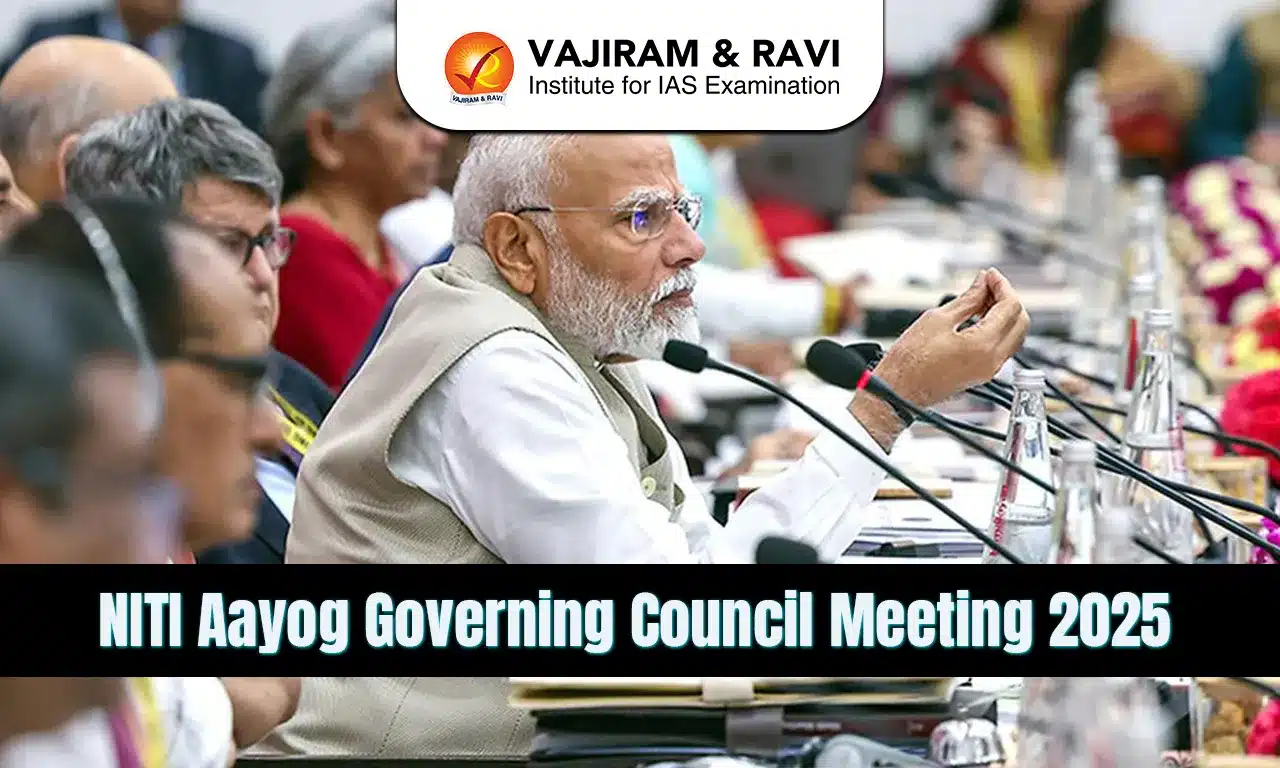
NITI Aayog Governing Council Meeting 2025

NITI Aayog Latest News

  • The 10th meeting of the Governing Council of NITI Aayog, chaired by Prime Minister Narendra Modi, was recently held in New Delhi. 

About NITI Aayog

  • The NITI Aayog (National Institution for Transforming India) is the premier policy think tank of the Government of India, established in 2015 to replace the Planning Commission
  • Its primary mandate is to promote cooperative federalism, facilitate evidence-based policymaking, and guide India’s long-term developmental strategy toward achieving Viksit Bharat @2047.
    • Functions of NITI Aayog
      • Formulating strategic and long-term policy frameworks.
      • Coordinating between the Centre and states.
      • Encouraging innovation, technology-driven governance, and sustainable development.
      • Monitoring implementation of key national programmes.

Governing Council of NITI Aayog

  • The Governing Council is the apex decision-making body of NITI Aayog. It is chaired by the Prime Minister of India and comprises:
    • Chief Ministers of all states and Union Territories with legislatures.
    • Lieutenant Governors of other UTs.
    • Union Ministers for key portfolios.
    • Vice-Chairperson and senior officials of NITI Aayog.
  • This council meets annually to discuss key policy issues, align Centre-state priorities, and foster a collaborative approach to India's growth and development. 
  • It plays a crucial role in strengthening “Team India” spirit across different levels of government.

Highlights of PM Narendra Modi’s Address

  • Focus on Viksit Bharat @2047
    • PM Modi began by emphasizing the shared goal of making India a “Viksit Bharat” (developed nation) by 2047. 
    • He encouraged each state to align its developmental agenda accordingly, ensuring that every state, city, municipal body, and village transforms into a 'Viksit' unit.
  • Team India Approach
    • The Prime Minister underscored the importance of Centre-state collaboration. “If the Centre and states work together like Team India, no goal is impossible,” he stated. 
    • He advocated for coordinated planning across sectors such as infrastructure, services, governance, and innovation.
  • Modernising Civil Preparedness
    • Reflecting on Operation Sindoor and national security concerns, PM Modi emphasized that such efforts should not be one-time responses. 
    • He urged states to institutionalize civil defence mechanisms and enhance disaster resilience capabilities.

Strategic Recommendations by the PM

  • Leverage Free Trade Agreements (FTAs)
    • PM Modi advised states to strategically use India’s new FTAs to boost local manufacturing and exports. He called for an investor-friendly regulatory environment and proposed removing outdated laws to attract global investments.
  • Tourism Development
    • PM Modi proposed the “One State, One Global Destination” initiative. Each state should develop at least one world-class tourist hub with comprehensive infrastructure. This would catalyse both direct tourism revenue and the development of nearby cities.
  • Urban and Workforce Reforms
    • In response to rapid urbanisation, the Prime Minister stressed the need for future-ready cities built on principles of sustainability, innovation, and resilience. He also called for reforms to integrate more women into the workforce, urging states to craft gender-sensitive laws and policies.

Key State-Level Inputs and Demands

  • Tamil Nadu’s Tax Revenue Demand
    • Chief Minister M.K. Stalin demanded that states receive a 50% share in central taxes, up from the current 33.16%. He also urged for:
      • A dedicated urban transformation mission like AMRUT 2.0.
      • A Clean-Ganga-style river rejuvenation mission for Tamil Nadu rivers such as Cauvery and Vaigai.
  • Andhra Pradesh’s Sub-Group Proposal
    • CM N. Chandrababu Naidu proposed forming three sub-groups of states to work with the Centre:
      • GDP Growth and Investments
      • Population Management
      • Technology-Driven Governance (using AI, drones, digital platforms)
  • Chhattisgarh’s 3T Model
    • CM Vishnu Deo Sai proposed a 3T (Technology, Transparency, Transformation) development model under the “Chhattisgarh Anjor Vision Document”. It targets:
      • Tenfold increase in per capita income.
      • Doubling GSDP in five years.
      • Naxal-free Chhattisgarh by March 2026.
  • Punjab’s Concerns on Water and Borders
    • CM Bhagwant Mann raised Punjab’s claim over Yamuna river waters and demanded:
      • Inclusion of border villages in the Vibrant Villages Programme.
      • More funds for anti-drug initiatives and border security.
      • Reversal of perceived “step-motherly treatment” by the Centre.

NITI Aayog Meeting FAQs

Q1. What is the Governing Council of NITI Aayog?

Ans. It is NITI Aayog’s top decision-making body comprising the PM, CMs, LGs, and Union Ministers.

Q2. What was the theme of the 10th Governing Council meeting?

Ans. The theme was “Viksit Rajya for Viksit Bharat @2047.”

Q3. What reforms did PM Modi urge states to implement?

Ans. Modi called for leveraging FTAs, removing obsolete laws, boosting tourism, and increasing women’s workforce participation.

Q4. What was Tamil Nadu’s key demand at the meeting?

Ans. Tamil Nadu demanded a 50% share in central taxes and a Clean-Ganga-style mission for its rivers.

Q5. How many state leaders attended the 2025 NITI Aayog meeting?

Ans. 31 out of 36 CMs and LGs attended the meeting, marking record participation.

Source: TH | IE | TOI

India-Bangladesh Trade Tensions: Regional Impact of Land Port Closures

India-Bangladesh Land Port Closure

India-Bangladesh Land Port Closure Latest News

  • Recently, India’s Directorate General of Foreign Trade ordered the closure of all land ports with Bangladesh for the export of apparel and certain goods via northeastern ports. 
  • The move is seen as a consequence of deteriorating India-Bangladesh relations following the fall of the Hasina government in August, with both countries yet to rebuild a functional diplomatic rapport.

Key Highlights of the May Trade Order on Bangladesh

  • Import Restrictions via Land Ports
    • India has halted the import of readymade garments from Bangladesh through all land ports. 
    • Imports are now only permitted via Nhava Sheva and Kolkata seaports.
  • Export Bans to Bangladesh through the Northeast
    • Exports of specific goods have been banned through the land ports of Assam, Meghalaya, Mizoram, and Tripura.
    • These include fruits, fruit-flavoured drinks, processed food items (like baked goods, chips, and confectionery), cotton and cotton yarn waste, finished plastic and PVC goods (excluding pigments, dyes, plasticisers, and granules), and wooden furniture.
  • Additional Land Routes Affected
    • The same export restrictions apply at the Changrabandha and Fulbari land customs stations in West Bengal.
  • Exemptions from the Ban
    • Imports of fish, LPG, edible oil, and crushed stone from Bangladesh remain unaffected by the order.

Reasons Behind India’s Trade Restrictions on Bangladesh

  • Call for Reciprocity in Trade
    • India cited the need to ensure reciprocal trade relations after Bangladesh took unilateral steps affecting Indian exports.
  • Bangladesh's Restrictions Triggered Response
    • On April 13, Bangladesh’s National Board of Revenue banned the import of cotton yarn from India via land ports.
    • It also halted Indian rice exports through the Hili land port in West Bengal.
  • Rising Friction at Border Crossings
    • Indian officials reported that Bangladeshi authorities had been conducting aggressive inspections of Indian trucks for several months, leading to delays and trade disruptions.
  • Scale of Border Trade Affected
    • India and Bangladesh share 24 operational land ports, with several more under development, making these restrictions significant in scope and impact.

India’s Justification for the Trade Restrictions

  • Immediate Implementation with Scope for Review
    • The restrictions, effective from May 17, are subject to regular review. 
    • Even seaport trade with Bangladesh will face increased scrutiny and periodic assessments.
  • Allegations of Trade Imbalance and Market Manipulation
    • Indian officials accused Bangladesh of “cherry-picking” trade issues and attempting to treat the northeast region of India as a “captive market” for its goods, without offering fair access or transit for Indian products.
  • Strategic Importance of the Northeast Region
    • Citing Prime Minister Modi’s remarks, officials emphasized that the northeast is central to India’s BIMSTEC vision and economic strategy. 
    • The move is aimed at encouraging domestic manufacturing and entrepreneurship in the region, in line with the Atmanirbhar Bharat initiative.

Impact on Bangladesh’s Trade with Nepal and Bhutan

  • India’s Assurances on Third-Country Trade
    • India has stated that its order will not affect Bangladesh’s trade with Nepal and Bhutan.
    • Despite India’s claims, the overland trade restrictions are expected to cause logistical hurdles, leading to delays and disruptions in shipments from Bangladesh to Nepal.
  • Ripple Effect on Investment Climate
    • The sudden order has created uncertainty, prompting investment planners to adopt a cautious approach towards entering or expanding operations in Bangladesh.

Wider Geopolitical Undercurrents Behind India’s Land Port Closure

  • A Diplomatic Message to Bangladesh
    • Indian officials have described the land port restrictions as a calculated signal to Bangladesh, particularly in response to remarks made by interim government chief Mohammed Yunus during his visit to China in March.
  • Concerns Over Northeast Region References
    • Prof. Yunus referred to India’s northeast as “landlocked” and promoted Bangladesh as a strategic route for Chinese access to the region, positioning Bangladesh as a “guardian of the ocean.” 
    • India found these remarks unacceptable.
  • Apprehensions About Bangladesh-Pakistan Ties
    • Indian officials also cited growing warmth between Bangladesh’s interim government and Pakistan—an actor India holds responsible for cross-border terrorism—as part of the backdrop to the decision.
  • Economic and Symbolic Impact
    • While the ban on readymade garments affects only a $700 million slice of Bangladesh’s $50 billion exports, India believes it is significant enough to convey its geopolitical concerns to both Bangladesh and the global community.

India-Bangladesh Land Port Closure FAQs

Q1. Why did India shut land ports with Bangladesh?

Ans. India cited lack of trade reciprocity and geopolitical concerns with Bangladesh’s interim government as key reasons.

Q2. What goods were banned in the May 2025 order?

Ans. Apparel, food items, plastic goods, cotton waste, and furniture were restricted via northeastern land ports.

Q3. Will this affect Bangladesh’s trade with Nepal?

Ans. Yes, logistical disruptions from land closures are likely to hamper smooth trade with Nepal.

Q4. How did Bangladesh react to the ban?

Ans. Informally disappointed, Bangladesh criticized lack of communication and expressed concern over garment export losses.

Q5. Is this part of a larger political issue?

Ans. Yes, it responds to controversial remarks by Bangladesh’s interim leader and warming ties with China and Pakistan.

Source: TH

Nagshankar Temple

Nagshankar Temple

Nagshankar Temple Latest News

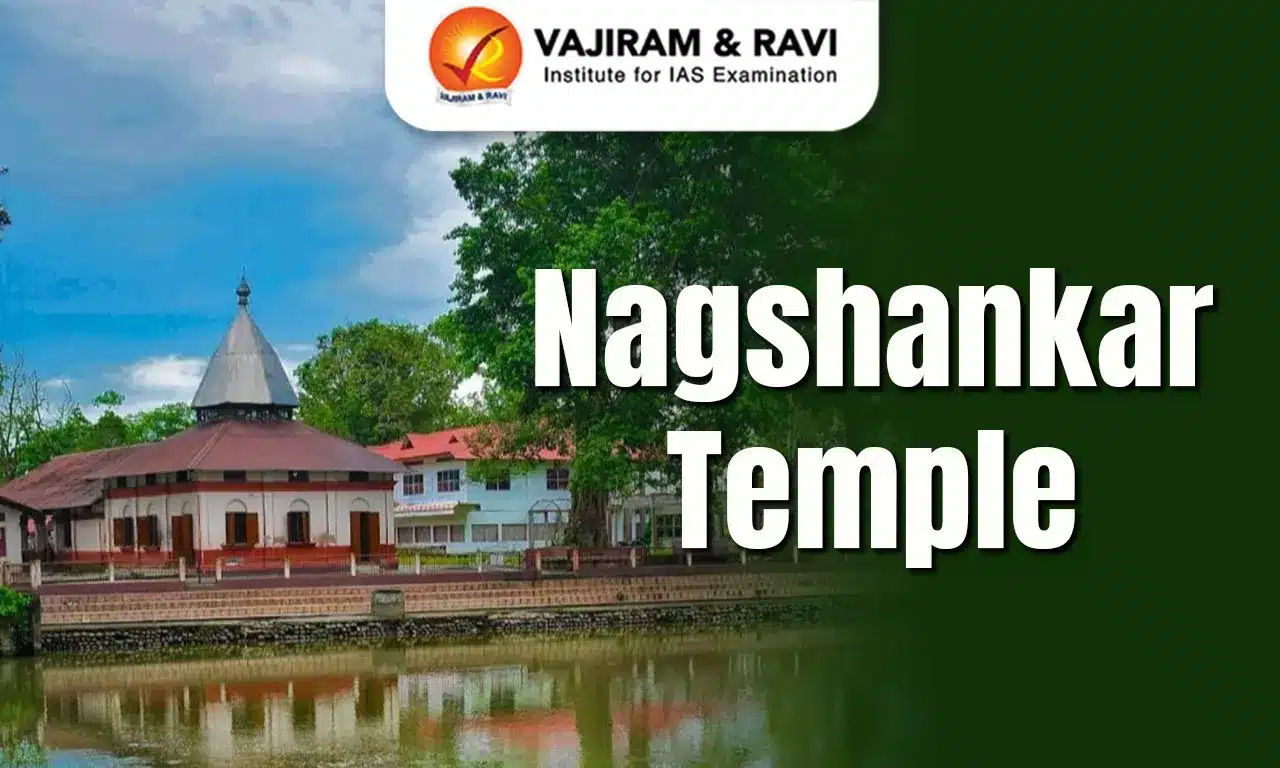
Nagshankar, in northeastern Assam’s Biswanath district, has been designated a model temple for turtle conservation.

About Nagshankar Temple

  • It is an ancient Hindu shrine dedicated to Lord Shiva.
  • It is situated on the north bank of the river Brahmaputra within the administrative district of Biswanath in Assam.
  • It is said to have been built by King Narasankar of Nagakha in the 4th century AD. 
  • Later on it was repaired by Ahom king Su-sen-pha in 1480. 
  • The temple premises feature a large pond, whichhouses 250-300 of the world's rarest species of turtles. 
    • Among the species, black softshell, Indian softshell, and Malayan softshell are found.
    • Some of these turtles are even believed to be hundreds of years old. 
  • Its campus also has animals like peacocks, deer, and pythons.

Nagshankar Temple FAQs

Q1. In which Indian state is the Nagshankar Temple located?

Ans. Assam

Q2. Who is said to have originally built the Nagshankar Temple?

Ans. It is said to have been built by King Narasankar of Nagakha in the 4th century AD. 

Q3. What unique feature does the temple pond contain?

Ans. Rare species of turtles

SourceTH

NITI Aayog

NITI Aayog

NITI Aayog Latest News

The 10th Governing Council Meeting of NITI Aayog was recently held in New Delhi, chaired by the Prime Minister, under the theme “Viksit Rajya for Viksit Bharat@2047”.

About NITI Aayog

  • NITI Aayog is the premier policy think-tank of the Government of India, established through a Union Cabinet resolution in January 2015, replacing the erstwhile Planning Commission.
  • It is neither a Constitutional body nor a statutory body, as it has been created by an executive decision, not through legislation or constitutional amendment.
  • NITI Aayog has a twin mandate:
    • To oversee the adoption, implementation, and monitoring of the Sustainable Development Goals (SDGs) across the country.
    • To promote both competitive and cooperative federalism by enhancing the involvement of States and Union Territories in the development process.

Composition and Organisational Structure

  • The Chairperson of NITI Aayog is the Prime Minister of India.
  • The Governing Council of NITI Aayog includes:
    • The Prime Minister as its head,
    • The Chief Ministers of all States and UTs with legislatures,
    • Lieutenant Governors of other UTs,
    • A maximum of four Union Ministers as ex-officio members, nominated by the Prime Minister,
    • The Vice-Chairperson, appointed by the Prime Minister,
    • Full-time Members of NITI Aayog,
    • Special Invitees (domain experts and specialists) nominated by the Prime Minister.
  • Regional Councils are constituted for specific durations to address particular regional issues affecting more than one state. These councils are:
    • Convened by the Prime Minister, and
    • Comprised of the Chief Ministers and Lt. Governors of the concerned region.
  • The Chief Executive Officer (CEO) of NITI Aayog is:
    • Appointed by the Prime Minister for a fixed tenure,
    • Holds the rank of Secretary to the Government of India.

Key Objectives of NITI Aayog

  • To formulate credible and inclusive development plans at the village level, with a focus on the marginalized and vulnerable sections of society who risk being left out of economic growth.
  • To ensure that national security considerations are integrated into the formulation of economic policies and strategies.
  • To establish a knowledge-driven, innovation-friendly, and entrepreneurial ecosystem that supports long-term sustainable development.
  • To act as a platform for the resolution of inter-sectoral and inter-departmental coordination issues, enabling smoother policy implementation.

NITI Aayog FAQs

Q1. When was NITI Aayog established and what did it replace?
Ans: NITI Aayog was established on 1st January 2015, replacing the Planning Commission of India.

Q2. What is the full form of NITI Aayog?
Ans: National Institution for Transforming India Aayog.

Q3. Who is the Chairperson of NITI Aayog?
Ans: The Prime Minister of India is the ex-officio Chairperson of NITI Aayog.

Source: IE

Tianwen-2 Mission

Tianwen-2 Mission

Tianwen-2 Mission Latest News

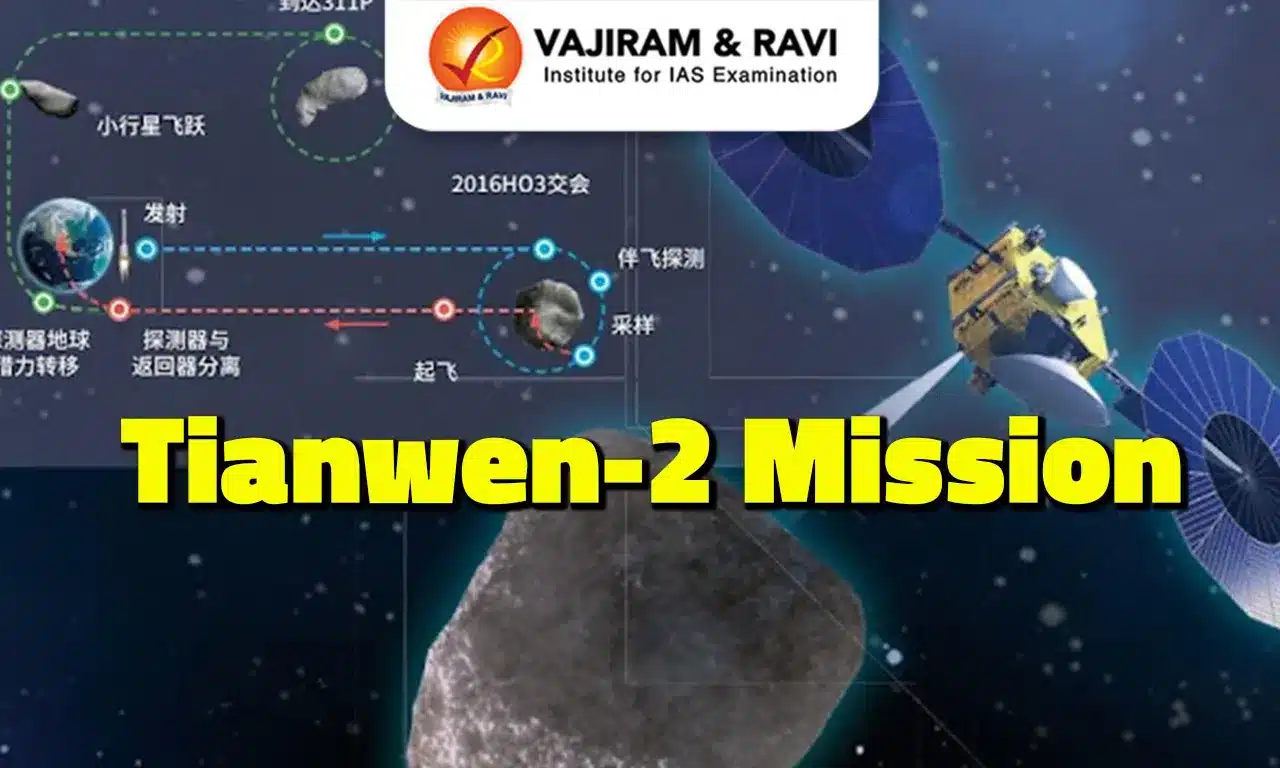
China is set to launch its Tianwen-2 mission, which aims to survey and sample the near-Earth asteroid 469219 Kamo‘oalewa.

About Tianwen-2 Mission

  • Launch VehicleLong March 3B rocket.
  • Launch Site: Xichang Satellite Launch Centre, Sichuan Province, China.
  • AgencyChina National Space Administration (CNSA).
  • Objective: Survey and sample asteroid Kamo’oalewa, then travel to the asteroid belt to study comet 311P/PANSTARRS.

What is Asteroid Kamo‘oalewa?

  • Kamo‘oalewa is a near-Earth asteroid discovered in 2016 by the Pan-STARRS 1 telescope on Haleakalā, Hawaii.
  • It belongs to a rare class called quasi-satellites of Earth, which orbit the Sun, but remain gravitationally influenced by Earth due to their close proximity.
  • It follows a highly elliptical solar orbit and appears to alternate between leading and trailing Earth, giving the illusion of orbiting Earth.
  • Kamo‘oalewa has been in its current orbit for ~100 years, and is expected to stay for another 300 years, though quasi-satellite orbits are inherently unstable over long timescales.

Tianwen-2’s Sampling Strategy

  • Tianwen-2 will use the “touch-and-go” technique to collect samples — a method also used by NASA’s OSIRIS-Rex and Japan’s Hayabusa2 missions.
  • In this method, the spacecraft briefly hovers over the asteroid’s surface, where a robotic arm releases a projectile or gas burst to dislodge particles, which are captured in a chamber.
  • A backup “anchor-and-attach” method may be used, where four robotic arms drill into the surface to retrieve subsurface material.

About Tianwen Series

  • The Tianwen series (meaning “Heavenly Questions”, inspired by the classical Chinese poem by Qu Yuan) represents China's growing ambitions in deep space exploration.
  • Tianwen-1, launched in 2020, became China’s first successful Mars mission, delivering an orbiter, lander, and rover to the Martian surface. The rover ceased operation in 2022.
  • Tianwen-3, expected by 2028, aims to retrieve samples from Mars, placing China among the few nations planning interplanetary sample return missions.

Tianwen-2 Mission FAQs

Q1. What is the Tianwen-2 Mission?
Ans: Tianwen-2 is China’s planned asteroid sample-return mission, aimed at collecting samples from a near-Earth asteroid and studying it.

Q2. Who is conducting the Tianwen-2 Mission?
Ans: The mission is being led by the China National Space Administration (CNSA).

Q3. What is the target asteroid for Tianwen-2?
Ans: Tianwen-2 is expected to target the asteroid 2016 HO3, a quasi-satellite of Earth.

Source: IE

South Korea

South Korea

South Korea Latest News

South Korea has officially expressed concern to China regarding a recently declared “No-Sail Zone” in the Yellow Sea, a sensitive maritime area where Exclusive Economic Zones (EEZs) of both countries overlap.

Key Facts about South Korea

  • Location: South Korea is situated in East Asia, bordered to the north by the Democratic People’s Republic of Korea (North Korea), to the east by the East Sea (Sea of Japan), to the south by the East China Sea, and to the west by the Yellow Sea.
  • Political Division: The Korean Peninsula is divided along the 38th Parallel, also known as the Demilitarised Zone (DMZ).
  • Capital: Seoul.
  • Major Rivers: Han River, Nakdong River.
  • Major IslandsJeju Island in the Korea Strait is the largest island.
  • Mountains: The country is dominated by the Taebaek Mountain range along the eastern coast.
  • Highest PeakMount Halla on Jeju Island (1,950 meters), an extinct volcano.

Geopolitical and Legal Significance

  • South Korea's Foreign Ministry is currently assessing the legality of this declaration under international maritime law, specifically under the United Nations Convention on the Law of the Sea (UNCLOS).
  • The Yellow Sea is a strategic body of water in East Asia, bordered by China and the Korean Peninsula, and is vital for regional securityfisheries, and commercial shipping routes.
  • South Korea is invoking international maritime law, especially UNCLOS Articles 58, 74, and 87, which govern freedom of navigationEEZ rights, and military activities in international waters.

South Korea FAQs

Q1. What is the capital of South Korea?
Ans: The capital of South Korea is Seoul.

Q2. Does India have a trade agreement with South Korea?
Ans: Yes, India and South Korea signed a Comprehensive Economic Partnership Agreement (CEPA) in 2010.

Source: TH

Debt Recovery Tribunals (DRTs)

Debt Recovery Tribunals (DRTs)

Debt Recovery Tribunals (DRTs) Latest News

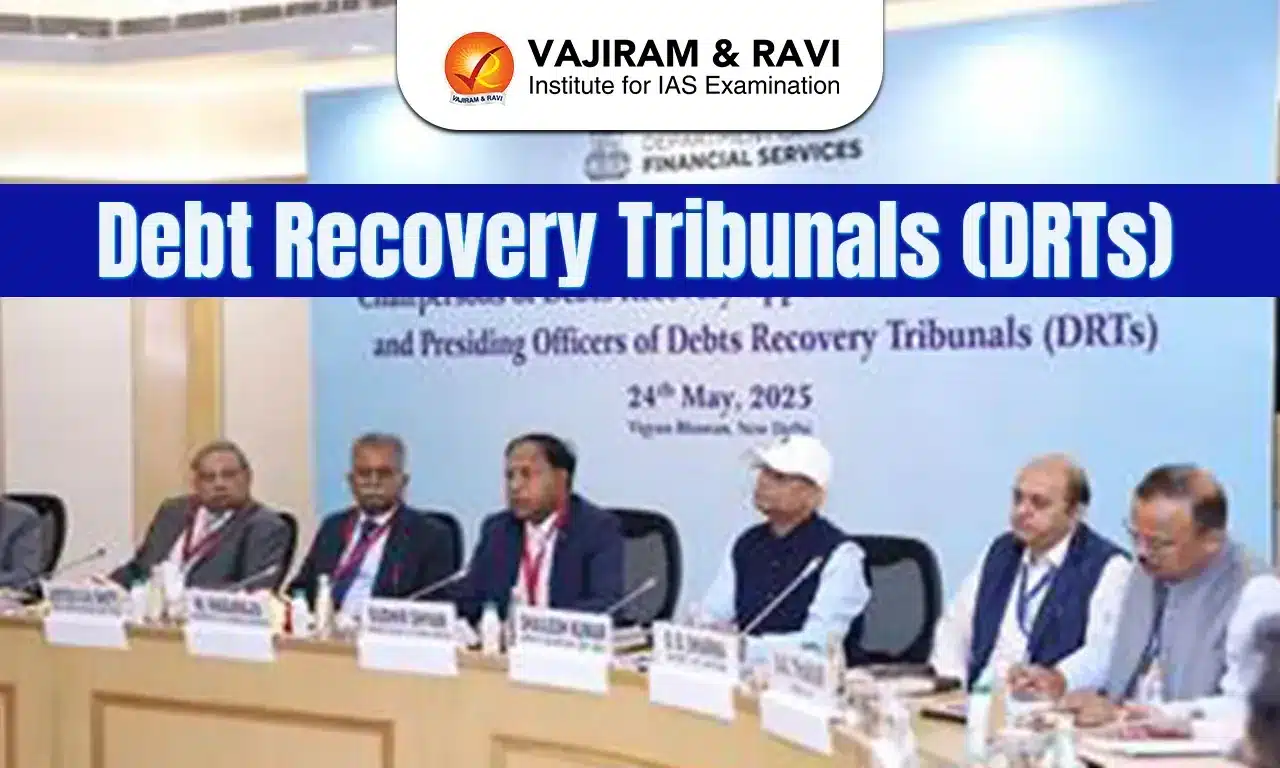
The Department of Financial Services (DFS) under the Ministry of Finance organised a colloquium recently at New Delhi, bringing together Chairpersons of Debt Recovery Appellate Tribunals (DRATs) and Presiding Officers of Debt Recovery Tribunals (DRTs).

About Debt Recovery Tribunals (DRTs)

  • Debt Recovery Tribunals (DRTs) are quasi-judicial bodies established under the Recovery of Debts Due to Banks and Financial Institutions Act, 1993.
  • Their primary role is adjudicating debt recovery disputes related to banks and financial institutions.
  • DRTs handle loan default cases above ₹20 lakh, focusing on secured debts.
  • DRTs also hear Securitisation Applications (SAs) filed under the SARFAESI Act, 2002 by borrowers or aggrieved parties.
  • There are currently 39 DRTs functioning across India, each headed by a Presiding Officer.

Structure and Powers of DRTs

  • A DRT is presided over by a judicial officer qualified to be a District Judge.
  • It can also have administrative and technical members appointed by the Central Government.
  • Under Section 22(2) of the Recovery of Debts Act, DRTs have powers to:
    • Summon and examine witnesses,
    • Compel the production of documents,
    • Receive evidence on affidavits,
    • Review or dismiss applications,
    • Conduct ex parte proceedings,
    • Issue commissions for document and witness examination.
  • Jurisdiction of DRTs: Each DRT has a territorial jurisdiction defined by the Central Government.
    • Jurisdiction is limited to cases involving debt recovery by banks and financial institutions.

About Debt Recovery Appellate Tribunals (DRATs)

  • DRATs are the appellate authorities for decisions made by DRTs.
  • Appeals can be filed by aggrieved parties seeking review of DRT rulings.
  • Currently, 5 DRATs are functioning in India, each headed by a Chairperson.
  • DRATs ensure judicial oversight and uniformity in debt recovery matters and promote legal clarity on complex recovery disputes.

Debt Recovery Tribunals (DRTs) FAQs

Q1. What are Debt Recovery Tribunals (DRTs)?
Ans: DRTs are quasi-judicial bodies established under the Recovery of Debts and Bankruptcy Act, 1993 to facilitate the expeditious recovery of debts due to banks and financial institutions.

Q2. How many DRTs and DRATs are there in India?
Ans: As of now, there are 39 DRTs and 5 Debt Recovery Appellate Tribunals (DRATs) functioning across India.

Q3. What is the monetary limit for cases to be filed in DRT?
Ans: A bank or financial institution can approach a DRT if the debt amount is ₹20 lakh or more.

Source: PIB

Indian SARS-CoV-2 Genomics Consortium (INSACOG)

Indian SARS-CoV-2 Genomics Consortium (INSACOG)

Indian SARS-CoV-2 Genomics Consortium Latest News

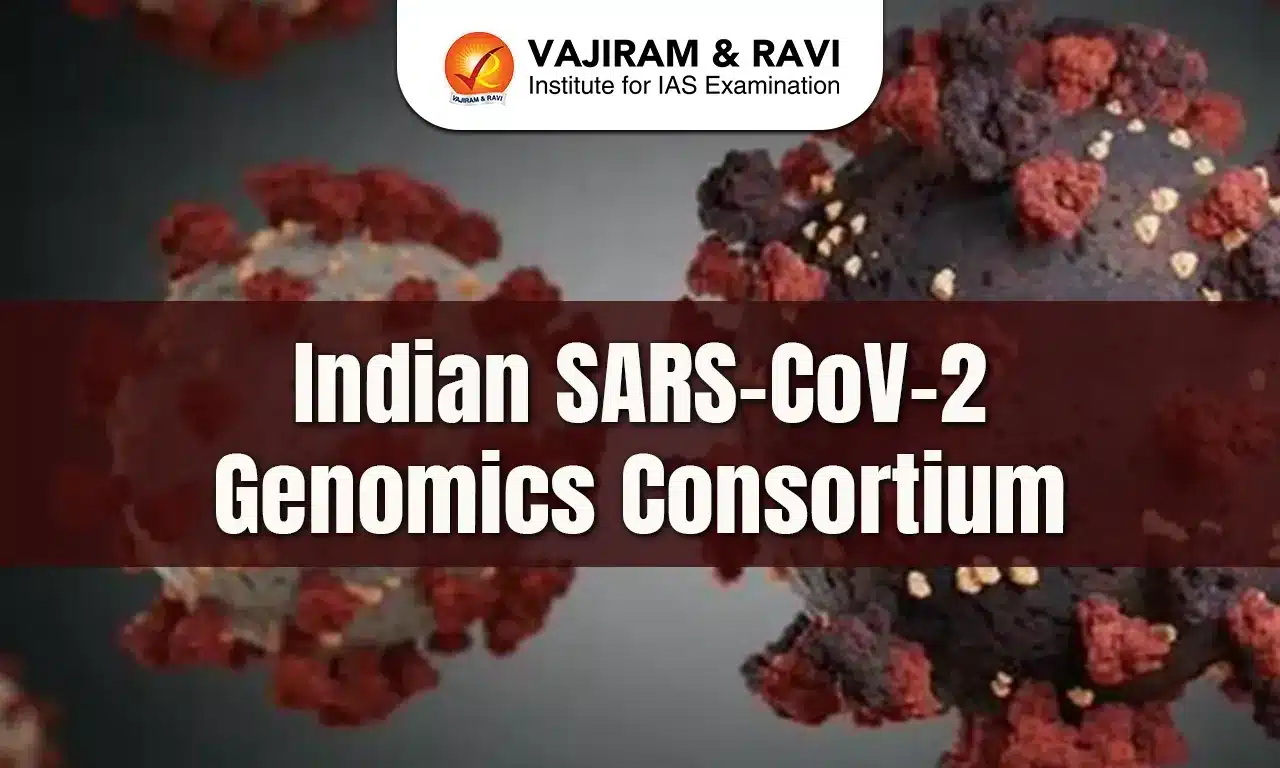
One case of the newly emerging COVID-19 variant NB.1.8.1 and four instances of the LF.7 type have been detected in India, according to Indian SARS-CoV-2 Genomics Consortium (INSACOG) data.

About Indian SARS-CoV-2 Genomics Consortium

  • INSACOG was established by the Government of India in December 2020.
  • It was jointly initiated by the Union Ministry of Health, and the Department of Biotechnology (DBT) with the Council for Scientific & Industrial Research (CSIR) and the Indian Council of Medical Research (ICMR).
  • It is a consortium of 54 laboratories to monitor the genomic variations in the SARS-CoV-2 by a sentinel sequencing effort which is facilitated by the National Centre for Disease Control (NCDC), Delhi, involving the Central Surveillance Unit (CSU) under the Integrated Disease Surveillance Programme (IDSP). 
  • The mandate of INSACOG has evolved with time, and the focus has shifted from primarily tracking variants among international passengers to early detection of variants that may emerge within the country. 
  • It has the following objectives:
    • Early detection of genomic variants of public health implication through sentinel surveillance.
    • To determine the genomic variants in unusual events/trends (vaccine breakthroughs, super spreader events, high mortality/morbidity trend areas, etc.)
    • To correlate the genome surveillance data with epidemiological data.
    • To suggest public health actions based on the analysis of genomic and epidemiological surveillance data.
  • The data from the genome sequencing laboratories is being analysed as per the field data trends to study the linkages, if any, between the genomic variants and epidemiological trends. 
  • This helps to understand superspreader events and outbreaks and strengthen public health interventions across the country to help in breaking the chains of transmission.

Indian SARS-CoV-2 Genomics Consortium FAQs

Q1. What is the primary function of INSACOG?

Ans. Monitoring SARS-CoV-2 genomic variations

Q2. Which organizations, apart from the Ministry of Health and DBT, are involved in INSACOG?

Ans. ICMR and CSIR

Q3. How many laboratories are part of the INSACOG consortium?

Ans. 54

SourceTH

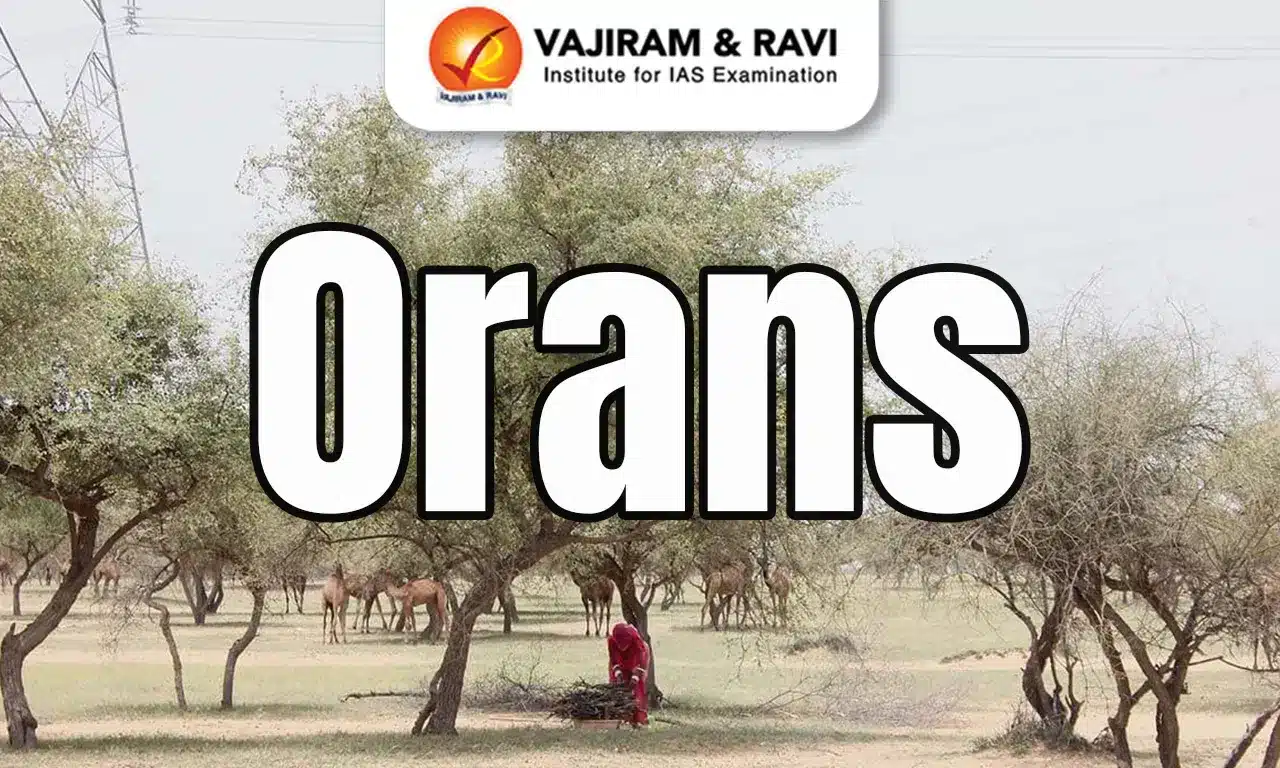
Orans

Orans

Orans Latest News

Rajasthan has initiated the process for classifying the community-protected ‘Oran’ lands as forests in compliance with the Supreme Court’s direction.

About Orans

  • Orans are traditional sacred groves found in Rajasthan.
  • They are patches of forests dedicated by villagers to different deities as a socio-religious tradition and managed by the rural communities. 
  • Orans serve as centers of socio-religious activity for local communities. Festivals and fairs are held annually, often on specific dates, to honor these sacred places. 
  • Rajasthan is home to about 25,000 ‘Oran’ lands covering an area of 6 lakh hectares.
  • ‘Oran’ land is used by local communities for grazing, forest products, natural water filtration, and for livelihood opportunities to promote the livestock economy. 
  • Water bodies within the orans, such as Talab (pond), Nadi (small pond), open wells, and streams, are crucial water resources for livestock and wildlife. 
  • In the Thar Desert, some orans have ancient goverdhan/shilalekh (petrograph) near water bodies.
  • The area covered by an oran can range from a few hectares to several hundred hectares. For example, the Bhadariya Mata Oran in Jaisalmer district spans 17,821 hectares.
  • Orans also form the natural habitat for India’s most critically endangered bird, the Great Indian Bustard (GIB), a protected species under the Wildlife Protection Act, which is also the State bird of Rajasthan. 
  • The State’s forest policy of 2023 gave the status of general community land to ‘Orans’, which was considered insufficient for their conservation as well as protection against encroachment and degradation.
  • The Supreme Court recognised ‘Oran’ lands as forests under the Forest Conservation Act, 1980, in a landmark judgment delivered on December 18, 2024. 

Orans FAQs

Q1. What are Orans?

Ans. Orans are traditional sacred groves found in Rajasthan.

Q2. Which critically endangered bird species is naturally protected in the Orans?

Ans. Great Indian Bustard

Q3. Approximately how many Oran lands exist in Rajasthan?

Ans. 25,000

SourceTH

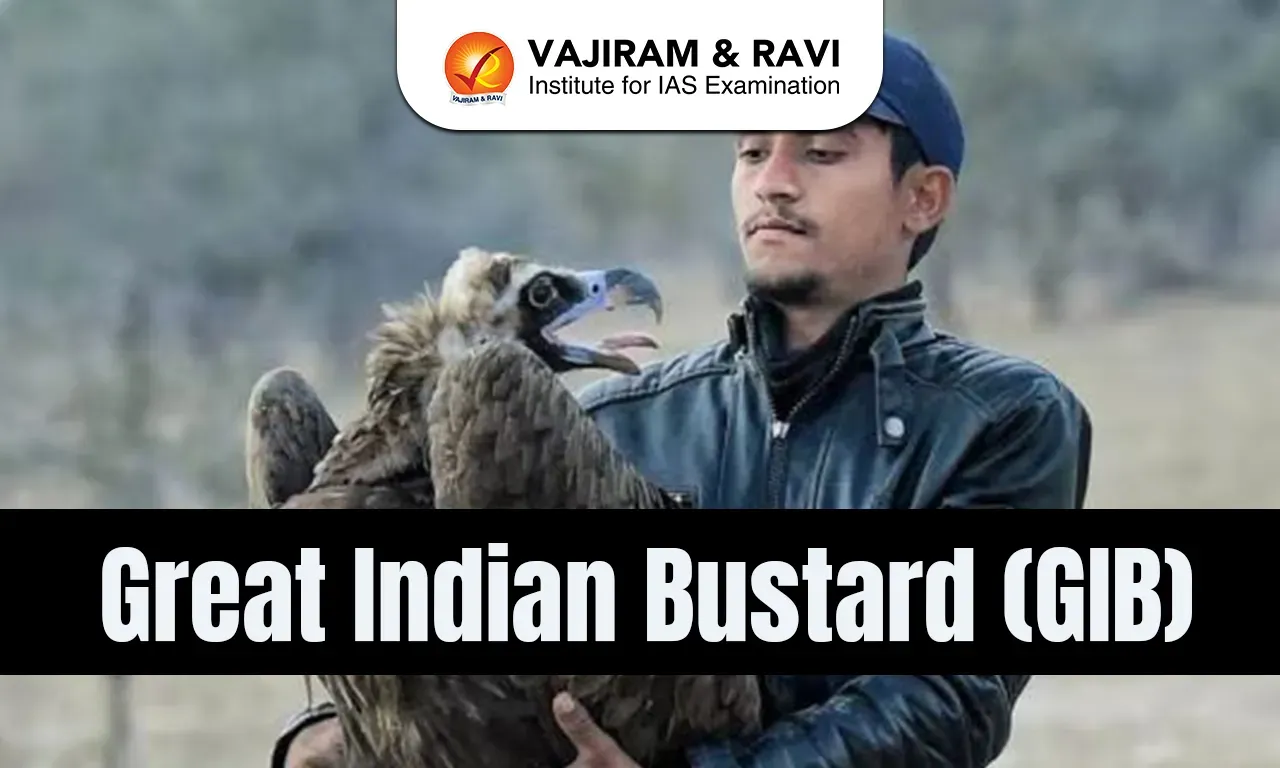
Great Indian Bustard (GIB)

Great Indian Bustard (GIB)

Great Indian Bustard (GIB) Latest News

Radheshyam Pemani Bishnoi, a 28-year-old wildlife conservationist from Jaisalmer, Rajasthan, died in a road accident while on an anti-poaching patrol. He was a flag bearer in the GIB Community Conservation Programme.

About the Great Indian Bustard (GIB)

  • The Great Indian Bustard(Ardeotis nigriceps) is a large terrestrial bird endemic to the Indian subcontinent.
  • The bird is primarily found in dry grasslands and scrublands, which are rapidly declining due to agricultural expansion and development.
  • Its core population (~100 individuals) survives in the Thar Desert, mainly in Jaisalmer and Barmer districts of Rajasthan.
  • The total population is critically low, estimated to be around 100–150 individuals across India.

Physical Characteristics

  • The Great Indian Bustard is one of the heaviest flying birds in the world.
  • It has a horizontal body posturelong bare legs, and resembles an ostrich in appearance.
  • Distinctive features include:
    • black crown on the forehead,
    • pale head and neck,
    • brownish body with grey, black, and brown patterns on the wings.
  • Both sexes are similar in size, with the heaviest individuals reaching up to 15 kg (33 pounds).
  • The bird has a lifespan of 12–15 years.

Reproductive and Feeding Behaviour

  • GIBs breed during the monsoon, laying a single egg directly on open ground, making the nest highly vulnerable to predation and trampling.
  • They are opportunistic feeders, consuming a varied diet depending on seasonal availability:
    • Grass seeds,
    • Insects such as grasshoppers and beetles,
    • Occasionally small rodents and reptiles.

Conservation Status

  • IUCN Red ListCritically Endangered
  • Wildlife (Protection) Act, 1972Schedule I species (highest level of protection under Indian law)
  • CITESAppendix I, indicating it is threatened with extinction and international trade is strictly regulated.

Great Indian Bustard FAQs

Q1. What is the conservation status of the Great Indian Bustard?
Ans: It is listed as Critically Endangered on the IUCN Red List.

Q2. In which states is the Great Indian Bustard mainly found?
Ans: Mainly found in Rajasthan, and also in parts of Gujarat, Maharashtra, Karnataka, and Andhra Pradesh.

Q3. What is the main threat to the Great Indian Bustard?
Ans: The major threats include habitat loss, collisions with power transmission lines, and predation of eggs and chicks.

Source: IE

Enquire Now