Vajiram & Ravi provides Daily articles for 27 May 2025, tailored for aspirants. We cover all relevant news and events crucial for the exam, ensuring you stay updated & well-prepared.
Recently, the Ministry of Panchayati Raj organised a two-day national write-shop on rolling out of Panchayat Advancement Index (PAI) Version 2.0 for the financial year 2023-24 in New Delhi.
About Panchayat Advancement Index
It is a multi-domain and multi-sectoral index that is intended to be used to assess the overall holistic development, performance & progress of Panchayats.
It aims to assess and measure the progress made by grassroots-level institutions in achieving localized SDGs, thereby contributing to the attainment of SDG 2030.
The index takes into account various socio-economic indicators and parameters to gauge the well-being and development status of the local communities within the jurisdiction of a Panchayat.
One of the purposes of the PAI is to identify the development gaps of the Panchayats through the scores achieved across various LSDG themes and enable the Panchayat for evidence-based planning at grassroots level.
It has been compiled based on 435 unique local Indicators (331 mandatory & 104 optional) consisting of 566 unique data points across 9 themes of LSDGs (Localization of Sustainable Development Goals) aligned with National Indicator Framework (NIF) of the Ministry of Statistics and Programme Implementation (MoSPI).
The PAI reflects India’s commitment to achieving the SDG 2030 Agenda through participatory, bottom-up development.
Based on the PAI scores & thematic Scores achieved by different Gram Panchayats, these GPs are grouped into one of the categories of performance – Achiever: (90+), Front Runner: (75 to below 90); Performer: (60 to below 75); Aspirant: (40 to below 60) and Beginners (below 40).
While PAI Version 1.0 served as the baseline and covered data from 2.16 lakh Gram Panchayats across 29 States/UTs, PAI Version 2.0 represents a major leap forward in functionality, efficiency, and usability.
The transition from PAI 1.0 to 2.0 reflects a focused refinement of the framework, with a sharper and more practical set of indicators and data points to improve usability and reliability while retaining thematic comprehensiveness.
Panchayat Advancement Index FAQs
Q1: Who releases the Panchayat Advancement Index?
Ans: The Ministry of Panchayati Raj
Q2: What is the Panchayat Advancement Index PAI?
Ans: Multi-domain and multi-sectoral index that is intended to be used to assess the overall holistic development, performance & progress of panchayats.
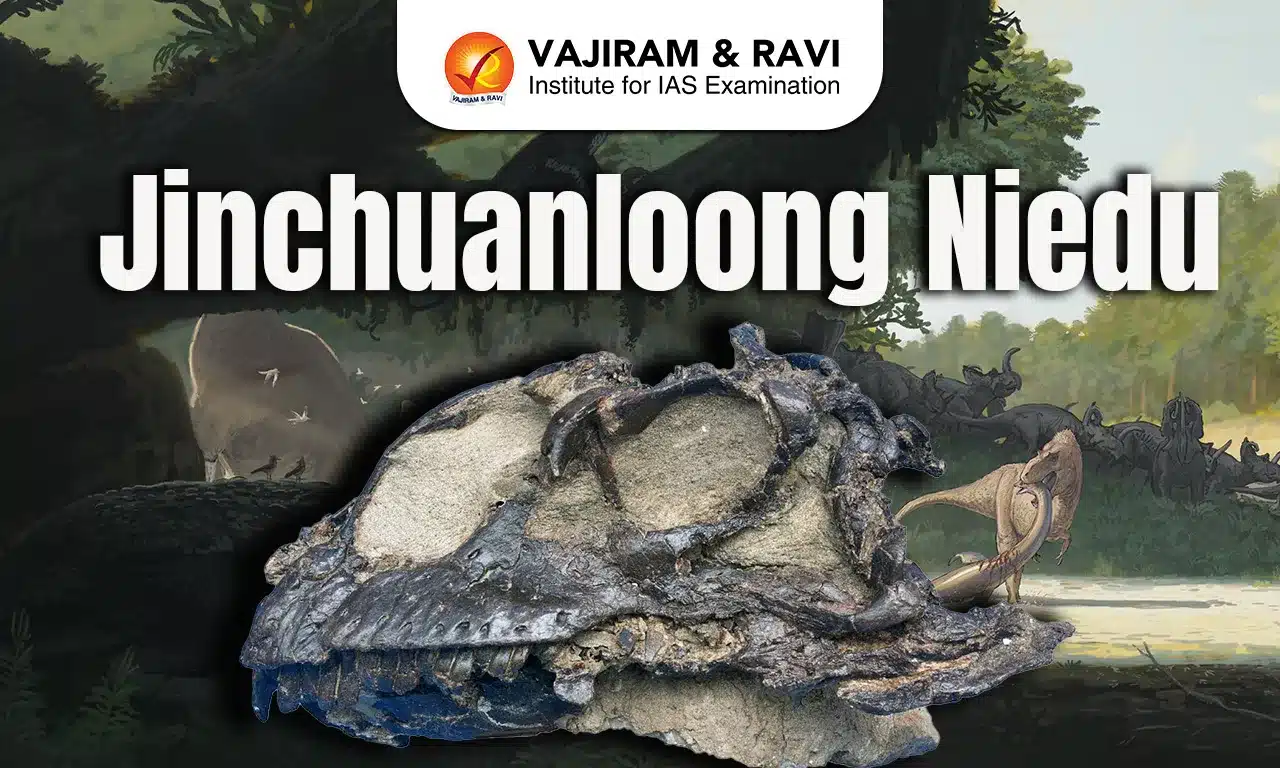
A new genus and species of eusauropod dinosaur named Jinchuanloong niedu has been recently identified from a fossilized partial skeleton with a nearly complete skull found in the Chinese province of Gansu.
About Jinchuanloong niedu
It is an early-diverging member of a group of long-necked, strictly herbivorous, quadrupedal dinosaurs called Eusauropoda.
The fossilized remains of Jinchuanloong niedu were collected from the lower part of the Xinhe Formation near Jinchang city, Gansu province, northwestern China.
Jinchuanloong niedu roamed our planet during the Middle Jurassic period, some 165 million years ago.
Key Facts about Sauropod Dinosaurs
Sauropods are any member of the dinosaur subgroup Sauropoda, marked by large size, a long neck and tail, a four-legged stance, and a herbivorous diet.
These were the largest of all dinosaurs and the largest land animals that ever lived.
They lived from the Early Jurassic to Late Cretaceous, and have been found on all continents.
Due to the global warming event in the late Early Jurassic, eusauropods were the only surviving sauropod lineage subsequently.
In the Middle and Late Jurassic, the non-neosauropod, eusauropod became dominant, represented by Shunosaurus, Omeisaurus, and ‘core Mamenchisaurus-like taxa’.
Jinchuanloong niedu FAQs
Q1: What type of dinosaur is Jinchuanloong niedu?
Ans: It is an early-diverging member of a group of long-necked, strictly herbivorous, quadrupedal dinosaurs called Eusauropoda.
Q2: Where were the fossil remains of Jinchuanloong niedu discovered?
Ans: Xinhe Formation, Gansu Province, China
Q3: Jinchuanloong niedu lived during which geological period?
Recently, the Kumbakonamvetrilai or betel leaf or paan leaf was granted a Geographical Indication (GI) tag by the Government of India.
About KumbakonamVetrilai
It is predominantly grown in Thanjavur’s fertile Cauvery river basin, giving it a unique taste and aroma.
The dark to light green, oblong heart-shaped leaves with a pungent taste are cultivated.
The betel leaf has been widely cultivated across Kumbakonam and adjacent villages of Ayyampettai, Swamimalai and Rajagiri in Thanjavur district of Tamil Nadu.
It is a staple in South Asian households and is central to preparing paan, a popular South Asian post-meal chew.
The Kumbakonam betel leaf is exported to some countries.
Harvesting Process of Kumbakonam Vetrilai
After 20–25 days of planting, kolunthu vetrilai – the first leaves – emerge.
The first-year harvest happens from the seventh to 12th month.
It is called maaruvethalai, produces larger leaves with a better shelf life of six to seven days, and fetches higher prices in the market.
Second and third-year yields – kelavethalai and kattavethalai – are smaller compared to the first year’s yield.
KumbakonamVetrilai FAQs
Q1: Why is Kumbakonam famous for betel leaves?
Ans: The uniqueness of the Kumbakonam betel leaf comes from the soil in Cauvery River banks, which is rich in organic content.
Q2: Which country is famous for betel leaf?
Ans: Major betel leaf growing countries are Sri Lanka, India, Thailand and Bangladesh.
National Apprenticeship Promotion Scheme (NAPS) and the National Apprenticeship Training Scheme Latest News
Recently, the 38th Meeting of the Central Apprenticeship Council (CAC), chaired by the Minister of State (Independent Charge), Ministry of Skill Development and Entrepreneurship (MSDE), recommended a 36% increase in stipend provided under the National Apprenticeship Promotion Scheme (NAPS) and the National Apprenticeship Training Scheme (NATS).
About National Apprenticeship Promotion Scheme (NAPS) and the National Apprenticeship Training Scheme
The National Apprenticeship Promotion Scheme (NAPS) was launched on19th August 2016 by the Government of India.
The scheme entails financial support to establishments undertaking apprenticeship programs.
It is an initiative by the Ministry of Skill Development and Entrepreneurship aimed at promoting apprenticeship training across India.
NAPS registration is essential for candidates and establishments to benefit from this program.
Objectives
To develop skilled manpower for the industry by promotion of on-the-job experiential training.
To encourage establishments to enrol apprentices by sharing partial stipend support to the apprentices.
To provide up-skilling opportunities for candidates who have undergone short-term skill training.
To encourage enrolment of apprentices in small establishments (MSMEs), and those located in underserved areas like in aspirational districts and in the North-East region.
This scheme provides financial incentives to establishments engaging apprentices under the Apprentices Act, 1961. By offering partial stipend support and advocacy, the scheme encourages industries to train a skilled workforce andbridge the gap between education and employment.
The scheme not only promotes skill development but also focuses on building a trained workforce that aligns with industry needs. Candidates who complete their training receive a NAPS certificate, which enhances their employability.
About National Apprenticeship Training Scheme
It is one of the flagship programmes of Government of India for Skilling Indian Youth in Trade disciplines.
It is under the provisions of the Apprentices Act, 1961 amended in 1973.
It offers Graduate, Diploma students and Vocational certificate holders; practical, hands-on On-the-Job-Training (OJT) based skilling opportunities.
Duration: Ranging from 6 months to 1 year.
During the period of apprenticeship, the apprentices are paid a stipend amount, 50% of which is reimbursable to the employer from the Government of India.
At the end of the training period the apprentices are issued a Certificate of Proficiency by the Government of India which can be registered at all employment exchanges across India as valid employment experience.
There is no guarantee of employment after completion of training as an apprentice.
National Apprenticeship Promotion Scheme (NAPS) and the National Apprenticeship Training Scheme FAQs
Q1: Who is eligible for the National Apprenticeship Promotion Scheme?
Ans: Individual who has completed 14 years of age (18 years in case of Hazardous industries defined under the Apprenticeship Rules).
Q2: What is the national apprenticeship training scheme?
Ans: The basic objective of the scheme is to bridge any gap, in so far practical/ hands on experience of fresh graduate engineers, diploma holders and general streams students.
PKM1, a variety of Moringa oleifera, has had a global impact, especially in countries such as Senegal, Rwanda, and Madagascar on the African continent.
About Moringa
It is known as the “tree of life” or “miracle tree,” and is classified as an important herbal plant.
Its botanical name is Moringa oleifera, and it is native to India, which was introduced from India to Africa, Southeast Africa, and the Philippines in ancient times.
Required climatic conditions
It requires tropical and subtropical regions and grows at a temperature of about 25–35 °C
It is a deciduous type of tree typically grown in tropical and subtropical regions across the globe
It grows best in indirect sunlight and without waterlogging, and the soil should be slightly acidic to alkaline.
The tree begins to bear fruit at 6 to 8 months of age.
Distribution: It is widely distributed worldwide, but its indigenous origin is in India, Arabia and the East Indies.
It is common in Asia, Africa, the Caribbean, Latin America, the Pacific Islands, Florida, Madagascar, Central America, Cuba, the Philippines, Ethiopia, and Nigeria.
Benefits of Moringa
With its high nutritional values, every part of the tree is suitable for either nutritional or commercial purposes.
The leaves are rich in minerals, vitamins and other essential phytochemicals.
Extracts from the leaves are used to treat malnutrition, augment breast milk in lactating mothers.
Moringa FAQs
Q1: Is moringa a leguminous evergreen tree?
Ans: The Moringa (drumstick tree) is a leguminous evergreen tree.
Q2: What is moringa called in India?
Ans: Indian common name of Moringa oleifera Hindi mungna, saijna, shajna.
Semi-Transparent Perovskite Solar Cell Latest News
Recently, the IIT Bombay researchers have developed a semi-transparent perovskite solar cell (PSC).
About Semi-Transparent Perovskite Solar Cell
It is layered over a traditional silicon-based solar cell, forming a 4-terminal (4T) tandem structure.
Material used: The bottom sub-cell uses well-established silicon technology, while the top sub-cell features an indigenously developed halide perovskite semiconductor, enabling high light absorption and efficient energy conversion.
This helps in power conversion efficiency of approximately 30 per cent compared with around 20 per cent now.
Halide perovskite is among the most efficient light-absorbing materials known today. Apart from being highly efficient in converting light into electricity, it is affordable as electronic grade perovskite semiconductors can be produced locally with available chemical resources.
Perovskite Solar Cells are a type of photovoltaic (PV) technology that uses crystal structures called perovskites for converting sunlight into electricity.
These crystals share the structure of the mineral calcium titanium oxide (CaTiO₃) and can be engineered to possess a wide range of optical, electrical, and semiconducting properties.
The general chemical formula of a perovskite compound is ABX₃, where 'A' and 'B' are cations, and 'X' is an anion.
They offer high power conversion efficiencies at a lower cost than traditional silicon-based PVs, but they suffer from shorter lifespan and stability issues.
Semi-Transparent Perovskite Solar Cell FAQs
Q1: What is the lifespan of a perovskite solar cell?
Ans: At least 20 years.
Q2: What is Perovskite?
Ans: Perovskite refers to materials with the crystal structure of calcium titanium oxide (CaTiO₃), discovered in 1839 in Russia. The general formula is ABX₃, where ‘A’ and ‘B’ are cations and ‘X’ is an anion.
A nine-month-old boy, Kyle “KJ” Muldoon Jr., became the first known human to be successfully treated using custom base editing therapy, a precise form of gene editing.
KJ suffers from CPS1 deficiency, a rare genetic disorder causing toxic ammonia buildup in blood.
Gene Editing Breakthrough
What is the CPS1 deficiency? Carbamoyl Phosphate Synthetase I (CPS1) deficiency prevents the breakdown of nitrogen in the body, and leads to hyperammonemia, a potentially fatal condition.
Treatment innovation: Scientists from the University of Pennsylvania and Children’s Hospital of Philadelphia used base editing, an advanced technique derived from CRISPR-Cas9.
CRISPR and its Mechanism
What is CRISPR?
Stands for Clustered Regularly Interspaced Short Palindromic Repeats (CRISPR), it is an immune system found in microbes such as bacteria which fights invading viruses.
When a virus infects a bacterial cell, CRISPR helps to establish a memory (a genetic one, not in the form of antibodies like in humans).
When a virus enters a bacterial cell, the bacterium takes a piece of the virus’s genome and inserts the DNA into its own genome.
CRISPR then produces a new “guide” RNA, which directs an enzyme (a type of protein) called Cas9 to act like “molecular scissors” to cut and eliminate the virus DNA.
Development of CRISPR-Cas9 technology: Pioneered in 2012 by Jennifer Doudna and Emmanuelle Charpentier, which earned them the Nobel Prize for Chemistry (2020).
Working of CRISPR-Cas9 Gene Editing
The first task for the gene-editing tool is to identify the abnormal DNA sequence behind a patient’s ailment.
Once the bad DNA is located, scientists create a guide RNA attached to a Cas9 enzyme, which is then introduced to the target cells of the patient.
The guide RNA recognises the bad DNA sequence, then the Cas9 enzyme cuts the DNA at the specified location in a process called a “double-strand break” (since the cut is made on both strands of the DNA).
To prevent the regrowth of bad sequence, scientists also supply the correct DNA sequence after the “cutting” process which is meant to attach itself to the broken strands of DNA.
Base Editing - The Next-Gen CRISPR
Key features:
Base editing and CRISPR-Cas9 differ significantly in how they modify DNA.
Unlike CRISPR-Cas9, base editing does not make a double-strand break.
Rather, it enables targeted single-base conversions with the help of a Cas9 enzyme fused to a base-modifying enzyme.
This allows scientists to fix mispairing of the bases by changing one specific base.
Application in KJ’s case: Specific mispaired base responsible for CPS1 was corrected.
Advantages:
Base editing system works like a pencil and eraser, unlike the scissors and glue of CRISPR, and doesn’t require foreign DNA insertion.
Precision, compact delivery, and fewer components.
Easier to transport in viral vectors or other delivery systems.
Ethical, Economic and Regulatory Challenges
Accessibility and cost: Prohibitively expensive - likely in hundreds of thousands of dollars. KJ’s treatment is funded by research institutes and biotechnology firms.
Scalability issues:
Treatment was personalised; not applicable to other patients.
Commercial disincentive for pharmaceutical companies due to high cost and customisation needs.
Regulatory bottlenecks: Complex approval mechanisms, especially in countries like India. Need for reform in bioethics, policy, and governance frameworks.
Conclusion - Hope Amidst Challenges
KJ’s case marks a milestone in personalised medicine.
Despite its potential to revolutionise treatment of rare genetic diseases, base editing remains constrained by cost, customisation, and policy hurdles.
Future success will depend on efforts to make advanced biotechnologies affordable, scalable, and ethically regulated.
Breakthrough in Gene Editing FAQs
Q1. What is CPS1 deficiency, and how does it affect the human body?
Ans. CPS1 deficiency is a rare genetic disorder that leads to the accumulation of toxic levels of ammonia in the blood due to a defect in the urea cycle enzyme Carbamoyl Phosphate Synthetase I.
Q2. How does CRISPR-Cas9 gene-editing technology function at the molecular level?
Ans. CRISPR-Cas9 uses a guide RNA to direct the Cas9 enzyme to a specific DNA sequence, where it introduces a double-strand break to remove or replace faulty genetic material.
Q3. What is base editing, and how is it different from CRISPR-Cas9?
Ans. Base editing is a precision gene-editing tool that alters a single DNA base without making double-strand breaks, unlike CRISPR-Cas9, which cuts both DNA strands and requires insertion of foreign DNA.
Q4. Why is the application of base editing in clinical treatment currently limited?
Ans. The clinical use of base editing is limited by high costs, customisation for individual patients, regulatory hurdles, and lack of scalability for mass application.
Q5. Discuss the ethical and regulatory challenges in implementing personalised gene-editing therapies like base editing in India.
Ans. India faces ethical concerns over genetic modifications and regulatory bottlenecks due to bureaucratic red tape, making the clinical implementation of personalised therapies like base editing difficult.
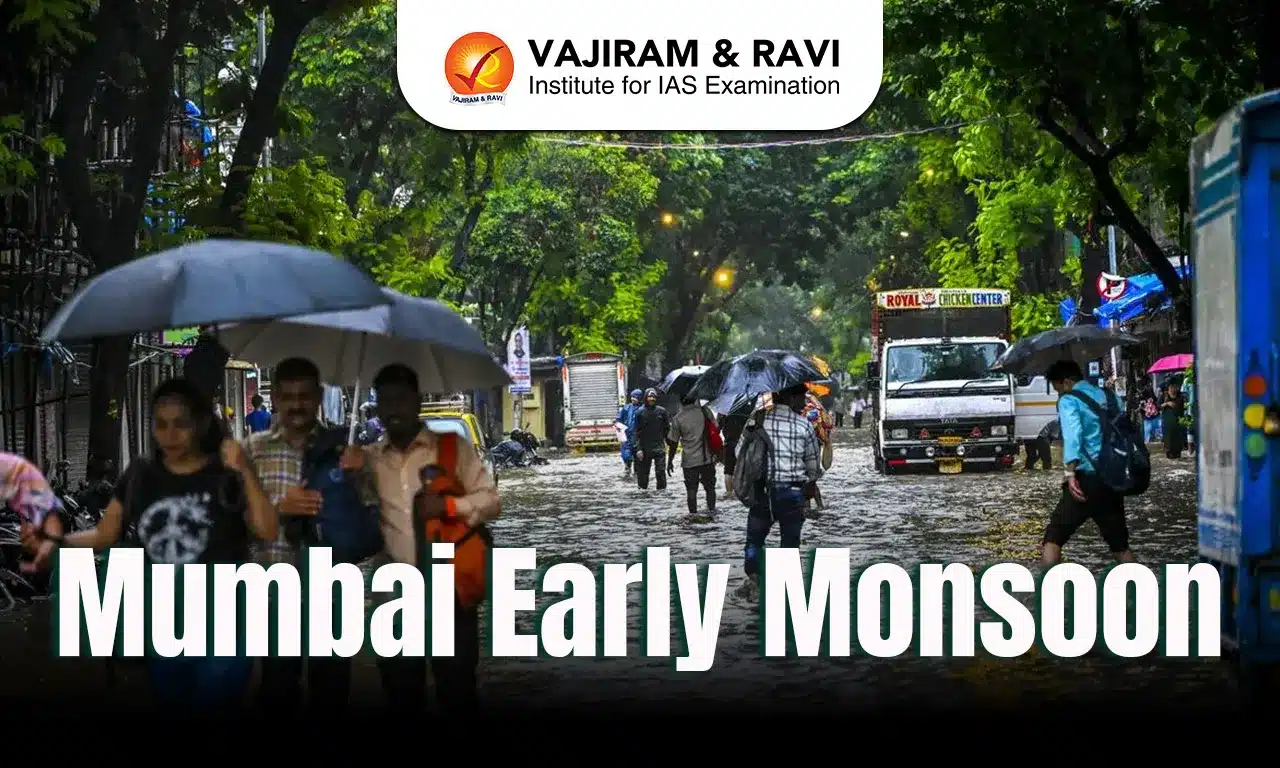
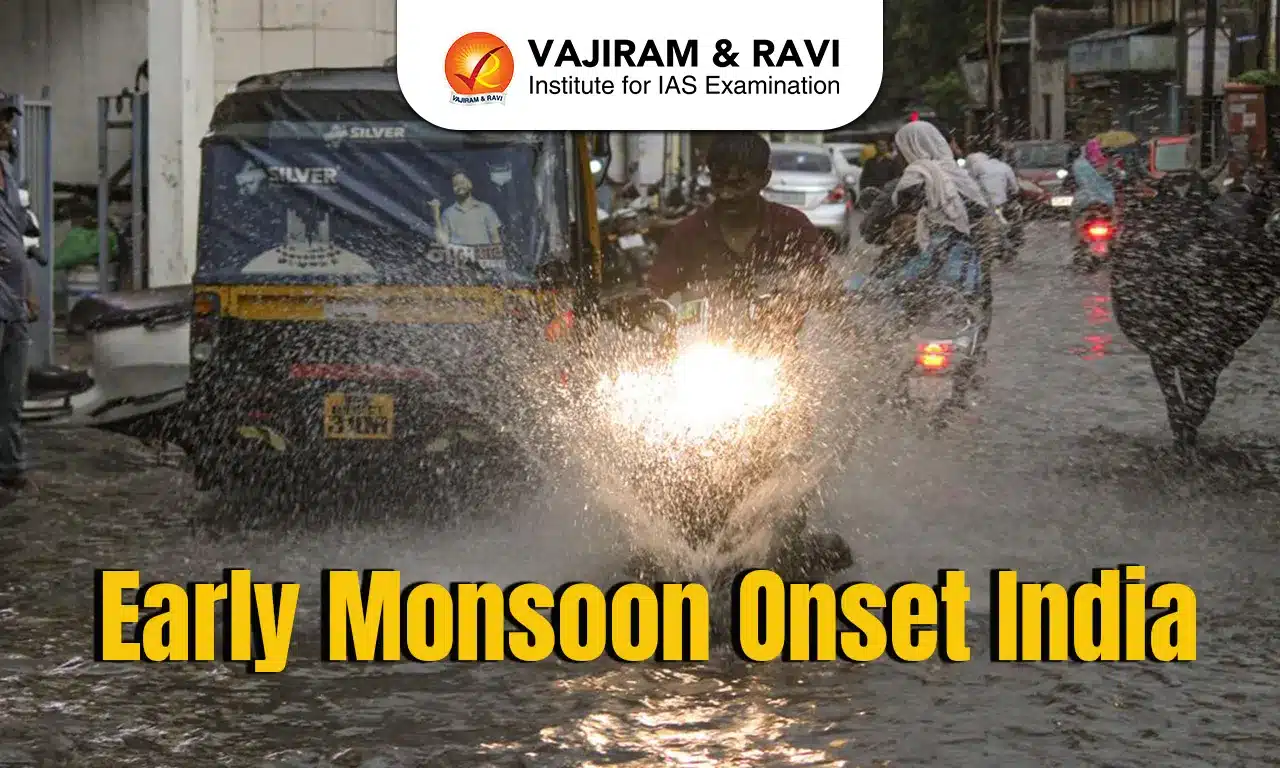
Mumbai experienced an unusually early and intense monsoon, arriving two weeks ahead of schedule and disrupting daily life with waterlogging, traffic jams, and delayed trains.
According to IMD records since 1950, this is the earliest monsoon onset ever recorded in the city, breaking the previous record of May 29. The normal onset date is June 11.
Madden-Julian Oscillation (MJO)
MJO is an equatorial, eastward-moving system of anomalous rainfall and atmospheric circulation.
It is planetary in scale and consists of alternating wet and dry phases, each lasting 30 to 60 days.
It travels across the Indian and Pacific Oceans, sometimes reaching the Atlantic and re-entering the Indian Ocean.
Behavior and Mechanism
The MJO features enhanced convection and suppressed rainfall zones that move eastward at about 5 m/s (11 mph).
It affects surface winds, upper-level divergence, and ocean-atmosphere interactions.
The active phase is monitored using outgoing longwave radiation—lower values indicate stronger convection (thunderstorms).
Phases of the MJO
The MJO has two main phases:
Enhanced Rainfall (Convective) Phase
Surface Winds Converge: Air is drawn in at the surface and rises.
Rising Air Cools and Condenses: This leads to cloud formation and increased rainfall.
Upper-Level Wind Divergence: Winds reverse direction at the top of the atmosphere.
Suppressed Rainfall Phase
Upper-Level Winds Converge: Air descends from higher altitudes.
Descending Air Warms and Dries: Leads to dry conditions and reduced rainfall.
Surface Winds Diverge: Air spreads out at the surface, inhibiting convection.
Dipole Nature of MJO
Strong MJO activity often divides the globe into two contrasting halves:
One under enhanced convection and rainfall
The other under suppressed convection and rainfall
This dipole system moves eastward across the tropics, marking the progression of MJO.
Criteria for Active MJO
To be classified as active, the dipole must be:
Clearly defined
Propagating eastward over time
Impact on Indian Monsoon
The MJO significantly influences the timing, intensity, and breaks in the Indian monsoon.
Stronger rainfall often occurs in India 5–10 days after warming of sea surface temperatures linked to the MJO.
The break in monsoon, especially in July, is often caused when the MJO's active phase moves eastward away from the region.
Impact on Tropical Cyclones
MJO plays a role in tropical cyclogenesis by creating favorable or unfavorable large-scale conditions.
Ascending motion enhances storm formation.
Descending motion suppresses cyclone activity.
The preferred cyclone region shifts from Western Pacific → Central Pacific → Atlantic as the MJO progresses.
There's an inverse cyclone activity pattern between the North Pacific and North Atlantic, influenced by opposite MJO phases.
Factors Behind Mumbai's Earliest Monsoon Onset
Early Onset in Kerala
The monsoon arrived in Kerala on May 24 — the earliest since 2009 — setting the stage for its rapid advancement.
Typically, Mumbai receives monsoon around June 11, nearly 10 days after Kerala.
Rapid Progression
Unusually, the southwest monsoon travelled from Kerala to Maharashtra within just 24 hours, reaching Mumbai by May 27.
Favourable Weather Conditions
According to IMD, very favourable atmospheric conditions supported both the early onset and fast progression of the monsoon.
Active Madden-Julian Oscillation (MJO):
A highly active MJO — a global system of wind and pressure patterns — was in Phase 4 with high amplitude, creating ideal conditions for enhanced rainfall and storm activity over India.
MJO phase 4 represents a period of enhanced rainfall over the Indian Ocean and western Pacific, with a slight increase in rainfall over the southwest quarter of the globe, while other regions experience slightly below normal rainfall.
Strong Cross-Equatorial Flow
This flow, which transports moisture across the equator, was particularly strong, bringing in significant humidity needed to fuel monsoon clouds.
Low Pressure in Arabian Sea
A low-pressure area, formed due to cyclonic circulation, not only contributed to heavy pre-monsoon showers in Mumbai but also accelerated the monsoon’s arrival.
Mumbai Early Monsoon FAQs
Q1. Which month is heavy rain in Mumbai?
Ans. July to September are the months when the monsoon sets in, and Mumbai experiences torrential rains. The weather becomes humid, but the rains bring relief from the scorching heat.
Q2. What caused Mumbai's early monsoon?
Ans. A strong MJO, active low-pressure area, and rapid cross-equatorial moisture flow.
Q3. What is MJO Phase 4?
Ans. It brings enhanced rainfall over the Indian Ocean, supporting strong monsoon activity.
Q4. How fast did the monsoon move from Kerala to Mumbai?
Ans. It took only 24 hours—an unusually rapid progression.
Q5. Did unusual May weather affect Mumbai?
Ans. Yes, it led to intense rainfall, waterlogging, and transportation disruptions before June.
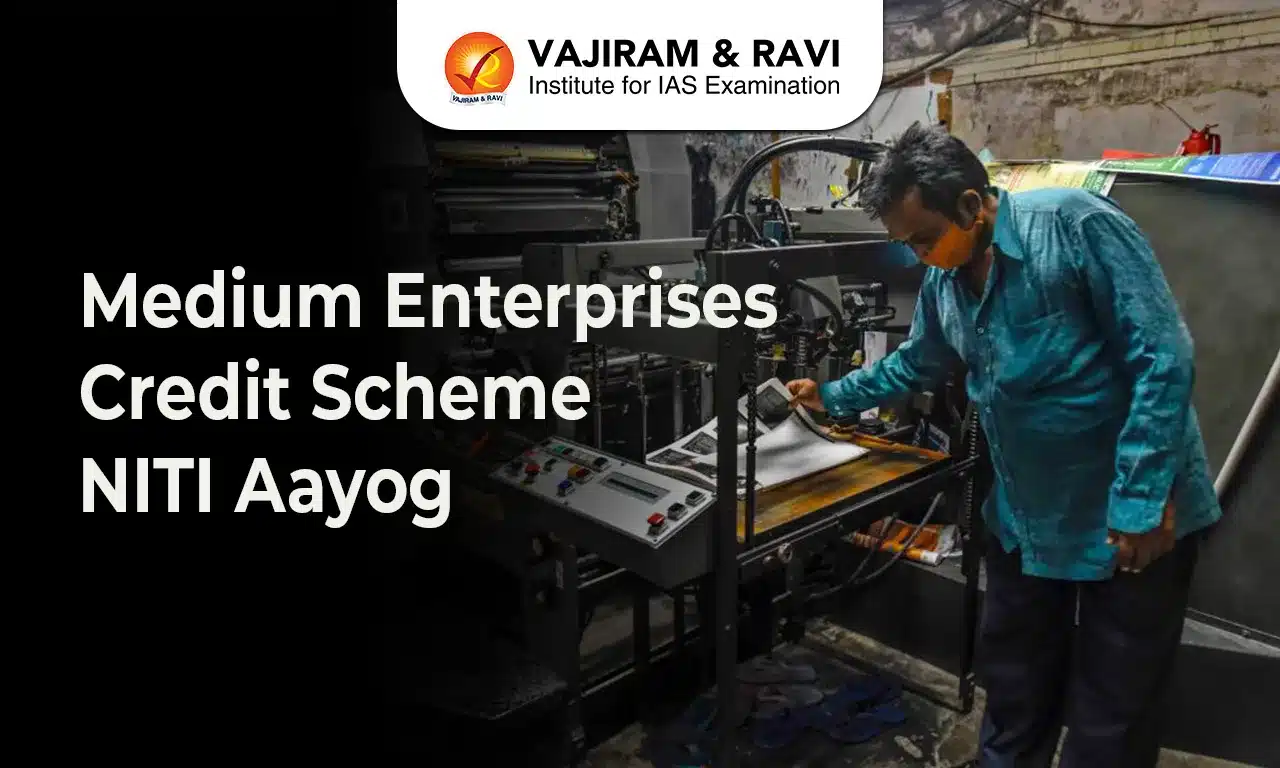
The NITI Aayog, government's policy think tank, has recommended the introduction of a dedicated financing scheme to allow medium enterprises to avail loans at concessional rates.
Introduction
Medium enterprises (MEs) represent a crucial but often overlooked segment of India’s economic fabric.
Despite contributing significantly to exports and employment, they face persistent challenges in accessing affordable credit.
In response, NITI Aayog has released a comprehensive report recommending policy interventions to ease financial constraints and strengthen the sector’s growth trajectory.
Significance of Medium Enterprises in the MSME Ecosystem
India’s MSME sector, comprising Micro, Small, and Medium Enterprises, contributes about 29% to the country’s GDP and employs over 60% of its workforce.
While micro enterprises make up 97% and small enterprises 2.7% of registered MSMEs, medium enterprises form only 0.3%.
However, this small segment is responsible for nearly 40% of MSME exports, underlining its strategic importance in driving India’s industrial competitiveness and export performance.
Credit Challenges Faced by Medium Enterprises
According to the NITI Aayog report titled “Designing Policy for Medium Enterprises”, the sector faces a credit gap of $10 billion (as of 2024), primarily due to structural and institutional barriers.
Medium enterprises typically receive fewer priority sector loans than micro units and face borrowing costs that are approximately 4% higher than large corporations.
Moreover, only 8 of the 18 MSME government schemes cater to medium enterprises, and just 17.81% of total funds are allocated to them.
This has exacerbated funding constraints, leaving MEs without sufficient working capital support.
NITI Aayog’s Recommendations
Dedicated Working Capital Financing Scheme
NITI Aayog has suggested a sector-wise financing scheme based on enterprise turnover, with loans capped at ₹25 crore, and a maximum of ₹5 crore per individual request.
The scheme would be managed by the Ministry of MSME and aim to provide timely and flexible funding for manufacturing and services units.
Medium Enterprise Credit Card
To address urgent liquidity needs such as payroll, inventory purchases, and equipment repair, a medium enterprise credit card facility with a ₹5 crore limit has been proposed.
The interest rates would align with market norms but include a grace period for repayment.
Faster Fund Disbursal Through Retail Banks
The report advocates the involvement of retail banks for quicker fund distribution, under the supervision of the MSME ministry.
This would cut bureaucratic delays and ensure timely credit access.
Broader Structural Issues Identified
Apart from financial constraints, medium enterprises struggle with several non-financial challenges:
Low adoption of advanced technologies
Inadequate R&D support
Lack of sector-specific testing infrastructure
Mismatch between training programmes and actual enterprise needs
These factors hinder scalability and innovation potential within the segment.
Suggested Digital and Skilling Reforms
To improve access to government resources, NITI Aayog recommends developing a dedicated sub-portal under the existing Udyam platform. This portal would include:
Scheme discovery tools
Compliance support
AI-driven navigation assistance for enterprises
Additionally, it calls for the integration of medium enterprise-specific modules into skilling and entrepreneurship training, aligned with regional and sectoral demands.
Policy Outlook: Building a Supportive Ecosystem
The report underscores that unlocking the potential of medium enterprises demands an inclusive and coordinated policy framework.
Strategic interventions in financing, skilling, digital access, and infrastructure are essential to harness the segment’s full capabilities.
By enabling greater ease of doing business and removing systemic credit bottlenecks, India can position its medium enterprises as powerful drivers of export growth, employment, and self-reliance in the global economy.
Medium Enterprises Credit Scheme FAQs
Q1. What percentage of registered MSMEs are medium enterprises?
Ans. Medium enterprises account for just 0.3% of all registered MSMEs.
Q2. How much of MSME exports are contributed by medium enterprises?
Ans. Medium enterprises contribute nearly 40% of all MSME exports.
Q3. What is the proposed credit card limit for medium enterprises?
Ans. NITI Aayog has recommended a ₹5 crore credit card facility for medium enterprises.
Q4. What is the estimated credit demand gap for medium enterprises?
Ans. The credit gap for medium enterprises in 2024 is estimated at $10 billion.
Q5. What additional digital support has NITI Aayog proposed for medium enterprises?
Ans. A dedicated Udyam portal subsection with scheme discovery tools, compliance help, and AI-based guidance has been proposed.
The IMD declared monsoon onset over Kerala on May 24, eight days earlier than the normal June 1 schedule. This onset signals the start of the June–September southwest monsoon, which delivers over 70% of India's annual rainfall, making it vital for agriculture and the economy.
The last time the monsoon arrived this early was in 2009, on May 23.
Monsoon Onset Declaration: Criteria and Process
The IMD attempts to declare the schedule for southwest monsoon onset any time after May 10. To do so, certain essential criteria are considered.
Key Criteria for Onset
Rainfall
At least 60% of 14 designated southern meteorological stations (including Thiruvananthapuram, Kochi, Mangalore, etc.) must report ≥2.5 mm rainfall for two consecutive days.
Wind Field
Westerly winds must dominate up to 600 hPa pressure level.
Wind speed at 925 hPa must range between 15–20 knots (27–37 km/h).
Outgoing Longwave Radiation (OLR)
The Earth absorbs and reflects solar energy, affecting global temperature and climate.
Aerosol particles in the atmosphere can absorb sunlight, contributing to atmospheric warming.
The absorbed energy is re-emitted as longwave infrared radiation (OLR).
OLR mainly originates from the warmed upper atmosphere, with some from the Earth's surface.
This radiation helps warm the lower atmosphere, which in turn warms the Earth’s surface.
OLR values must be below 200 W/m², indicating favorable atmospheric conditions for monsoon onset.
IMD Declaration
The monsoon onset is declared on the second day after all above conditions are met.
This Year’s Onset
A simultaneous onset occurred over Kerala, Lakshadweep, Mahe (Puducherry), parts of the Arabian Sea, Bay of Bengal, and southern Karnataka and Mizoram.
Factors Behind Early Monsoon Onset in India
The early onset of the southwest monsoon was driven by favourable atmospheric and oceanic conditions.
A low-pressure area over the Arabian Sea and a trough over Vidarbha enhanced moisture inflow and atmospheric convection, accelerating the monsoon’s advance.
Madden-Julian Oscillation (MJO)
MJO is a significant and complex ocean-atmosphere phenomenon that originates in the Indian Ocean and plays a crucial role in influencing the Indian monsoon.
It involves disturbances in clouds, winds, and pressure that move eastward at a speed of 4–8 metres per second.
These disturbances, known as MJO wind bands, can circle the globe within 30 to 60 days and lead to major weather changes along their path.
When the MJO is in a favourable phase, it can enhance rainfall over India during the monsoon season.
Mascarene High
The IMD describes the Mascarene High as a high-pressure area found around the Mascarene Islands (in the south Indian Ocean) during the monsoon period.
The variation in the intensity of high pressure is responsible for heavy rains along India’s west coast.
Convection and Rainfall
An increase in convective activity—vertical movement of heat and moisture in the atmosphere—can lead to rainfall.
For example, a convective system over Haryana recently moved southeastward and caused rain in the Delhi region.
Somali Jet and Monsoon Strength
The Somali jet is a low-level, cross-equatorial wind system originating near Mauritius and north Madagascar.
By May, it crosses the east coast of Africa and reaches the Arabian Sea and the west coast of India.
A strong Somali jet enhances the monsoon winds, contributing to a robust monsoon.
Heat-Low and Moisture Inflow
With the Sun’s shift to the northern hemisphere during summer, a low-pressure zone forms over the Arabian Sea.
A heat-low over Pakistan and nearby regions acts like a suction pump, drawing moist air into the monsoon trough and intensifying monsoon rainfall.
Monsoon Trough
The monsoon trough is an elongated low-pressure area stretching from the heat low over northwest India to the north Bay of Bengal.
Its north-south oscillation brings rainfall across the core monsoon zone during June to September.
Additionally, the pressure gradient and the monsoon onset vortex—a cyclonic system in the Arabian Sea—contribute to the timely and strong onset of the monsoon.
Early Monsoon Onset India FAQs
Q1. When did the 2025 monsoon begin in India?
Ans. On May 24, eight days earlier than the normal onset date of June 1.
Q2. What is the Madden-Julian Oscillation (MJO)?
Ans. A global weather system that enhances rainfall when in a favourable phase over the Indian Ocean.
Q3. How does the Somali Jet affect monsoons?
Ans. A strong Somali Jet enhances monsoon winds, boosting rainfall along India’s west coast.
Q4. What is the role of the heat-low?
Ans. It draws moist air from the sea into the land, strengthening the monsoon trough.
Q5. Why is OLR important for monsoon onset?
Ans. Low OLR values (<200 W/m²) indicate atmospheric conditions favorable for monsoon development.
The Indian Navy’s guided missile frigate INS Brahmaputra, which suffered extensive damage in a dockyard accident last year, is likely to regain seaworthiness by the end of 2025 and be fully combat-ready by mid-2026, senior officials said recently.
About INS Brahmaputra
It is the first indigenously built Brahmaputra-class guided missile frigate.
It was built by Kolkata-based Garden Reach Shipbuilders and Engineers Limited (GRSE).
It was commissioned into the Indian Navy on April 14, 2000.
It takes on various roles such as coastal and offshore patrolling, monitoring sea routes, conducting maritime diplomacy, and carrying out counter-terrorism and anti-piracy missions.
INS Brahmaputra Features
Its crest features a grey, one-horned Indian rhinoceros, which is native to the Brahmaputra valley, set against a brown background with white and blue sea waves.
The ship has a displacement of 5,300 tonnes, is 125 meters long, and is 14.4 meters wide.
It can reach speeds over 27 knots (about 50 km/h).
It is equipped with medium- and close-range guns,anti-aircraft weapons, surface-to-surface and surface-to-air missiles, and torpedo launchers.
It is equipped with a range of sensors for all aspects of maritime warfare and can operate Sea King and Chetak helicopters.
It is crewed by 40 officers and 330 sailors.
INS Brahmaputra FAQs
Q1: INS Brahmaputra belongs to which class of ships?
Ans: It is the first indigenously built Brahmaputra-class guided missile frigate.
Q2: In which year was INS Brahmaputra commissioned into the Indian Navy?
Ans: 2000
Q3: What is the primary operational role of INS Brahmaputra?