
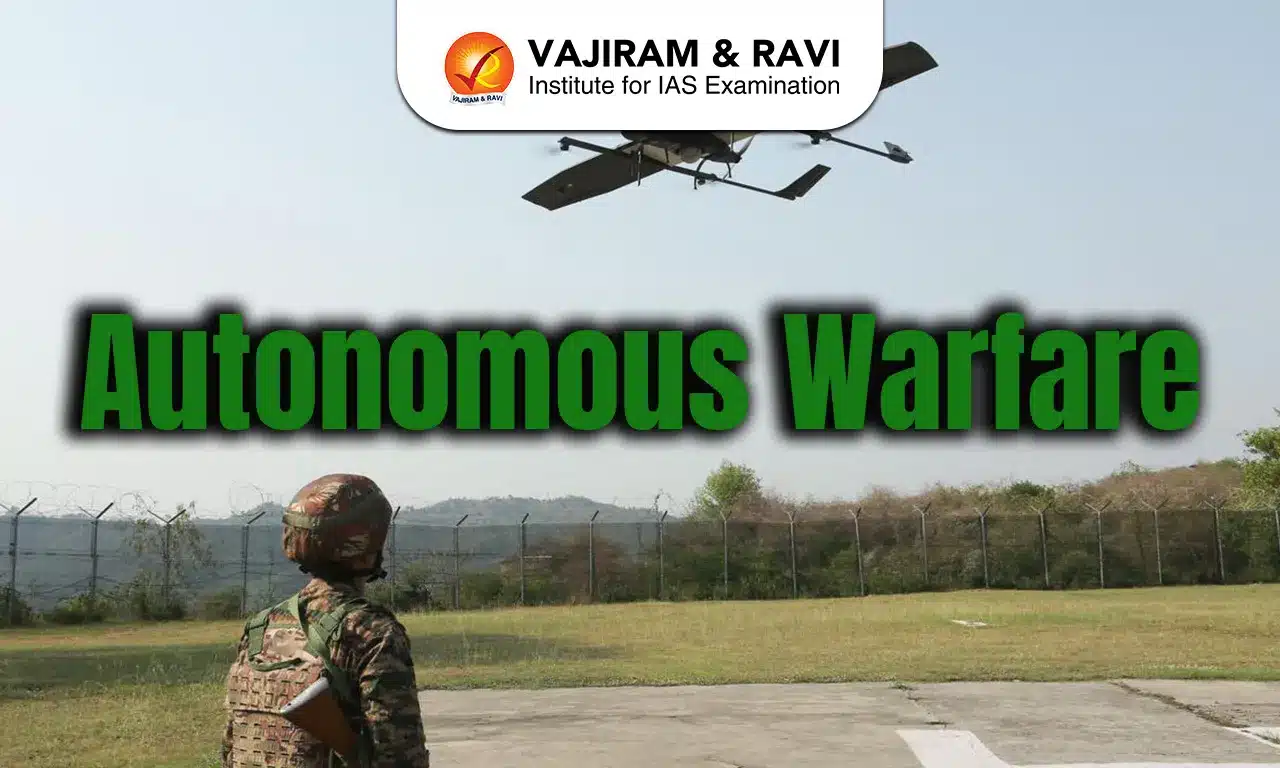
Autonomous Warfare Latest News
- Launched in early May as retaliation for the April 22 Pahalgam terror attack, Operation Sindoor marked the first direct drone-led military conflict between nuclear-armed India and Pakistan.
- Over four days, both nations shifted to a new mode of engagement centered on Unmanned Aerial Systems (UAS)—including armed drones, loitering munitions, and electronic decoys—operating below the threshold of full-scale war.
- Prior to the operation, Israeli Heron MK-II and indigenous TAPAS-BH-201 (Rustom-II) UAVs conducted deep surveillance into Pakistani airspace.
- From May 7, India struck nine targets, and both sides deployed a wide range of drones for real-time ISR (Intelligence, Surveillance, Reconnaissance) and precision strikes.
- Tactics included the use of decoy drones to spoof enemy radars and drain interceptor stocks. The conflict de-escalated by May 10 following a ceasefire, setting a precedent for drone-centric warfare in South Asia.
India’s Use of Aerial Systems in Operation Sindoor
- India used a varied fleet of Unmanned Aerial Systems (UAS), including:
- Indigenous loitering munitions like Nagastra-1
- Israeli-origin Harop drones (capable of autonomous radar targeting)
- Swarm drones developed by DRDO and private firms for radar saturation
Tactical Strategy: Sequenced Drone Strikes
- Initial waves included decoy drones and EW (electronic warfare) payloads to confuse radar and exhaust SAM (Surface-to-Air Missile) defences.
- Followed by precision loitering munitions and armed UAVs guided by Heron MK II and TAPAS-BH-201 drones.
- Quadcopters and micro-UAVs supplied real-time ISR feeds via the Integrated Battle Management System (IBMS) for dynamic target acquisition.
Notable Impacts and Strikes
- Reports claimed a cricket match in Rawalpindi was disrupted due to Indian drone strikes.
- A Chinese-supplied HQ-9 SAM system near Lahore was reportedly destroyed by an Indian Harop drone.
Strategic Implications
- The operation showcased India’s growing capability in autonomous warfare, executing precise, risk-free cross-border strikes.
- Analysts highlighted this as a new model of deterrence in South Asia, signaling a shift in regional aerial power dynamics in India’s favor.
India’s Multi-Layered Air Defence System During Operation Sindoor
- Integrated Air Command and Control System (IACCS) is India’s core air defence nerve centre.
- It fuses inputs from ground-based radars, AWACS, satellites, and other sensors.
- It also enables real-time tracking and interception of low-altitude threats like drones via integration with SAMs and fighter jets.
- It is designed with redundancy — damage to nodes doesn't disrupt overall operations due to alternate data links and mobile radars.
Pakistan’s Attempted Disruption
- Pakistan tried to overload IACCS by varying drone altitude, timing, and routes to: Disrupt communication nodes; Confuse command loops; Find vulnerabilities for follow-up drone/missile strikes.
- All attacks were unsuccessful; any disruptions were swiftly mitigated.
Advanced Features and Failover Capabilities
- IACCS’s ‘mesh’ architecture allows:
- Seamless failover when nodes are hit.
- Sustained situational awareness using satellite uplinks and mobile platforms.
- Directed Energy Weapons (DEWs): Employed high-powered lasers/microwaves to neutralise drones quickly.
Tactical Support: Akashteer System
- Akashteer developed by Bharat Electronics Limited (BEL) for Army Air Defence units.
- Digitised command layer ensures:
- Real-time coordination between sensors and weapons.
- Effective handling of low-level threats like UAVs, even under EW/communication stress.
Layered Architecture of the Air Defence Shield
- India used a multi-layer defence combining:
- Retrofitted Cold War-era systems.
- Modern missile platforms.
- Low-Level Air Defence (LLAD) Network
- Composed of legacy systems upgraded with radar-directed fire and electro-optical sights.
- Even Army and BSF snipers contributed by shooting down drones in frontline areas.
- Modern Additions
- Israeli SPYDER missile system with Python-5 and Derby missiles: Used for point defence against UAVs, cruise missiles, and aircraft.
A New Kind of War – The Technological Evolution of Operation Sindoor
- Advanced Missile Systems for Layered Defence
- Akash & Akash-NG: Provided medium-range air defence against aerial threats.
- Barak-8: India-Israel joint development offering long-range protection of high-value strategic assets from aircraft, drones, and missiles.
- S-400 'Triumf' (Sudarshan Chakra): Russia-made cutting-edge long-range air defence system; India has received 3 out of 5 units ordered.
- Centralised Integration through IACCS
- All missile systems were seamlessly integrated via the Integrated Air Command and Control System (IACCS).
- Enabled coordinated, real-time responses to a full spectrum of aerial threats.
- Dawn of Algorithmic, Autonomous Warfare
- Operation Sindoor marked a paradigm shift:
- From conventional to autonomous, algorithm-driven warfare.
- Deterrence mechanisms are now shaped by data, drones, and digital precision rather than brute force.
- Future conflicts may begin not with human mobilization but with the silent launch of autonomous drones — a shift in both strategy and psychology of warfare.
- Operation Sindoor marked a paradigm shift:
Autonomous Warfare FAQs
Q1. What is Operation Sindoor?
Ans. A drone-led military conflict between India and Pakistan launched in May, marking the start of autonomous warfare in South Asia.
Q2. Which drones did India use?
Ans. India used Nagastra-1, Harop drones, and swarm drones for precision strikes and aerial dominance.
Q3. What is the IACCS?
Ans. India’s Integrated Air Command and Control System ensures real-time tracking and neutralization of drone threats using multi-source data integration.
Q4. What role did Directed Energy Weapons play?
Ans. DEWs used high-powered lasers and microwaves to quickly detect and disable incoming enemy drones during combat.
Q5. How did India defend against Pakistani drones?
Ans. India employed a layered air defence system with LLAD platforms, Akash missiles, SPYDER systems, and upgraded Cold War-era weapons.
.Source: TH
