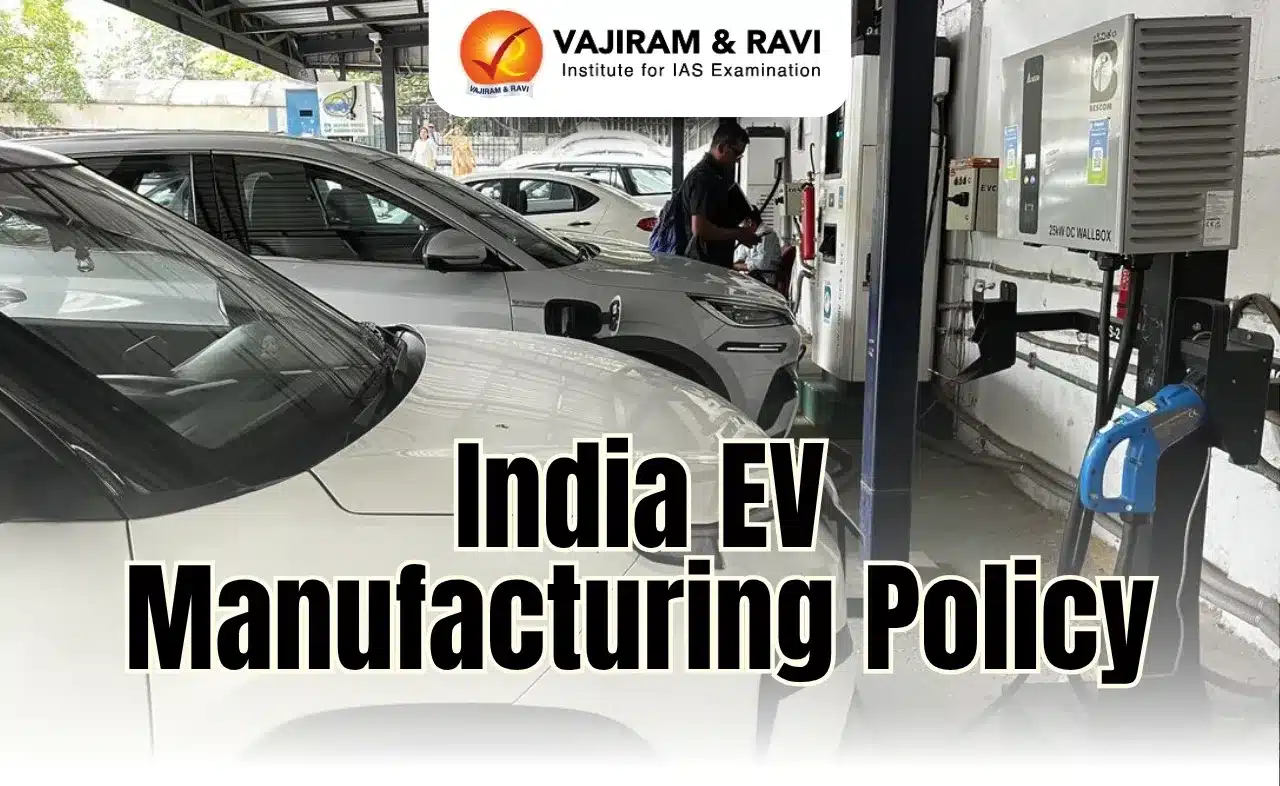
India’s EV Localisation Policy Latest News
- The Ministry of Heavy Industries notified guidelines of the Scheme to Promote Manufacturing of Electric Passenger Cars in India.
India’s Strategy to Accelerate EV Manufacturing
- India has taken a bold step to bolster its electric vehicle (EV) sector by unveiling a policy aimed at encouraging domestic manufacturing while permitting limited imports of fully built electric cars at reduced import duties.
- This Scheme to Promote Manufacturing of Electric Passenger Cars, announced by the Ministry of Heavy Industries (MHI), is part of a broader effort to enhance clean mobility and industrial competitiveness.
Key Provisions of the Scheme
- The central feature of the policy is a sharp reduction in customs duty on completely built units (CBUs) of electric cars, from the current 70-100% to just 15%.
- This duty cut applies to vehicles priced at or above $35,000 (approximately Rs. 29.75 lakh) for a five-year period. However, this benefit is contingent on manufacturers investing a minimum of Rs. 4,150 crore in India over three years.
- These investments must result in domestic value addition (DVA) of at least 25% within three years, increasing to 50% by the fifth year.
- A maximum of 8,000 vehicles can be imported annually under the concessional duty regime, and the total foregone customs duty is capped at Rs. 6,484 crore.
- MHI estimates that an imported EV under this scheme would incur a landing cost of Rs. 36 lakh, significantly lower than before.
Assessing Ecosystem Impact
- The policy aims to strike a balance between short-term affordability for Indian consumers and long-term self-reliance in manufacturing.
- According to FADA data for FY 2025, EVs made up 7.8% of total vehicle sales, with three-wheelers leading at 57% within their segment, followed by two-wheelers (6.1%), passenger vehicles (2.6%), and commercial vehicles (0.9%).
- The International Energy Agency (IEA) identified India as the largest global market for electric three-wheelers in 2024, underscoring the importance of focusing not only on private four-wheelers but also on mass and last-mile mobility.
- Critics, however, caution that the scheme could dilute India's domestic manufacturing ambitions if foreign firms are not compelled to transfer core technologies. Countries often resist exporting their technological edge, potentially reducing India to a component assembly hub.
- Another critic emphasized the importance of innovation, R&D, and skilling, elements that powered China and South Korea's emergence as global EV leaders. Without these, India may fail to build a truly indigenous ecosystem.
Concerns Over Industrial and Employment Policy
- Indian EV manufacturers, notably Tata Motors and Mahindra, have expressed reservations about the scheme.
- In December 2023, Tata opposed Tesla’s demand for lower import duties, arguing that such a move would disrupt an investment climate based on a stable, protectionist tax regime.
- IEA data revealed that over 80% of electric cars produced in India in 2024 came from local manufacturers, while Chinese imports contributed less than 15% to EV sales, thanks in part to the earlier high-duty barriers and availability of affordable domestic options.
- Analysts argue that the new policy may tilt the scale in favour of foreign capital, thereby impacting domestic players and job creation.
- As EVs typically require fewer moving parts than traditional internal combustion engines, the shift could also mean fewer jobs in traditional manufacturing sectors unless accompanied by new skilling initiatives.
- Furthermore, S&P Global Mobility has pointed out that India’s continued reliance on imported batteries and components, along with the high upfront cost of EVs (20–30% more than ICE vehicles), remains a barrier to mass adoption and localisation.
Path Forward
- Experts suggest that India’s EV roadmap must be reoriented toward building domestic capacity, fostering innovation, and ensuring broad-based industrial growth.
- Rather than focusing primarily on attracting foreign OEMs, policies should invest in research institutes, encourage public sector participation, and fund start-ups in the EV supply chain.
- A critical challenge will be to integrate India's climate commitments with its manufacturing strategy.
- As India targets net-zero emissions by 2070, it must simultaneously expand clean mobility options and ensure they are accessible, affordable, and built with local value addition.
India EV Manufacturing Policy FAQs
Q1. What is the core provision of India’s new EV manufacturing scheme?
Ans. The policy allows import of electric cars at 15% duty if the manufacturer invests ₹4,150 crore and meets localisation targets.
Q2. How many EVs can be imported under the scheme annually?
Ans. A maximum of 8,000 electric vehicles can be imported per year at the reduced duty rate.
Q3. What localisation targets are set for EV manufacturers?
Ans. Manufacturers must achieve 25% domestic value addition in three years and 50% in five years.
Q4. Why are Indian automakers opposing the scheme?
Ans. Domestic players like Tata fear reduced import duties could disrupt the investment climate and harm local industries.
Q5. How does the policy align with India’s EV and climate goals?
Ans. The policy aims to boost clean mobility while encouraging foreign investment, but concerns remain over technology transfer and job creation.
Source: TH