Naxalism in India is a powerful reminder of the urgent need to address deep socio-economic inequalities, resolve land disputes, and uplift marginalised tribal communities. Naxalism, which is also referred to as Naxal, Naxalite, or Naksalvadi, represents militant left-wing movements active across various parts of India under diverse organisational structures.
Naxalism has significant implications for internal security, tribal development, governance and economic growth, particularly in affected areas. Although the geographical spread of Left-Wing Extremism has declined substantially, challenges remain in addressing underdevelopment, tribal rights, forest-related disputes, recruitment networks, security gaps and residual violence.
Naxalism Meaning
Naxalism refers to the militant left-wing movement in India rooted in communist ideologies. It aims to address social and economic inequalities through armed struggle. Naxalism operates under various organisational frameworks across India and remains a persistent internal security challenge.
Naxalism in India
Naxalism in India refers to the far-left Maoist insurgency that originated in Naxalbari, West Bengal, in 1967. It seeks to overthrow the state through armed rebellion, primarily operating in the "Red Corridor." Rooted in socio-economic disparities, it remains a major internal security challenge despite sustained counterinsurgency efforts.
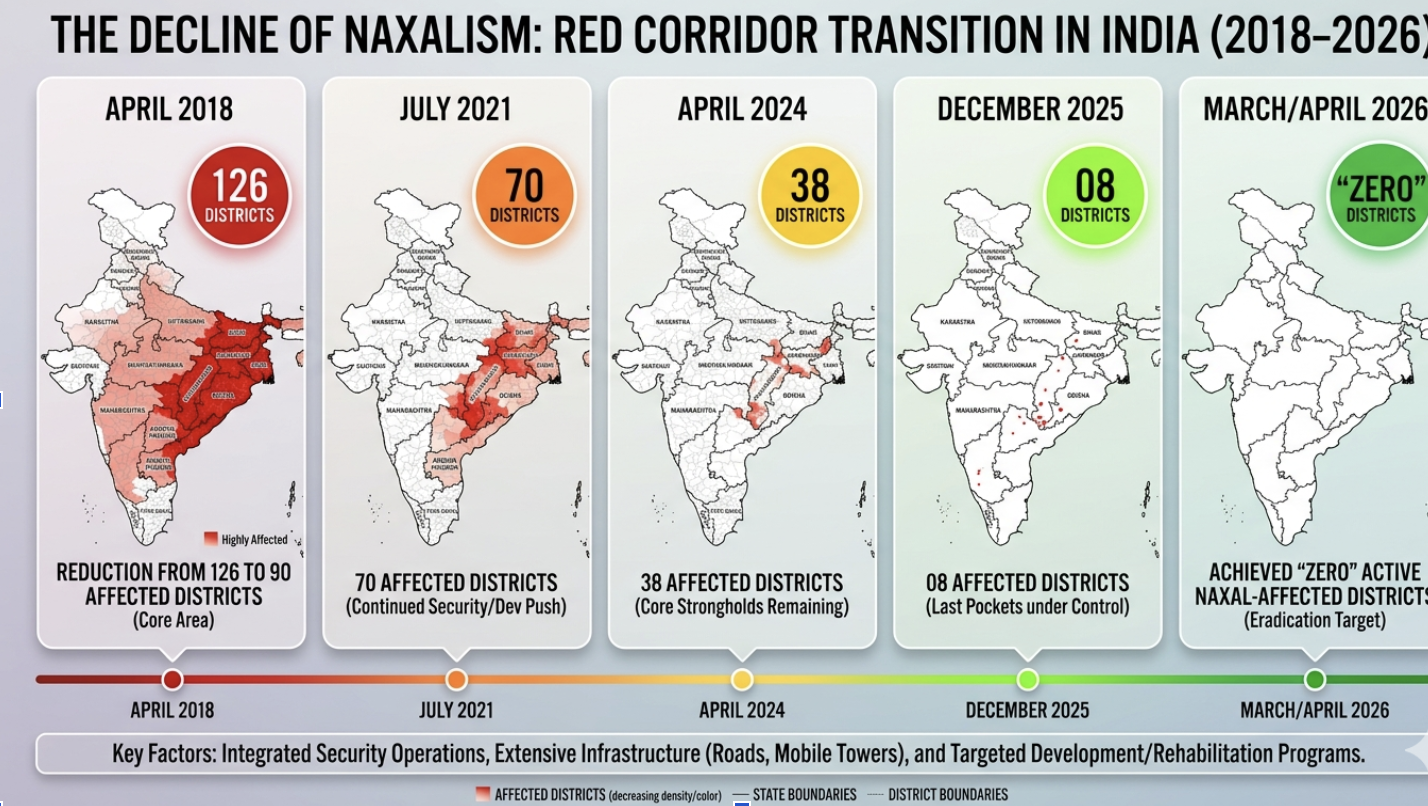
- The number of Naxal-affected districts reduced from 126 to 90 in April 2018, 70 in July 2021, 38 in April 2024, 08 in December, 2025, and to “zero” in March/April 2026.


Naxalism in India History
The history of Naxalism in India began in ~1967 with the Naxalbari uprising, later spreading across India. Despite government crackdowns and factional splits, it evolved into the CPI (Maoist) and remains an ongoing socio-political and security challenge.
- Origins in the Naxalbari Uprising (1967): The movement began with a peasant revolt in Naxalbari village, West Bengal, led by communist leaders against local landlords. The revolt protested exploitative practices and demanded land reforms.
- Formation of CPI (Marxist-Leninist) (1969): Following ideological splits within the Communist Party of India (Marxist), leaders like Charu Majumdar and Kanu Sanyal established the Communist Party of India (Marxist-Leninist) to pursue armed revolution.
- Spread to Other States (1970s): The Naxalite movement expanded beyond West Bengal to rural areas in states such as Andhra Pradesh, Bihar, Odisha, and Madhya Pradesh, gaining support among marginalised communities.
- Government Crackdown and Operation Steeplechase (1971–1972): The Indian government launched military operations to suppress Naxalite activities, resulting in the arrest and deaths of key leaders, including Charu Majumdar in 1972.
- Emergence of New Groups (1980s–1990s): Despite setbacks, factions like the People's War Group (PWG) and Maoist Communist Centre (MCC) emerged, continuing insurgent activities and advocating Maoist ideologies.
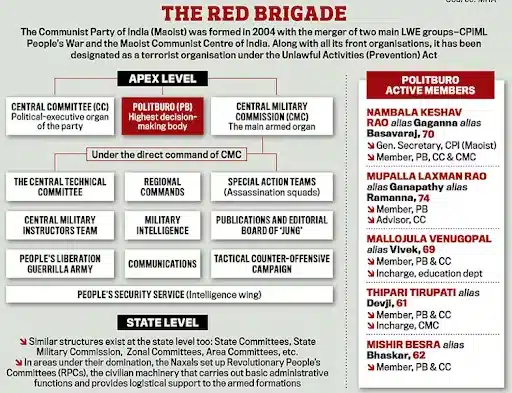
- Formation of CPI (Maoist) (2004): The PWG and MCC merged to form the Communist Party of India (Maoist), intensifying insurgency efforts and consolidating influence in the "Red Corridor."
- Government Countermeasures (2000s–Present): The Indian government has implemented security operations and development initiatives to address Naxalism, aiming to curb violence and address underlying socio-economic issues.
Current Status of Naxalism in India
India has officially fulfilled its goal of becoming Naxal-free, with the Ministry of Home Affairs announcing that the insurgency will be largely dissolved by March 31, 2026. Through coordinated security operations, structural development, and huge cadre surrenders, the number of Naxal-affected districts was reduced to zero. While the armed insurrection has been fully dismantled, the government continues to monitor former strongholds and provide developmental assistance in order to keep peace indefinitely.
Naxalism in India Phases
Phases of Naxalism in India include emergence, regrouping and expansion, and consolidation, marked by armed struggle, ideological shifts, and state responses combining force and development. The growth and evolution of Naxalism in India, commonly referred to as Left-Wing Extremism (LWE), can be categorised into three distinct phases:
Phase 1: Naxalbari and Early Struggles (1967–1974)
Phase 1 of Naxalism in India started with the Naxalbari Uprising (1967), which crystallised after police fired on protesting peasants in Naxalbari village, Darjeeling, West Bengal, on May 25, 1967. Leaders like Charu Majumdar, Jangal Santhal, and Kanu Sanyal mobilised landless peasants to seize landlords' lands, branding them as "class enemies."
- Formation of CPI (Marxist-Leninist): Led by Charu Majumdar, the Communist Party of India (Marxist-Leninist) was established in 1969, inspired by the Communist Party of China.
- Ideology: The CPI (ML) rejected the electoral process and promoted violent revolution to achieve political goals. This was the first major instance of an armed peasant uprising post-independence.
- Post-Charu Majumdar’s Death: The party lacked credible leadership, was fragmented, and was eventually reorganised as CPI (ML) Liberation in 1974.
- Groups like CPI (ML) Satyanarayan Singh Group (SNS) and factions led by Ashim Chatterjee and Santosh Rana emerged.
- Impact of Emergency (1975): The movement faced severe repression, with around 40,000 cadres imprisoned.
Phase 2: Revival and Strategic Expansion (1980s)
Phase 2 of Naxalism in India was marked by a re-emergence in a more violent form, extending its influence from West Bengal to Bihar, Odisha, Andhra Pradesh, and Chhattisgarh, following the strategy of a protracted war.
- Formation of People’s War Group (PWG): Established in 1980 in Andhra Pradesh under Kondapalli Seetharamaiah, the PWG drew heavily from Mao Tse Tung's theory of peasant insurrection.
- Objective: To establish a "people’s government" through guerrilla warfare, converting rural areas into liberated zones before encircling cities.
- Emergence of MCC: The Maoist Communist Centre (MCC), originally formed as Dakshin Desh in 1969, also aimed to achieve a people’s government through organised armed struggle.
- Setbacks: Security operations and internal conflicts weakened the movement during this period.
Phase 3: Consolidation and Escalation (2000–Present)
Phase 3 of Naxalism in India was marked by the formation of the People’s Guerrilla Army in 2000, marking the transition to more coordinated violence. The PWG and MCC merged to form CPI (Maoist), which became the most dominant and violent LWE outfit.
- Territorial Spread: By the 2000s, Naxalism affected 233 districts in 20 states, particularly in the Dandakaranya region (Chhattisgarh, Odisha, Maharashtra, Andhra Pradesh).
- Parallel Administration: Maoists operate a parallel judiciary and government in affected areas.
- LWE activities are now confined to nine states: Chhattisgarh, Odisha, Jharkhand, Madhya Pradesh, Kerala, Maharashtra, Telangana, Andhra Pradesh, and West Bengal.
Major Naxal Attacks in India
The Naxalite-Maoist insurgency has led to several significant attacks in India over the years. Notable incidents include:
- Dantewada Attack: On April 6, 2010, Maoist insurgents ambushed a convoy of the Central Reserve Police Force (CRPF) near Chintalnar village in Chhattisgarh's Dantewada district, resulting in the deaths of 76 CRPF personnel.
- Dantewada Bus Bombing: On May 17, 2010, Maoists targeted a civilian bus in Dantewada district by detonating a landmine, leading to the deaths of 31 to 44 individuals, including Special Police Officers and civilians.
- Jehanabad Jail Break: On November 13, 2005, over a thousand Maoist insurgents attacked the Jehanabad prison in Bihar, freeing more than 300 inmates, including several top Maoist leaders.
- Sukma Attack: On April 24, 2017, Maoists ambushed a CRPF convoy in Sukma district, Chhattisgarh, killing 26 personnel.
- Sukma–Bijapur Attack: On April 3, 2021, an ambush by Maoist militants in the Sukma-Bijapur border area led to the deaths of 22 security personnel and 20 insurgents.
- Indravati Forest Clash: On February 9, 2025, in Chhattisgarh's Indravati forest region, a clash between Maoist insurgents and security forces resulted in the deaths of at least 31 rebels and two police officers.
Naxalism in India Causes
Naxalism in India is caused by socio-economic inequalities, landlessness, exploitation of tribal communities, lack of development, unemployment, displacement due to mining projects, and ineffective governance in remote and marginalised regions.
- Landlessness and Agrarian Distress: Widespread landlessness among marginalised communities and failure to implement land reforms have led to agrarian distress, exploitation by landlords, and deep-rooted dissatisfaction, fueling support for the Naxalite movement.
- Exploitation of Tribal Communities: Tribal populations in central and eastern India have long faced neglect, displacement due to mining and development projects, and exploitation by forest officials and contractors, creating fertile ground for insurgent ideologies.
- Poverty and Economic Inequality: Severe poverty, lack of employment opportunities, and unequal distribution of resources in underdeveloped regions contribute to resentment against the state, making Naxal ideology appealing to the economically deprived.
- Lack of Education and Health Services: The absence of a quality education sector, healthcare, and basic infrastructure in remote and forested areas deepens alienation and mistrust toward government institutions, enabling extremist groups to gain influence and control.
- Poor Governance and Corruption: Administrative apathy, corruption at grassroots levels, and failure to deliver justice or basic entitlements push people toward Naxal groups that promise swift and alternative systems of governance.
- Displacement due to Industrialisation: Unplanned industrial development and resource extraction have led to mass displacement without adequate rehabilitation, particularly affecting tribals and Dalits, intensifying their discontent and support for violent resistance.
- Police Atrocities and State Violence: Allegations of custodial torture, fake encounters, and heavy-handed operations by security forces have aggravated local grievances, reinforcing the Naxal narrative of state oppression and injustice.
Naxalism in India Challenges
Combating Naxalism in India faces challenges like difficult terrain, poor intelligence, guerrilla tactics, socio-economic grievances, legal concerns, and resource constraints, which hinder effective operations and long-term resolution of the insurgency.
- Inadequate Intelligence and Coordination: Effective counterinsurgency operations require precise intelligence. However, gathering actionable information is challenging due to the rebels' deep integration with local communities and the lack of coordination among various government agencies.
- Ambush Tactics and Guerrilla Warfare: Naxalites employ guerrilla tactics, including ambushes and hit-and-run attacks, exploiting their familiarity with the terrain to inflict casualties on security forces and then disappearing into dense forests.
- Socio-Economic Grievances: Persistent issues like poverty, landlessness, and unemployment in affected regions fuel local support for Naxalism, complicating efforts to delegitimise the insurgency without addressing these underlying problems.
- Legal and Human Rights Concerns: Operations against Naxalites must balance security objectives with human rights considerations. Allegations of excesses by security forces can erode public trust and inadvertently bolster insurgent propaganda.
- Resource Constraints: Limited manpower, equipment, and funding for security forces impede sustained operations, while Naxalites often have access to illicit funds and arms, creating an asymmetry in capabilities.
Naxalism in India Government Measures
The Indian government combats Naxalism through security operations, development programs, infrastructure expansion, improved governance, and rehabilitation policies to address both violence and the socio-economic grievances of affected communities.
- Security Operations: Major operations like Operation Steeplechase (1971), Operation Green Hunt (2009), and Operation Black Forest (2025) deployed joint forces and specialised COBRA commandos to curb Naxalite activity.
- 663 fortified police stations have been constructed, compared with only 66 before 2014. In addition, 408 new CAPF security camps were established to strengthen the security grid in remote areas.
- Financial Disruption: A dedicated National Investigation Agency (NIA) mechanism was established to target Naxal financing. By December 2025, the NIA had seized assets worth over ₹40 crore, while the Enforcement Directorate (ED) attached ₹12 crore and State agencies confiscated another ₹40 crore.
- Surrender and Rehabilitation: Surrendered cadres receive an immediate grant of ₹5 lakh for higher-ranked cadres and ₹2.5 lakh for others, along with ₹10,000 monthly for 36 months. In 2025 alone, 2,337 Naxalites surrendered, while 3,927 cadres surrendered between 2024 and March 2026.
- Technology: After 2014, the Central Government transformed counter-Naxal operations through the extensive use of modern technology. Unmanned Aerial Vehicles (UAVs), drone technology, satellite imagery, and AI-based data analysis enabled real-time monitoring and precise surveillance.
- SAMADHAN Strategy: An operational strategy to fight Left Wing Extremism. The strategy emphasises:
- Smart leadership
- Aggressive strategy
- Motivation and training
- Actionable intelligence
- Dashboard-based performance metrics
- Harnessing technology
- Action plans for theatres
- No financial access for insurgents.
- Aspirational Districts Programme (ADP), launched by the Government of India in January 2018, aims to rapidly transform 112 of the most under-developed districts across the country, including those affected by Left Wing Extremism (LWE).
- Tribal Youth Integration: Under the Tribal Youth Exchange Programme (TYEP), 37,655 tribal youth from erstwhile LWE-affected areas have participated since 2014, promoting national integration and exposure to development opportunities.
Naxalism in India Way Forward
A sustainable response to Naxalism/Left-Wing Extremism (LWE) requires a balance between security measures and addressing governance, development, and rights-related concerns.
- Strengthen Local Governance: Improve the delivery of public services and make district administration more accessible and accountable in affected areas.
- Protect Tribal Rights: Ensure effective implementation of laws and constitutional safeguards relating to land, forest resources and community rights.
- Accelerate Development: Prioritise roads, schools, healthcare, electricity, digital connectivity and livelihood opportunities in remote areas.
- Improve Security Capacity: Strengthen state police, intelligence-sharing and coordination between State Police and Central Armed Police Forces while maintaining civilian protection.
- Promote Community Participation: Involve local communities in development planning and grievance redressal so that governance becomes more responsive to local needs.
- Strengthen Surrender and Rehabilitation: Provide credible rehabilitation and reintegration support to individuals who abandon violence and return to mainstream society.
Naxalism in India UPSC PYQs
Q1: Naxalism is a social, economic, and developmental issue manifesting as a violent internal security threat. In this context, discuss the emerging issues and suggest a multilayered strategy to tackle the menace of Naxalism. (UPSC Mains 2022)
Q2: What are the determinants of left-wing extremism in Eastern India? What strategy should the Government of India, civil administration, and security forces adopt to counter the threat in affected areas? (UPSC Mains 2020)
Q3: Left Wing Extremism (LWE) is showing a downward trend, but still affects many parts of the country. Briefly explain the Government of India’s approach to counter the challenges posed by LWE. (UPSC Mains 2018)
Q4: Mob violence is emerging as a serious law and order problem in India. By giving examples, analyse the causes and consequences of such violence. (UPSC Mains 2017)
Q5: The government’s development drives for large industries in backward areas have isolated tribal populations facing multiple displacements. With Malkangiri and Naxalbari as case studies, discuss corrective strategies needed to reintegrate affected citizens into mainstream social and economic growth. (UPSC Mains 2015)

 Last updated on Oct, 2026
→ UPSC 2027 Notification will be released on 13 January 2027 at upsconline.nic.in.
→ Check Nobel Prize 2026 Winners List here.
→ Download PIB PRiSM Monthly Magazine 2026 here.
→ Check UPSC Monthly Current Affairs Magazine The Recitals here.
→ Check out the latest UPSC Syllabus here.
→ Download UPSC Model Answers for Mains 2026
→ UPSC Mains Question Paper 2026 is out now for Essay & GS Paper 1, 2, 3 & 4.
→ UPSC Calendar 2027 has been released.
→ Enroll in Vajiram & Ravi’s UPSC Mains Test Series 2027 for structured answer writing practice, expert evaluation, and exam-oriented feedback.
→ Join Vajiram & Ravi’s UPSC Mentorship Program 2027 for personalized guidance, strategy planning, and one-to-one support from experienced mentors.
→ Go through the UPSC Mains Previous Year Papers to enhance your preparation.
→ UPSC has released UPSC Toppers List 2025 with the Civil Services final result on its official website.
→ Also check Best UPSC Coaching in India
Naxalism in India FAQs
Q1. What is Naxalism in India?+
Q2. What are Naxalites in India?+
Q3. What is the current status of Naxals in India?+
Q4. Are Naxals and Maoists the same?+
Q5. Which state has the most Naxalites?+
Tags: naxalism in india quest UPSC Internal Security Notes