
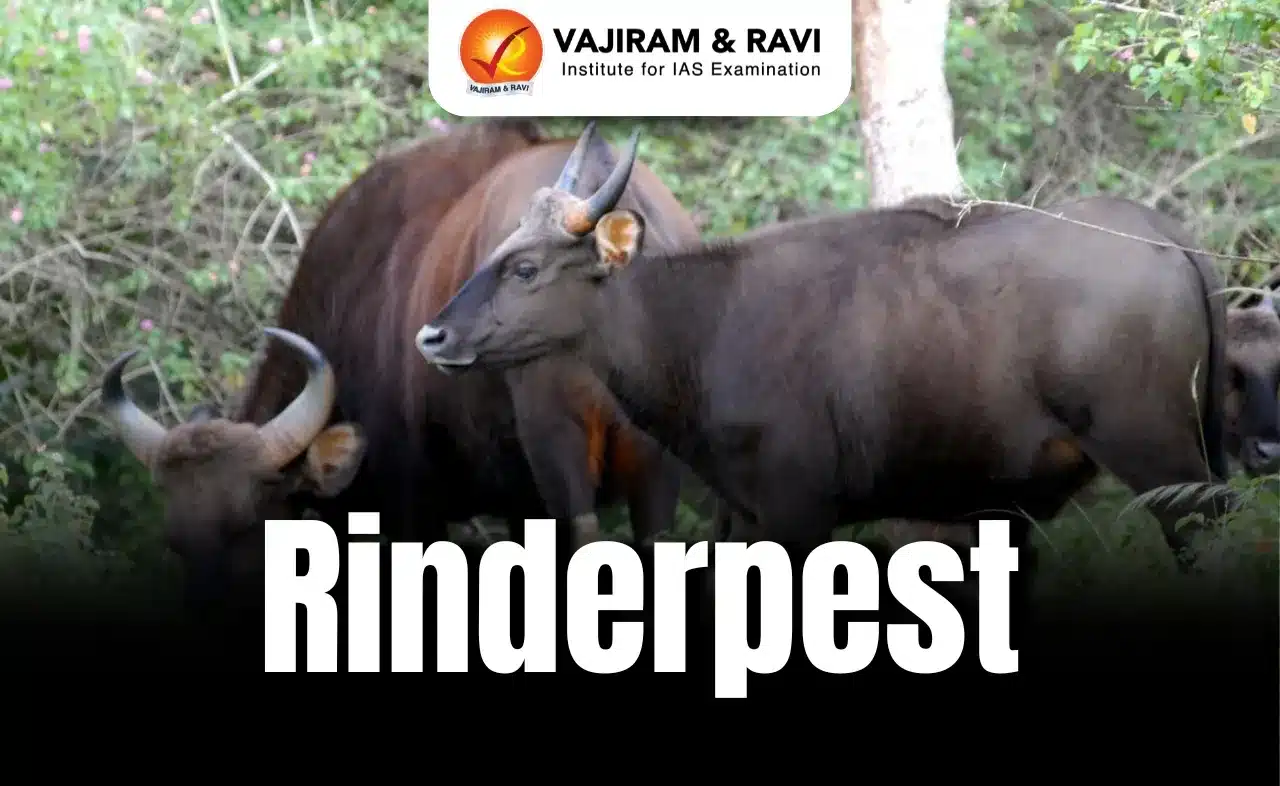
Rinderpest Latest News
India has secured a prestigious position in global animal health with the designation of the ICAR-National Institute of High Security Animal Diseases (NIHSAD) in Bhopal as a Category A Rinderpest Holding Facility (RHF).
About Rinderpest
- It is also known as cattle plague, is a contagious viral disease affecting clovenhoofed animals (mainly cattle and buffalo).
- It is caused by a virus of the Paramyxoviridae family, genus Morbillivirus.
- Many species of wild and domestic cloven-hoofed animals (including sheep and goats) show only mild symptoms of the disease when infected, but for cattle and buffalo, mortality rates can reach up to 100 per cent in highly susceptible herds.
- Other than cattle and buffalo, rinderpest can infect zebus, water buffaloes, African buffaloes, eland, kudu, wildebeest, various antelopes, bushpigs, warthogs, giraffes.
Transmission of Rinderpest
- It is spread by effective contact between animals carrying the virus and susceptible animals. The virus is found in nasal secretions a few days before any clinical signs appear.
- As the disease progresses the virus is found in most body fluids and either death ensues, or the animal recovers, develops immunity and clears the virus from the body.
Symptoms of Rinderpest
- In cattle, signs of the disease include fever, erosive lesions in the mouth, discharge from the nose and eyes, profuse diarrhoea and dehydration, often leading to death within 10 to 15 days.
- In other species rinderpest may show milder clinical signs.
- There is no public health risk, since rinderpest does not affect people.
- It historically occurred in Europe, Africa and Asia.
- In 2011 this disease was officially eradicated.
Designation of Rinderpest Holding Facility
- It is given by the World Organisation for Animal Health (WOAH) and the United Nations’ Food and Agriculture Organization (FAO).
- To prevent its re-emergence, WOAH and FAO restrict the storage of Rinderpest Virus-Containing Material (RVCM) to a select few high-security laboratories worldwide.
- ICAR-NIHSAD, a Biosafety Level-3 (BSL-3) facility and WOAH reference laboratory for avian influenza, was designated as India’s RVCM repository in 2012.
- Following a rigorous evaluation the institute earned Category A RHF status for one year.
- This recognition places India among a distinguished group of only six facilities worldwide entrusted with the critical responsibility of securely holding rinderpest virus material.
Source: PIB
Rinderpest
Q1: What is the disease blue tongue?
Ans: Bluetongue is an insect-borne, viral disease that affects sheep, cattle, and other ruminants.
Q2: What does World Organisation for Animal Health (WOAH) do?
Ans: The WOAH 's objectives are to: ensure transparency in the global animal disease and zoonosis situation. collect, analyse and disseminate scientific veterinary information. provide expertise and encourage international solidarity in the control of animal
