
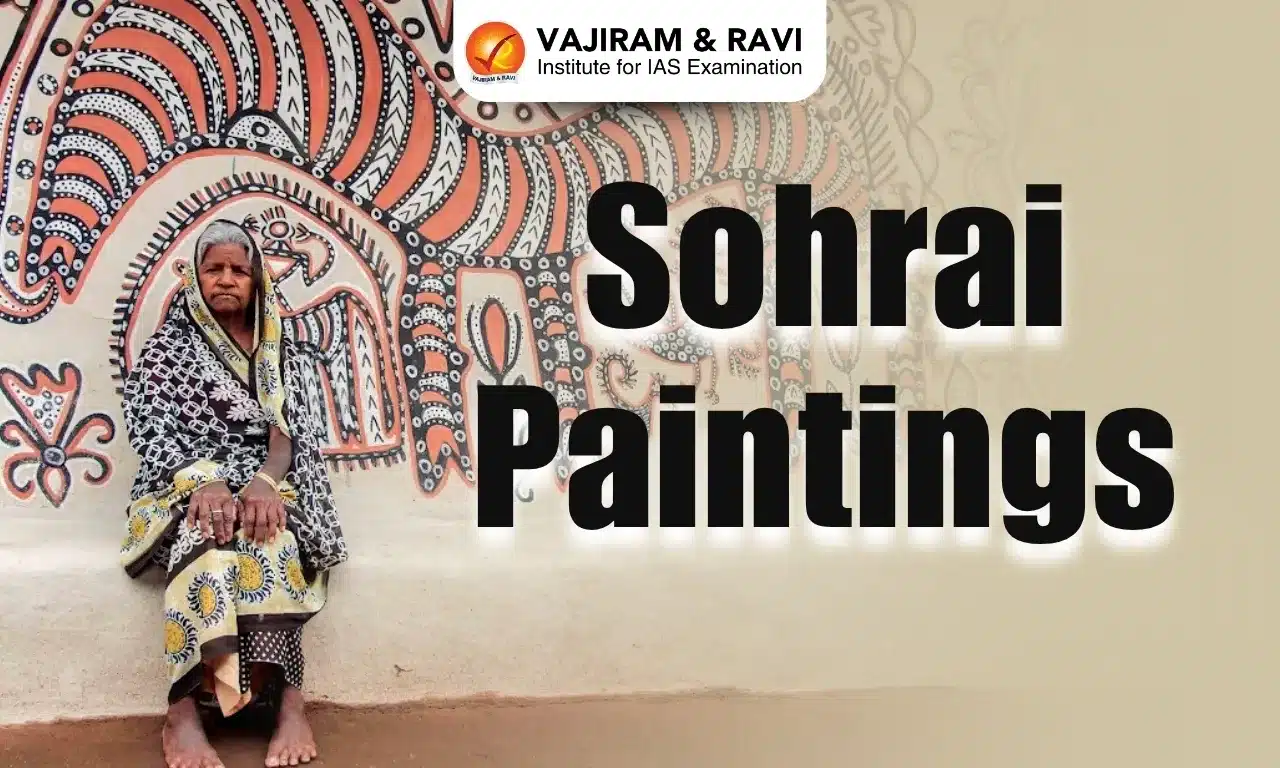
Sohrai Paintings Latest News
The indigenous mural tradition of Sohrai Art from Jharkhand took centre stage at the second edition of Kala Utsav 2025 – Artists in Residence Programme, held at Rashtrapati Bhavan.
About Sohrai Paintings
- It is an indigenous mural art form.
- The word ‘Sohrai’ comes from soro – translating to ‘to drive with a stick’.
- This art form dates back to the Meso-chalcolithic period (9000-5000 BC).
- The Isko rock shelter excavated in Barkagaon, Hazaribagh area also has rock paintings that are exactly similar to the traditional Sohrai paintings.
Features of Sohrai Paintings
- Sohrai paintings are distinctive for their vibrant colours, intricate patterns, and symbolic motifs;
- There is a Sohrai festival held every year, marking the harvesting season and the arrival of winter.
- Themes: It is usually based on natural elements of the universe, this includes forests, rivers, animals amongst others.
- These ancient paintings are made by tribal women with the use of natural substances like charcoal, clay, or soil.
- It is practiced by indigenous communities, particularly in the States of Jharkhand, Bihar, Odisha, and West Bengal.
- It is the art of the women of the Kurmi, Santal, Munda, Oraon, Agaria, Ghatwal tribes.
- This art form from Hazaribagh in Jharkhand has received the GI tag for this art form.
Source: PIB
Sohrai Paintings FAQs
Q1: What is the meaning of Sohrai art?
Ans: Sohrai art also known as harvest art is traditionally associated with the domestication of cattle and their use in agriculture. The traditional term 'Soh' or 'Soro' means to drive away and 'Rai' means a stick.
Q2: Which tribe made the painting of Sohrai?
Ans: Kurmi Mahto, Santhals, Oraons and Mundas
