
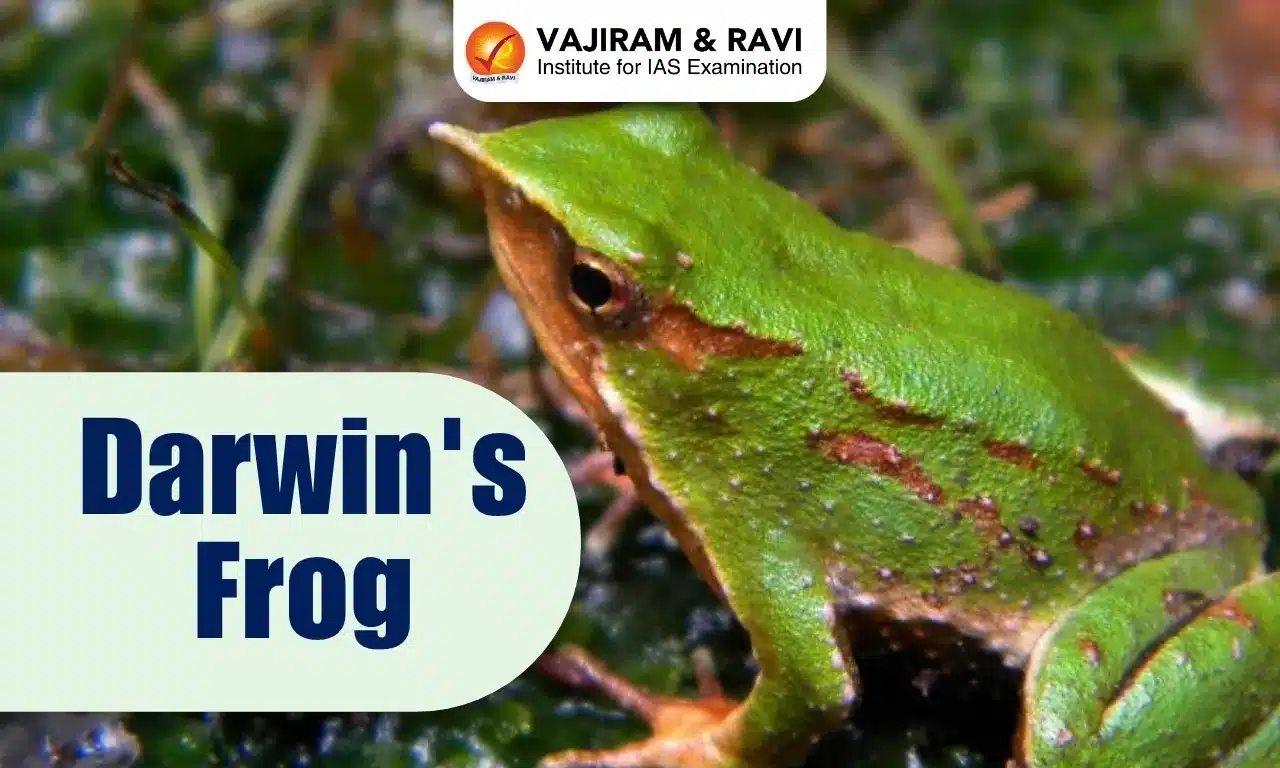
Darwin's Frog Latest News
Recently, Chile has launched a new effort to save the endangered Darwin's frog.
About Darwin's Frog
- Darwin's frog (Rhinoderma darwinii ), also called the southern Darwin's frog.
- Features of Darwin's Frog
- It is unique among amphibians for its brooding habits.
- It is a tiny amphibian with leaf-like skin whose males carry tadpoles within pouches in their mouths.
- It is a diurnal creature, meaning it sleeps at night and is mostly active during daytime.
- When threatened by predators, the frog plays dead. It lays very still on the forest floor or floating in a stream.
- It measures 3 cm (1.18 inches), was discovered in Chile's southern Chiloe islands by Charles Darwin during his 1834 trip around the world.
- Distribution: It is a rhinodermatid frog native to the forest streams of Chile and Argentina.
- Habitat: It is found in a variety of vegetation types and it appears that a mixture of grassland, mossy areas, coarse woody debris, and young trees and bushes in a mature native forest provides its optimum habitat requirements.
- Diet: Darwin's frog feeds on insects and other arthropods.
- It actually comprises two: the endangered Rhinoderma darwinii (Southern Darwin's frog) and the Rhinoderma rufum (Northern Darwin's frog), which is categorized as "critically endangered" and has already virtually disappeared.
- Threats: Forest fires, climate change, invasive species and urbanization have hurt the humid forests of southern Chile and Argentina where Darwin's frog typically lives.
Source: TH
Darwin's Frog FAQs
Q1: Why is it called Darwin's frog?
Ans: Darwin's frogs were named after the father of evolution, who discovered them in 1834 in Chile during his voyage around the world on the ship HMS Beagle.
Q2: What is a Darwin's frog mouth brooding?
Ans: Mouth-brooding frogs carry their litters, or broods, of young in their mouths, particularly in the males' vocal sacs.

