UPSC Daily Quiz 6 August 2025

UPSC Daily Quiz

The Daily UPSC Quiz by Vajiram & Ravi is a thoughtfully curated initiative designed to support UPSC aspirants in strengthening their current affairs knowledge and core conceptual understanding. Aligned with the UPSC Syllabus 2025, this daily quiz serves as a revision resource, helping candidates assess their preparation, revise key topics, and stay updated with relevant issues. Whether you are preparing for Prelims or sharpening your revision for Mains, consistent practice with these Daily UPSC Quiz can significantly enhance accuracy, speed, and confidence in solving exam-level questions.

[WpProQuiz 38]


UPSC Daily Quiz FAQs

Q1: What is the Daily UPSC Quiz?

Ans: The Daily UPSC Quiz is a set of practice questions based on current affairs, static subjects, and PYQs that help aspirants enhance retention and test conceptual clarity regularly.

Q2: How is the Daily Quiz useful for UPSC preparation?

Ans: Daily quizzes support learning, help in revision, improve time management, and boost accuracy for both UPSC Prelims and Mains through consistent practice.

Q3: Are the quiz questions based on the UPSC syllabus?

Ans: Yes, all questions are aligned with the UPSC Syllabus 2025, covering key areas like Polity, Economy, Environment, History, Geography, and Current Affairs.

Q4: Are solutions and explanations provided with the quiz?

Ans: Yes, each quiz includes detailed explanations and source references to enhance conceptual understanding and enable self-assessment.

Q5: Is the Daily UPSC Quiz suitable for both Prelims and Mains?

Ans: Primarily focused on Prelims (MCQ format), but it also indirectly helps in Mains by strengthening subject knowledge and factual clarity.

East India Association, Founder, History, Feature

East India Association

The East India Association was established for the first time by Dadabhai Naoroji in London in 1866. The organisation set up its branches in many cities such as Bombay, Kolkata and Madras in 1869. The aim of setting up this organisation was to spread awareness to the British people about the conditions in India and to create support for Indian welfare. The organisation is also known as a predecessor of Indian National Congress. In this article, we are going to cover all about the East India Association and its features. 

East India Association

  • The East India Association focused on the problem and questions related to India and to influence the British leaders to undertake the development of India. 
  • The aim of the association was to advocate public interests and welfare of Indians. 
  • The association worked towards presenting the right picture of India to the British public and raising a voice about Indian concerns in the British press. 
  • The Ethnological Society of London worked on proving that Asians were inferior to Europeans in 1866. 

East India Association Features 

The East India Association established by Dababhai Naoriji in 1866 had the following features: 

  • The East India Association was established, drawing inspiration from Dadabhai Naoroji, and eventually superseded the London Indian Society.
  • Lord Lyveden was the first president of the organization.
  • Initially, the association had around 1,000 members, but later women were admitted after 1912.
  • The association aimed to promote awareness about Indian affairs among the British public through two prominent journals:
    • Journal of the East India Association
    • The Asiatic Quarterly Review (which later replaced the former)
  • The Asiatic Quarterly Review also published various papers and proceedings of the association.
  • The association conducted lectures by both Indian and British speakers, covering a wide range of topics such as:
    • Economic development
    • Indian literature
    • Women’s suffrage
  • In 1949, the East India Association overtook the National Indian Association, becoming the Britain, India, and Pakistan Association.
  • Later, in 1966, it merged with the former India Society (then known as the Royal India, Pakistan, and Ceylon Society) to form the Royal Society for India, Pakistan, and Ceylon.

East India Association FAQs

Q1: Who is the founder of East India Association?

Ans: Dadabhai Naoroji founded the East India Association in 1866.

Q2: Why was the East India Association established?

Ans: It was established to present India's perspective on political, economic, and social issues to the British public and Parliament.

Q3: Who organized the East Bharat Association?

Ans: The East Bharat Association was organized by Dadabhai Naoroji in London.

Q4: When was the East India Association established?

Ans: The East India Association was established in the year 1866.

Q5: Who was Dadabhai Naoroji?

Ans: Dadabhai Naoroji was an Indian nationalist leader, social reformer, and the first Indian elected to the British Parliament.

86th Constitutional Amendment Act, Objectives, Key Details

86th Constitutional Amendment Act

The 86th Constitutional Amendment Act protects the citizen’s right to education. It covers all about the challenges related to education in India. The amendment adds three provisions in the constitution of India that target the rights to free and compulsory education for children in the age group between 6 to 14 years as a fundamental right.

86th Constitutional Amendment Act, 2002

The 86th Constitutional Amendment Act, 2002 is also known as the Right of Children to Free and Compulsory Education (RTE). The amendment added provisions about the necessity of a child to receive free and compulsory education as a fundamental right. 

Under Article 21A of the Indian Constitution, every child aged between 6 to 14 years has the fundamental right to receive free and compulsory elementary education of an equitable and satisfactory quality. It places the responsibility on State Governments to ensure this right is fulfilled.

A significant implicant of this amendment is that all schools catering to this age group are mandated to provide free and compulsory education. Moreover, no private unaided school is permitted to deny admission to eligible children, and failure to comply may invite penalties and legal action.

Additionally, the amendment emphasizes the role of local authorities in implementing this provision. They are required to develop and enforce suitable schemes involving parents, teachers, and school management committees to ensure the effective realization of this constitutional right.

86th Amendment Act 2002 Objectives

86th Amendment Act 2002 has the following objectives: 

  • The amendment makes sure that every child below 14 years of age is getting free and compulsory education in the form of formal schooling. 
  • Article 21A provides guarantee of right to education, making education a fundamental right for children aged 6 to 14 years. 
  • It is mandatory for the state to provide free and compulsory education to children in the form of proper schooling. 
  • Schools should be established in the vicinity of residential areas, making enrollment easy. 
  • The 86th Amendment Act, 2002 also lays down the responsibility on the parents to send their children to school.
    The Act further ensures that children are not only enrolled but also provided an environment conducive to learning, including early childhood care and opportunities for quality education.

Right to Education

The Right to Education Act, introduced in 1995, is a landmark legislation aimed at securing free and compulsory education for all children aged 6 to 14 years, regardless of their religion, caste, culture, or background.

  1. The Act makes sure that every child who wants to receive an education and complete primary schooling is entitled to do so.
  2.  Many children are deprived of education due to financial constraints, lack of infrastructure, and limited access to resources. This Act seeks to eliminate those barriers.
  3. It recognizes that families may struggle to afford education or may be unaware of their children's rights. The Act empowers them by offering legal backing and institutional support.
  4. By making education a fundamental right, the Act provides families and communities with a platform to demand schooling for their children.
  5. The overall aim is to create an environment where no child is left behind, and where quality education is not a privilege but a guaranteed right.

86th Constitutional Amendment Act FAQs

Q1: What is the 86th Constitutional Amendment Act?

Ans: The 86th Constitutional Amendment Act, 2002 made education a fundamental right for children aged 6 to 14 years by inserting Article 21A.

Q2: Which fundamental duty was added by the 86th amendment Act 2002?

Ans: The duty of parents or guardians to provide opportunities for education to children aged 6 to 14 was added as Article 51A.

Q3: What is the 86th Constitution amendment Bill significance?

Ans: It made free and compulsory education for children aged 6–14 a justiciable fundamental right under Article 21A.

Q4: Is Right to Education a fundamental right?

Ans: Yes, the Right to Education is a fundamental right under Article 21A of the Constitution.

Q5: Which article of Indian Constitution ensures right to education?

Ans: Article 21A of the Indian Constitution ensures the Right to Education.

101st Constitutional Amendment Act, Importance, Key Details

101st Constitutional Amendment Act

Under 101st Constitutional Amendment Act, Goods and Service tax which is popularly known as GST was included in the Constitution of India. Article 366(12A) discusses the same which also refers to tax applied to the supply of goods, services or even both from which sale of alcohol is exempted.

The Goods and Services Tax (GST) marked a major shift in the Indirect Tax System of India. It merged several Central and State taxes into a single tax, resolving the issue of double taxation. For consumers, one of the biggest benefits was the expected drop in the overall tax burden on goods earlier around 25-30%. It also made the cost of taxes more transparent, so people could actually see how much they were paying.

101st Constitutional Amendment Act

Article 246 of the Indian Constitution splits legislative powers, including taxation, between the Parliament and State Legislatures. The Constitution ensures that fiscal powers of the Centre and the States are clearly separated, with minimal overlap.

The Centre can tax the manufacture of goods except alcoholic beverages for human use, opium, and narcotic drugs. States are allowed to tax the sale of goods, but not their manufacture. For inter-state sales, the Centre levies a tax called the Central Sales Tax, but the revenue goes entirely to the state where the sale originated.

When it comes to services, only the Centre is allowed to impose a service tax. States cannot levy taxes on the import or export of goods; this power lies solely with the Centre. The Centre also collects additional customs duties (CVD and SAD) to make up for taxes like excise duty and VAT that would apply if the same goods were made domestically.

With the launch of GST, the Constitution had to be amended to give both the Centre and States the power to tax and collect GST.

Also Check: 103rd Constitutional Amendment Act

Legislative Basis Of GST

The GST Bill was first introduced in the 16th Lok Sabha in 2014. It was passed by the Lok Sabha in May 2015 and, after a few changes, cleared the Rajya Sabha in August 2016. Once the required number of states ratified it, the Bill received the President’s assent on September 8, 2016, and became the 101st Constitutional Amendment. The GST Council was formed soon after, on September 12, 2016, with a dedicated Secretariat to guide its work. To ensure a smooth rollout of GST, several committees and sector-specific groups were created, including representatives from both the Centre and the States.

Important provisions of the Bill

  • Central GST (CGST) subsumes excise duty, service tax, and other central levies
  • State GST (SGST) covers VAT, luxury tax, and other state-level taxes.
  • For interstate trade, GST is applied through the Integrated GST (IGST). IGST isn’t a separate tax but a mechanism to coordinate tax sharing between the Centre and the States. 
  • To enable this framework, the Constitution was amended to include Articles 246A, 269A, and 279A, along with key changes to the 7th Schedule.

Key aspects of Article 246 (A)

Article 246A establishes that both the Union and the States can make laws on goods and services tax. In the case of intra-state trade, both the Centre and the State have the authority to levy GST. However, when it comes to inter-state trade and commerce, only the central government has the exclusive power to impose GST.

Key aspects of Article 269 A

Article 269A deals with the taxation of inter-state trade under GST. It discusses that the Government of India will collect this tax and then distribute it between the Centre and the States, based on the recommendations of the GST Council.

Key aspects of Article 279-A

Article 279A mandates the President to establish a GST Council within sixty days of the Act coming into force. The Council is chaired by the Union Finance Minister, with the Union Minister of State for Revenue or Finance as a member. Each state nominates one minister in charge of finance or taxation. In terms of decision-making, the Centre holds one-third of the voting power, while the states share the remaining two-thirds. Any decision requires a three-fourths majority to pass.

Key Aspects of List I

  • The Article mandates the President to constitute a GST Council within sixty days of the GST Act coming into effect.
  • The GST Council will be headed by the Union Finance Minister, who will serve as its Chairman.
  • The Union Minister of State in charge of Revenue or Finance will also be a member of the Council.
  • Each state will nominate one member who is in charge of finance or taxation.
  • The Council's structure ensures that the central government holds one-third of the total voting power.
  • The remaining two-thirds of the voting power rests with the states collectively.
  • For any decision to be passed in the Council, a three-fourths majority vote is required.

Also Check: 104th Constitutional Amendment Act

Main Features of GST

  • Levied on Supply: GST applies to the supply of goods and services, replacing earlier taxes on manufacturing, sales, or service provision.
  • Destination-Based Tax: It follows a destination-based model, meaning the tax revenue goes to the state where goods or services are consumed, not where they're produced.
  • Dual Structure: GST has two components, Central GST (CGST) levied by the Centre and State GST (SGST) levied by the States both charged on the same transaction.
  • Import as Inter-State Supply: Imports are treated as inter-state supplies and attract Integrated GST (IGST), along with customs duties.
  • Rates Decided by GST Council: GST rates for CGST, SGST, and IGST are decided through mutual agreement between the Centre and States, based on recommendations by the GST Council.

Multiple Tax Slabs: GST was introduced with multiple tax rates 5%, 12%, 18%, and 28% with goods and services classified under each slab by the GST Council.

101st Constitutional Amendment Act FAQs

Q1: What is the 101st Constitutional Amendment Act?

Ans: It introduced the Goods and Services Tax (GST) in India, unifying multiple indirect taxes into a single nationwide tax regime.

Q2: When was the 101st Constitutional Amendment passed?

Ans: The Amendment was passed by Parliament in August 2016 and came into effect on 1st July 2017.

Q3: What is the main objective of the 101st Amendment?

Ans: Its main aim is to create a unified national market by replacing various indirect taxes with a single tax, GST.

Q4: Which Article was inserted by the 101st Amendment?

Ans: It inserted Article 279A into the Constitution, which provides for the establishment of the GST Council.

Q5: What is the GST Council?

Ans: The GST Council is a constitutional body that recommends tax rates, exemptions, and regulations related to GST in India.

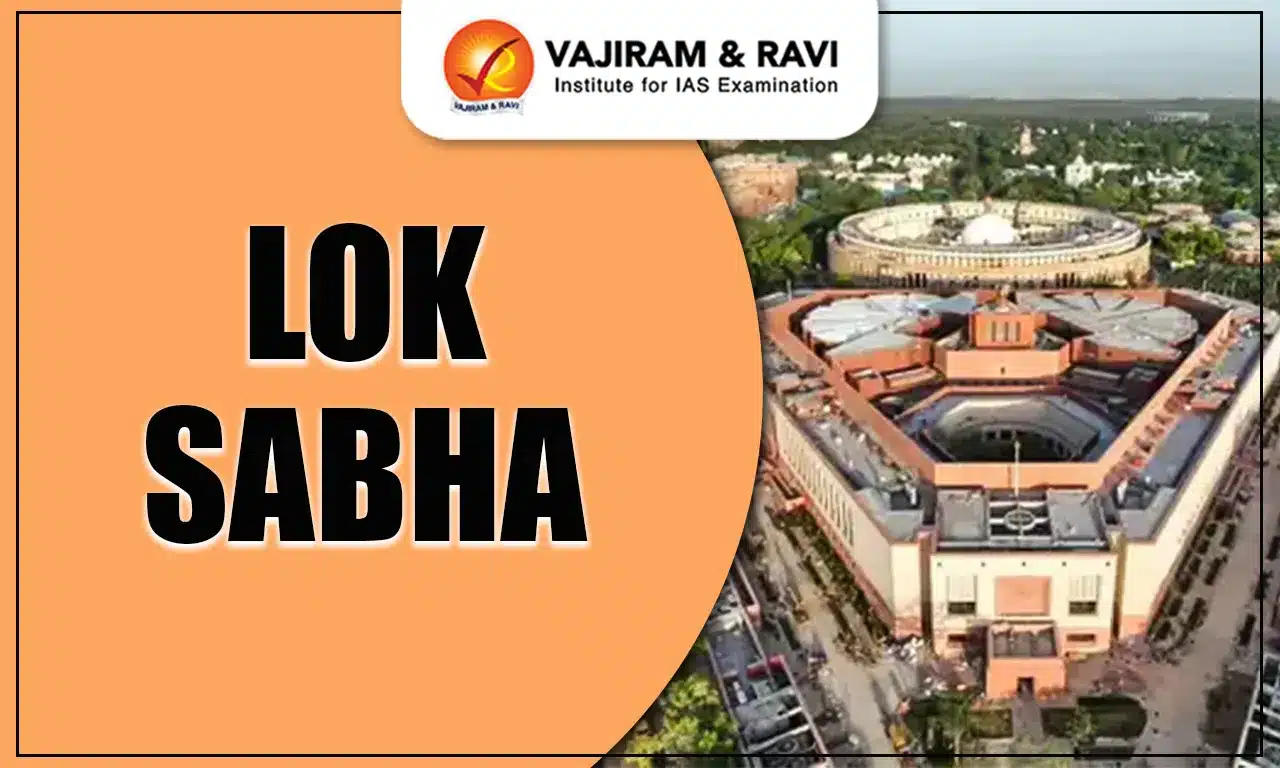
Lok Sabha, Members Count, Qualifications, Election Process, Duration

Lok Sabha

The Lok Sabha represents the people of India, helping in shaping national policies, enacting laws and representing the interests of citizens of India. This lower house of parliament plays an important role in the democratic governance of India. In this article, we are going to cover all about Lok Sabha, its structure, composition, systems of elections of members and other cases. 

Lok Sabha

The Lok Sabha is also known as the Lower House of the Parliament of India or the House of People. The house consists of people directly elected representatives of India. According to the Constitution of India, the Lok Sabha plays an important role in making laws, formulating the Union Budget and articulating the democratic will of people.  

Lok Sabha Composition

The Lok Sabha is composed of 550 members, including: 

  • 530 members are representatives of the States
    • 20 members are representatives of the Union Territories
    • Currently, the Lok Sabha consists of 543 members, including: 
    • 524 members are representatives of the State
    • 19 members are representatives of Union Territories

Also Read: Difference between Lok Sabha and Rajya Sabha

Representation of States in the Lok Sabha

Members representing states in the Lok Sabha are directly elected by the people through territorial constituencies.
The elections are conducted based on the Universal Adult Franchise, meaning:

  • Every Indian citizen aged 18 and above
  • Not disqualified by law or the Constitution
    is eligible to vote.
    Note: The voting age was lowered from 21 to 18 by the 61st Constitutional Amendment Act, 1988.

Representation of Union Territories in the Lok Sabha

The Constitution empowers Parliament to decide how Union Territories are represented in the Lok Sabha.
Under the Union Territories (Direct Election to the House of the People) Act, 1965, members from UTs are also chosen by direct elections.

Representation of Nominated Members in Lok Sabha

Currently, no members are nominated to the Lok Sabha.
Earlier, the President could nominate 2 members from the Anglo-Indian community if they were underrepresented.
This provision was abolished by the 104th Constitutional Amendment Act, 2019, and ceased on 25th January 2020.

Lok Sabha Duration 

  • The duration of Lok Sabha is five years starting from the date when it starts for the first time after the general elections. 
  • The President of India has the power to dissolve the Lok Sabha at any time before the completion of five years and this decision cannot be challenged in court. 
  • The term of Lok Sabha can also be extended by the law to Parliament during the National Emergency , one year at a time, as many times. However, this extension cannot continue beyond a period of six months after the emergency has ceased to be in effect.

Also Read: Functions of Parliament

Lok Sabha System of Elections

One needs to cover multiple aspects to conduct the Lok Sabha Elections: 

  • Territorial Constituencies,
  • Readjustment after each Census,
  • Reservation of seats for SCs and STs, and
  • First-Past-The-Post System. 

Territorial Constituencies and Representation in the Lok Sabha

Division of States into Territorial Constituencies

For the purpose of direct elections to the Lok Sabha, each State is divided into territorial constituencies. To ensure uniformity of representation both:

  • Among States, and
  • Within constituencies of the same State,
    the Constitution makes the following provisions:
  1. Allocation of Seats to States
    • Seats are allotted to each State in such a manner that the ratio between the population of the State and the number of seats allotted is the same for all States.
    • This provision, however, does not apply to States with a population less than six million.

  2. Division into Territorial Constituencies
    • Within each State, constituencies are demarcated in a way that the ratio between the population of each constituency and the number of seats remains the same throughout the State.

Readjustment After Each Census

The Constitution mandates that after every Census, a readjustment must be done in:

  • The allocation of Lok Sabha seats to States, and
  • The division of States into territorial constituencies.
  • Parliament is empowered to determine the authority and procedure for this readjustment.
    For this purpose, the Delimitation Commission Act is enacted as needed.
  • So far, the Delimitation Acts were passed in the years: 1952, 1962, 1972, and 2002.

Freeze on Readjustment of Lok Sabha Seats

Although the Constitution originally required seat readjustment after each Census, certain amendments have frozen this process:

  • 42nd Amendment Act (1976)
    • Froze the allocation of seats and delimitation of constituencies at the 1971 Census level till the year 2000.
  • 84th Amendment Act (2001)
    • Extended the freeze till 2026, but allowed rationalisation of territorial constituencies based on 1991 Census figures.
  • 87th Amendment Act (2003)
    • Modified the basis to 2001 Census for delimiting constituencies, without altering the total number of seats.

Reservation of Seats for SCs and STs in Lok Sabha

The Constitution provides for reservation of seats for Scheduled Castes (SCs) and Scheduled Tribes (STs) in the Lok Sabha based on their population proportion:

  • Formula:

    • (SC/ST seats in a State / Total seats of the State) = (SC/ST population in that State / Total population of the State)
  • These reserved seats are not elected by separate electorates. All voters in the constituency elect the candidate.
  • SC/ST candidates can also contest from general (non-reserved) constituencies.

Reservation Period

  • Initially meant to last only 10 years (till 1960).
  • The reservation has been periodically extended by constitutional amendments.
  • 104th Amendment Act (2019) extended the reservation up to 2030.

Basis of Reservation

  • 84th Amendment Act (2001): Basis was 1991 Census.
  • 87th Amendment Act (2003): Revised the basis to 2001 Census.

Thus, currently, the number of reserved seats for SCs and STs is based on the 2001 Census figures.

Electoral System: First-Past-The-Post (FPTP)

  • System of Territorial Representation: Each constituency elects one Lok Sabha member who represents that geographic area.
  • Single-Member Constituencies: Each constituency returns only one representative.
  • First-Past-The-Post: The candidate with the highest number of votes is declared elected, regardless of whether they secure a majority.

Also Read: Rajya Sabha

Lok Sabha Qualifications of Members

The Constitution of India and the Representation of People’s Act of 1951 provides a list of qualifications that must be met to become a Member of Lok Sabha. These qualifications are both constitutional and statutory in nature. These qualifications are : 

Constitutional Qualifications in the Lok Sabha

As per the Constitution of India, a person must meet the following criteria to be elected as a Member of the Lok Sabha:

  • Must be a citizen of India
  • Must make and subscribe to an oath or affirmation before a person authorised by the Election Commission
  • Must be at least 25 years of age
  • Must possess any other qualifications as prescribed by Parliament

Statutory Qualifications in the Lok Sabha

Under the Representation of the People Act, 1951, the following additional qualifications apply:

  • Must be registered as an elector in a parliamentary constituency from where the person intends to contest
  • For seats reserved for Scheduled Castes (SC) or Scheduled Tribes (ST), the candidate must belong to the respective community in any State or Union Territory

Note: A candidate from SC or ST can also contest from a general (non-reserved) seat.

Lok Sabha Disqualifications of Members

The Constitution of India and the Representatives of People's Act 1951 give many guidelines for the disqualifications of the Members of Lok Sabha. These disqualifications are both constitutional and statutory in nature. The disqualifications include: 

Constitutional Disqualifications for Members of Lok Sabha

As per the Indian Constitution, a person shall be disqualified from being elected as a Member of Lok Sabha:

  • if he/she holds any office of profit under the Union or State Government (except that of a Minister or any other office exempted by Parliament).
  • if he/she is of unsound mind and stands so declared by a court.
  • if he/she is an undischarged insolvent.
  • if he/she is not a citizen of India or has voluntarily acquired the citizenship of a foreign state or is under any acknowledgement of allegiance to a foreign state.
  • if he/she is so disqualified under any law made by Parliament.

Statutory Disqualifications for Members of Lok Sabha

The Indian Parliament has laid down the following additional disqualifications for the Members of Lok Sabha in the Representation of People Act (1951).

  • He/she must not have been found guilty of certain electoral offences or corrupt practices in the elections.
  • He/she must not have been convicted for any offence resulting in imprisonment for two or more years.
    • But, the detention of a person under a preventive detention law is not a disqualification.
  • He/she must not have failed to lodge an account of his/her election expenses within the time.
  • He/she must not have any interest in government contracts, works or services.
  • He/she must not be a Director or Managing agent nor hold an office of profit in a corporation in which the government has a share of at least 25 per cent.
  • He/she must not have been dismissed from government service for corruption or disloyalty to the State.
  • He/she must not have been convicted for promoting enmity between different groups or for the offence of bribery.
  • He/she must not have been punished for preaching and practising social crimes such as untouchability, dowry and sati.

Lok Sabha Oath or Affirmation of Members

The members of Lok Sabha have to make and subscribe to an Oath or Affirmation in front of the President or any person appointed by him/her. 

  • In his/her Oath or Affirmation, a Member of Lok Sabha swears:
    • to bear true faith and allegiance to the Constitution of India,
    • to uphold the sovereignty and integrity of India,
    • to faithfully discharge the duty upon which he/she is about to enter.
  • Without taking the oath, the Member of Lok Sabha is not allowed to vote or participate in the proceedings of the house or use any parliamentary privileges. 
  • A person is liable to a penalty of Rs. 500 for each day he/she sits or votes as a Member in a House in the following conditions:
    • Before taking and subscribing to the prescribed Oath or Affirmation,
    • When he/she knows that he/she is not qualified or that he/she is disqualified for membership in Lok Sabha,
    • When he/she knows that he/she is prohibited from sitting or voting in the House by virtue of any parliamentary law.

Lok Sabha Members Salaries and Allowances 

  • The salaries and allowances of Lok Sabha members are determined by the Parliament.
  • The constitution of India does not give any provision of pension for the Members of Lok Sabha.
    • However, in 1976, the Parliament provided the provision of pension to the Members of the Lok Sabha.
  • Moreover, the Members of Lok Sabha are also given travelling facilities, free accommodation, telephone, vehicle advance, medical facilities and so on.

Lok Sabha Members Vacating of Seats

A Member of Lok Sabha vacates his/her seat in the following cases:

  • Double Membership,
  • Disqualification,
  • Resignation,
  • Absence, and
  • Other Cases

1. Double Membership

  • A person cannot simultaneously be a member of both Houses of Parliament—Lok Sabha and Rajya Sabha.
  • As per the Representation of the People Act, 1951:
    • If elected to both Houses, the individual must choose one within 10 days; otherwise, the Rajya Sabha seat is vacated.
    • If a sitting member of one House is elected to the other, their original seat is vacated.
    • If elected to two seats in the same House, the individual must retain one; failure to choose leads to both seats being vacated.
  • Similarly, one cannot be a member of both Parliament and a State Legislature at the same time. If so elected, the parliamentary seat is vacated unless the state seat is resigned within 14 days.

2. Disqualification

  • A member's seat becomes vacant if they incur any constitutional disqualification, including defection under the Tenth Schedule.

3. Resignation

  • A Lok Sabha member may resign by writing to the Speaker.
  • The seat is vacated upon acceptance of the resignation.
  • However, the Speaker may reject the resignation if it is found to be involuntary or not genuine.

4. Absence

  • If a member is absent from all Lok Sabha meetings for 60 days without permission, the House may declare their seat vacant.
  • Periods when the House is prorogued or adjourned for over four consecutive days are excluded from this count.

5. Other Cases

A Lok Sabha member must vacate their seat if:

  • Their election is declared void by a court,
  • They are expelled by the House,
  • They are elected as President or Vice-President of India,
  • They are appointed as the Governor of a State.

Lok Sabha FAQs

Q1: How many members are there in Lok Sabha?

Ans: The Lok Sabha has a maximum strength of 552 members.

Q2: Who is qualified to join Lok Sabha?

Ans: A person must be an Indian citizen, at least 25 years old, and meet other constitutional and statutory criteria.

Q3: Are there any reserved seats in Lok Sabha?

Ans: Yes, certain seats are reserved for Scheduled Castes (SC) and Scheduled Tribes (ST).

Q4: When can a member of Lok Sabha vacate the seat?

Ans: A seat is vacated due to resignation, disqualification, prolonged absence, or upon assuming certain offices.

Q5: How are members of Lok Sabha elected?

Ans: Members are directly elected by the people through general elections using the first-past-the-post system.

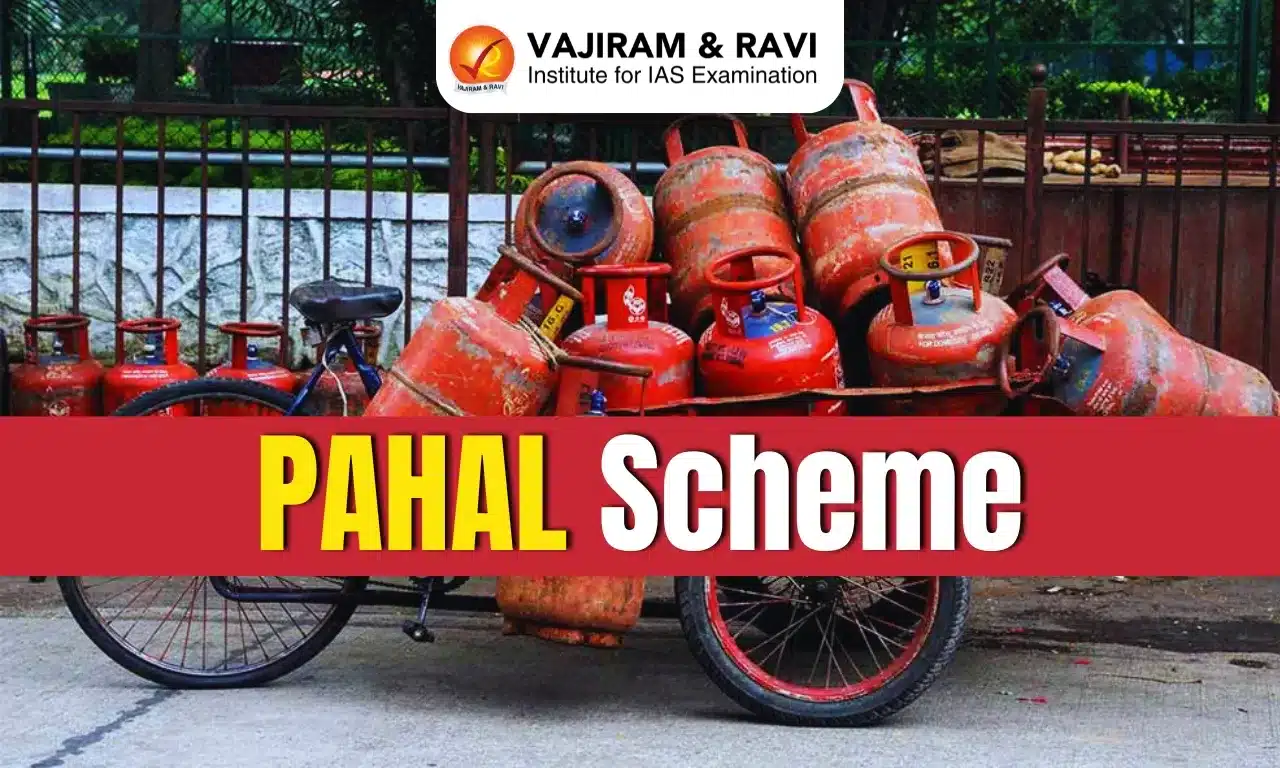
PAHAL (Direct Benefit Transfer for LPG) Scheme

PAHAL Scheme

PAHAL Scheme Latest News

The Indian government has deactivated more than 4 crore duplicate or inactive domestic LPG connections under its PAHAL direct benefit transfer scheme, the Petroleum Minister told parliament recently.

About PAHAL Scheme

  • Pratyaksh Hanstantrit Labh/Direct Benefits Transfer For LPG (PAHAL) scheme, launched by the Ministry Of Petroleum and Natural Gas, is India’s Direct Benefit Transfer (DBT) system for LPG subsidies. 
  • Instead of subsidized cylinders being delivered directly, the consumer pays the full market price for LPG and the government transfers the subsidy amount to the registered bank account.
  • It covers over 17 crore LPG consumers nationwide, making it the largest cash transfer program globally.

PAHAL Scheme Objectives

  • Ensures transparency and eliminates intermediaries.
  • Removing incentives for diversion.
  • Protect the entitlement and ensure the payment of subsidy to the consumers.
  • Improving the availability or delivery of LPG cylinders for genuine customers.
  • Eliminating the fake or duplicate connections.
  • Providing self-selection in subsidy.

PAHAL Scheme Eligibility

  • The applicant must be an LPG user.
  • The combined taxable income of the applicant and their spouse should not exceed ₹10,00,000 in the previous financial year, as per the Income Tax Act, 1961.

PAHAL Scheme Working

  • The consumer books a gas cylinder at the market price.
  • Once delivered, the government credits the subsidy amount directly into the linked bank account of the consumer.
  • There are two types of consumers in the scheme:
  • Primary Aadhaar-Based DBT (preferred): Aadhaar is linked with both the LPG consumer number and the bank account.
  • Alternative (Non-Aadhaar-Based): Bank account is linked directly with the LPG consumer number if Aadhaar linking is not available.

Source: CNBC

PAHAL Scheme FAQs

Q1: Which ministry launched the PAHAL (Direct Benefit Transfer for LPG) scheme?

Ans: Ministry of Petroleum and Natural Gas

Q2: What is the primary objective of the PAHAL scheme?

Ans: Transfer LPG subsidies directly to consumers' bank accounts.

Q3: What was one of the key motivations behind introducing the PAHAL scheme?

Ans: To prevent diversion and misuse of subsidized LPG.

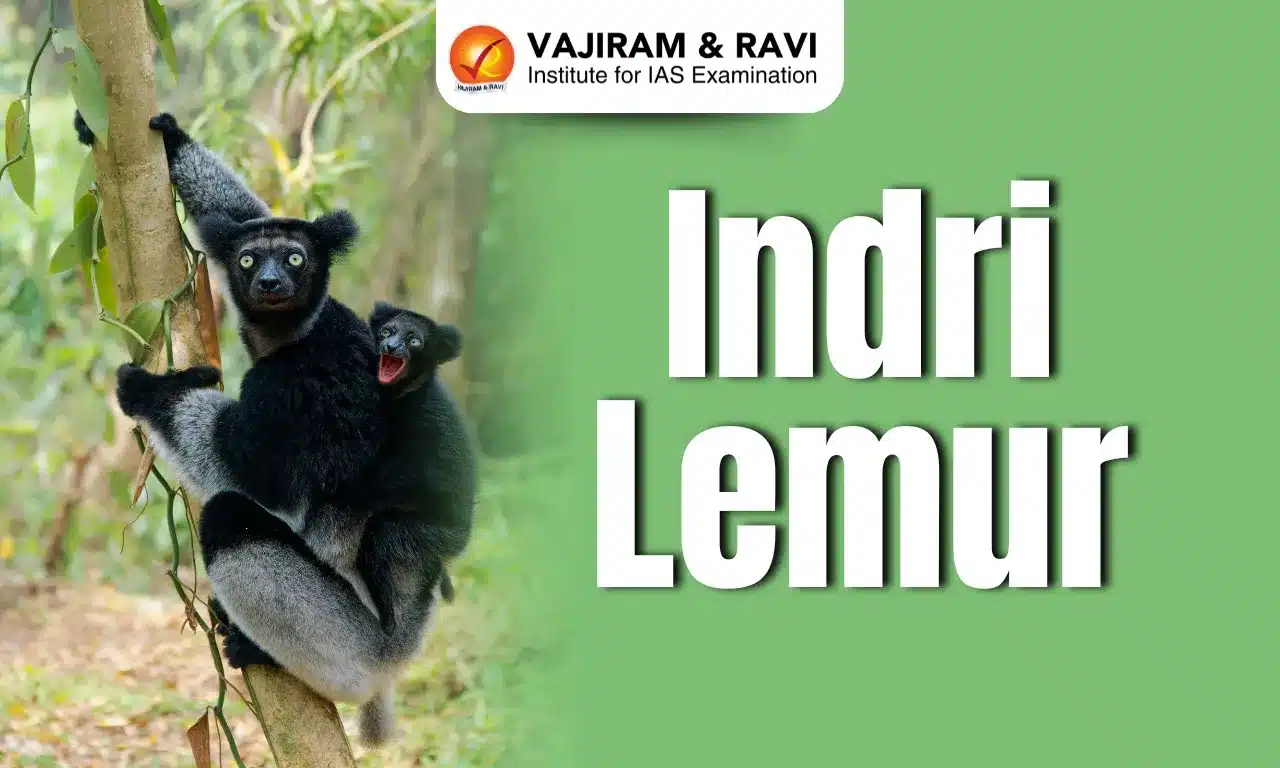
Indri Lemur

Indri Lemur

Indri Lemur Latest News

Joint research has, for the first time, ascertained the composition of the intestinal microbiome of the indri, a critically endangered lemur only found in the north-east of Madagascar.

About Indri Lemur

  • Indri, or babakoto in the local language, is the largest of the surviving lemur species.
  • Scientific Name: Indri indri

Indri Lemur Distribution

  • Found only in remote parts of northeastern Madagascar.
  • Resides in coastal and montane rainforest from sea level to 1,800 m.

Indri Lemur Features

  • It is 60–70 cm (24–28 inches) long, with a rudimentary tail and large hands and feet. 
  • The round head has a pointed face and round, furry ears. 
  • Indris have smooth, silky fur covering their whole bodies. 
  • Its fur is black, with white on the head, throat, forearms, and buttocks; the relative proportions of white and black vary geographically. 
  • In the wild, indris live between 15 and 18 years.
  • Active during the day and thoroughly arboreal, the indri clings to trees and climbs in an upright position as it feeds on leaves, fruit, flowers, and other vegetation.

Indri Lemur Conservation Status

It is classified as 'Critically Endangered' under the IUCN Red List.

Source: PHYS

Indri Lemur FAQs

Q1: Where do indri lemurs live?

Ans: Indri lemurs are found only in remote parts of northeastern Madagascar.

Q2: What is the conservation status of the Indri lemur as per the IUCN Red List?

Ans: Critically Endangered

Q3: What is the average lifespan of an Indri in the wild?

Ans: 15–18 years

India Cine Hub Portal

India Cine Hub Portal

India Cine Hub Portal Latest News

Recently, the central government urged states to use India Cine Hub Portal to facilitate Global film Production locally.

About India Cine Hub Portal

  • It was launched on June 28, 2024.
  • It is a single-window system streamlining filmmaking permissions, incentives, and resource mapping across India.
  • It was set up by the Ministry of Information & Broadcasting, Government of India in the National Film Development Corporation (NFDC) with a view to promote and facilitate film shootings by foreign filmmakers in India.
  • It acts as a single-window facilitation and clearance mechanism that eases filming in India, as well as endeavouring to create a film-friendly ecosystem and promoting the country as a filming destination.

Features of India Cine Hub Portal

  • It features GIS-based location mapping and a common application form, the portal enhances ease of doing business and promotes India as a global filming destination.
  • Seven states and two Union Territories have fully integrated with the platform, while 21 states and six Union Territories have been on boarded.
  • The services rendered by the India Cine Hub (ICH) have now been extended to Indian filmmakers as well.

Source: PIB

India Cine Hub Portal FAQs

Q1: What does National Film Development Corporation do?

Ans: It functions in areas of film financing, production and distribution and under the Ministry of Information and Broadcasting, Government of India. The primary goal of the NFDC is to plan, promote and organise an integrated and efficient development of the Indian film industry and foster excellence in cinema.

Q2: Who is called the father of Indian cinema?

Ans: Dadasaheb Phalke

Bay of Bengal Initiative for Multi-Sectoral Technical and Economic Cooperation (BIMSTEC)

BIMSTEC

BIMSTEC Latest News

The first-ever BIMSTEC Traditional Music Festival was recently held at Bharat Mandapam in New Delhi.

About BIMSTEC

  • It is a grouping of seven member states lying in the littoral and adjacent areas of the Bay of Bengal.
  • The organization came into existence on 6 June 1997 through the 'Bangkok Declaration'. 
  • Membership: It is a unique link connecting South Asia with Southeast Asia - five Members from South Asia (Bangladesh, Bhutan, India, Nepal, and Sri Lanka) and two from South-East Asia (Myanmar and Thailand). 
  • BIMSTEC organizes intergovernmental interactions through Summits, Ministerial Meetings, Senior Officials Meetings, Permanent Working Committee, Joint Working Groups, and Experts Level Meetings,
  • The BIMSTEC region brings together 1.7 billion people - 22% of the world population with a combined GDP of US$ 5 trillion.
  • Permanent Secretariat: Dhaka, Bangladesh.
  • BIMSTEC has identified 14 priority areas of cooperation where a member country takes the lead.
    • India is the lead country for Transport & Communication, Tourism, Environment & Disaster Management, and Counter Terrorism & Transnational Crime.

Source: NOA

BIMSTEC FAQs

Q1: What is BIMSTEC?

Ans: It is a grouping of nations lying in the littoral and adjacent areas of the Bay of Bengal.

Q2: How many countries are in BIMSTEC?

Ans: There are 7 member countries in BIMSTEC.

Q3: Which are the member countries of BIMSTEC?

Ans: The member countries of BIMSTEC are Bangladesh, Bhutan, India, Myanmar, Nepal, Sri Lanka, and Thailand.

Q4: Where is BIMSTEC headquarters?

Ans: BIMSTEC headquarters is located in Dhaka, Bangladesh.

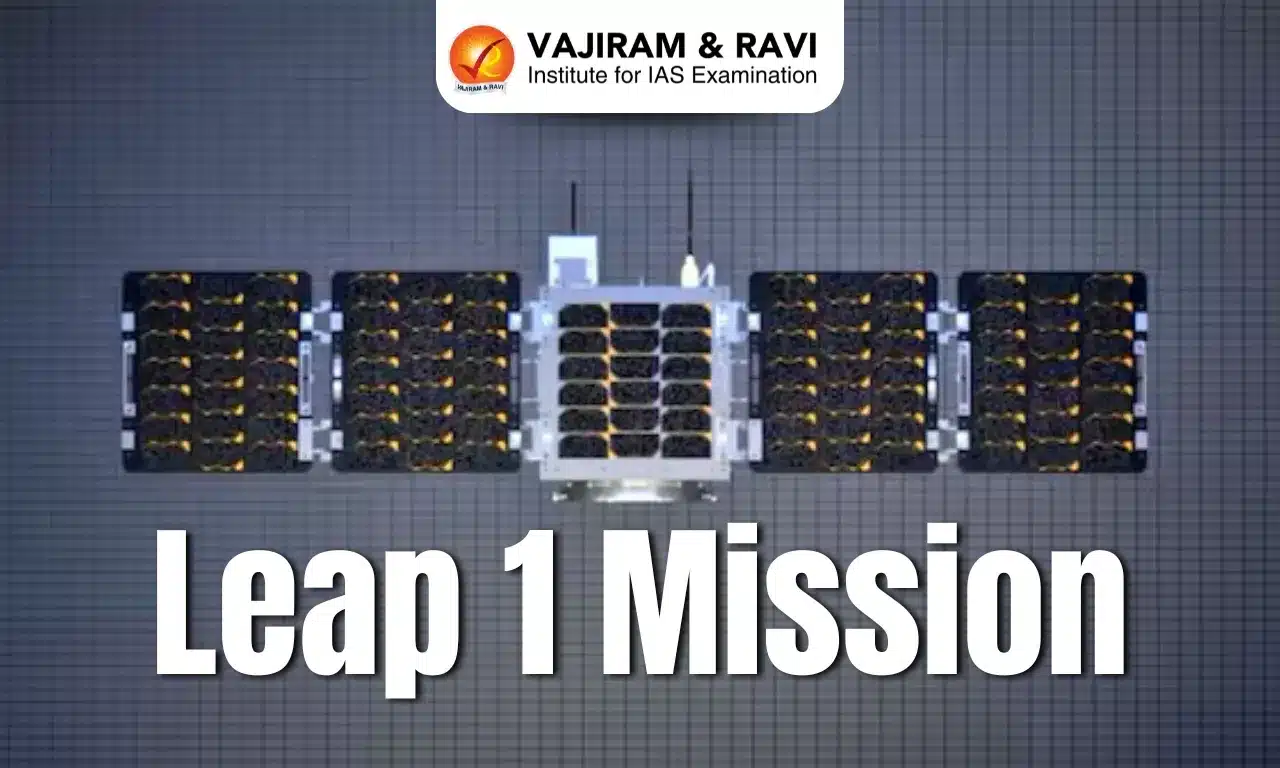
Leap-1 Mission

Leap-1 Mission

Leap-1 Mission Latest News

A budding space tech startup Dhruva Space from India, is set to launch its first commercial satellite mission called LEAP-1.

About Leap-1 Mission

  • It is Dhruva Space’s first commercial satellite mission, which is carrying payloads for AI and Earth observation.
  • It utilises Dhruva Space’s indigenously developed P-30 satellite platform which was successfully space-qualified during the LEAP-TD mission on ISRO’s PSLV-C58 in January 2024.
  • It is developed by Dhruva Space and Australia-based Akula Tech and Esper Satellites.
  • The mission carries two distinct payloads:
    • Nexus-01: It features an advanced artificial intelligence (AI) module.
    • AI module promises unprecedented on-orbit intelligence with onboard data processing and AI/ML model re-training capabilities for rapid, near-real-time insights.
    • AI flexibly supports applications such as fire detection and spectral analysis, continuously improving via live sensor data retraining.
    • Esper Satellites’ OTR-2 mission: It is equipped with a cutting-edge hyperspectral imager.
    • This hyperspectral imager delivers spectrally rich Earth observation data through their EarthTones API, setting a new standard in remote sensing technology.
  • Significance: This payload fusion enhances capabilities across applications including defense, disaster response, agriculture, mining, and environmental monitoring.

Source: India today

Leap-1 Mission FAQs

Q1: What is a satellite platform?

Ans: A satellite platform provides the support on which to mount instruments and the infrastructure for the mission such as power, communications to the ground and navigation.

Q2: What is the earth engine API?

Ans: Earth Engine is a platform for geospatial data storage, analysis, and visualization.

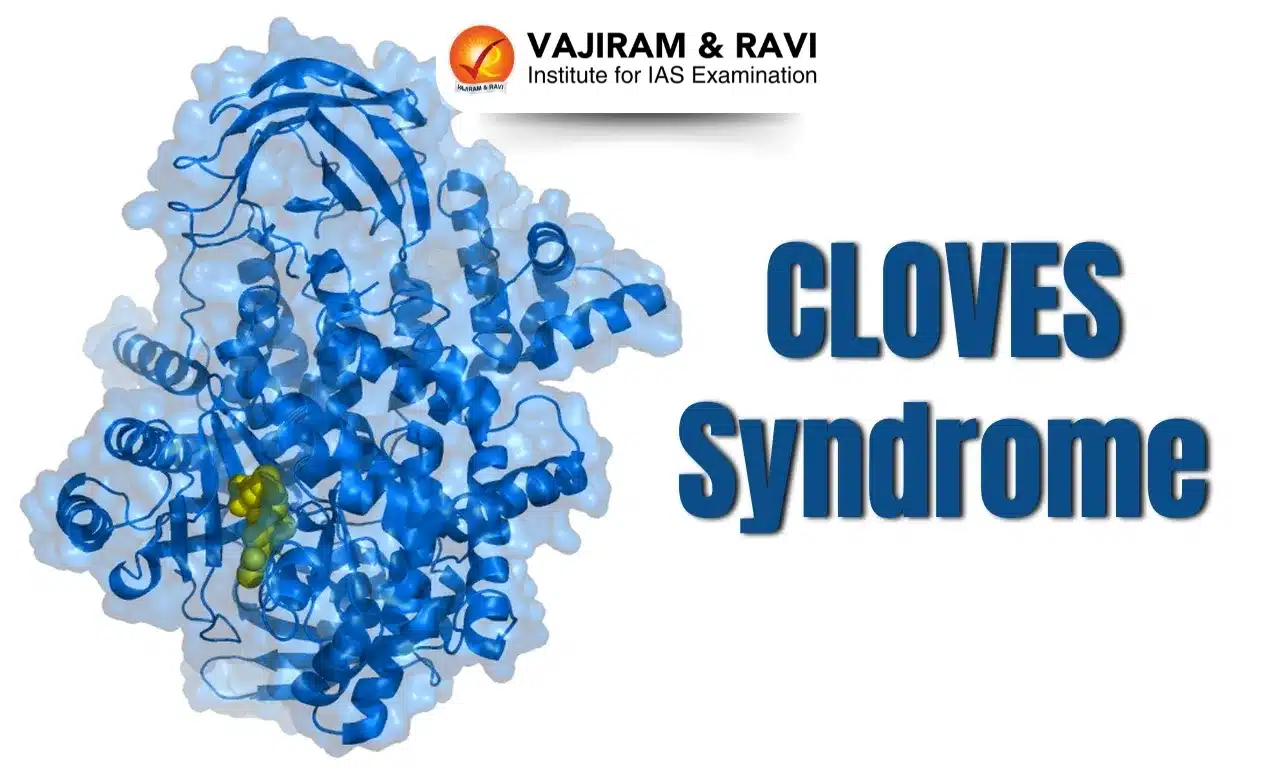
CLOVES Syndrome

CLOVES Syndrome

CLOVES Syndrome Latest News

Researchers believe that CLOVES Syndrome is caused by mutations in a gene called PIK3CA and less than 200 cases are believed to have been reported worldwide.     

About CLOVES Syndrome

  • CLOVES Syndrome, in which the letters stand for: Congenital; Lipomatous; Overgrowth; Vascular malformations ; Epidermal nevi and Spinal/skeletal anomalies/Scoliosis, is very rare condition.       
  • It is a rare genetic disorder.
  • Cause: It is caused by mutations in a gene called PIK3CA which makes one of the proteins in an enzyme called PI3K, which is involved in many important functions in a cell.
  • Mutations in the PIK3CA gene may cause the PI3K enzyme to become overactive, which may cause cancer cells to grow.
  • PIK3CA gene mutations have been found in many types of cancer, including cancers of the breast, lung, ovary, stomach, brain, colon, and rectum.
  • CLOVES Syndrome is an overgrowth disorder, part of a larger group of similar disorders called PIK3CA-related overgrowth spectrum or PROS.
  • The mutations in the PIK3CA gene are believed to occur spontaneously in the womb.
  • It is not hereditary and cannot be passed on.   

Symptoms of CLOVES Syndrome

  • Growth of Soft masses of fatty tissue on the abdomen, back, sides and buttocks.
  • Vascular or blood vessel anomalies such as dilated veins that may be seen in the chest, arms and legs and that may pose a risk of blood clots
  • Large and wide hands or feet, with large gaps between fingers and toes; ‘port wine stain’ birthmarks;
  • Spinal problems such as scoliosis or a tethered cord; kidney problems; skin abnormalities such as raised bumps,
  • Treatment: There is no cure as yet for CLOVES syndrome. However, with the right diagnosis, healthcare providers can help patients manage symptoms.

Source: TH

CLOVES Syndrome FAQs

Q1: What is the difference between CLOVES and Klippel Trenaunay syndrome?

Ans: CLOVES is caused by a mosaic mutation in PIK3CA. This is the same gene that is mutated in M-CM. Klippel-Trenaunay syndrome (KTS) is characterized by a triad of findings including slow-flow vascular malformations involving the veins and capillaries, an abnormally developed lymphatic system, and hemihyperplasia.

Q2: What is CLOVES syndrome?

Ans: Congenital Lipomatous Overgrowth, Vascular Malformations, Epidermal Nevis, Spinal/Skeletal Anomalies/Scoliosis (CLOVES) syndrome is a very rare congenital (present at birth) disorder characterized by a combination of vascular (involving the blood vessels), skin, spinal, and bone or joint abnormalities.

Intermediate-Range Nuclear Forces (INF) Treaty

Intermediate-Range Nuclear Forces (INF) Treaty

Intermediate-Range Nuclear Forces (INF) Treaty Latest News

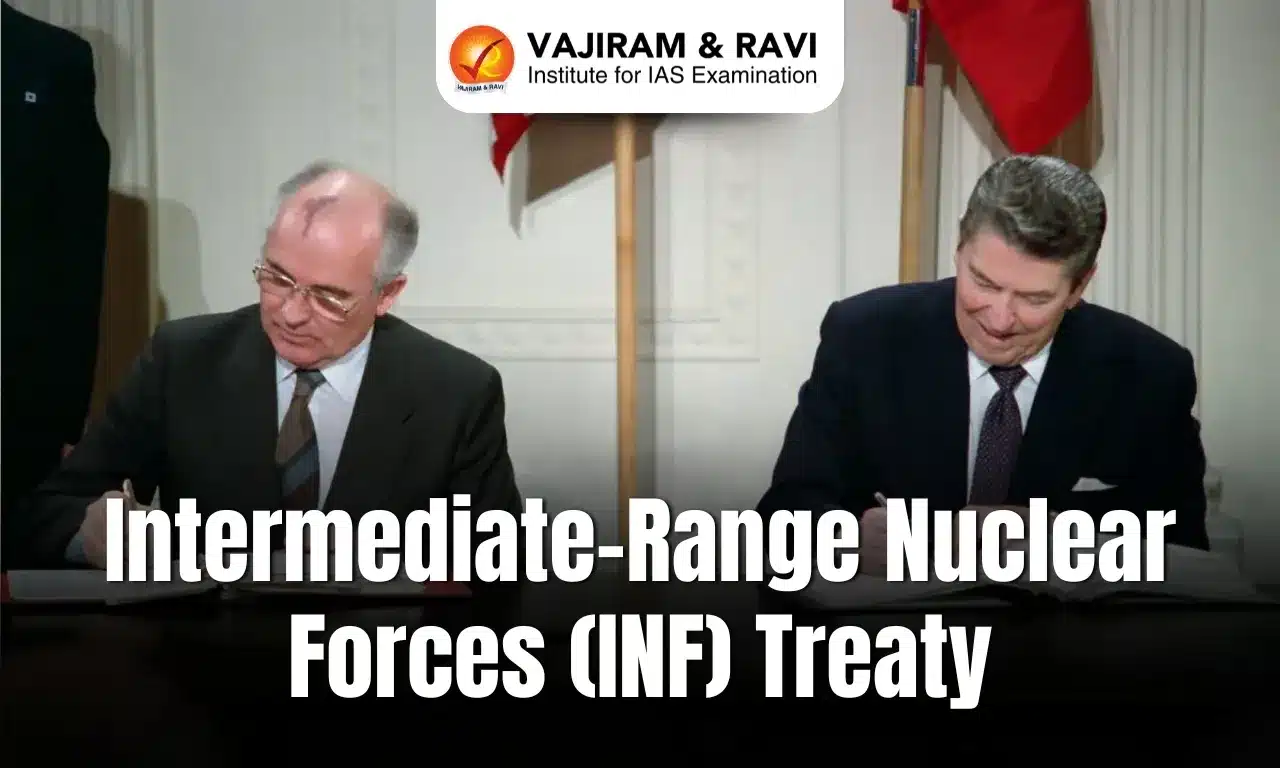
Russia has officially declared it no longer considers itself bound by the Intermediate-Range Nuclear Forces (INF) Treaty.        

About Intermediate-Range Nuclear Forces (INF) Treaty

  • It was signed between the United States and Russia (Formerly known as the Soviet Union) in 1987.
  • Objective: Under this treaty both powers agreed to destroy two categories of lethal missile systems from their own stocks as a means to decelerate the nuclear arms race.
  • The need for such an expansive treaty was felt after a considerable build-up of missiles capable of carrying nuclear warheads by both sides in their European spheres of influence, threatening the security of the entire continent.
  • The treaty came to fruition after years of negotiations during the leadership of US President Ronald Reagan and Soviet leader Mikhail Gorbachev.
  • The treaty led to the elimination of an entire class of weapons, ground-launched missiles with a range of 500 to 5,500 kilometres.
  • It also allowed verification by observers from both sides — thus leading to the dismantling of 2,619 missiles in three years.
  • Present status of the treaty: The US withdrew from it, citing violations by Russia.      

Source: News on air

Intermediate-Range Nuclear Forces (INF) Treaty FAQs

Q1: What are the intermediate range nuclear weapons?

Ans: An intermediate-range ballistic missile (IRBM) is a ballistic missile with a range between 3,000 to 5,500 km (1,864 to 3,418 miles).

Q2: What is the difference between ICBM and intermediate range?

Ans: The Intermediate-range ballistic missiles travell between 3,000–5,500 kilometers (approximately 1,860-3,410 miles) and Intercontinental ballistic missiles (ICBMs), traveling more than 5,500 kilometers.

Defence Acquisition Council (DAC)

Defence Acquisition Council

Defence Acquisition Council Latest News

The Defence Acquisition Council (DAC) recently sanctioned multiple procurement proposals worth nearly ₹67,000 crore to strengthen the nation’s military preparedness.

About Defence Acquisition Council

  • It is the highest decision-making body of the Defence Ministry on procurement.
  • The main objective of the DAC is to ensure expeditious procurement of the approved requirements of the armed forces in terms of capabilities sought and time frame prescribed by optimally utilizing the allocated budgetary resources.
  • Formation: It was formed after the Group of Minister’s recommendations on ‘Reforming the National Security System’, in 2001, post-Kargil War (1999).

Defence Acquisition Council Composition

  • Chairman: Defence Minister 
  • Members: 
    • Minister of State for Defence
    • Chief of Defence Staff (CDS) 
    • Chief of Army Staff (COAS) 
    • Chief of Naval Staff (CNS) 
    • Chief of Air Staff (CAS) 
    • Defence Secretary 
    • Secretary, Dept. of Defence Production and Supplies 
    • Secretary, Defence Research and Development 
    • Secretary, Defence Finance 
    • Vice Chief of Defence Staff (when appointed)/CISC 
    • Special Secretary (Acquisition) 
  • Member Secretary: Dy. Chief of Defence Staff (PP&FD)

Defence Acquisition Council Functions

  • Give in principle approval of a 15-year Long Term Integrated Perspective Plan (LTIPP) for defence forces.
  • Accord of acceptance of necessity to acquisition proposals. 
  • Categorisation of the acquisition proposals relating to ‘Buy’, ‘Buy & Make’, and ‘Make’. 
  • Look into issues relating to single vendor clearance.
  • Take decisions regarding ‘offset’ provisions in respect of acquisition proposals above Rs 300 crore.
  • Take decisions regarding the Transfer of Technology under the ‘Buy & Make’ category of acquisition proposals. 
  • Field trial evaluation.

Source: TH

Defence Acquisition Council FAQs

Q1: What is the Defence Acquisition Council?

Ans: It is the highest decision-making body of the Defence Ministry on procurement.

Q2: Who chairs the Defence Acquisition Council in India?

Ans: Defence Minister

Q3: When was the Defence Acquisition Council (DAC) established?

Ans: It was formed after the Group of Minister’s recommendations on ‘Reforming the National Security System’, in 2001, post-Kargil War (1999).

Lalit Kala Akademi

Lalit Kala Akademi

Lalit Kala Akademi Latest News

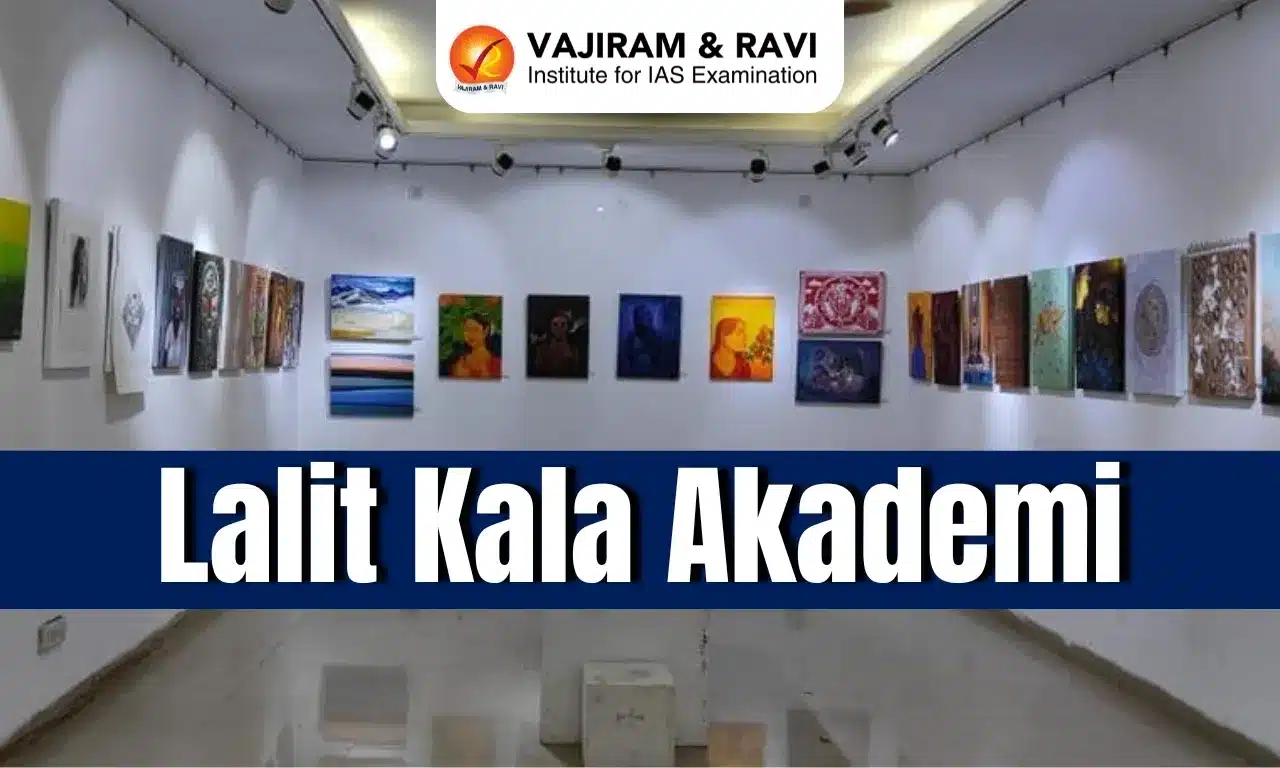
The 64th National Exhibition of Art (NEA), organized by the Lalit Kala Akademi, India’s National Academy of Art, was recently inaugurated in New Delhi with a grand ceremony.

About Lalit Kala Akademi

  • Lalit Kala Akademi, National Academy of Art, New Delhi, was set up by the Government of India as an autonomous body, on 5th August, 1954, to promote and propagate understanding of Indian art, in and outside the country.
  • It was inaugurated on 5th August 1954 by the then Minister for Education, Maulana Abul Kalam Azad.
  • The Akademi was given the status of statutory authority in 1957, under the Societies Registration Act 1860.
  • Headquarters: New Delhi.
  • It functions through its General Council, Executive Board, and other Committees.
  • It has regional centres situated at Chennai, Lucknow, Kolkata, Bhubaneswar, Garhi.
  • Funding: It is funded by the Ministry of Culture.
  • The institution has been involved in identifying and showcasing visual art. 
  • It has preserved and documented a permanent collection of the highest order that reflects the vitality, complexity, and unfolding patterns of contemporary, modern, folk, and tribal art in India. 
  • It promotes the Visual Art of India in various countries of the world through Cultural Agreements and Cultural Exchange Programmes.
  • The National Exhibition of Art is the most prestigious annual event of the Lalit Kala Akademi. 
    • Begun in 1955, it is directed towards showcasing and representing visual advances in the year.

Source: PIB

Lalit Kala Akademi FAQs

Q1: When was the Lalit Kala Akademi established?

Ans: 1954

Q2: Where is the headquarters of the Lalit Kala Akademi located?

Ans: New Delhi

Q3: The Lalit Kala Akademi functions under which Ministry?

Ans: Ministry of Culture

Q4: What is the primary focus of Lalit Kala Akademi’s efforts?

Ans: Propagating visual arts.

Nilgiri Tahr

Nilgiri Tahr

Nilgiri Tahrs Latest News

Recently, a joint census in Kerala and Tamil Nadu has reported a population of 2,668 Nilgiri tahrs.    

About Nilgiri Tahrs

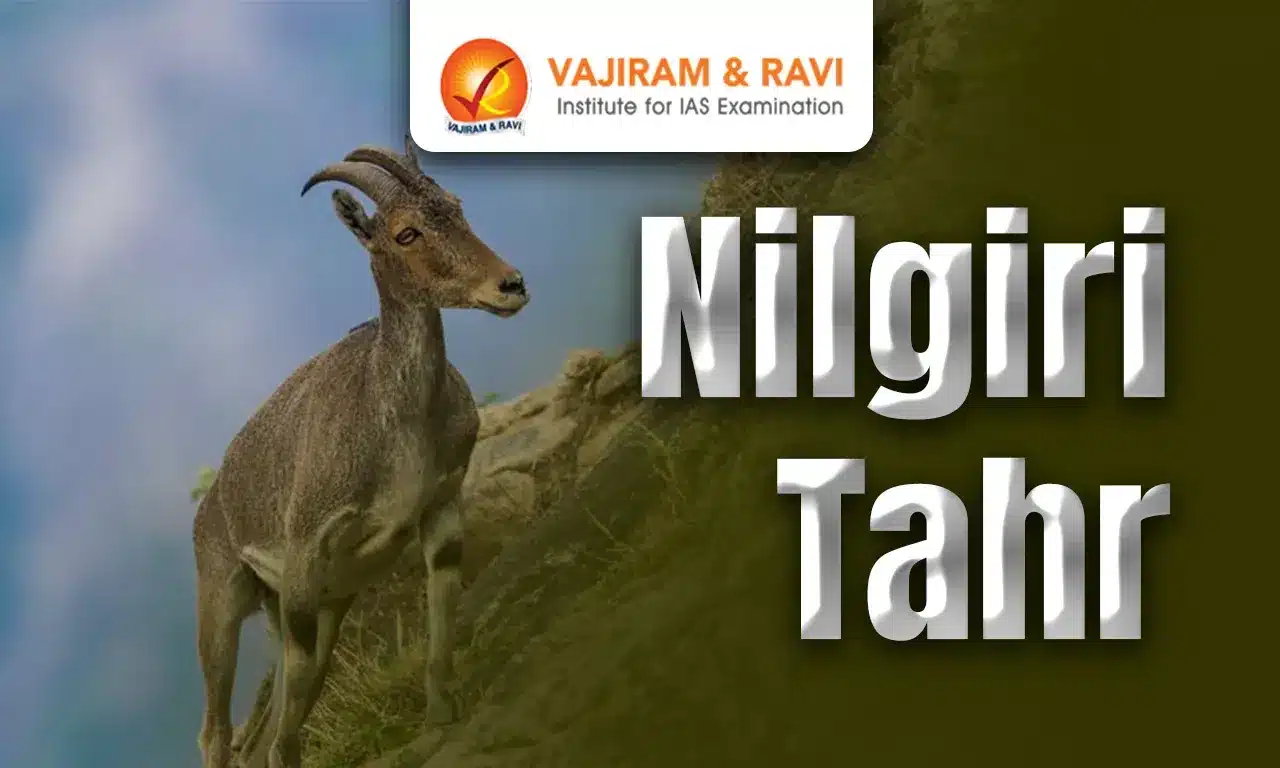
  • The Nilgiri Tahr is a mountain ungulate endemic to the southern part of the Western Ghats. 
  • It is also known by the name Nilgiri Ibex or simply Ibex. Locally the animal is called ‘Varayaadu’.
  • It is the only mountain ungulate in southern India.

Features of Nilgiri Tahr

  • These are stocky goats with short, coarse fur and a bristly mane. 
  • The males are found to be larger than the females, and have a darker color when mature. 
  • Both sexes have curved horns, which are larger in the males.
  • There are facial markings, particularly distinct in mature males.

Habitat and Distribution of Nilgiri Tahr

  • It is found in a roughly 400 km stretch in the Western Ghats, which falls in the states of Kerala and Tamil Nadu. 
  • These tahrs inhabit the open montane grassland habitat of the southwestern ghats montane rain forests ecoregion. 
  • At elevations ranging from 1200 to 2600 m, the jungle opens into grasslands interspersed with pockets of stunted forests, known as ‘sholas.’
  • The Eravikulam National Park (Kerala) has the highest density and largest surviving population of Nilgiri tahr. 

Conservation Status Nilgiri Tahr

  • IUCN Red List: Endangered 
  • Wildlife (Protection) Act of India, 1972: Schedule I

Source: TH

Nilgiri Tahr FAQs

Q1: What is the IUCN status of Nilgiri tahr?

Ans: Endangered 

Q2: Where is Nilgiri Tahr endemic to?

Ans: The Nilgiri Tahr (also known as Nilgiri Ibex) is found primarily in the Western Ghats of southern India.

Q3: The Nilgiri Tahr is the state animal of which Indian state?

Ans: Tamil Nadu

Daily Editorial Analysis 6 August 2025

Daily Editorial Analysis

India’s Presence Amid a Broken Template of Geopolitics

Context

  • India stands at a decisive crossroads in global geopolitics, where its aspiration to punch its weight faces tough constraints imposed by the evolving international order.
  • As major powers re-configurate alliances and recalibrate policies, India encounters a series of diplomatic and strategic setbacks.
  • These setbacks highlight the complexities of asserting influence while maintaining sovereignty and economic momentum.

Operation Sindoor: A Reality Check

  • Operation Sindoor exemplified India’s challenge in mobilising international support against cross-border terrorism.
  • Despite clear evidence implicating Pakistan-based groups, notably, three Lashkar-e-Taiba operatives eliminated after the Pahalgam attack of April 22, 2025, many strategic partners hesitated to openly call out Pakistan for harbouring United Nations-sanctioned terrorists.
  • The United States, under President Donald Trump, complicated narratives by claiming credit for brokering a ceasefire with economic leverage, conflicting with the Indian government’s own account.
  • In a perplexing diplomatic move, the U.S. even welcomed Pakistan’s Field Marshal Asim Munir after the operation.
  • However, not all signals were negative: The U.S. designated The Resistance Front (TRF), responsible for the Pahalgam attack, as a Foreign Terrorist Organisation, and the UN Security Council Monitoring Team identified TRF’s role, marking a partial but insufficient international consensus on India’s security concerns.

U.S.-India Tensions: Trade, Security, and Trust

  • Geopolitical friction with the U.S., long touted as India’s ‘natural ally,’ has grown on several fronts:
  • President Trump’s abrupt imposition of a 25% tariff on Indian goods on the day of the flagship NISAR satellite launch transformed a trade dispute into a tool of political pressure, especially linking tariffs to India’s continued imports of Russian oil.
  • The U.S. strategy appeared opportunistic; while it criticized India’s Russian oil imports, it continued to seek U.S.-Russian rapprochement and permitted U.S. companies to engage in select trade with China.
  • Trump’s calls to U.S. companies to halt investment in India, and instead hire only Americans, coincide with U.S. security and trade priorities that have increasingly excluded or sidelined Indian interests in broader Indo-Pacific and global contexts.

The European Union and Economic Pressure

  • Even as India negotiates its trade pact with Europe, the EU has sanctioned a key refinery with Russian ownership, fully aware that stopping Russian oil flows through India inflates global prices.
  • Paradoxically, several EU states (such as Hungary, Slovakia, and Belgium) continue their own Russian oil imports through exemptions.
  • Meanwhile, the EU’s carbon taxes and digital trade barriers persist, measures India views as unfair, particularly when compared to more lenient treatment of European trade with Russia.

China’s Assertive Neighbourhood Diplomacy and India’ Balancing Act

  • China’s Assertive Neighbourhood Diplomacy

    • China’s attempted trilateral grouping with Pakistan and Bangladesh aimed to marginalize India, though Bangladesh has so far resisted.
    • Military and strategic manoeuvres, like helping Bangladesh revive the Lalmonirhat airbase and supporting Pakistan during Operation Sindoor, augment the pressure along India’s vulnerable northeast.
    • China’s standardisation of place names in Arunachal Pradesh and plans for a vast hydroelectric dam on the Yarlung Zangbo (Brahmaputra) in Tibet underline Beijing’s assertive strategy to control resources and set terms in border regions.
    • Economically, China controls key supply chains affecting India’s rare earths, pharmaceuticals, and machinery, giving it leverage over Indian industries.
  • India’s Balancing Act and the Pitfalls of Silence

    • It refrains from taking assertive positions in global hotspots such as Israel-Gaza, Israel-Iran, and the Ukraine conflict, largely abstaining at the UN.
    • While meant to preserve autonomy and avoid entanglement, this approach diminishes India’s geopolitical clout and leaves its interests sidelined in global negotiations.
    • The argument that India should merely focus on becoming the world’s third largest economy ignores the reality that in today’s world, economic progress is inseparable from strategic engagement.
    • Fragmenting norms, trade protectionism, and coercive geopolitics increasingly dictate economic and tech outcomes, not simply free trade or WTO agreements.

The Road Ahead: Towards Multi-Alignment

  • Recognising the shrinking space for manoeuvre, India has started calling out Western double standards, especially the hypocrisy in the U.S. and EU’s own trade and energy dealings with Russia while criticising India for similar partnerships.
  • India’s recent call for a ceasefire in Gaza signals a willingness to assert itself in global conflict resolution, seeking to safeguard its autonomy while pushing for more equitable engagement with allies.
  • The need to finalise an India-U.S. trade pact, re-engage with multilateral groupings like BRICS (hosting the 2026 summit), expand ties with the Shanghai Cooperation Organisation, and revisit strategic relationships with East Asian economies (after missing out on RCEP) are now urgent priorities.

Conclusion

  • The shifting tectonics of global politics require India not just to adapt, but to assertively pursue national interests through diversified partnerships, robust diplomatic outreach, and an unapologetic defence of its economic and security imperatives.
  • The era of quiet economic focus without proactive geopolitical engagement is over.
  • India must now claim its role as a decisive actor in shaping the rules and outcomes of the new international order.

India’s Presence Amid a Broken Template of Geopolitics FAQs

Q1. What was Operation Sindoor’s significance for India?
Ans. Operation Sindoor highlighted the difficulty India faces in gaining international support against terrorism linked to Pakistan.

Q2. How has the U.S. strained its relationship with India recently?
Ans. The U.S. imposed tariffs on Indian goods and showed inconsistent support regarding India's security concerns, weakening mutual trust.

Q3. Why is China increasing its influence in India’s neighborhood?
Ans. China is leveraging India’s strained Western relations to advance its strategic and economic interests in South Asia.

Q4. What is India’s stance on global conflicts like the Israel-Gaza war?
Ans. India has largely remained silent or neutral, which risks reducing its geopolitical influence.

Q5. What strategy should India adopt going forward in geopolitics?
Ans. India should adopt a multi-alignment strategy and engage more assertively to protect its economic and security interests.

Source: The Hindu


The Technocratic Calculus of India’s Welfare State

Context

  • India’s approach to welfare governance is undergoing a profound transformation, moving from traditional rights-based models towards a technocratically-driven, data-centric system.
  • As illustrated by massive Aadhaar enrolments, the integration of over 1,200 schemes into the Direct Benefit Transfer (DBT) mechanism, and the proliferation of digital grievance platforms, the Indian state is redefining how social welfare is conceived, delivered, and experienced.

The Promise and Perils of Technocratic Governance

  • On the surface, the digitisation of welfare promises greater efficiency and reach.
  • By tracking beneficiaries through databases and bypassing traditional leakages, such as ghost beneficiaries, the state claims more effective targeting and coverage.
  • However, this transition brings into focus critical questions about the very nature and purpose of welfare, and whether democratic ideals are being subordinated to the demands of algorithmic rationality.
  • Recent developments in political theory and game-theoretic research underscore that technocratic governance often flourishes where political polarisation is high.
  • In such contexts, elected leaders, regardless of party, tend to offload difficult policy choices onto data-driven systems.
  • The discourse shifts noticeably from the moral and philosophical question, ‘Who deserves support and why? to a managerial concern: How do we minimise leakage and maximise coverage?
  • This shift, while rationalised as progress, often avoids grappling with constitutional complexities and lived realities.

Theoretical Lenses: Habermas, Foucault, and Agamben

  • This transformation can be illuminated through critical perspectives.
  • Habermas’s notion of ‘technocratic consciousness’ and Foucault’s ‘governmentality’ both describe how state rationality becomes increasingly measurable, auditable, and resistant to political challenge.
  • Welfare schemes like E-SHRAM and PM-KISAN exemplify a push for unidirectional, innovation-driven interventions that value measurability and error-intolerance above democratic dialogue or ambiguity.
  • Conversely, participatory planning and community feedback, bedrocks of democratic deliberation, are receding.
  • Agamben’s concept of homo sacer is particularly resonant: the citizen is reduced to a mere auditable beneficiary, stripped of agency and rights, visible to the state only as data.

Democratic Deficits and Declining Social Investment

  • The data-driven approach risks reducing citizenship to computable metrics, with substantial implications.
  • India’s social sector spending has fallen to 17% in 2024-25, down from an average of 21% over the previous decade.
  • This drop is not merely statistical: minorities, labour, nutrition, and social security programs have suffered a dramatic decline from 11% of spending pre-COVID-19 to just 3% post-pandemic.
  • Behind the numbers are real consequences for the most vulnerable.
  • Further accentuating the democratic deficit is the mounting crisis within the Right to Information (RTI) framework.
  • With over 400,000 cases pending across information commissions and key leadership vacancies, the RTI, once a powerful transparency tool, is struggling to fulfil its role.

The Centralisation Trap: Accountability and Algorithmic Insulation

  • The Centralised Public Grievance Redress and Monitoring System is emblematic of both progress and peril.
  • While it expedites the routing and tracking of complaints, it also risks centralising visibility of grievances without ensuring true responsibility or accountability.
  • This algorithmic insulation makes it increasingly difficult to hold power to account, undermining democratic checks and balances.

The Way Forward

  • Towards Democratic and Anti-Fragile Welfare Systems

    • Acknowledging these challenges is not to dismiss the value of digital innovation, but to urge a reimagining of welfare that foregrounds democratic antifragility.
    • The state must empower local knowledge, participatory institutions like gram sabhas, and frontline officials with discretion and reflexivity.
    • Community-driven audits, institutional support for platform cooperatives, and robust offline fallback mechanisms have all been cited as crucial reforms.
    • Embedding the right to explanation and appeal in digital governance is essential to countering the opacity and rigidity of automated systems.
    • Drawing on international best practices and domestic successes like Kerala’s Kudumbashree, a plural, responsive welfare regime is possible.
  • Re-centring the Citizen

    • Ultimately, a welfare machine that operates efficiently but ignores democratic deliberation will serve everyone except those most in need.
    • For India to achieve the vision of a Viksit Bharat, digitisation must be reoriented around democratic and antifragile principles, transforming citizens from ledger entries into full partners in governance.

Conclusion

  • India stands at a crossroads where the pursuit of efficiency must not come at the expense of justice, agency, and democratic accountability.
  • The challenge is not to slow technological progress, but to harness it in ways that deepen democracy, expand participatory governance, and safeguard the rights and dignity of every citizen.

The Technocratic Calculus of India’s Welfare State FAQs

Q1. What is the main shift in India’s welfare governance discussed in the analysis?
Ans. India’s welfare governance is shifting from a rights-based model to a technocratic, data-driven system.

Q2. What is one key risk of relying solely on digital welfare systems?
Ans. Relying only on digital systems can reduce political accountability and weaken democratic participation.

Q3. Which philosophers’ ideas are used to analyse the current welfare changes?
Ans. The parallel can be drawn from the ideas of Habermas, Foucault, Agamben, and Rancière.

Q4. What is happening to India’s social sector spending according to the analysis?
Ans. India’s social sector spending has declined significantly in recent years.

Q5. What is suggested as a crucial step for future welfare reforms in India?
Ans. Strengthening local participation, community audits, and citizen rights in digital governance.

Source: The Hindu


India’s Technological Journey - From SITE to the Age of Techno-Capitalism

Context:

  • The article marks the anniversary of the Satellite Instructional Television Experiment (SITE) of 1975, a landmark Indo-US collaboration.
  • It also traces the evolution of technology cooperation from Cold War idealism to the present-day era of American “techno-capitalism” under Donald Trump, assessing implications for India.

SITE - A Pioneering Indo-US Technological Collaboration:

  • Launch year: A pioneering collaboration launched in 1975.
  • Partners: Indian Space Research Organisation (ISRO) and the US National Aeronautics and Space Administration (NASA), using ATS-6 satellite.
  • Coverage: 2,400 villages across six of India’s most underdeveloped states to beam educational programmes in local languages.
  • Content focus: Primary education, health awareness, agricultural practices, and national integration.
  • Significance: Landmark in India’s developmental technology vision; expression of US “scientific internationalism.”
  • Setback: Indo-US tech cooperation stalled after India’s 1974 nuclear test due to US non-proliferation concerns.

Revival of Technology Cooperation:

  • Renewed engagement: It took three decades to overcome these disputes and rebuild bilateral trust.
  • 2023 milestone: Launch of Initiative on Critical and Emerging Technologies (ICET) under President Biden to boost cooperation in advanced technologies.
  • Challenges: Bilateral frictions over Russia, trade, Pakistan; divergent tech ecosystem paths.


Contrasting Global Technology Models:

  • US model:

    • Shift from state dominance (NASA) to private sector leadership (SpaceX).
    • The state acts as a catalyst through defence procurement, standard-setting.
  • China model:

    • Centralised, mission-driven technological modernisation since late 1970s.
    • Heavy state investment; global reach via Digital and Space Silk Roads.
  • India’s position: Hybrid approach; reforms in space sector but lag in mobilising private sector and upgrading higher education/research.

Trump’s Techno-Capitalism:

  • Philosophy: Deregulatory, nationalist, expansionist, pro-entrepreneur.
  • AI Policy (2025): Remove regulatory barriers, build AI infrastructure, boost AI manufacturing, mobilise massive public-private investment.
  • Cryptocurrency Policy (GENIUS Act):
    • Dollar-backed stablecoins with full reserves.
    • Strategic Bitcoin Reserve.
    • Rejection of central bank digital currency.
    • Aim: To reinforce US dollar supremacy, to counter de-dollarisation.
  • Ideological architect:
    • Peter Thiel - a venture capitalist and co-founder of PayPal and Palantir, and a staunch supporter of Trump’s tech agenda.
    • Thiel insists that true innovation arises not from state mandates or regulatory frameworks, but from visionary entrepreneurs liberated from liberal-democratic constraints.
    • His worldview blends libertarian individualism with a muscular nationalism that sees China as America’s principal technological adversary.

Global Shift in State-Tech Relations:

  • This marks a decisive break from the techno-optimism of the 1990s, when the rise of the internet was seen as heralding a borderless, decentralised world where the state would gradually recede.
  • However, this dream proved short-lived. Governments reasserted themselves through regulation, surveillance, and digital sovereignty.
  • Today, the world is witnessing the rise of a new state-capital compact—a “tech broligarchy”.
    • Trump’s approach: Aligning Silicon Valley elites with US geopolitical objectives.
    • Objective: To pursue technological supremacy not for utopian ends, but for strategic advantage.

Implications for India:

  • Risks:

    • AI automation threatens IT outsourcing jobs.
    • Possible decline in H-1B visa approvals.
    • Rise of techno-nationalism in the West affecting India’s tech exports.
  • Required actions:

    • Overhaul domestic tech sector.
    • Increase R&D investment.
    • Integrate private enterprise into innovation strategies.
    • Prepare workforce and regulations for rapid tech transformation.

Conclusion:

  • India stands at a pivotal juncture where strategic investment in research, innovation, and private sector integration can transform it into a leading technological power.
  • By proactively adapting to global shifts in AI, space, and digital finance, India can secure its competitiveness and resilience in the emerging techno-capitalist world order.

India’s Technological Journey FAQs

Q1. What was the significance of the 1975 SITE programme for India–US cooperation?

Ans. It showcased technology for development via ISRO–NASA collaboration but was disrupted by post-1974 nuclear tensions.

Q2. How do US and Chinese technology models differ, and where does India stand?

Ans. The US fosters private-led innovation, China drives state-led missions, and India is a hybrid but lagging in scale and R&D.

Q3. What is meant by US “techno-capitalism” under recent policy shifts?

Ans. It is a nationalist, deregulatory alignment of Silicon Valley with state strategy, boosting AI and crypto dominance.

Q4. What risks do AI and US visa changes pose to India’s IT sector?

Ans. They threaten job automation, reduce market access, and limit mobility for Indian tech professionals.

Q5. What steps should India take to face the global techno-capitalist order?

Ans. Invest in R&D, reform higher education, scale private tech, adapt regulations, and skill the workforce.

Source: IE

Daily Editorial Analysis 6 August 2025 FAQs

Q1: What is editorial analysis?

Ans: Editorial analysis is the critical examination and interpretation of newspaper editorials to extract key insights, arguments, and perspectives relevant to UPSC preparation.

Q2: What is an editorial analyst?

Ans: An editorial analyst is someone who studies and breaks down editorials to highlight their relevance, structure, and usefulness for competitive exams like the UPSC.

Q3: What is an editorial for UPSC?

Ans: For UPSC, an editorial refers to opinion-based articles in reputed newspapers that provide analysis on current affairs, governance, policy, and socio-economic issues.

Q4: What are the sources of UPSC Editorial Analysis?

Ans: Key sources include editorials from The Hindu and Indian Express.

Q5: Can Editorial Analysis help in Mains Answer Writing?

Ans: Yes, editorial analysis enhances content quality, analytical depth, and structure in Mains answer writing.

Flash Floods in Uttarkashi: Causes, Topography, and Climate Change Risks Explained

Flash Floods in Uttarkashi

Flash Floods in Uttarkashi Latest News

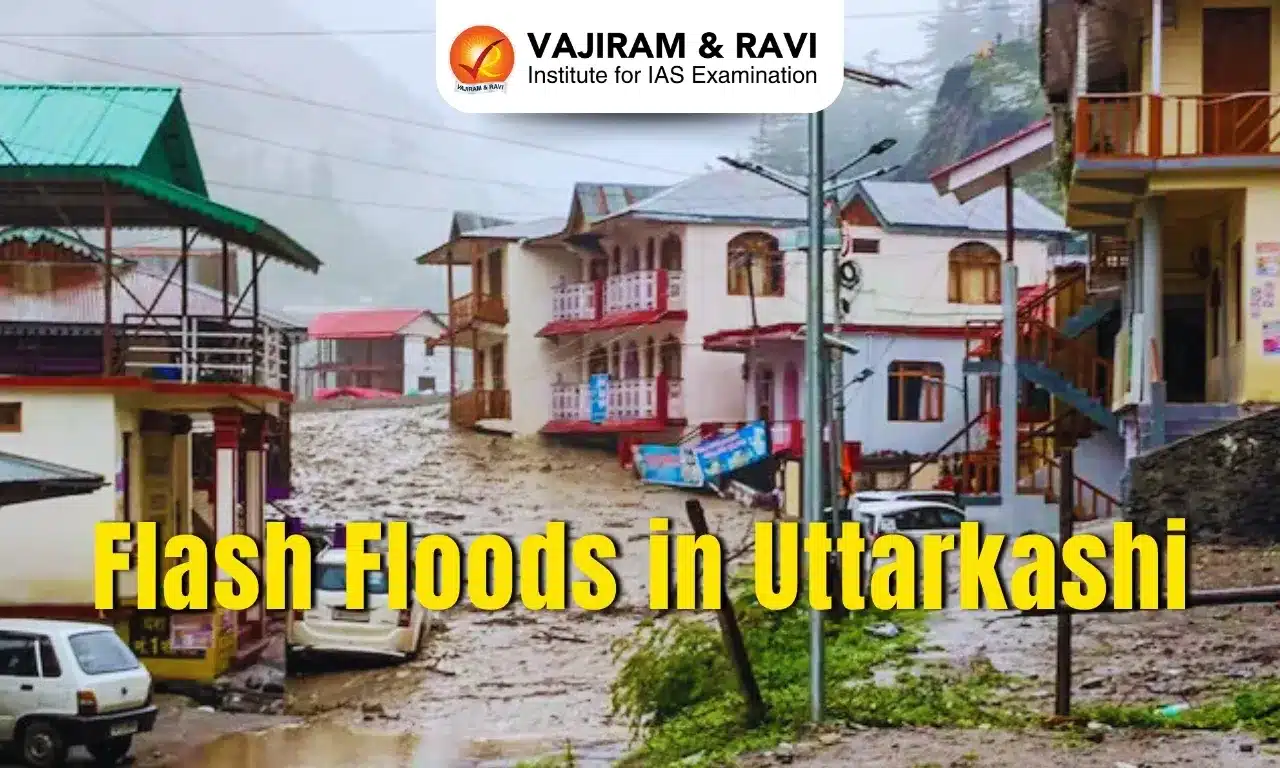
  • At least four people died as flash floods and mudslides struck Dharali village in Uttarkashi, Uttarakhand, damaging several buildings, shops, and hotels. 
  • While cloudbursts are common triggers of flash floods in Uttarakhand’s hilly regions, the recent incident was not due to a technical cloudburst but rather sustained heavy rainfall over the past three days. 
  • The region’s topography, prone to landslides during intense rains, caused mud and debris to surge into rivers, leading to destructive flash floods downstream.

Topography of Uttarkashi

  • Uttarkashi district ranges from 800 to 6,900 metres above sea level, with vast snow-covered areas and several glaciers. 
  • It houses the source regions of the Ganga (Gangotri) and Yamuna (Yamunotri) rivers. 
  • The terrain is rugged, with high ridges, perennial rivers, narrow valleys, and deep gorges. 
  • Land slopes sharply southwest, with valley drops of up to 800 metres.

Rainfall Pattern in Uttarkashi

  • Uttarkashi receives an average annual rainfall of 1,289 mm, with the southwest monsoon (June-September) bringing maximum rainfall, especially in southern areas. 
  • The highest recorded rainfall was 2,436 mm in 1969. July is the wettest month, averaging 312 mm. 
  • The district is also prone to frequent thunderstorms in its hilly regions.

Flash Flood

  • A flash flood is a sudden, intense flood that occurs within a very short period (usually within 6 hours) of heavy rainfall, dam/levee failure, or sudden release of water (like glacier bursts or cloudbursts). 
  • Flash floods are characterized by:
    • Rapid onset and high intensity.
    • Localized impact, often affecting mountainous or hilly terrains.
    • Triggered by localized heavy rain, cloudbursts, glacial lake outbursts (GLOFs), or infrastructure failures.
  • The distinguishing factor between a flood and a flash flood is the amount of time it takes for the flood to occur.
    • A flash flood occurs within minutes or hours. A flood occurs more gradually.
  • Flash floods are often more dangerous because they occur with little warning. 
  • Their quick nature makes them much more powerful than floods, and they often become raging torrents of water, sweeping away everything in their path.

Factors Behind Uttarkashi Flash Floods

  • Continuous rainfall over the past few days, combined with Uttarkashi’s fragile topography, triggered mudslides, debris flows, and flash floods. 
  • Climate change-induced intense rainfall and accelerated glacier melting further worsened the situation. 
  • Rainfall of any intensity, if continuous, recorded over such high altitudes where Uttarkashi is located, can be disastrous. 
  • That is because this region is built on layers of mudslides over the past several centuries.
  • Uttarkashi district is situated along the southern Himalayan slope, where there is limited vegetation and no significant obstruction. 
  • Mild triggers such as rainfall or earthquakes can cause loose moraine and soil to easily slither downhill, swallowing homes and roads along its path.

Glacial Avalanche or Lake Breach Suspected

  • Satellite imagery confirmed the presence of large glaciers and at least two glacial lakes directly above the affected area. 
  • Experts suspect a sudden release of water from a glacier burst or a GLOF could have unleashed the destructive torrent, similar to the 2021 Raini disaster in Chamoli. 
    • In that incident, a rock-ice avalanche devastated hydropower projects and caused over 200 deaths.
  • According to the Wadia Institute of Himalayan Geology, Uttarakhand has 1,266 glacial lakes, many of which pose severe risks to downstream communities. 
  • The National Disaster Management Authority (NDMA) has identified 13 glacial lakes as high-risk, with five classified as extremely dangerous due to their potential for sudden breaches.

Why Uttarkashi Rainfall Was Not a Cloudburst

  • According to IMD, a cloudburst requires 100 mm rainfall in an hour over a 10x10 km area
  • Uttarkashi recorded only 2.7 mm in 24 hours till 8:30 am on August 5, with rainfall throughout the day remaining below cloudburst thresholds. 
  • Though heavy rains occurred in Uttarakhand, such as 300 mm in Haridwar, Uttarkashi’s event did not meet cloudburst criteria.
  • Cloudbursts cause widespread destruction—collapsing houses, disrupting transport, and leading to significant casualties. 
  • The growing frequency of these events necessitates robust disaster management policies, better infrastructure planning, and proactive global and national intervention, as urged by the 2023 research paper.

Source: IE | ToI | ET

Flash Floods in Uttarkashi FAQs

Q1: What caused the flash floods in Uttarkashi?

Ans: Continuous rainfall, fragile topography, and a suspected glacier burst or glacial lake outburst caused the devastating flash floods.

Q2: Why was it not considered a cloudburst event?

Ans: Rainfall intensity remained below the 100 mm/hour cloudburst threshold defined by IMD, despite sustained heavy rainfall over days.

Q3: What makes Uttarkashi prone to flash floods?

Ans: Steep slopes, loose soil layers from ancient mudslides, and glacier-fed rivers make Uttarkashi vulnerable to sudden flash floods.

Q4: How does climate change worsen such disasters?

Ans: Climate change increases rainfall intensity, accelerates glacier melting, and destabilizes moraine, leading to more frequent flash floods.

Q5: What are glacial lakes, and why are they risky?

Ans: Glacial lakes formed by melting glaciers can suddenly breach, unleashing torrents downstream, causing flash floods and destruction.

Tackling Money Laundering in India: Challenges, PMLA Provisions, and FATF Compliance Explained

Tackling Money Laundering

Tackling Money Laundering Latest News

  • Since 2015, the Enforcement Directorate (ED) has taken up 5,892 cases under the Prevention of Money Laundering Act (PMLA), 2002, but only 15 convictions have been secured so far, according to a report presented by the Finance Minister in the Rajya Sabha. 
  • While the government asserts that investigations and Enforcement Case Information Reports (ECIRs) have been initiated in almost all cases, the low conviction rate highlights the inefficacy in securing prosecutions. 
  • Additionally, the continuous rise in money laundering cases suggests the government's inability to effectively curb such financial crimes.

Laundromats: Financial Vehicles for Money Laundering and Illicit Activities

  • The term “laundromat” originated from organised crime syndicates in the U.S. using laundromats as fronts to disguise illegal earnings. 
  • In financial terms, a laundromat refers to an all-purpose financial vehicle, often set up by banks or financial service companies, which facilitates laundering proceeds of crime.
    • It does so by hiding asset ownership, embezzling funds, evading taxes, bypassing currency restrictions, and moving money offshore. 
  • These entities are used to obscure the true source and ownership of illicit funds under the guise of legitimate financial operations.

The Process and Impact of Money Laundering

  • Money laundering, as defined under Section 3 of the Prevention of Money Laundering Act (PMLA), involves concealing, possessing, acquiring, or using proceeds of crime and projecting them as untainted property. 
  • The laundering process typically unfolds in three stages: 
    • Placement, where illicit money is introduced into the financial system, often broken into smaller sums through "smurfing"; 
    • Layering, where funds are moved through investments and transactions to obscure their origin; and 
    • Integration, where the laundered money re-enters the economy via real estate, businesses, or asset formation. 
  • The Supreme Court, in P. Chidambaram vs. Enforcement Directorate (2019), noted that laundering conceals illegal sources, undermining the financial system and national sovereignty. 
  • Additionally, it disrupts monetary stability, fuels inflation, and distorts trade, as highlighted by the Financial Action Task Force (FATF).

Key Provisions and Challenges of the Prevention of Money Laundering Act (PMLA)

  • The Prevention of Money Laundering Act (PMLA) was enacted in line with the UN Political Declaration and Global Programme of Action (1990) to prevent money laundering and confiscate properties derived from criminal activities. 
  • A notable aspect of the Act is that it shifts the burden of proof onto the accused. 
  • Additionally, an Enforcement Case Information Report (ECIR) is sufficient to initiate proceedings, without the necessity of a First Information Report (FIR).
    • This was upheld by the Supreme Court in Vir Bhadra Singh vs. ED (2017)
  • The only prerequisite is the commission of a scheduled offence, considered an offence against the state. 
  • However, despite the Act's stringent provisions, money laundering remains widespread, posing a serious challenge to law enforcement.

Addressing Implementation Challenges and Misuse of PMLA

  • The rapid rise in money laundering cases raises concerns about the effective implementation and misuse of the Prevention of Money Laundering Act (PMLA). 
  • The Supreme Court, in Vijay Madanlal Chaudhury vs. Union of India (2022), clarified that while prosecution under Section 3 requires a registered scheduled offence, authorities can attach properties under Section 5 without a pre-registered case. 
  • This loophole has often been exploited for politically motivated actions. 
  • To curb such misuse, authorities must adhere to the Financial Action Task Force (FATF) guidelines and handle cases with greater diligence and transparency. 
  • Money laundering’s direct link to terror financing necessitates its serious and impartial enforcement. 
  • Additionally, India’s Double Taxation Avoidance Agreements (DTAA) with around 85 countries facilitate international cooperation in tackling money laundering, but stronger efforts are needed to ensure their effective utilization.

Source: TH | FATF

Tackling Money Laundering FAQs

Q1: What is money laundering under PMLA?

Ans: Money laundering involves concealing proceeds of crime and projecting them as legitimate assets through financial transactions and layering.

Q2: How do laundromats operate in financial crimes?

Ans: Laundromats mask illicit funds, facilitate offshore transfers, evade taxes, and hide asset ownership under legal financial operations facade.

Q3: What are the three stages of money laundering?

Ans: Placement introduces illicit funds, layering disguises origins through transactions, and integration reintroduces laundered money into the legitimate economy.

Q4: Why is PMLA criticised for misuse?

Ans: Authorities exploit PMLA's broad powers for politically motivated actions, using property attachments without pre-registered scheduled offences.

Q5: How can India strengthen money laundering enforcement?

Ans: Strict adherence to FATF recommendations, ensuring transparency, avoiding political misuse, and fostering international cooperation are crucial enforcement measures.

India-Philippines Strategic Partnership: Defence, Trade, and Maritime Cooperation

India-Philippines Strategic Partnership

India-Philippines Strategic Partnership Latest News

  • India and the Philippines have elevated their bilateral ties to a strategic partnership during President Ferdinand Marcos Jr.’s maiden visit to India, focusing on defence, maritime cooperation, and trade.

Historical Background

  • India and the Philippines established diplomatic relations in 1949. 
  • Over the decades, their engagement has evolved steadily, shaped by shared democratic values, anti-colonial legacies, and an increasing convergence in geopolitical interests. 
  • India’s "Look East" and now "Act East" policy has progressively deepened engagement with Southeast Asian countries, with the Philippines playing an increasingly central role.

Trade and Economic Ties

  • India and the Philippines signed a Trade Agreement in 1979, but significant bilateral trade growth began after the late 1990s, spurred by India’s Look East Policy and the 2009 India-ASEAN Trade in Goods Agreement. 
  • Bilateral trade crossed the USD 3 billion mark for the first time in 2022-23 and reached USD 3.53 billion in 2023-24, with India enjoying a trade surplus. 
  • Major Indian exports include engineering goods, pharmaceuticals, chemicals, automotive parts, and rice, while key imports from the Philippines include semiconductors, electrical machinery, ores, and food industry residues
  • The Philippines accounts for nearly 20% of Indian pharma exports to ASEAN.

Development Cooperation

  • India has offered several capacity-building and training programmes to the Philippines under the Indian Technical and Economic Cooperation (ITEC) Programme
  • Both countries cooperate in areas such as disaster relief, humanitarian assistance, and now increasingly in digital infrastructure, with India offering to support the Philippines’ Sovereign Data Cloud pilot project.

Defence and Maritime Cooperation

  • In recent years, defence cooperation has emerged as the most dynamic pillar of India-Philippines relations. 
  • In 2022, India secured a landmark USD 375 million deal to supply BrahMos supersonic cruise missiles to the Philippine Navy, making it India’s first major defence export in Southeast Asia.
  • India and the Philippines have held joint naval exercises and regular dialogues on maritime security, defence logistics, and military training. 
  • The growing alignment comes amid shared concerns over China’s assertiveness in the South China Sea and the need for a rules-based maritime order.

News Summary

  • The bilateral relationship witnessed a transformative moment during the first-ever state visit of Philippine President Ferdinand Marcos Jr. to India recently, at the invitation of Prime Minister Narendra Modi.
  • Key Highlights of the Visit:
    • Strategic Partnership Formalised: India and the Philippines officially elevated their ties to a Strategic Partnership, signalling long-term cooperation in strategic sectors.
    • Maritime Security and Defence Dialogue: Both sides agreed to institutionalise a Ministerial Defence Dialogue and enhance defence industry cooperation.
    • BrahMos Expansion and Joint Production: The Philippines reaffirmed its interest in expanding the BrahMos missile deal and exploring joint production and co-development.
    • Regional Cooperation in the Indo-Pacific: India reiterated its support for ASEAN centrality and upheld the 2016 Arbitral Tribunal ruling on the South China Sea, aligning with the Philippines’ territorial position.
    • Trade and Economic Commitments: Both leaders pledged to double bilateral trade by 2030 and signed MOUs in pharmaceuticals, digital payments, and green energy.
    • People-to-People Engagement: India announced additional ITEC scholarships for Filipino professionals and new youth exchange programs.
  • President Marcos described India as an “indispensable partner” in ensuring regional peace, stability, and prosperity, while PM Modi lauded the Philippines’ trust in Indian defence capabilities and commitment to a free Indo-Pacific.

Source: TH | IE

India-Philippines Strategic Partnership FAQs

Q1: When did India and the Philippines establish formal diplomatic relations?

Ans: India and the Philippines established diplomatic ties in 1949.

Q2: What is the current status of India-Philippines relations?

Ans: In July 2025, India and the Philippines elevated their ties to a Strategic Partnership.

Q3: What defence system has India exported to the Philippines?

Ans: India has exported the BrahMos supersonic cruise missile system to the Philippines.

Q4: What are key areas of cooperation between India and the Philippines?

Ans: Defence, maritime security, trade, digital payments, and education are major areas of cooperation.

Q5: What was a major outcome of President Marcos Jr.'s 2025 visit to India?

Ans: The visit led to the formal upgrade of bilateral ties to a Strategic Partnership.

Enquire Now