UPSC Daily Quiz 9 August 2025

UPSC Daily Quiz

The Daily UPSC Quiz by Vajiram & Ravi is a thoughtfully curated initiative designed to support UPSC aspirants in strengthening their current affairs knowledge and core conceptual understanding. Aligned with the UPSC Syllabus 2025, this daily quiz serves as a revision resource, helping candidates assess their preparation, revise key topics, and stay updated with relevant issues. Whether you are preparing for Prelims or sharpening your revision for Mains, consistent practice with these Daily UPSC Quiz can significantly enhance accuracy, speed, and confidence in solving exam-level questions.

[WpProQuiz 41]

UPSC Daily Quiz FAQs

Q1: What is the Daily UPSC Quiz?

Ans: The Daily UPSC Quiz is a set of practice questions based on current affairs, static subjects, and PYQs that help aspirants enhance retention and test conceptual clarity regularly.

Q2: How is the Daily Quiz useful for UPSC preparation?

Ans: Daily quizzes support learning, help in revision, improve time management, and boost accuracy for both UPSC Prelims and Mains through consistent practice.

Q3: Are the quiz questions based on the UPSC syllabus?

Ans: Yes, all questions are aligned with the UPSC Syllabus 2025, covering key areas like Polity, Economy, Environment, History, Geography, and Current Affairs.

Q4: Are solutions and explanations provided with the quiz?

Ans: Yes, each quiz includes detailed explanations and source references to enhance conceptual understanding and enable self-assessment.

Q5: Is the Daily UPSC Quiz suitable for both Prelims and Mains?

Ans: Primarily focused on Prelims (MCQ format), but it also indirectly helps in Mains by strengthening subject knowledge and factual clarity.

Daily Editorial Analysis 9 August 2025

Daily Editorial Analysis

With Tariffs, India’s Growth Rate Needs a Careful Watch

Context

  • Recent trade measures by the United States have created significant headwinds for India’s economic growth and external account stability.
  • Effective August 7, the U.S. imposed a 25% reciprocal tariff on Indian exports.
  • This was followed by a penal levy, an additional 25% tariff, announced on August 6, to take effect from August 29, 2025, in response to India’s continued crude oil imports from Russia.
  • These developments carry far-reaching consequences for India’s trade balance, current account deficit (CAD), GDP growth, and strategic trade positioning.

India–U.S. Trade Dynamics

  • India enjoys a merchandise trade surplus with the United States, amounting to $41.18 billion in 2024–25, a figure that has been growing steadily.
  • The S. appears to be targeting both sides of the trade equation, India’s exports and its crude oil import sources.
  • The reciprocal tariff directly challenges India’s export competitiveness, while the penal levy operates not only as an export deterrent but also as a non-tariff barrier, designed to push India away from Russian crude towards higher-cost imports, possibly from the U.S. itself.
  • Such unilateral measures undermine the principles of free and fair trade, introducing strategic pressure that extends beyond economics into geopolitical alignment.

Impact of the Reciprocal Tariffs

  • Export Decline Estimate: Assuming an import elasticity of –1, India’s exports to the U.S. could decline by 25%, a substantial contraction.
  • Trade Deficit Effect: In 2024–25 terms, this would widen the trade deficit by 56% of GDP, pushing it to 7.84%.
  • GDP Growth Impact: The growth rate could drop by 6 percentage points, from 6.5% to 5.9%.
  • Current Account Deficit: CAD could rise from 6% to 1.15%.
  • For 2025–26, given that four months have already elapsed before implementation, the GDP impact might be –0.4%, with a correspondingly smaller CAD increase.

Mitigating Factors and Caveats

  • New Trade Agreements: India’s trade deal with the United Kingdom, along with ongoing negotiations with the European Union and other partners, may partially offset export losses.
  • Competitor Tariffs:S. tariff hikes on other exporting nations could shift some demand back to Indian products.
  • Exchange Rate Adjustment: The rupee’s depreciation to around ₹87.5 per U.S. dollar could enhance export competitiveness.
  • However, even after considering these buffers, India’s GDP growth in 2025–26 is expected to be 5% lower than the base forecast, and the CAD could widen by a similar margin.
  • A forced shift from Russian to U.S. crude imports could further strain the CAD, weaken the rupee, and fuel inflation, especially if global oil prices rise.

Policy Options for India

  • Negotiation with the U.S.: The current trade deal is not finalised, providing an opportunity to seek compromise while safeguarding sensitive sectors such as agriculture, allied industries, and MSMEs.
  • Export Market Diversification: While challenging in the short term, expanding into alternative markets remains a long-term necessity.
  • Additionally, domestic tariff reform could boost export competitiveness. Empirical evidence shows that India’s own import tariffs negatively affect exports, with an estimated elasticity worse than –1.
  • Reducing tariffs on inputs that feed into export production could strengthen manufacturing and trade resilience.

Impact of the Penal Levy

  • The penal levy, another 25% tariff, mirrors the economic impact of the reciprocal tariff but is partially softened by commodity exemptions.
  • Combined, the two measures could cut over 6 percentage points from the current year’s projected growth.
  • India views the penalty as discriminatory, noting that many other countries import more from Russia without facing such sanctions.
  • The three-week window before the levy takes effect represents a critical period for diplomatic engagement.

Conclusion

  • The imposition of reciprocal tariffs and penal levies reflects the use of trade policy as a coercive geopolitical tool.
  • While India may manage the immediate growth slowdown through negotiations, currency adjustment, and new trade partnerships, the persistence of such measures threatens the stability of the global trade system.
  • A coordinated effort with other nations to restore a rules-based, non-discriminatory trading environment is essential.
  • In the meantime, India must act decisively to defend its trade interests, strengthen its export base, and minimise dependency on any single market or energy source.

With Tariffs, India’s Growth Rate Needs a Careful Watch FAQs

Q1. Why did the United States impose a 25% reciprocal tariff on Indian exports?
Ans. The United States imposed the tariff to address the growing trade surplus India has with it and to pressure India on its trade policies.

Q2. What additional penalty did the U.S. announce on August 6, 2025?
Ans. The U.S. announced a penal levy of an additional 25% on Indian exports because India continued importing oil from Russia.

Q3. How could the reciprocal tariff affect India’s GDP growth in 2024–25?
Ans. It could reduce GDP growth by about 0.6 percentage points, from 6.5% to 5.9%.

Q4. What strategy could India use to offset the impact of these tariffs?
Ans. India could diversify its export markets and lower certain domestic import tariffs to boost export competitiveness.

Q5. Why does India consider the penal levy discriminatory?
Ans. India considers it discriminatory because many other countries import more from Russia without facing similar penalties.

Source: The Hindu


Industrial Accidents, the Human Cost of Indifference

Context

  • India’s industrial landscape, spanning oil refineries, chemical plants, factories, and construction sites, powers the nation’s economic growth.
  • Yet behind this progress lies an underreported and persistent human tragedy, the needless deaths of thousands of workers due to preventable accidents.
  • These incidents are not inevitable acts of fate but the outcome of systemic negligence, regulatory inertia, and a societal undervaluing of workers’ lives.

The Scale of the Problem

  • Government data, Right to Information findings, and independent studies reveal the alarming scope of India’s industrial safety crisis
  • In the last five years, at least 6,500 workers have died in factories, construction sites, and mines, averaging nearly three deaths every single day.
  • States like Andhra Pradesh and Tamil Nadu alone account for over 200 fatalities from major industrial mishaps in the past decade, with the unregistered and informal sector likely pushing the real toll far higher.
  • A 2022 Centre for Science and Environment (CSE) study recorded over 130 major chemical accidents in just 30 months after 2020, causing 218 deaths and more than 300 injuries.
  • These are not abstract statistics. Each figure represents a family shattered, a breadwinner lost, and a community pushed into grief and economic hardship.

Common and Preventable Causes

  • What makes these fatalities especially unacceptable is the simplicity of their prevention. Most tragedies stem from basic, easily addressable lapses:
  • Lack of Fire No-Objection Certificates (NOC): Many factories operate without clearance from the Fire Department.
  • Non-existent or faulty firefighting systems: Missing alarms, extinguishers, or sensors.
  • Absence of permit-to-work systems: Hazardous jobs undertaken without formal risk assessment.
  • No training for workers: Especially among migrant or contract labourers, language barriers leave safety protocols unread and unheeded.
  • Inaccessible fire exits: Often locked, blocked, or hidden by stored materials.
  • No real accountability: Safety audits become box-ticking rituals, prosecutions are rare, and penalties are negligible.
  • Such failures, while common in small and medium enterprises, are not confined to them.
  • Even large corporations often prioritise operational efficiency over a deep-rooted safety culture.

Comparative Perspective and Geographic Spread and Repetition

  • Comparative Perspective

    • In nations such as Germany and Japan, safety is not merely a compliance issue but a core industrial value embedded into workplace design, training, and management.
    • By contrast, India’s approach remains largely reactive, strengthening measures only after disasters occur.
    • This reactive culture ensures that accidents are not isolated aberrations but recurring features of the industrial environment.
  • Geographic Spread and Repetition

    • Gujarat reported over 60 major industrial fires and gas leaks in 2021 alone. Maharashtra, Chhattisgarh, and Uttar Pradesh show equally grim records.
    • According to the Directorate General Factory Advice Service and Labour Institutes (DGFASLI), India experiences one serious industrial accident every two days in registered factories, and the scale in unregistered units remains unknown.
    • The sequence is depressingly predictable: tragedy, public outrage, token compensation, a committee inquiry, and then silence, until the next avoidable catastrophe.

Underlying Causes: Indifference and Class Bias

  • At the heart of this cycle is national indifference.
  • Regulators are often under-resourced or complicit.
  • Companies cut safety costs, viewing them as overheads rather than obligations.
  • Society at large remains apathetic, especially when victims are economically marginalised migrant or contract workers.
  • A troubling class bias permeates the system: safety failures in a corporate office or technology park would provoke outrage, yet similar lapses in a factory employing low-income workers barely register in public consciousness.

Rejecting the Act of God Defence and Pathways to Change

  • Rejecting the Act of God

    • Industrial accidents are often mischaracterised as acts of God, language that shifts responsibility away from human decision-makers.
    • In reality, these tragedies are man-made, the product of inadequate safety systems and regulatory failure.
    • Countries such as South Korea and Singapore have moved towards corporate manslaughter laws, holding senior executives criminally liable for gross safety negligence. India has yet to take such a decisive step.
  • Pathways to Change

    • Strengthening labour safety boards with resources, training, and independence.
    • Digitising risk reporting and ensuring transparent accident databases.
    • Protecting whistle-blowers who expose unsafe practices.
    • Embedding safety culture in both SMEs and large corporations through rigorous training and design standards.
    • Legislating executive accountability for preventable workplace deaths.

Conclusion

  • The means to prevent these tragedies already exist. What is lacking is the will, from policymakers, industry leaders, and society, to act decisively.
  • Industrial safety is not a privilege granted by employers; it is a fundamental right of every worker.
  • Until India replaces its culture of post-tragedy response with one of prevention and accountability, it will continue to silently affirm the most damning question of all: Who cares?

Industrial Accidents, the Human Cost of Indifference FAQs

Q1. How many industrial workers have died in India in the last five years according to official data?
Ans. At least 6,500 industrial workers have died in India in the last five years.

Q2. What is a common cause of industrial accidents mentioned in the analysis?
Ans. A common cause is the lack of basic fire safety measures such as alarms, extinguishers, and fire exits.

Q3. Which countries are cited as having deeply embedded safety cultures?
Ans. Germany and Japan are cited as countries with deeply embedded safety cultures.

Q4. What is the main cultural problem behind recurring industrial disasters in India?
Ans. The main problem is national indifference and a lack of value placed on the lives of low-income workers.

Q5. What legal measure do countries like South Korea and Singapore have that India does not?
Ans. They have corporate manslaughter laws holding senior executives criminally accountable for safety failures.

Source: The Hindu


Age of Consent Debate in India and its Socio-Legal Implications

Context:

  • The Supreme Court of India is currently hearing Nipun Saxena and Anr vs Union of India, a PIL examining whether the age of “consensual” sexual relationships under the Protection of Children from Sexual Offences (POCSO) Act, 2012 should be reduced from 18 years.
  • The debate raises critical questions about child protection, sexual autonomy, societal norms, and the vulnerabilities of marginalised girls.

Current Legal Framework:

  • POCSO Act, 2012: Criminalises any sexual activity with persons under 18, regardless of consent.
  • Legal position: “Consensual” sexual activity with a minor is still classified as sexual exploitation.
  • Impact: Many cases involve romantic relationships rather than abuse, yet attract the same legal penalties.

Key Issues in the Debate:

  • Vulnerability of marginalised girls:

    • Many girls engage in sexual relationships to escape domestic violence, sexual abuse, or discrimination.
    • Arrest and prosecution of partners under POCSO often result in forced pregnancies, shelter home confinement, or return to abusive families.
  • Judicial and social responses:

    • Calcutta High Court case: Acquitted man accused of non-exploitative consensual relationship with 16-year-old, but highlighted legal contradictions.
    • NCRB data: As a result of mandatory reporting under the POSCO Act, cases of child sexual abuse rose from 8541 in 2012 to 53874 in 2021.
    • Praja Foundation report:
      • 54% of POCSO cases involved partners, friends, or known persons.
      • Many were linked to elopement, refusing marriage and deserting the victim.
    • Child marriage and socio-cultural factors:
      • 2022 data: 1.6 million child marriages recorded in India, with barely 900 cases registered (India Child Protection report).
      • Drivers: Brahminical patriarchy, poverty, lack of education, and fear of premarital sex. Parents often marry off daughters early to “protect honour,” not out of tradition but due to desperation.

The Consent Dilemma:

  • Defining consent:

    • Consent may be enthusiastic, reluctant, manipulated, revoked, or misunderstood.
    • Courts face difficulties in uniformly interpreting consent.
    • POCSO treats all under-18 sexual activity as abuse, making no distinction between coercion and mutual consent in minors.
  • The elopement paradox:

    • Girls eloping face isolation, threats, and legal battles, along with pregnancy and stigma.
    • Extending the logic of consent in cases involving abuse by guardians is rare due to dependency and fear of retaliation.

Implications of Blanket Age Reduction:

  • Risks: Could increase invisibility of vulnerable girls, reduce legal safeguards, and normalise exploitation.
  • Need for nuanced approach: A uniform lowering of age without considering socio-economic context could harm rather than help.
  • Policy challenge: Lawmakers must balance protection from exploitation with respect for adolescent autonomy while considering India’s socio-cultural realities.

Way Forward:

  • India must move towards a context-sensitive reform of the POCSO Act that distinguishes between exploitative and non-exploitative adolescent relationships, backed by comprehensive sex education and community awareness programmes.
  • Leveraging technology-enabled reporting systems, survivor-centric legal aid, and rehabilitative support can ensure both protection from abuse and preservation of adolescent agency.

Conclusion:

  • A balanced approach to the age of consent is vital to safeguard vulnerable children without criminalising consensual adolescent relationships.
  • Lawmakers must integrate legal reform with socio-economic interventions, ensuring justice systems reflect India’s evolving social realities while upholding the dignity and rights of its youth.

Age of Consent Debate in India FAQs

Q1. What challenges arise from the current age of consent under POCSO?

Ans. It criminalises non-exploitative adolescent relationships, causing legal harassment and loss of agency.

Q2. What socio-cultural factors drive early marriages in India?

Ans. Patriarchy, poverty, lack of education, fear of premarital relationships, and honour concerns.

Q3. Why is defining consent for minors legally complex?

Ans. POCSO treats all under-18 sexual activity as abuse, ignoring consent nuances.

Q4. What are the risks of reducing the age of consent uniformly?

Ans. It may increase exploitation and weaken child protection safeguards.

Q5. How can law balance child protection with adolescent autonomy?

Ans. By distinguishing exploitative from consensual cases, adding sex education, and raising awareness.

Daily Editorial Analysis 9 August 2025 FAQs

Q1: What is editorial analysis?

Ans: Editorial analysis is the critical examination and interpretation of newspaper editorials to extract key insights, arguments, and perspectives relevant to UPSC preparation.

Q2: What is an editorial analyst?

Ans: An editorial analyst is someone who studies and breaks down editorials to highlight their relevance, structure, and usefulness for competitive exams like the UPSC.

Q3: What is an editorial for UPSC?

Ans: For UPSC, an editorial refers to opinion-based articles in reputed newspapers that provide analysis on current affairs, governance, policy, and socio-economic issues.

Q4: What are the sources of UPSC Editorial Analysis?

Ans: Key sources include editorials from The Hindu and Indian Express.

Q5: Can Editorial Analysis help in Mains Answer Writing?

Ans: Yes, editorial analysis enhances content quality, analytical depth, and structure in Mains answer writing.

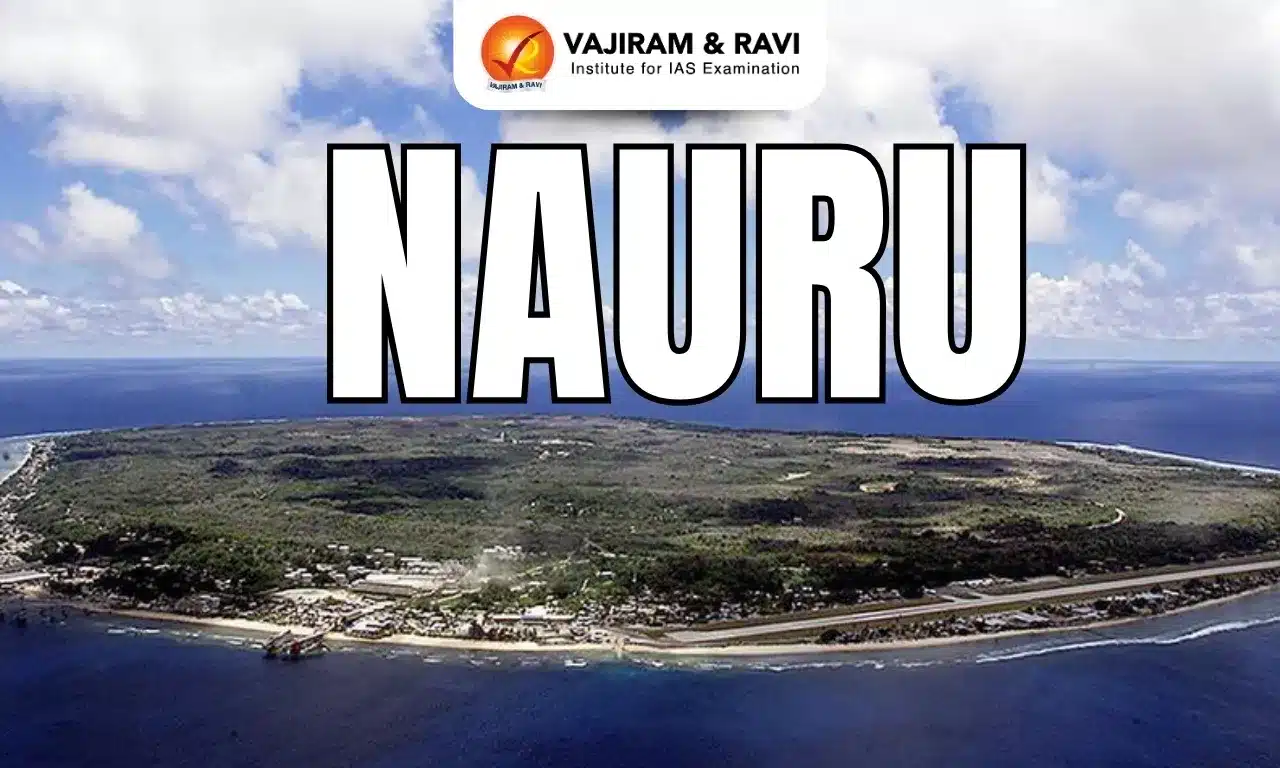
Nauru

Nauru

Nauru Latest News

A remote Pacific nation, Nauru selling passports to fund climate action has approved just six applicants since early this year.

About Nauru

  • Location: Nauru is an island nation and a microstate in Oceania, located in the southwestern Pacific Ocean. 
  • The island is about 1,300 km northeast of the Solomon Islands; its closest neighbour is the island of Banaba, in Kiribati, some 300 km to the east. 
  • Topography: Nauru is a raised, fossilized coral atoll and is one of the three great phosphate rock islands in the Pacific Ocean. 
  • The island is dominated by a central phosphate plateau which is surrounded by coral cliffs. 
  • Phosphate mining has ravaged the interior of the island, leaving about four-fifths of it uninhabitable and uncultivable.
  • It has no official capital city. Located on the southern coast of the island country is the district of Yaren – the de facto capital of Nauru.
  • Language: Their native language is Nauruan, but English is widely spoken as it is used for government and commercial purposes.
  • Political structure: Its constitution, adopted upon gaining independence in 1968, established it as a republic with a Westminster-style parliamentary system of government.

Source: TH

Nauru FAQs

Q1: Is Nauru a sovereign nation?

Ans: Nauru is one of the world's smallest independent states.

Q2: Is Nauru a UN member state?

Ans: The Republic of Nauru was admitted as the 187th member state of the United Nations in September 1999.

CATCH Grant Program

CATCH Grant Program

CATCH Grant Program Latest News

Recently, IndiaAI Independent Business Division (IBD), in collaboration with the National Cancer Grid (NCG), has announced the launch of the Cancer AI & Technology Challenge (CATCH) Grant Program.

About CATCH Grant Program

  • It seeks to support the development and deployment of innovative Artificial Intelligence (AI) solutions to strengthen cancer screening, diagnostics, treatment support, and healthcare operations across India.
  • Grants: This Program will provide up to ₹50 lakh per project to selected teams comprising technology innovators and clinical institutions. The grants will be co-funded by IndiaAI and NCG.
  • The initiative is designed to catalyse piloted deployment of AI solutions within the NCG hospital network, with the potential for future scale-up based on demonstrated clinical impact and operational readiness.
  • Successful pilot projects may also be eligible for an additional scale-up grant of up to ₹1 crore, facilitated by IndiaAI, for wider deployment across the NCG network or through national implementation pathways.
  • The Challenge will focus on high-impact categories including AI-enabled screening, diagnostics, clinical decision support, patient engagement, operational efficiency, research, and data curation.
  • A total of up to 10 proposals will be selected for piloting under this round, based on technical maturity, feasibility, and alignment with healthcare delivery needs.

Who is Eligible for the CATCH Grant Program?

  • Applicants may include startups, health technology companies, academic institutions, and public or private hospitals.
  • Joint applications from Clinical Leads (hospitals or clinicians) and Technical Leads (technology developers) are encouraged.
  • The program will emphasize responsible AI development, clinical validation, and readiness for deployment in Indian healthcare contexts.

Key Facts about IndiaAI

  • It is an Independent Business Division under the Digital India Corporation (DIC) of the Ministry of Electronics and IT (MeitY),
  • It is the implementation agency of the IndiaAI Mission, which aims to democratize AI's benefits across all strata of society, bolster India’s global leadership in AI, foster technological self-reliance, and ensure ethical and responsible use of AI.

Source: PIB

CATCH Grant Program FAQs

Q1: What is the national cancer grid?

Ans: It is a network of major cancer centres, research institutes, patient groups and charitable institutions across India with the mandate of establishing uniform standards of patient care.

Q2: What is Cancer?

Ans: It is a disease in which some of the body’s cells grow uncontrollably and spread to other parts of the body.

Bharat Forecast System

Bharat Forecasting System (BFS)

Bharat Forecast System Latest News

Recently, the union Minister of State (Independent Charge) for Science and Technology, Earth Sciences informed the Rajya Sabha about the Bharat Forecast System.

About Bharat Forecast System

  • It is an indigenously built advanced weather forecasting system.
  • It is based on the newly implemented Triangular Cubic Octahedral (TCo) dynamical grid that enables the model to operate at 6 km horizontal resolution, surpassing its predecessor (GFS T1534 ~ 12km) and typical global operational models having horizontal resolution of 9–14 km.
  • Supercomputing facilities Arka (IITM-Pune) and Arunika (NCMRWF-Noida), enabled the model to be used for real-time weather prediction.
  • The BharatFS was developed with the objective of generating forecasts at the cluster of panchayats level and improving the prediction of extremes.
  •  In research mode, it has demonstrated significant improvement in the rainfall forecast over the core monsoon region and 30% better accuracy for the extreme rainfall forecast compared to the previous operational model.   
  • With the increase in horizontal resolution, the BharatFS is capable of generating distinct forecasts every 6 km.
  • It has demonstrated significant improvement in the skill of predicting the core monsoon region rainfall, with a 30% improvement in the accuracy for the forecasting of extreme rainfall events.
  • The BharatFS was developed by a team of scientists from Indian institutions like IITM-Pune, with support from the NCMRWF-Noida and the India Meteorological Department (IMD).
  • The development and launch of BharatFS has enabled India to upgrade its meteorological services and support neighboring countries, reinforcing regional leadership and self-reliance.
  • Significance: This allows the capturing of local weather features, thus enabling the forecasts to cater to a cluster of panchayats/villages.
  • Localized forecasts help farmers with crop planning, irrigation, and harvesting. Additionally, water authorities can better manage reservoirs during monsoons, reducing flood risk and improving yield resilience.

Source: PIB

Bharat Forecast System FAQs

Q1: What is the Bharat forecasting system in India?

Ans: It is the newly implemented Triangular Cubic Octahedral (TCo) dynamical grid that enables the model to operate at 6 km horizontal resolution.

Q2: Which institution developed the Bharat Forecasting System?

Ans: Indian Institute of Tropical Meteorology (IITM), Pune.

MERITE Scheme

MERITE Scheme

MERITE Scheme Latest News

Recently, the Union Cabinet has approved the proposal for implementation of the ‘Multidisciplinary Education and Research Improvement in Technical Education’ (MERITE) Scheme.

About MERITE Scheme

  • It is a ‘Central Sector Scheme’ which will be implemented in government engineering institutions and Polytechnics in all States/ UTs.
  • This scheme has been formulated in collaboration with the World Bank.
  • Objective: To improve the quality, equity and governance in technical education covering all States/UTs by implementing interventions aligned with the National Educational Policy-2020 (NEP-2020).
  • Funding: Total financial implication of Rs.4200 crore for a period from 2025-26 to 2029-30. Out of Rs.4200 crore, there will be an external assistance of Rs.2100 crore from World Bank as loan.
  • It will have the facility of funds transfer from the Central Government to participating entities through a Central Nodal Agency.
  • Eminent educational institutions like the IITs and IIMs and regulatory bodies in the higher education sector such as the AICTE, NBA etc. will also play a significant role in the scheme implementation. 
  • The initiative emphasizes enhancing students' skills to improve their employability through a comprehensive, multi-faceted approach.
  • Key interventions include offering internship opportunities, updating curricula to align with industry requirements, organizing faculty development programs, and setting up research hubs.
  • Additionally, support will be provided to incubation and innovation centers, skill and maker labs, and language workshops.

Benefits of MERITE Scheme

  • An estimated 275 Government/ Government-aided technical institutions are expected to be selected and supported under the scheme.
  • This will include selected National Institutes of Technology (NITs), State Engineering Institutions, Polytechnics and Affiliating Technical Universities (ATUs).
  • Apart from this, the State/ UT departments handling the technical education sector will also be supported through the MERITE scheme.

Source: PIB

MERITE Scheme FAQs

Q1: What are Central sector schemes (CSS)?

Ans: These are schemes that are fully funded and implemented by the central government of a country, without any financial contribution from the state or local governments.

Q2: What are the foundational pillars of National Educational Policy 2020?

Ans: Access, Equity, Quality, Affordability and Accountability

Dardanelles Strait

Dardanelles Strait

Dardanelles Strait Latest News

Turkey recently closed the Dardanelles strait to shipping traffic due to forest fires in the area.

About Dardanelles Strait

  • It is a narrow strait in northwestern Turkey, connecting the Aegean Sea and the Sea of Marmara.
  • It also separates the continent of Europe from the westernmost tip of Asia Minor. 
  • The strait is named for the ancient city of Dardanus. In ancient times it was called the Hellespont, meaning “Helle’s sea,” in memory of Helle, a mythical princess.
  • It is one of the narrowest straits used for international navigation. The Dardanelles has a length of 61 km and a width ranging from 1.2 to 6.5 km.
  • Another strait, called the Bosporus, connects the Sea of Marmara with the Black Sea. 
  • Together the Bosporus and the Dardanelles provide the only sea connection between the lands lying on the Black Sea and the rest of the world. 
  • The Gallipoli Peninsula lies along the western side of the Dardanelles Strait.
  • Major ports along its shores include Gallipoli, Eceabat, and Çanakkale, all in Turkey.

Source: MSN

Dardanelles Strait FAQs

Q1: The Dardanelles Strait connects which two water bodies?

Ans: Aegean Sea and Sea of Marmara

Q2: The Dardanelles Strait separates which two landmasses?

Ans: Europe and the westernmost tip of Asia Minor.

Q3: What is the approximate length of the Dardanelles Strait?

Ans: 61 km

Q4: Which strait connects the Sea of Marmara to the Black Sea?

Ans: Bosphorus Strait

Lepcha Tribe

Lepcha Tribe

Lepcha Tribe Latest News

Sikkim recently celebrated Tendong Lho Rum Faat, the traditional nature-worshipping festival of the primitive Lepcha tribe.

About Lepcha Tribe

  • They are an indigenous people of eastern Nepal, western Bhutan, Sikkim state, and the Darjeeling district of West Bengal.
  • They are classified as a Scheduled Tribe in the state of Sikkim.
  • The Lepchas call themselves ‘Rongs’ or ‘Rongkups’. 
  • They occupy the southern and eastern slopes of Mt. Kanchenjunga (world’s third highest mountain). 
  • The region Lepchas inhabit varies in elevation from 230 m (750 ft) in the Sikkim basin to the summit of Kanchenjunga at 8,586 m (28,168 ft) above sea level.
  • They are thought to be the earliest inhabitants of Sikkim but have adopted many elements of the culture of the Bhutia people, who entered Sikkim from Tibet in the 14th century and afterward. 
  • While some intermarriage has occurred between the two groups, they tend to stay apart and to speak their own languages, which are dialects of Tibetan. 
  • They speak the language of Lepcha, which has its own script based on Sanskrit.
  • They are a vanishing tribe with a dwindling population. Lepcha has an estimated population of around 42,909 individuals at the time of the Indian Census 2011.
  • Livelihood: Traditionally hunters and gatherers, the Lepchā now also engage in farming and cattle breeding.
  • Religion and Beliefs
    • Originally, Lepchas were nature worshipers and had belief in witch-craftship and spirits. But in due course they embarrassed Buddhism. 
    • The community would traditionally have worshiped Mt. Kanchenjunga, which they regard as their guardian deity.
  • They have regular festivals involving singing and dancing, as well as archery contests.

Source: EM

Lepcha Tribe FAQ's

Q1: The Lepcha tribe is classified as a Scheduled Tribe in which Indian state?

Ans: Sikkim

Q2: Which mountain is regarded as the guardian deity of the Lepcha tribe?

Ans: Mount Kanchenjunga

Q3: In which district of West Bengal do Lepchas mainly live?

Ans: Darjeeling

Khorramshahr-5

Khorramshahr-5

Khorramshahr-5 Latest News

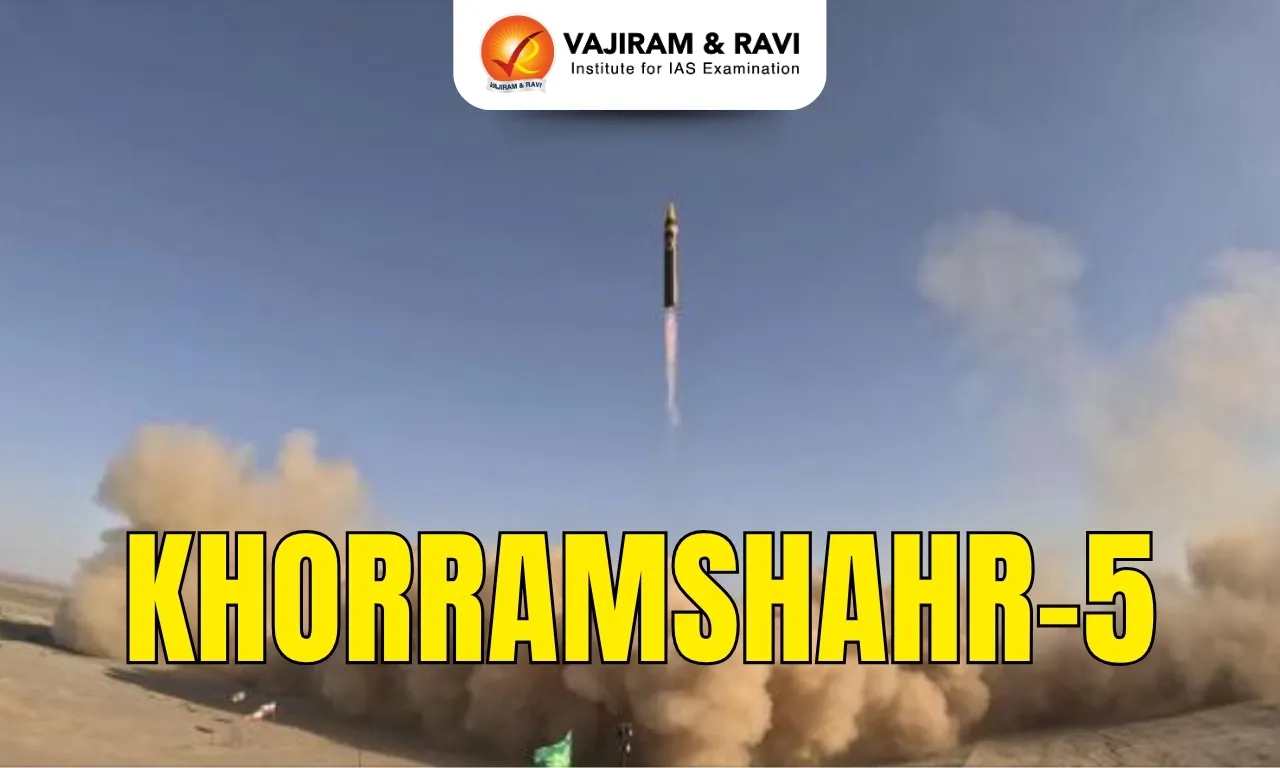
Iran may have developed or prepared for testing its first intercontinental ballistic missile (ICBM), called Khorramshahr-5, according to recent reports.

About Khorramshahr-5

  • It is an intercontinental ballistic missile (ICBM) developed by Iran.
  • It is said to have an operational range of 12,000 kilometers.
  • The missile's speed has been reported to be Mach 16 (approximately 20,000 km/h), typical of ICBMs in mid- or terminal flight.
  • It can reportedly carry a heavy warhead weighing approximately two tons.

What is an Intercontinental Ballistic Missile (ICBM)?

  • An ICBM is a powerful long-range missile designed mainly to carry and deliver nuclear weapons. 
  • Range: ICBMs can travel over 5,500 kilometers, with some capable of reaching up to 16,000 kilometers.
  • Speed: They can fly at speeds faster than 20,000 kilometers per hour, making them hard to intercept.
  • Payload: ICBMs are usually equipped with nuclear warheads but could theoretically carry other weapons, like chemical or biological ones, though this is rare.
  • Deployment: These missiles can be launched from underground silos, mobile land launchers, or submarines at sea.
  • Countries with Operational ICBMs:
    • The countries that have operational ICBMs include Russia, the United States, China, France, India, the United Kingdom, Israel, and North Korea.
    • India’s Agni V is a solid-fueled ICBM.

Source: N18

Khorramshahr-5 FAQs

Q1: Khorramshahr-5 is classified as which type of missile?

Ans: Intercontinental ballistic missile (ICBM)

Q2: Which country developed the Khorramshahr-5 missile?

Ans: Iran

Q3: What is the reported operational range of the Khorramshahr-5 missile?

Ans: 12,000 km

Steel Import Monitoring System 2.0 Portal

Steel Import Monitoring System 2.0 Portal

Steel Import Monitoring System 2.0 Portal Latest News

Recently, the Government of India has revised the advance registration period to apply for registration on the Steel Import Monitoring System (SIMS) 2.0 portal for import of all steel products, except some items.

About Steel Import Monitoring System 2.0 Portal

  • SIMS 2.0 Portal was launched by the Union Ministry of Steels, Government of India.
  • SIMS was introduced in 2019, and has played a crucial role in providing detailed steel import data to the domestic industry.

Features of SIMS 2.0 Portal

  • It provides advanced information about steel imports to both the government as well as relevant stakeholders.
  • It features API integration with multiple government portals, enhancing quality control and streamlining processes for improved efficiency and effectiveness.
  • The portal boasts a robust data entry system, ensuring consistent and authentic data, which promotes transparency and accountability.
  • Integration of various databases enables stakeholders to locate areas of risk and, thereby, permit better risk management.
  • Based on industry feedback, the Ministry has revamped the portal to develop a more effective SIMS 2.0, a significant step forward in monitoring steel imports and promoting the growth of the domestic steel industry.
  • Significance: Availability of such detailed data not only provides input for policy making but also signals areas for production and growth to the domestic steel industry

Source: PIB

Steel Import Monitoring System 2.0 Portal FAQs

Q1: Who launched the steel import Monitoring System 2.0 portal?

Ans: Ministry of Steel

Q2: What is a steel import monitoring system?

Ans: It is a government initiative designed to monitor and regulate the import of steel products into India.

Barak River

Barak River

Barak River Latest News

Communities along the Barak River say their nets have been empty following the June floods in a region once teeming with Hilsa, Rohu, and Catla.

About Barak River

  • It is the second largest river in Northeast India after the Brahmaputra. 
  • It runs through Manipur, Nagaland, Mizoram, and Assam in India, and Bangladesh.
  • Course:
    • Origin: It rises from the Manipur hills, south of Mao in the Senapati district of Manipur, at an elevation of 2,331 m.
    • It flows then along the Nagaland-Manipur border through hilly terrains and enters Assam.
    • Just before flowing into the neighboring country of Bangladesh, the Barak splits into the Surma River and the Kusiyara River. 
    • These two rivers meet to form the Meghna River, which flows southward, joins the Padma River, and finally drains into the Bay of Bengal. 
  • Length: Barak has a length of about 900 km. It spans 524 km in India, with a significant part along the Indo-Bangladesh border. 
  • The Barak River basin, formed by the Barak and its tributaries, drains India, Bangladesh, and Myanmar.
  • The major part of the basin is covered with forest, accounting for 72.58% of the total area, and only 1.92% of the basin is covered by water bodies.
  • The basin is bounded by the Barail Range in the north, the Naga and Lushai Hills in the east, and Bangladesh in the south and west.
  • Tributaries: The key tributaries of the Barak River are Jiri, Chiri, Modhura, Jatinga, Harang, Kalain, Gumra, Dhaleswari, Singla, Longai, Sonai, and Katakhal.
  • The composite Ganga–Brahmaputra–Meghna basin covers nearly one-third of the land area of India.

Source: DTE

Barak River FAQs

Q1: Where is the origin of Barak River?

Ans: It rises from the Manipur hills, south of Mao in the Senapati district of Manipur.

Q2: What is the total length of the Barak River?

Ans: 900 km

Q3: The Barak River basin is bounded to the north by which range?

Ans: Barail Range

Jaisalmer and the Maratha Empire Controversy: What History Reveals

Jaisalmer Maratha Empire

Jaisalmer Maratha Empire Latest News

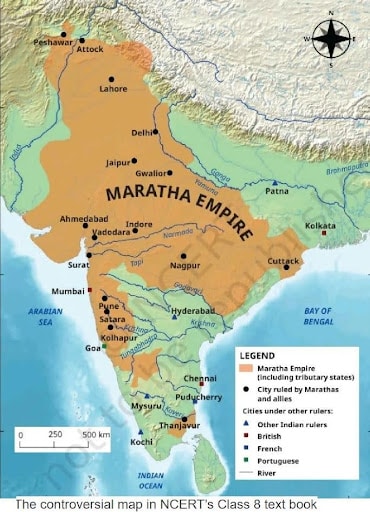
  • A controversy has erupted over a map in the new NCERT Class 8 social science textbook showing Jaisalmer as part of the Maratha empire in 1759.

  • Relatives of the former Jaisalmer royal family, called the depiction “historically misleading” and “factually baseless,”. 
  • They stated that no authentic records indicate Maratha control, invasion, taxation, or authority over Jaisalmer, and that royal archives confirm the Marathas never interfered in the princely state’s affairs. 
  • Responding to the objection, the chairperson of NCERT’s curricular area group for social science, said further research is underway to verify the map’s accuracy, and if errors are found, a corrected version will be prepared for future editions.

Northern Expansion of the Marathas: Economic Tribute vs. Political Control

  • In the early 18th century, as the Mughal empire fragmented, Peshwa Baji Rao I led Maratha expansion into northern regions, including parts of Rajasthan, Delhi, Punjab, Bundelkhand, Orissa, Bengal, and Bihar, consolidating control over Malwa after the Battle of Bhopal. 
  • Historians state that the Marathas often allowed local rulers to remain in power, securing agreements with zamindars to collect tribute rather than replacing them. 
  • They clarified that while the Marathas collected chauth and sardeshmukhi from Rajput territories and other regions, this did not always translate into political dominance, as many states paid tribute without recognizing the Peshwa as their sovereign.

Historians Confirm Jaisalmer Was Never Part of the Maratha Empire

  • Historians agree that while the Marathas expanded northwards after consolidating power in the Deccan, annexing regions like Malwa and Orissa and extracting tribute from several Rajput states, Jaisalmer was never under their control. 
  • According to them, the Marathas entered Rajasthan—often at the invitation of Rajput chiefs to resolve succession disputes—and confined most raids to Jaipur and Jodhpur, never targeting Jaisalmer or Bikaner. 
  • There is no historical evidence of Jaisalmer being a tributary state. Maratha expeditions in Rajasthan to claim tribute, but with no lasting administration, as local rulers often expelled Maratha agents once the armies left. 
  • Even prominent states like Amber-Jaipur failed to pay tribute regularly, and there is no record of Jaisalmer making such payments, reinforcing that it was never part of the Maratha empire.

Maratha Empire: Patchy Control and Varied Authority

  • Historians note that Maratha rule in the 18th century was far from uniform.
  • They described it as “patchy and irregular” between the 1730s and 1750s—ranging from fully administered territories to areas only loosely controlled, where resistant zamindars defied authority. 
  • Historians observed that the Maratha polity has often been framed as a regional awakening, a Hindu reaction to Muslim rule, or an effort to reform Hindu society.
  • They argued that it should instead be seen as one of many contemporary polities, not a proto-nationalist crusade. 
  • While the Marathas claimed sovereignty over large parts of India, their actual control varied greatly, and the more important question is understanding how authority was established rather than glorifying dynastic territorial claims.

NCERT Responds to Map Controversy, Open to Revisions

  • NCERT clarified that the new Class 8 social science chapter on the Marathas was prepared with expert consultation and based on earlier published maps, with no prior objections. 
  • The map includes areas under direct Maratha control as well as tributary states or regions under temporary agreements. 
  • NCERT acknowledged that a disclaimer on approximate borders, present in the Grade 7 book, should also have been included in Grade 8. 
  • Experts suggested using different shades on maps to distinguish direct control, tributary states, short-term conquests, and areas of influence, as a single colour oversimplifies history.

Source: IE | ToI | IT

Jaisalmer Maratha Empire FAQs

Q1: Was Jaisalmer ever part of the Maratha Empire?

Ans: No, historians confirm Jaisalmer was never under Maratha control or tribute, contrary to NCERT’s controversial textbook map.

Q2: What regions did the Marathas control in the north?

Ans: They expanded into Rajasthan, Delhi, Punjab, Bundelkhand, Orissa, Bengal, and Bihar, but often left local rulers in place.

Q3: Did the Marathas control Rajput states politically?

Ans: Not always. Many states paid chauth or sardeshmukhi but did not recognize Maratha political authority over them.

Q4: What is NCERT’s stance on the Jaisalmer map issue?

Ans: NCERT says the map was based on earlier sources, open to correction, and may revise it in future editions.

Q5: What improvements do experts suggest for historical maps?

Ans: Use colour shades to differentiate direct control, tributary states, temporary conquests, and influence, avoiding oversimplification of history.

Rain, Landslides, and Flash Floods in the Himalayas: Causes, Risks, and Mitigation

Himalayan Flash Floods

Himalayan Flash Floods Latest News

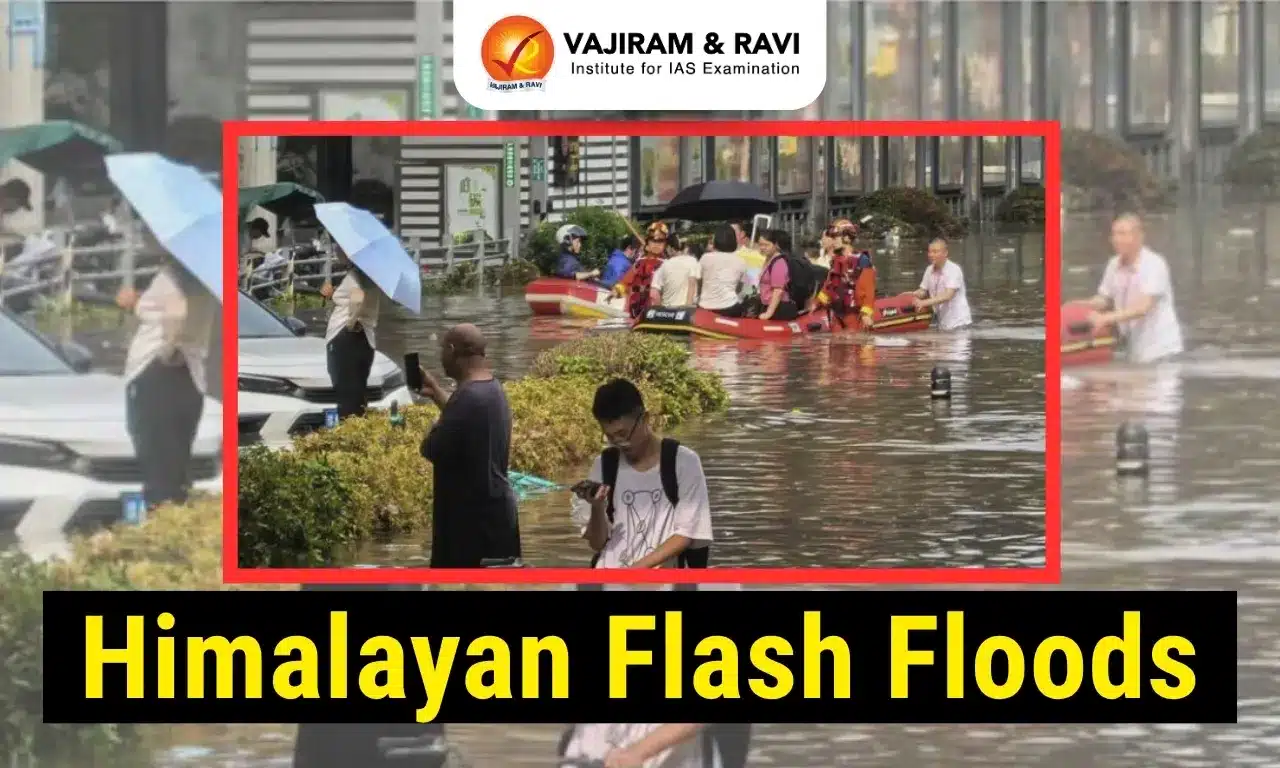
  • A flash flood in Dharali, Uttarkashi on August 5 killed at least four, left many missing, and caused widespread destruction. 
  • Hundreds were displaced, and similar extreme weather events in Himachal Pradesh last month killed dozens and affected thousands.

Unclear Cause of Dharali Flash Flood Highlights Rising Risks

  • Flash floods, often triggered by extreme rainfall causing landslides or mudslides, sweep debris into rivers, destroying everything in their path. 
  • The exact cause of the August 5 Dharali flood remains uncertain, though a glacial lake breach is a possibility yet to be confirmed. 
  • Despite normal monsoon levels in the area, the incident underscores growing disaster risks in ecologically fragile regions and the increasing difficulty of establishing effective early warning and mitigation systems.

Understanding Rainfall Patterns and Cloudburst Concerns in Uttarkashi

  • Despite heavy and continuous rainfall across Uttarakhand this month, Uttarkashi district experienced relatively low precipitation before the recent flash flood. 
  • On August 3 and 4, when Haridwar and Udham Singh Nagar saw very heavy rains, Uttarkashi received below-normal rainfall. 
  • According to IMD data, on August 5 — the flood day — Uttarkashi recorded 32 mm of rain, double the daily normal but far from an extreme rainfall event. 
  • Cloudbursts, defined by IMD as at least 100 mm of rain in about an hour over a 10×10 km area, are highly localised and often go unrecorded if measuring instruments are absent in the affected zone. 
  • Such intense, short-duration rain can trigger landslides and flash floods, as seen in Himachal Pradesh recently. 
  • However, in Uttarkashi’s case, there is no evidence of a cloudburst or cloudburst-like event, even in remote areas.

Multiple Triggers Behind Flash Floods in the Himalayas

  • Flash floods in the Himalayas are rarely caused by a single factor and do not always result directly from heavy rainfall or cloudbursts. 
  • Such events typically require a combination of conditions, such as 
    • intense rain leading to landslides 
    • or mudslides that channel debris into rivers, steep slopes that facilitate rapid water flow, 
    • or sudden glacial breaks releasing large volumes of water, as seen in Chamoli in 2021. 
  • In fragile terrains with eroding slopes and saturated soil, even low-intensity rainfall can trigger landslides or floods. 
  • The Himalayas, being young, geologically weak, and earthquake-prone, are inherently more vulnerable compared to older ranges like the Aravalis. 
  • Added to this natural fragility, large-scale construction and heavy vehicular traffic further heighten the risk during extreme rainfall events.

Early Warning Limitations and Mitigation for Flash Floods

  • The Dharali incident highlights the challenge of predicting flash floods, as even moderate rainfall can trigger them. 
  • While heavy rain forecasts and improving landslide predictions exist, determining whether such events will cause flash floods remains highly uncertain. 
  • Mitigation measures can help reduce risks, including: 
    • restricting construction near riverbanks, 
    • relocating vulnerable settlements away from rivers, and 
  • managing large boulders and construction debris to prevent them from being swept into waterways during high-flow events.

Source: IE

Himalayan Flash Floods FAQs

Q1: What caused the Dharali flash flood in Uttarkashi?

Ans: The exact cause is unclear, but possibilities include a glacial lake breach, highlighting complex triggers of Himalayan flash floods.

Q2: What is a cloudburst according to IMD?

Ans: A cloudburst is 100 mm or more rainfall in one hour over 10×10 km, often triggering landslides and flash floods.

Q3: Can low-intensity rainfall trigger flash floods?

Ans: Yes, in fragile Himalayan terrains with saturated soils and erosion, even small rain can cause landslides or flash floods.

Q4: Why are the Himalayas more vulnerable to flash floods?

Ans: They are young, geologically weak, earthquake-prone mountains, with added risks from construction, deforestation, and heavy traffic during extreme rainfall.

Q5: What mitigation measures can reduce Himalayan flash flood risks?

Ans: Avoid riverbank construction, relocate vulnerable settlements, and manage debris to prevent it being swept into rivers during high flow.

EV Policy Shift – For a Cleaner Transport Future

EV Policy

EV Policy Latest News

  • India has shifted its EV policy focus from cars to trucks, launching a Rs. 500-crore PM E-DRIVE subsidy for 5,600 heavy-duty e-trucks to curb transport emissions.

Introduction

  • India’s electric mobility strategy is undergoing a significant pivot. While earlier policy efforts focused on promoting electric cars, the government is now prioritising the electrification of trucks. 
  • This change aims to tackle the disproportionate share of emissions from heavy-duty vehicles, which make up just 3% of India’s vehicle fleet but contribute over a third of transport-related carbon emissions. 
  • The new focus is backed by a Rs. 500-crore subsidy to support 5,600 electric trucks under the PM E-DRIVE scheme.

Background - From Electric Cars to Electric Trucks

  • The turning point came in September 2024 when the PM E-DRIVE scheme was launched without subsidies for electric four-wheelers, unlike the earlier FAME programme
  • In August 2025, NITI Aayog reinforced this shift, noting that measuring India’s EV progress solely through car adoption is not suitable for a country where two-wheelers dominate and cars constitute only 13% of the vehicle fleet.
  • While EV adoption in the two-wheeler segment has reached 6%, electric cars accounted for just 2% of total four-wheeler sales in 2024. 
  • This figure lags far behind global leaders such as China (47%), Europe (23%), and the US (10%).

Challenges with Electric Car Adoption

  • Despite government incentives, tax waivers, falling battery costs, and supply chain development under the PLI scheme, electric car sales in India remain sluggish. 
  • High upfront costs, range anxiety, and low daily usage patterns for personal cars have limited adoption. 
  • Large cars over Rs. 10 lakh make up just 2% of the fleet, reducing the environmental impact of their electrification.
  • The government launched the Scheme to Promote Manufacturing of Electric Passenger Cars in 2024 to attract global automakers. However, uptake has been limited, with Tesla declining to set up manufacturing in India.

The Case for Electrifying Trucks

  • Heavy-duty trucks are the backbone of India’s road transport system, but are also major polluters. 
  • They emit 34% of the transport sector’s CO₂ emissions and over half of particulate pollution, despite being only a small fraction of the fleet. 
  • Long-haul trucks, in particular, have been identified as critical for achieving significant reductions in greenhouse gases.
  • Electric truck penetration is currently negligible, just 0.7% in 2024. 
  • Of the 8.34 lakh trucks sold that year, only 6,220 were electric, and just 280 had capacities above 3.5 tonnes.

Policy Measures and Incentives

  • Under the PM E-DRIVE scheme, the Ministry of Heavy Industries is offering incentives of up to Rs. 9.6 lakh per heavy-duty e-truck to offset high capital costs. 
  • A special allocation is being made for 1,100 trucks registered in Delhi to address severe air pollution.
  • In May 2025, the Office of the Principal Scientific Adviser identified 10 high-potential zero-emission trucking routes, including:
    • Chandigarh-Delhi-Jaipur
    • Dhanbad-Kolkata-Haldia
    • Bengaluru-Chennai-Villupuram
    • Salem-Coimbatore-Kochi

Global Context - Learning from China

  • China’s experience demonstrates the potential of electrifying freight. With 9% of heavy-duty trucks now electric, it is displacing over 1 million barrels of oil demand per day. 
  • India aims to replicate such impact, reducing both oil imports and urban air pollution.

Future Outlook - Building EV Infrastructure for Freight

  • The success of India’s truck electrification drive will depend on:
    • Rapid deployment of high-capacity charging stations along industrial corridors
    • Financial incentives for fleet operators to transition
    • Strengthening domestic manufacturing of e-trucks and batteries
    • Policy support for green freight logistics under public-private partnerships
  • If implemented effectively, this shift could position India as a leader in sustainable freight transport, delivering significant climate, health, and energy security benefits.

Source : IE

EV Policy FAQs

Q1: Why is India prioritising electric trucks over electric cars?

Ans: Trucks contribute over one-third of transport CO₂ emissions despite being just 3% of the fleet, making them a high-impact target for electrification.

Q2: What is the PM E-DRIVE scheme?

Ans: It is a government programme providing subsidies for electric vehicles, now focusing on e-trucks instead of electric cars.

Q3: How many e-trucks will be supported under the new policy?

Ans: The government plans to support 5,600 heavy-duty e-trucks with incentives up to ₹9.6 lakh per vehicle.

Q4: Why are electric car sales low in India?

Ans: High upfront costs, range anxiety, and low daily usage patterns have limited adoption despite subsidies and tax waivers.

Q5: Which countries have higher electric car penetration than India?

Ans: China, Europe, the US, and Vietnam have significantly higher EV penetration rates compared to India’s 2% in four-wheeler sales.

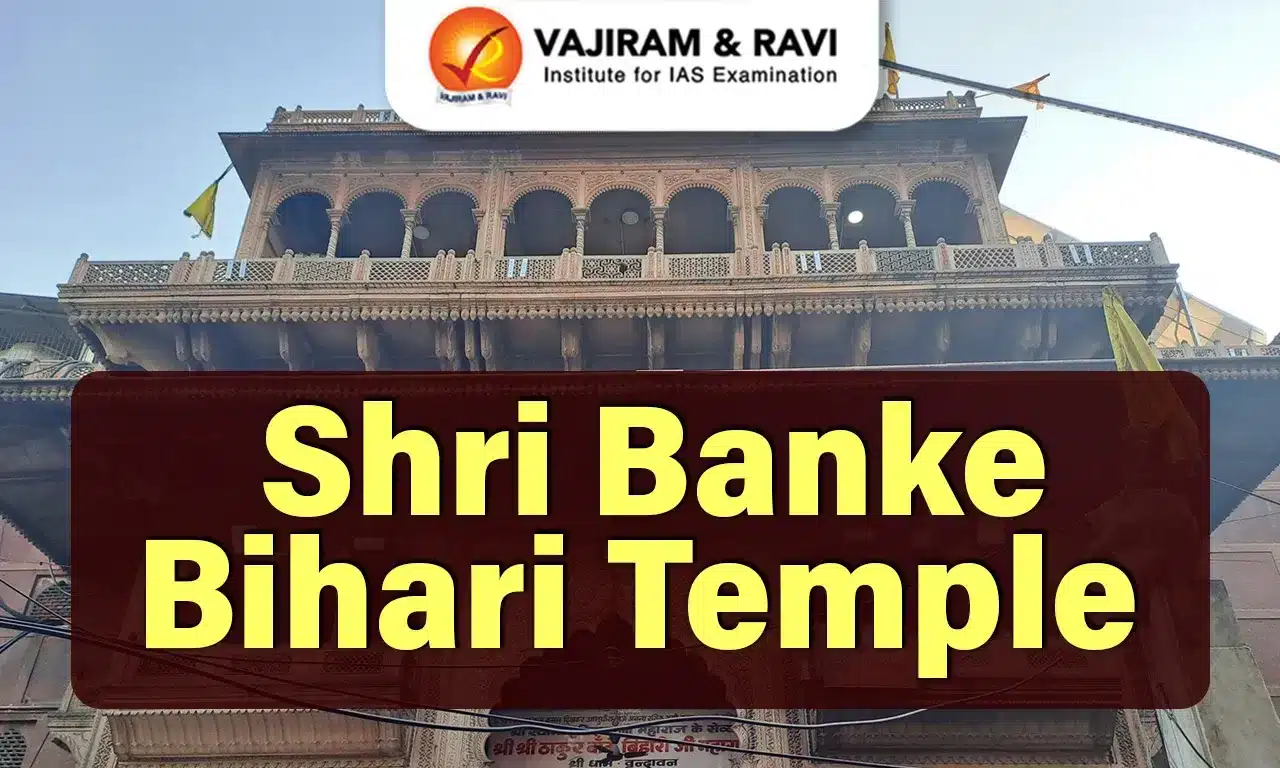
Shri Banke Bihari Temple

Shri Banke Bihari Temple

Shri Banke Bihari Temple Latest News

The Supreme Court recently expressed displeasure over the orders passed by Allahabad High Court in a PIL over the historic Banke Bihari Temple in Vrindavan and questioned the use of “intemperate language” against the Uttar Pradesh government.

About Shri Banke Bihari Temple

  • It is a Hindu temple dedicated to Lord Krishna in the holy city of Vrindavan in the Mathura District of Uttar Pradesh.
  • ‘Banke’ means bent, and ‘Bihari’ refers to Vihari, or enjoyer.
  • In this temple, the principal deity stands in the ‘tribhanga’ posture, which is tilted at three angles. Hence, Lord Krishna, who is bent at three places, got the name “Banke”.
  • It was established by Swami Haridas, a guru of the famous singer Tansen.
  • The present temple complex housing ‘Banke Bihari’ was constructed in 1864 and is a unique example of Indian craftsmanship. 
  • Architecture of the temple is influenced by the Rajasthani style, with arches and pillars adding to its magnificence.
  • In this temple, from the walls to the ceiling, the pictures of the deities have been painted through oil paintings. 
  • One unique feature of the Banke Bihari temple is that there are no bells or conchs on the premises.
  • In the freedom struggle, this temple was the main center of revolutionary activities; from here, the revolutionary newspaper “Bundelkhand Kesari” was published secretly.

Source: HT

Shri Banke Bihari Temple FAQs

Q1: Shri Banke Bihari Temple is located in which state?

Ans: It is located in the holy city of Vrindavan in the Mathura District of Uttar Pradesh.

Q2: Who established Shri Banke Bihari Temple?

Ans: It was established by Swami Haridas, a guru of the famous singer Tansen.

Difference Between Scheduled and Non-Scheduled Banks

Difference Between Scheduled and Non-Scheduled Banks

The Indian banking system is broadly classified into Scheduled and Non-Scheduled Banks as per the Reserve Bank of India Act, 1934. This classification is important for understanding how different banks function under regulatory norms and their eligibility for financial facilities from the RBI. 

The primary Difference Between Scheduled and Non-Scheduled Banks lies in their regulatory classification and compliance obligations. Scheduled Banks are those included in the Second Schedule of the Reserve Bank of India (RBI) Act, 1934, and they operate under specific guidelines and regulatory norms prescribed by the RBI. In contrast, Non-Scheduled Banks are not listed in this Schedule and are not obligated to adhere to the same regulatory framework, giving them a relatively limited scope of operation.

Scheduled Banks

Scheduled Banks are those financial institutions that are included in the Second Schedule of the Reserve Bank of India (RBI) Act, 1934. To qualify for this status, a bank must maintain a minimum paid-up capital of ₹5 lakhs and satisfy the RBI that its operations do not pose a threat to the interests of depositors.

A key operational requirement for Scheduled Banks is maintaining a mandatory balance with the RBI, known as the Cash Reserve Ratio (CRR). This ensures liquidity and financial stability within the banking system. In India, all major banking categories, including commercial banks, public sector banks, the State Bank of India and its associate banks, private sector banks, regional rural banks, cooperative banks, and foreign banks, can be classified under Scheduled Banks, provided they meet the requisite criteria.

To attain Scheduled Bank status, an institution must be a corporate entity (not an individual or partnership firm), maintain the minimum capital threshold, and demonstrate sound banking practices that uphold depositor confidence and financial integrity.

Key Features

  • Must have a paid-up capital and reserves of at least ₹5 lakhs.
  • Should not engage in activities harmful to depositors’ interests.
  • Eligible for borrowing funds from the RBI at the bank rate.
  • Must maintain Cash Reserve Ratio (CRR) with the RBI.
  • Examples: SBI, ICICI Bank, HDFC Bank, Punjab National Bank, etc.

Non-Scheduled Banks

Non-Scheduled Banks in India are not listed in the Second Schedule of the RBI Act, 1934, as they do not meet the criteria of minimum paid-up capital (₹5 lakhs) and other conditions set by the Reserve Bank of India. These banks operate on a smaller scale, maintain their cash reserves independently, and are not eligible for RBI financial assistance or clearinghouse membership. They are considered riskier due to limited regulatory oversight and are not required to submit regular reports to the RBI. Examples include some State Cooperative Banks and Urban Cooperative Banks that serve local banking needs in specific regions.

Key Features

  • Usually operate on a small scale, often region-specific.
  • Not eligible for borrowing from RBI for normal banking purposes.
  • Have to maintain CRR only with themselves, not with the RBI.
  • Not required to follow all provisions applicable to Scheduled Banks.
  • Example: Some local area banks or private financial institutions operating on a limited scale.

Difference Between Scheduled and Non-Scheduled Banks

The table below highlights the key Difference Between Scheduled and Non-Scheduled Banks in India. It compares them based on crucial factors such as RBI regulation, capital requirements, access to RBI facilities, operational scope, and reporting obligations. This comparison helps in understanding how these two categories of banks function within India's financial system.

Difference Between Scheduled and Non-Scheduled Banks
Basis of Difference Scheduled Banks Non-Scheduled Banks

Inclusion

Listed in the Second Schedule of the RBI Act, 1934

Not listed in the Second Schedule

Minimum Capital Requirement

At least ₹5 lakhs in paid-up capital and reserves

No such statutory requirement

Borrowing from RBI

Eligible to borrow funds from RBI under liquidity support

Not eligible for direct RBI support

Cash Reserve Ratio (CRR)

Must maintain CRR with RBI

Maintain CRR with themselves

Regulatory Oversight

Subject to full RBI regulation

Subject to limited RBI regulation

Scale of Operation

Operate on national or large scale

Operate on a smaller, regional scale

Examples

SBI, Axis Bank, Canara Bank, HDFC Bank

Local area banks, small private banks

Key Points to Remember

  • Scheduled Banks enjoy more credibility and access to RBI facilities.
  • Non-Scheduled Banks are typically small-scale and have limited access to national-level banking privileges.
  • The classification ensures a structured banking environment based on size, compliance, and stability.
  • Inclusion in the Second Schedule is a mark of regulatory approval and financial soundness.
Also Check Related Articles
Difference between NITI Aayog and Inter-State Council Difference Between Economic Survey and Union Budget
Difference Between Tropical Evergreen and Tropical Deciduous Forests Difference Between Ordinary Bill and Money Bill
Difference Between Legislative and Executive Difference between Himalayan and Peninsular Plateau
Difference Between Vedas and Upanishads Difference Between Scheduled and Non-Scheduled Banks
Difference Between Written and Unwritten Constitution Difference between NITI Aayog and Planning Commission
Difference between Colonialism and Imperialism Difference between Fundamental Rights and Directive Principles of State Policy
Difference between Procedure Established by Law and Due Process of Law Difference Between Democracy and Republic
Difference between Creamy Layer and Non-Creamy Layer of OBC Difference between Rajya Sabha and Vidhan Sabha
Difference Between Western Ghats and Eastern Ghats

Difference Between Scheduled and Non Scheduled Banks FAQs

Q1: What is the main difference between Scheduled and Non-Scheduled Banks?

Ans: Scheduled Banks are listed in the Second Schedule of the RBI Act and enjoy regulatory and financial privileges, while Non-Scheduled Banks are not listed and have limited facilities.

Q2: Can Non-Scheduled Banks borrow from the RBI?

Ans: No, Non-Scheduled Banks cannot borrow directly from the RBI for routine banking operations.

Q3: Do Scheduled Banks have to maintain CRR with the RBI?

Ans: Yes, Scheduled Banks must maintain a specified Cash Reserve Ratio (CRR) with the RBI.

Q4: Are all nationalized banks Scheduled Banks?

Ans: Yes, all public sector or nationalized banks in India are Scheduled Banks.

Q5: Can Non-Scheduled Banks become Scheduled Banks?

Ans: Yes, if a Non-Scheduled Bank meets the criteria set by the RBI, it can apply for Scheduled Bank status.

Difference Between Economic Survey and Union Budget

Difference Between Economic Survey and Union Budget

Every year, the Finance Ministry of India releases Economic Survey and Union Budget to analyse the economic condition in the previous year and frame the budget according to that in the next fiscal year. In the Indian Constitution, Article 112 discusses the Union Budget which is the annual financial statement including the expected receipts and expenditures for each year. Though both are presented around the same time and deal with the economy, they serve very different purposes.

Economic Survey

The Economic Survey is an annual report card of the Indian economy. It reviews the performance of key sectors such as agriculture, industry, services, inflation, trade, infrastructure, and employment during the previous financial year. The Economic Survey tells us what has happened in the economy. It is prepared by the Department of Economic Affairs, Ministry of Finance, under the guidance of the Chief Economic Adviser (CEA) and presented in Parliament a day before the Union Budget i.e. 31st January each year.

Key Features

  • Economic Survey provides a factual and analytical summary of economic trends
  • It highlights the key challenges from the previous year and policy recommendations for the next year.
  • Serves as a guide to economic planning and decision-making
  • Covers macroeconomic indicators, growth projections, and reform ideas

Union Budget

The Union Budget is the government’s official annual financial statement. It outlines the government’s estimated revenue and expenditure for the upcoming financial year (April 1 to March 31). The Union Budget tells us what the government plans to do with its money.

The Budget is prepared by the Ministry of Finance and presented by the Finance Minister of India in the Lok Sabha, usually on February 1st. It is the binding document, which is once passed by the parliament, it becomes the law.

Key Features

  • The Union Budget is divided into Revenue Budget and Capital Budget
  • Lists government expected spending on sectors like education, defence, health, etc.
  • Proposes changes in taxation policies, subsidies, and schemes
  • Union Budget shows the fiscal deficit, borrowing requirements, and receipts

Difference Between Economic Survey and Union Budget

The table below includes the side-by-side Difference Between Economic Survey and Union Budget:

Difference Between Economic Survey and Union Budget
Feature Economic Survey Union Budget

Purpose

Reviews the past year’s economic performance

Plans revenue and expenditure for the next year

Prepared by

Chief Economic Adviser & Dept. of Economic Affairs

Ministry of Finance

Presented by

Finance Minister

Finance Minister

Timing

One day before the Union Budget

On or around 1st February

Nature

Advisory, analytical

Legal and financial

Focus Area

Analysis of sectors, trends, and policies

Resource allocation, schemes, taxation

Binding

No, it’s not binding

Yes, once passed by Parliament

Legal Status

Not required under Constitution

Mandatory under Article 112 of the Constitution

Contains Policy Suggestions

Yes

Yes, but also includes concrete allocations

Document Type

Review and research report

Financial statement and legislative proposal

Also Check Related Articles
Difference between NITI Aayog and Inter-State Council Difference Between Economic Survey and Union Budget
Difference Between Tropical Evergreen and Tropical Deciduous Forests Difference Between Ordinary Bill and Money Bill
Difference Between Legislative and Executive Difference between Himalayan and Peninsular Plateau
Difference Between Vedas and Upanishads Difference Between Scheduled and Non-Scheduled Banks
Difference Between Written and Unwritten Constitution Difference between NITI Aayog and Planning Commission
Difference between Colonialism and Imperialism Difference between Fundamental Rights and Directive Principles of State Policy
Difference between Procedure Established by Law and Due Process of Law Difference Between Democracy and Republic
Difference between Creamy Layer and Non-Creamy Layer of OBC Difference between Rajya Sabha and Vidhan Sabha
Difference Between Western Ghats and Eastern Ghats

Difference between Economic Survey and Union Budget FAQs

Q1: What is the main difference between the Economic Survey and Union Budget?

Ans: The Economic Survey reviews the past year’s economic performance, while the Union Budget outlines the government’s financial plans for the upcoming year.

Q2: Who prepares the Economic Survey?

Ans: The Department of Economic Affairs under the Ministry of Finance, led by the Chief Economic Adviser.

Q3: Is the Economic Survey binding on the government?

Ans: No. It is advisory in nature and contains recommendations, not enforceable actions.

Q4: What is the constitutional basis for the Union Budget?

Ans: It is mandated under Article 112 of the Indian Constitution as the Annual Financial Statement.

Q5: When are both documents presented in Parliament?

Ans: The Economic Survey is presented a day before the Union Budget, which is typically on February 1st.

Difference between Creamy Layer and Non-Creamy Layer of OBC

Difference between Creamy Layer and Non-Creamy Layer of OBC

The Indian Constitution provides special provisions for the upliftment of the Other Backward Classes (OBCs). However, not all OBCs are eligible for reservations and benefits under government schemes. This distinction is made through the classification of Creamy Layer and Non-Creamy Layer within the OBC category. Understanding this classification is crucial for aspirants preparing for competitive exams and for those seeking government benefits.

Creamy Layer of OBC

The Creamy Layer refers to the wealthier and better-educated segment within the OBC category. These individuals are considered socially advanced and thus not eligible for reservation benefits in jobs, education, or government schemes meant for socially and educationally backward classes.

Eligibility Criteria for Creamy Layer (As of 2024)

  • Annual family income exceeds ₹8 lakh (some states consider ₹8 lakh–₹15 lakh for revision).
  • Parents employed in Group A or Group B central or state government services.
  • Professionals and high-income earners, including doctors, engineers, and entrepreneurs.

These individuals are excluded from reservation quotas under the OBC category.

Non-Creamy Layer of OBC

The Non-Creamy Layer refers to the economically and socially backward segment of OBCs. This group qualifies for reservation benefits in education, employment, and other government welfare schemes.

Eligibility Criteria for Non-Creamy Layer:

  • Annual family income is less than ₹8 lakh.
  • Parents are not in senior government posts or high-earning private positions.
  • Considered economically weaker and socially disadvantaged within the OBC category.

This classification enables the government to target affirmative action more effectively.

Difference Between Creamy Layer and Non-Creamy Layer of OBC

The classification of OBCs into Creamy Layer and Non-Creamy Layer is essential for equitable distribution of reservation benefits. It ensures that only the genuinely disadvantaged sections receive affirmative action support. The table below includes the Difference Between Creamy Layer and Non-Creamy Layer of OBC:

Difference between Creamy Layer and Non-Creamy Layer of OBC
Aspect Creamy Layer of OBC Non-Creamy Layer of OBC

Eligibility for Reservation

Not eligible

Eligible

Annual Income Limit

Above ₹8 lakh (as per current criteria)

Below ₹8 lakh

Social Status

Economically and socially advanced

Economically and socially backward

Government Job Criteria

Parents in Group A/Group B jobs

Parents in lower categories or unemployed

Purpose of Classification

To exclude affluent OBCs from reservation benefits

To provide benefits to the truly backward

Proof Required

No Non-Creamy Layer certificate needed

Must obtain a Non-Creamy Layer Certificate

Example

Doctor earning ₹15 lakh annually

Farmer with annual income of ₹4 lakh

Difference Between Creamy Layer and Non-Creamy Layer Key Points

  • The Creamy Layer concept was introduced in 1993 by the Supreme Court to ensure that the benefits of reservation reach the needy among OBCs.
  • Income and social status both play a role in determining whether an individual falls into the creamy or non-creamy category.
  • The Non-Creamy Layer Certificate is mandatory to avail of reservation in government jobs and educational institutions.
  • While SC/ST categories do not have a creamy layer criterion for reservation benefits, OBCs are divided into creamy and non-creamy layers.
Also Check Related Articles
Difference between NITI Aayog and Inter-State Council Difference Between Economic Survey and Union Budget
Difference Between Tropical Evergreen and Tropical Deciduous Forests Difference Between Ordinary Bill and Money Bill
Difference Between Legislative and Executive Difference between Himalayan and Peninsular Plateau
Difference Between Vedas and Upanishads Difference Between Scheduled and Non-Scheduled Banks
Difference Between Written and Unwritten Constitution Difference between NITI Aayog and Planning Commission
Difference between Colonialism and Imperialism Difference between Fundamental Rights and Directive Principles of State Policy
Difference between Procedure Established by Law and Due Process of Law Difference Between Democracy and Republic
Difference between Creamy Layer and Non-Creamy Layer of OBC Difference between Rajya Sabha and Vidhan Sabha
Difference Between Western Ghats and Eastern Ghats

Difference between Creamy Layer and Non-Creamy Layer of OBC FAQs

Q1: What is the income limit for determining the creamy layer of OBC?

Ans: As per current rules, the annual family income limit is ₹8 lakh. Above this, OBC individuals fall under the creamy layer and are not eligible for reservations.

Q2: Who issues the Non-Creamy Layer Certificate?

Ans: The Tahsildar or Revenue Officer of the concerned district issues the certificate after verifying the family’s income and occupational status.

Q3: Is the creamy layer concept applicable to SC/ST candidates?

Ans: No. The creamy layer criterion is only applicable to OBCs, not to Scheduled Castes (SC) or Scheduled Tribes (ST).

Q4: Is the income of siblings and spouses considered in determining the creamy layer?

Ans: No. Only the income of parents (mother and father) is considered, not of the individual, spouse, or siblings.

Q5: Can someone from the creamy layer apply under the general category?

Ans: Yes. Individuals belonging to the creamy layer of OBCs can apply under the general (unreserved) category in competitive exams or job recruitment.

Enquire Now