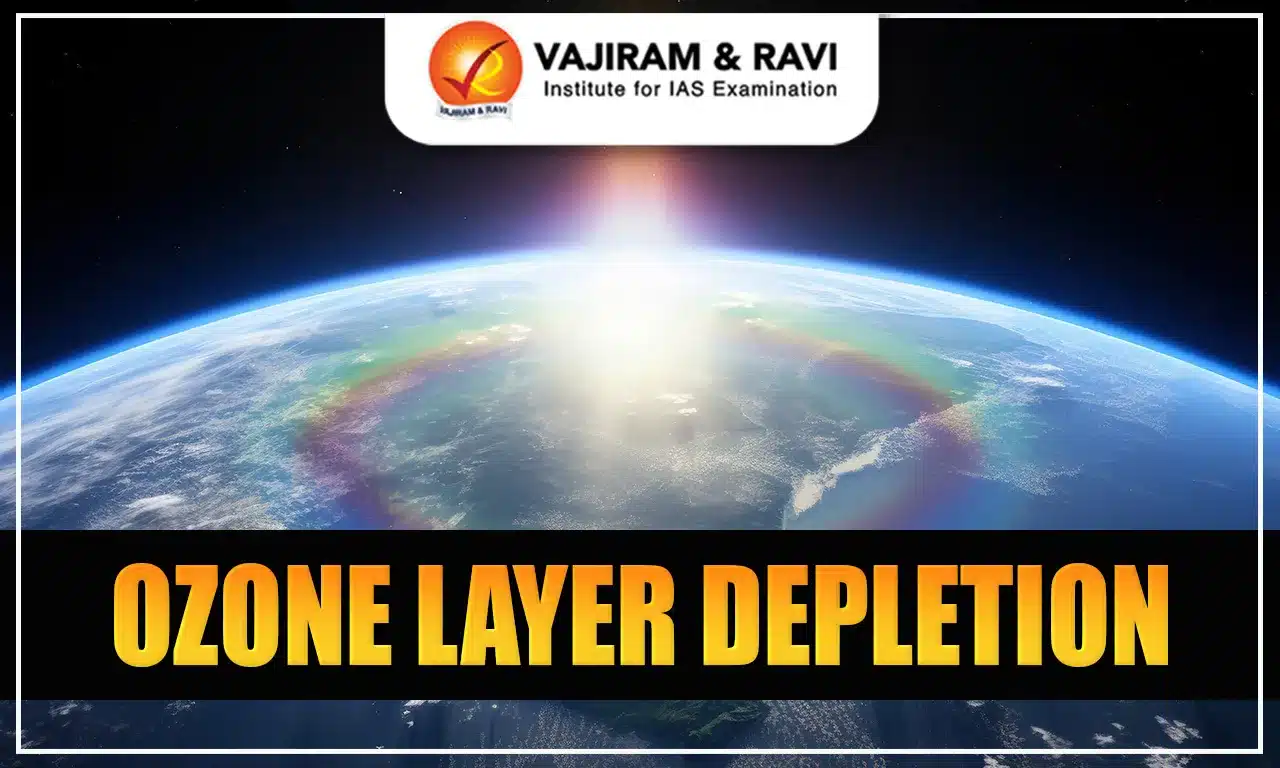
Ozone Layer Depletion has become one of the prevailing environmental challenges which refers as the thinning of this protective shield has raised serious concerns about rising ultraviolet (UV) radiation and its impact on human health, ecosystems, and climate. Understanding the causes and consequences of Ozone Depletion is crucial for addressing its long-term risks. This article discusses it in detail, covering its major causes, harmful effects, and the measures adopted both in India and at the global level through agreements such as the Vienna Convention, the Montreal Protocol, and the Kigali Agreement.
Ozone Layer
The Ozone Layer is a protective shield of naturally occurring gas located about 10-50 km above the Earth’s surface. Its primary function is to absorb harmful ultraviolet (UV) radiation, preventing it from reaching the ground.
Nearly 90% of the atmosphere’s ozone lies in the stratosphere, while the remaining 10% is found in the troposphere. The stratospheric ozone is what we commonly refer to as the “ozone layer.”
The concentration of ozone is not constant; it varies by location and over different time scales, ranging from daily to seasonal. These fluctuations are influenced by stratospheric winds, chemical processes of ozone production and destruction, and natural atmospheric circulation. Due to seasonal wind patterns in the stratosphere, total ozone levels are generally lowest near the equator and highest toward the poles.
Ozone Layer Depletion
Ozone Layer Depletion refers to the gradual thinning of the ozone layer present in the Earth’s stratosphere. Ozone, being a thermodynamically unstable gas, readily decomposes into molecular oxygen. Under normal conditions, an equilibrium is maintained between the production and decomposition of ozone molecules. Depletion occurs when this balance is disturbed, leading to a higher rate of ozone destruction than its formation.
Ozone Layer Depletion Mechanism
- The Ozone Layer is destroyed when it reacts with nitrogen, hydrogen, chlorine, or bromine molecules. Some of these Ozone Layer Depletion substances occur naturally, while others are of anthropogenic origin.
- Although natural phenomena may cause temporary ozone loss, the release of chlorine and bromine from synthetic compounds is widely recognized as the principal cause of the long-term depletion of stratospheric ozone across the globe.
- These gases tend to accumulate in the lower atmosphere, as they are chemically inert and resistant to dissolution in rain or snow. Over time, they are transported to the stratosphere, where they break down into more reactive forms and trigger a series of reactions that accelerate Ozone Layer Depletion.
Ozone Layer Depletion Causes
Ozone Layer Depletion occurs due to both natural and human-made factors:
- Natural Causes: Some naturally occurring substances contribute to ozone depletion. These include hydrogen oxides (HOx), methane (CH4), hydrogen gas (H2), nitrogen oxides (NOx), chlorine monoxide (ClO), stratospheric aerosols, and gases released during volcanic eruptions.
- Man-made Causes: Industrial activities and consumer products release halogen-based gases (such as CFCs, halons, and carbon tetrachloride) into the atmosphere. These synthetic compounds break down in the stratosphere, releasing chlorine and bromine that accelerate ozone destruction.
Ozone Depleting Substances
Ozone Depleting Substances (ODSs) are chemical compounds that break down ozone molecules in the stratosphere, leading to thinning of the ozone layer. These substances are either naturally occurring or synthetically produced, but human-made compounds, especially those containing chlorine and bromine, are the primary contributors to ozone depletion. Below is a table listing some of the most common ODSs, their sources, and uses:
| Ozone Depleting Substances | ||
| ODS | Chemical Composition | Primary Sources/Uses |
|
Chlorofluorocarbons (CFCs) |
Compounds of chlorine, fluorine, and carbon |
Refrigerants, aerosol propellants, foam-blowing agents |
|
Halons |
Compounds containing bromine, fluorine, and carbon |
Fire extinguishers, especially for aircraft and computer systems |
|
Carbon Tetrachloride (CCl₄) |
Carbon and chlorine compound |
Solvent, cleaning agent, feedstock for CFC production |
|
Methyl Chloroform (CH₃CCl₃) |
Carbon, hydrogen, and chlorine compound |
Industrial cleaning, degreasing solvents |
|
Hydrochlorofluorocarbons (HCFCs) |
Compounds of hydrogen, chlorine, fluorine, and carbon |
Transitional substitutes for CFCs in refrigeration and air-conditioning |
|
Methyl Bromide (CH₃Br) |
Compound of carbon, hydrogen, and bromine |
Soil fumigant, pesticide, and pest control in agriculture |
Ozone Layer Depletion Effects
While a small dose of UV-B radiation is beneficial for vitamin D synthesis and also serves as a natural germicide, excessive exposure caused by Ozone Layer Depletion has serious consequences for life on Earth. The weakening of the ozone shield allows harmful ultraviolet rays to penetrate the atmosphere, leading to multiple adverse effects:
| Ozone Layer Depletion Effects | |
| Domain | Effects of Ozone Layer Depletion |
|
Humans |
Increased risk of skin cancer, eye cataracts, weakened immune system, and premature aging due to higher UV exposure. |
|
Plants |
Reduced crop yield, damage to plant tissues, stunted growth, and disruption of photosynthesis. |
|
Aquatic Life |
Phytoplankton decline, affecting the base of the marine food chain; UV damage to fish eggs and larvae. |
|
Animals |
Skin diseases, eye damage, weakened immunity, and disrupted ecosystems due to loss of food sources. |
|
Environment |
Disruption of ecological balance, reduced biodiversity, and degradation of natural habitats. |
Measures to Reduce Ozone Layer Depletion
To safeguard the Ozone Layer and minimize its depletion, several international agreements, technological shifts, and lifestyle changes have been adopted. These measures focus on phasing out harmful chemicals, encouraging sustainable practices, and promoting global cooperation to restore and protect the ozone shield.
| Measures to Reduce Ozone Layer Depletion | |||
| Agreement / Protocol | Year | Key Features | Impact / Significance |
|
Vienna Convention for the Protection of the Ozone Layer |
1985 (effective 1988) |
First global framework to protect the ozone layer. Did not set binding targets but allowed adoption of future protocols. |
Created international consensus and laid the groundwork for the Montreal Protocol. |
|
Montreal Protocol on Substances that Deplete the Ozone Layer |
1987 (effective 1989) |
Legally binding treaty to phase out ozone-depleting substances (ODSs). Includes schedules for reduction/elimination. |
Considered one of the most successful environmental treaties. Universally ratified. |
|
London Amendment |
1990 |
Strengthened phase-out schedule and added financial mechanisms for developing countries. |
Accelerated control of CFCs and halons. |
|
Copenhagen Amendment |
1992 |
Expanded list of controlled substances, stricter phase-out timelines. |
Brought forward deadlines for ODS elimination. |
|
Montreal Amendment |
1997 |
Introduced new controls on trade and licensing of ODSs. |
Improved compliance and monitoring. |
|
Beijing Amendment |
1999 |
Added bromochloromethane to controlled substances, tightened controls. |
Closed loopholes in earlier agreements. |
|
Kigali Amendment |
2016 (effective 2019) |
Phases down Hydrofluorocarbons (HFCs), which are ozone-safe but potent greenhouse gases. Targets >80% reduction in HFCs by 2047. |
Extends the protocol’s role to climate change mitigation, making it a key global warming treaty. |
India’s Efforts to Control Ozone Layer Depletion
India has actively participated in global initiatives to protect the ozone layer and has taken several measures to control harmful substances. Some of the key efforts include:
- International Commitments: India signed the Vienna Convention in 1991 and the Montreal Protocol in 1992, marking its commitment to the global fight against ozone depletion.
- Phase-Out of ODSs: The country has successfully phased out the production and consumption of chlorofluorocarbons (CFCs), carbon tetrachloride, and halons.
- Kigali Amendment: In 2021, India ratified the Kigali Amendment to the Montreal Protocol. As per the agreement, India will begin phasing down hydrofluorocarbons (HFCs) by 2028 and aims to cut emissions by 15% of the 2024-26 baseline levels by 2047.
- Industrial Shifts: Earlier, some large steel manufacturers relied on carbon tetrachloride, a harmful chemical. Today, many have shifted to using tetrachloroethane, which is considered less damaging to the ozone layer.
- Institutional Support: A dedicated Ozone Cell under the Ministry of Environment, Forest and Climate Change coordinates national efforts in collaboration with the United Nations Development Programme (UNDP).
Ozone Layer Importance
- The Ozone Layer plays a key role in maintaining the Earth’s temperature balance by influencing atmospheric circulation patterns.
- It helps in preserving biodiversity by protecting both terrestrial and marine ecosystems from UV-induced disruptions.
- The ozone layer reduces UV-related degradation of materials such as plastics and paints, thereby prolonging their lifespan.
- It supports agricultural productivity by shielding crops from harmful UV radiation, which ensures better yields and food security.
- The ozone layer safeguards human health by preventing overexposure to UV rays that can cause skin cancer, cataracts, and other health issues.
- In this way, the Ozone Layer plays a crucial role in sustaining life and the environment on Earth
Ozone Layer Depletion FAQs
Q1: What is ozone layer depletion?
Ans: Ozone layer depletion is the thinning of the stratospheric ozone layer due to harmful chemicals like CFCs, halons, and other ozone-depleting substances.
Q2: Why is the ozone layer important?
Ans: It protects Earth from harmful ultraviolet (UV) radiation, preventing skin cancer, cataracts, and ecosystem damage.
Q3: What causes ozone layer depletion?
Ans: Chlorofluorocarbons (CFCs), halons, carbon tetrachloride, and methyl chloroform break down ozone molecules in the stratosphere.
Q4: What is the ozone hole?
Ans: It refers to a severe seasonal thinning of the ozone layer, especially over Antarctica, observed since the 1980s.
Q5: What are the effects of ozone depletion?
Ans: Increased UV radiation, skin diseases, eye disorders, reduced crop yields, harm to marine life, and global climate imbalance.