
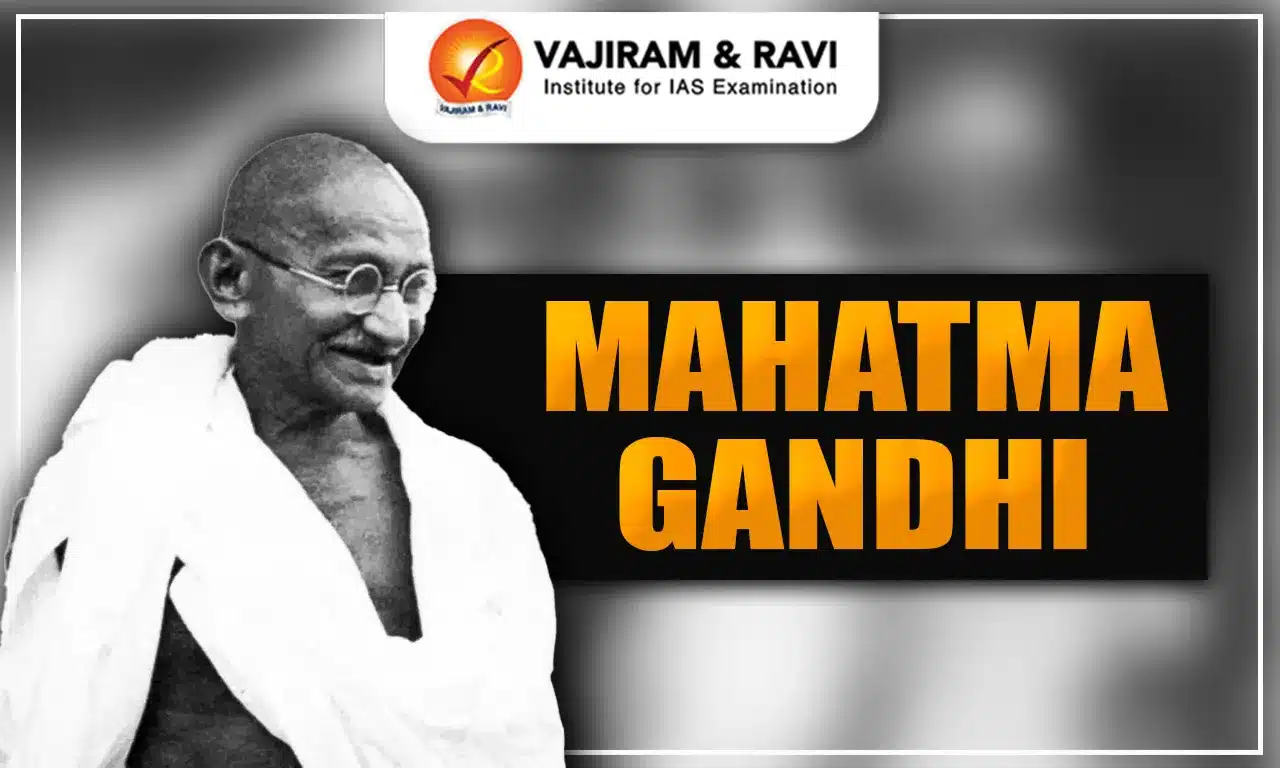
Mahatma Gandhi was born on 2nd October 1869 in Porbandar, Gujarat. When born he was named Mohandas Karamchand Gandhi. Also known as the Father of the Nation, his life was based on the ideals of truth, nonviolence and self-reliance. Mahatma Gandhi’s leadership not only shaped India’s freedom struggle but also inspired global movements for justice, equality and peace. His principles continue to guide humanity in addressing conflict and oppression through moral courage rather than violence. In this article, we are going to cover all about Mahatma Gandhi, his life, education, philosophy and his teachings.
Mahatma Gandhi Early Life and Education
Mahatma Gandhi was born in a Hindu family and grew up with deeply rooted values of morality, discipline and compassion. His background of growing up in a simple, truthful and empathetic family. He pursued his early education in Porbandar and later in Rajkot and left for London at the age of 18 to study law at University College London and the Inner Temple. During his stay in England, he adopted vegetarianism, studied world religions and refined his moral outlook, laying the groundwork for his future philosophy.
Mahatma Gandhi’s Experiences in South Africa
Mahatma Gandhi came back to India in 1891 and struggled to establish a legal practice. He moved to South Africa on a legal assignment and encountered the harsh realities of racial discrimination. Gandhiji faced humiliation when he was thrown out of the train at Pietermaritzburg for refusing to leave the “whites only” compartment despite having a valid ticket. These experiences of alienation awakened in him a spirit of resistance. In South Africa, Mahatma Gandhi practiced Satyagraha, a method of non violent resistance against injustice. For over two decades, he held campaigns for the rights of Indian immigrants against discriminatory laws, laid the foundation for his leadership style based on civil disobedience and moral strength.
Mahatma Gandhi’s Return to India
Mahatma Gandhi returned to India in 1915 and was welcomed by Gopal Krishna Gokhale, his political mentor. As soon as he entered India, Gandhi started working on grassroot levels and transformed India’s national struggle into a mass movement of the people. Some of these movements included:
- Champaran Satyagraha (1917)
-
-
- Mahatma Gandhi’s first Satyagrapha movement took place in India where he fought for the rights of indigo farmers in Bihar who were being exploited by European planters. The success of this movement gave Gandhiji the status of a national leader.
-
- Non- Cooperation Movement (1920-22)
-
-
- Gandhi motivated Indians to boycott British goods, schools, courts and titles. This marked the first nationwide participation of masses in the freedom struggle.
-
- Salt March/ Dandi March
-
-
- A 240 mile march from Sabarmati Ashram to Dandi took place with the goal of breaking the salt law imposed by the British. This symbolised mass defiance of colonial authority and caught global attention.
-
- Quit India Movement
-
- The Quit India Movement was launched during the time of World War II and demanded the immediate withdrawal of the British from India. While the whole movement was met with brutal repression, it galvanized with the slogan- “Do or Die”.
Mahatma Gandhi Philosophy and Teachings
Gandhi’s ideology was rooted in ancient Indian values and universal human ethics. His major principles include:
- Ahimsa (Nonviolence): Belief in non-harming as the most powerful weapon.
- Satyagraha: Resistance based on truth, courage, and moral force rather than violence.
- Sarvodaya: Welfare of all, especially the weakest sections of society.
- Swadeshi and Self-Reliance: Promoted indigenous industries like khadi to empower rural India and reduce dependency on foreign goods.
- Communal Harmony: Advocated religious tolerance and social unity, fighting against caste-based discrimination.
Mahatma Gandhi’s Legacy and Global Influence
Mahatma Gandhi’s fight for India’s independence came to fruition with India getting finally independent on 15 August, 1947. His teachings and influence is still remembered all over the world as an eternal force.
- In India: Gandhi remains the Father of the Nation. His birthday, October 2, is celebrated as Gandhi Jayanti and also observed globally as the International Day of Nonviolence. His emphasis on decentralization, village economy, and self-reliance continue to influence policies.
- Globally: Leaders such as Martin Luther King Jr., Nelson Mandela, and Dalai Lama drew inspiration from Gandhi’s nonviolent struggles. His methods have shaped civil rights and liberation movements across continents.
Mahatma Gandhi’s Literary Contributions
Gandhi was a prolific writer. His works include:
- “Hind Swaraj” (1909): A critique of modern civilization and vision of self-rule.
- Autobiography – “The Story of My Experiments with Truth.”
- Edited journals such as Young India, Harijan, Indian Opinion, and Navajivan.These writings remain key sources of his philosophy and political thought.
Mahatma Gandhi’s Recognition and Awards
Mahatma Gandhi was nominated five times for the Nobel Peace Prize but never received one. However his contributions were globally recognised and he was also declared the “Man of the Year” (1930) by the Times Magazine. In 2011, he was listed among the Top 25 Political Icons of all time.
Mahatma Gandhi’s Life Timeline
Here is a timeline of Mahatma Gandhi life journey and his major accomplishments:
| Year | Event | Significance |
|
1869 |
Birth of Mohandas Karamchand Gandhi on 2 October at Porbandar, Gujarat |
Beginning of the life of India’s “Father of the Nation.” |
|
1883 |
Married Kasturba Gandhi at age 13 |
Early marriage, common in that era. |
|
1888 |
Left for London to study law at Inner Temple |
Exposure to Western education and values. |
|
1891 |
Returned to India after completing law studies |
Began legal practice in Rajkot and Bombay. |
|
1893 |
Went to South Africa for legal work |
Faced racial discrimination; foundation of Satyagraha laid. |
|
1894 |
Founded the Natal Indian Congress in South Africa |
Organized Indians against racial discrimination. |
|
1906 |
First Satyagraha launched in South Africa |
Experimented with nonviolent resistance. |
|
1915 |
Returned to India |
Joined Indian freedom struggle; established Sabarmati Ashram. |
|
1917 |
Champaran Satyagraha |
First successful Satyagraha in India, for indigo farmers. |
|
1919 |
Jallianwala Bagh massacre |
Intensified Gandhi’s opposition to British rule. |
|
1920 |
Launched the Non-Cooperation Movement |
First mass movement under Gandhi’s leadership. |
|
1930 |
Dandi March (Salt March) |
Symbolic protest against salt tax; part of Civil Disobedience Movement. |
|
1931 |
Attended Second Round Table Conference in London |
Represented Indian National Congress. |
|
1942 |
Launched Quit India Movement |
Mass movement demanding immediate British withdrawal. |
|
1947 |
India achieved Independence on 15 August |
Culmination of Gandhi’s lifelong struggle. |
|
1948 |
Assassinated on 30 January by Nathuram Godse in New Delhi |
End of an era; Gandhi remembered as apostle of peace and nonviolence. |
Mahatma Gandhi FAQs
Q1: Who is Mahatma Gandhi in history?
Ans: Mahatma Gandhi was the leader of India’s freedom struggle against British rule, known for his philosophy of nonviolence and truth.
Q2: What was the name of the book written by Mahatma Gandhi?
Ans: His famous book is The Story of My Experiments with Truth, an autobiography.
Q3: How did Mahatma Gandhi change the world?
Ans: Gandhi inspired global movements for civil rights and freedom through nonviolence and peaceful resistance.
Q4: What was the civil disobedience movement?
Ans: The Civil Disobedience Movement (1930) was Gandhi’s campaign of mass nonviolent resistance against unjust British laws, notably marked by the Salt March.
Q5: Which round table conference did Gandhiji attend?
Ans: Mahatma Gandhi attended the Second Round Table Conference in 1931 as the sole representative of the Indian National Congress.
