
Prairies Latest News
Recent efforts—including a newly launched database—aim to ensure that the prairies are restored much more comprehensively.
About Prairies
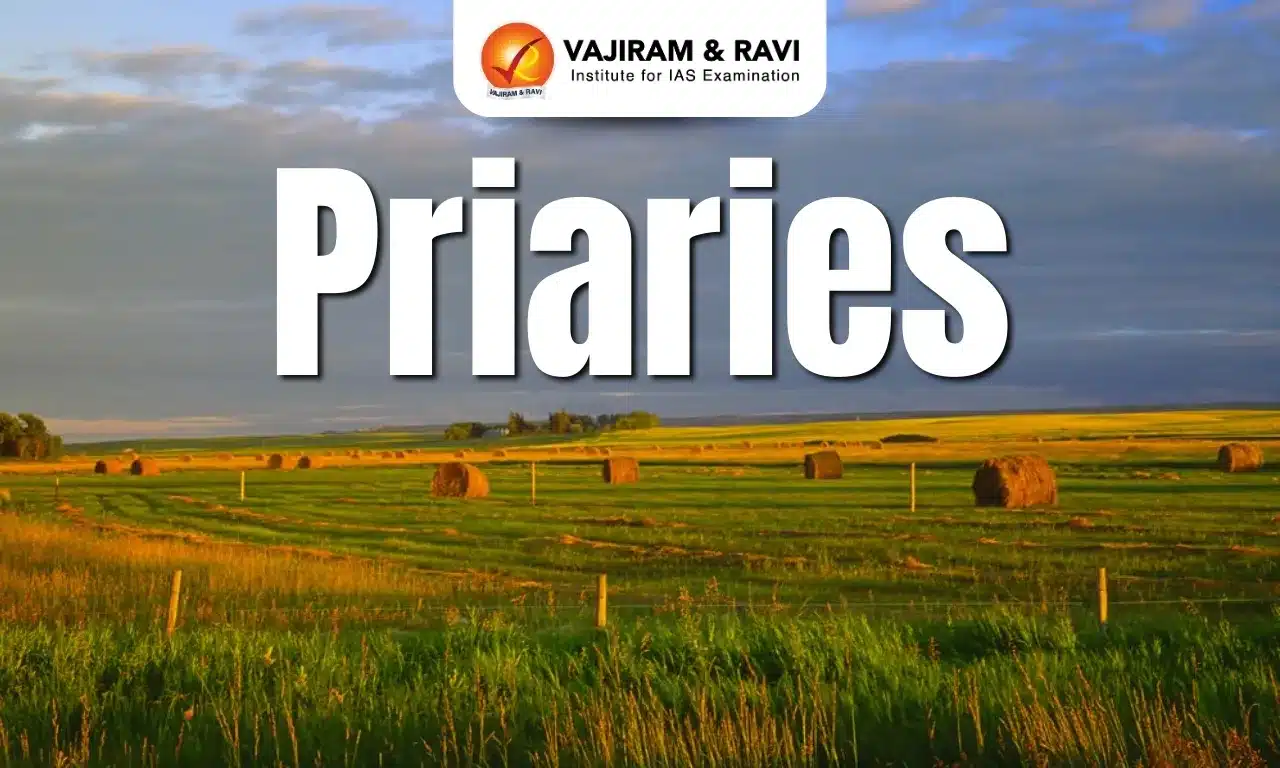
- Prairies are flat, temperate grasslands found in North America.
- Most North American prairies are in locations with a low amount of annual
- rainfall.
- Prairie vegetation is maintained by grazing, fire, drought, and low temperatures.
- Although grasses dominate, lichens, mosses, forbs, and low- to mid-size shrubs also comprise prairie vegetation.
- Taller shrubs and trees, mostly willows and poplars, including aspen and cottonwoods, are found in depressions and valleys where there is sufficient moisture and nutrients.
- Prairie, like other temperate grasslands, is among the most productive and diverse of earth’s terrestrial ecosystems.
- Grasses, the predominant cover in prairie vegetation, have the following adaptations:
- Deep or extensive roots.
- Growing points at or near the soil surface that are tucked in the crown of the plant.
- Narrow leaves.
- Small flowers in dense heads that are pollinated by wind.
- Tough stems and leaves hardened with silica phytoliths (plant stones).
- Strategies to optimize photosynthesis without losing moisture.
- Wildlife species living in prairies have adapted to a semi-arid, windy, open environment.
- Species found here include elk, deer, coyote, bobcat, Badgers, jackrabbits, ground squirrels, pocket gophers, etc
- Similar temperate grasslands in South America are called Pampas, while in Africa they are described as velds and in Asia are known as steppes.
Source: PHY
Prairies FAQs
Q1: Prairies are mainly found in which region?
Ans: North America
Q2: Which of the following is the dominant vegetation in prairies?
Ans: Grasses
Q3: What are temperate grasslands in South America called?
Ans: Steppes
