
Adi Vaani Latest News
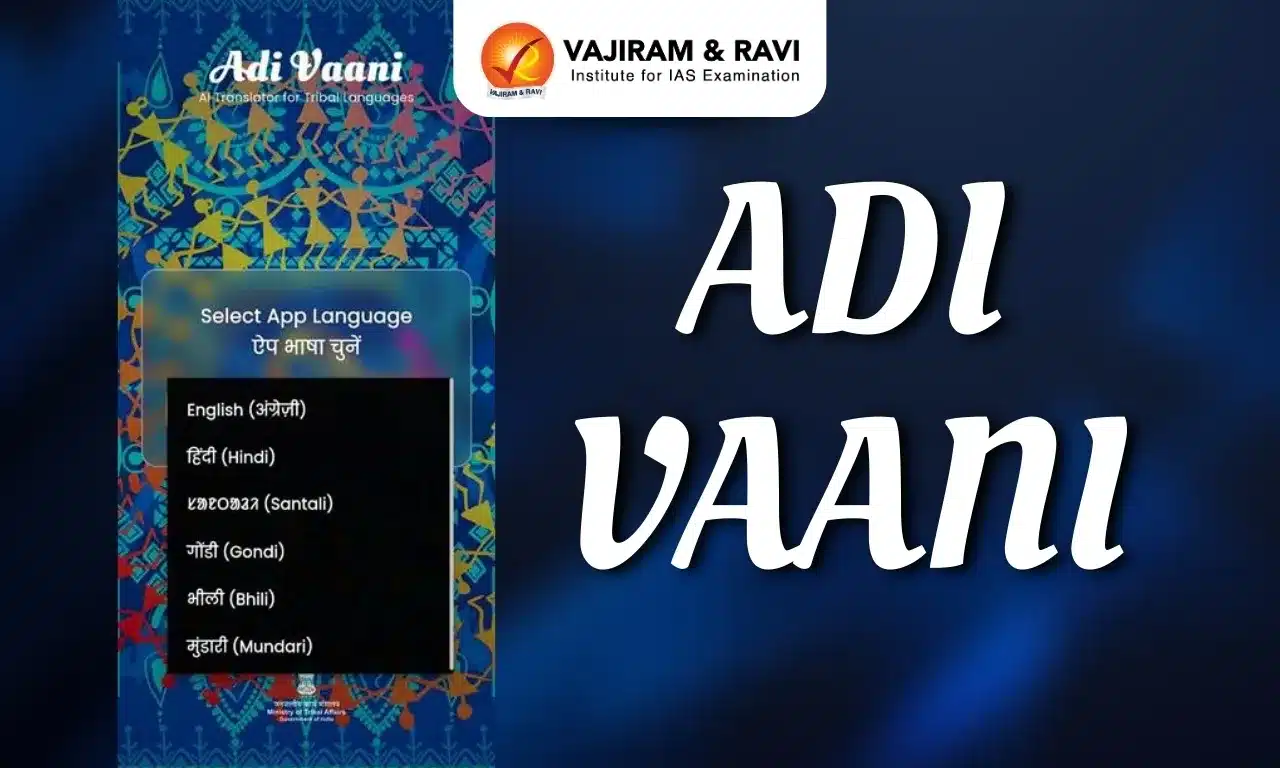
The Ministry of Tribal Affairs, Government of India, is launching the Beta Version of “Adi Vaani” language translator.
About Adi Vaani
- It is an AI-based translation tool that serves as the foundation for a future large language model dedicated to tribal languages.
- It is India’s first AI-powered translator for tribal languages.
- It is developed under the banner of Janjatiya Gaurav Varsh.
- It is designed to bridge communication gaps between tribal and non-tribal communities, while safeguarding endangered tribal languages using advanced Artificial Intelligence (AI).
- The project combines advanced AI technologies with community-driven approaches to protect, promote, and revitalize tribal languages and cultures across India.
- It is developed by a national consortium of premier institutions led by IIT Delhi with BITS Pilani, IIIT Hyderabad, and IIIT Nava Raipur in collaboration with Tribal Research Institutes (TRIs) in Jharkhand, Odisha, Madhya Pradesh, Chhattisgarh, and Meghalaya,
- The project aims to:
- Enable real-time translation (text and speech) between Hindi/English and tribal languages.
- Provide interactive language learning for students and early learners.
- Digitally preserve folklore, oral traditions, and cultural heritage.
- Support digital literacy, healthcare communication, and civic inclusion in tribal communities.
- Awareness of the government. schemes and important speeches
- Scope & Languages: In its Beta launch, Adi Vaani supports Santali (Odisha), Bhili (Madhya Pradesh), Mundari (Jharkhand), Gondi (Chhattisgarh)
Methodology & Features of Adi Vani
- AI Language Models: Refined deployment of models such as No Language Left Behind (NLLB) and IndicTrans2 for low-resource tribal languages.
- Community Participation: TRIs, experts, and communities are involved in data collection, validation, and iterative development.
Functional Toolkit of Adi Vani
- Text-to-Text, Text-to-Speech, Speech-to-Text, Speech-to-Speech translations.
- Optical Character Recognition (OCR) for digitizing manuscripts and primers.
- Bilingual dictionaries and curated repositories.
- Subtitles for Prime Minister’s speeches, health advisories (e.g., Sickle Cell Disease awareness), and information on government schemes and initiatives in tribal languages.
Source: PIB
Adi Vaani FAQs
Q1: What is optical character recognition used for?
Ans: Optical character recognition (OCR) is a technology that changes printed documents into digital image files.
Q2: What is the no language left behind model?
Ans: It is a first-of-its-kind, AI breakthrough project that open-sources models capable of delivering evaluated, high-quality translations directly between 200 languages.
