
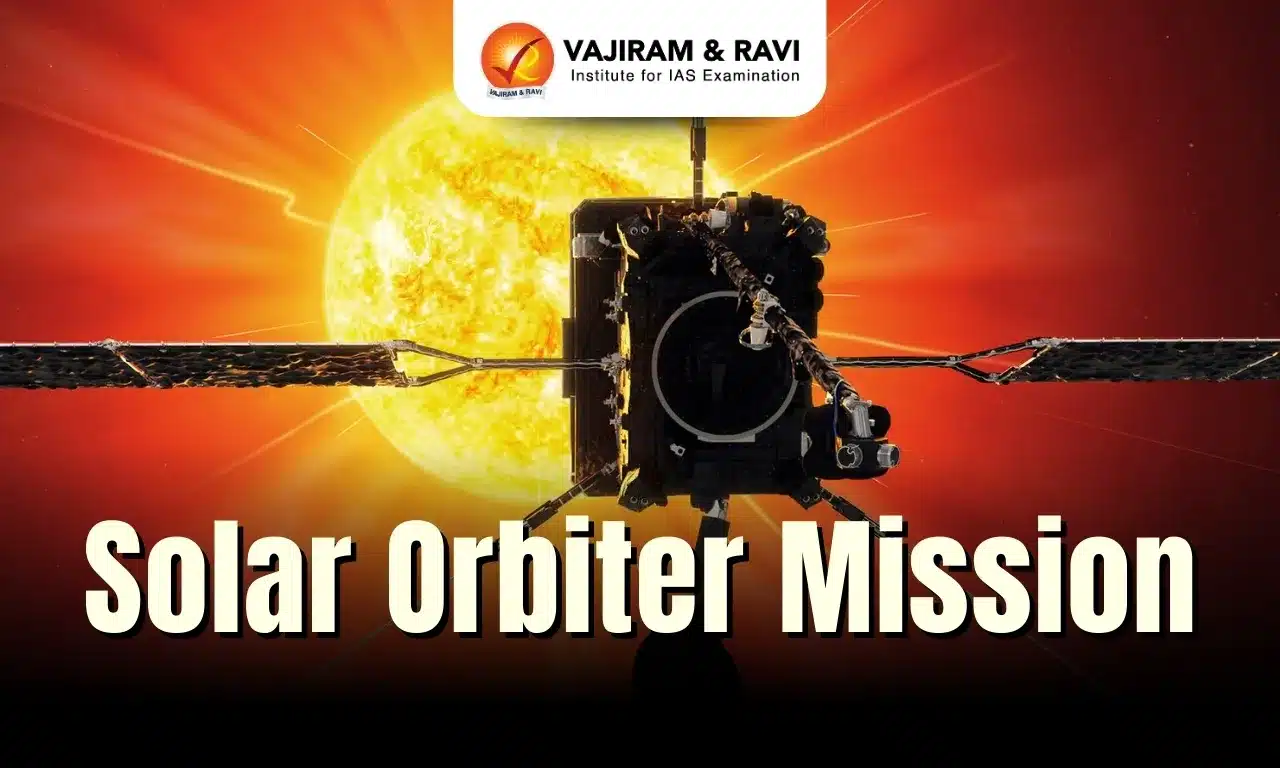
Solar Orbiter Mission Latest News
According to a new study the European Space Agency’s (ESA) Solar Orbiter Mission has traced the origin of Solar Energetic Electrons (SEEs) emerging from the Sun.
About Solar Orbiter Mission
- It is a joint project of the European Space Agency and NASA which was launched in 2020.
- Objective: It explores the Sun and heliosphere from close up and out of the ecliptic plane.
- Payload: It carries six remote-sensing instruments to observe the Sun and the solar corona, and four in-situ instruments to measure the solar wind, energetic particles, and electromagnetic fields.
What are Solar Energetic Electrons (SEE)?
- These are high-energy particles produced by the Sun.
- These particles play a key role in shaping the cosmic environment.
- Sources: They can be emitted during solar flares or coronal mass ejections
- Recent findings: It is observed that one type of SEE is tied to intense solar flares, explosive bursts from smaller patches of the Sun’s surface, while another stems from coronal mass ejections (CMEs).
- Between November 2020 and December 2022, the Solar Orbiter observed more than 300 bursts of SEEs.
- Significance: It will deepen understanding of space weather.
Source: DTE
Solar Orbiter Mission FAQs
Q1: What is the purpose of the Solar Orbiter mission?
Ans: The objective of the mission is to perform close-up, high-resolution studies of the Sun and its inner heliosphere.
Q2: What is a Coronal mass ejections (CMEs) from the Sun?
Ans: These are huge bubbles of coronal plasma threaded by intense magnetic field lines that are ejected from the Sun over the course of several hours.
