
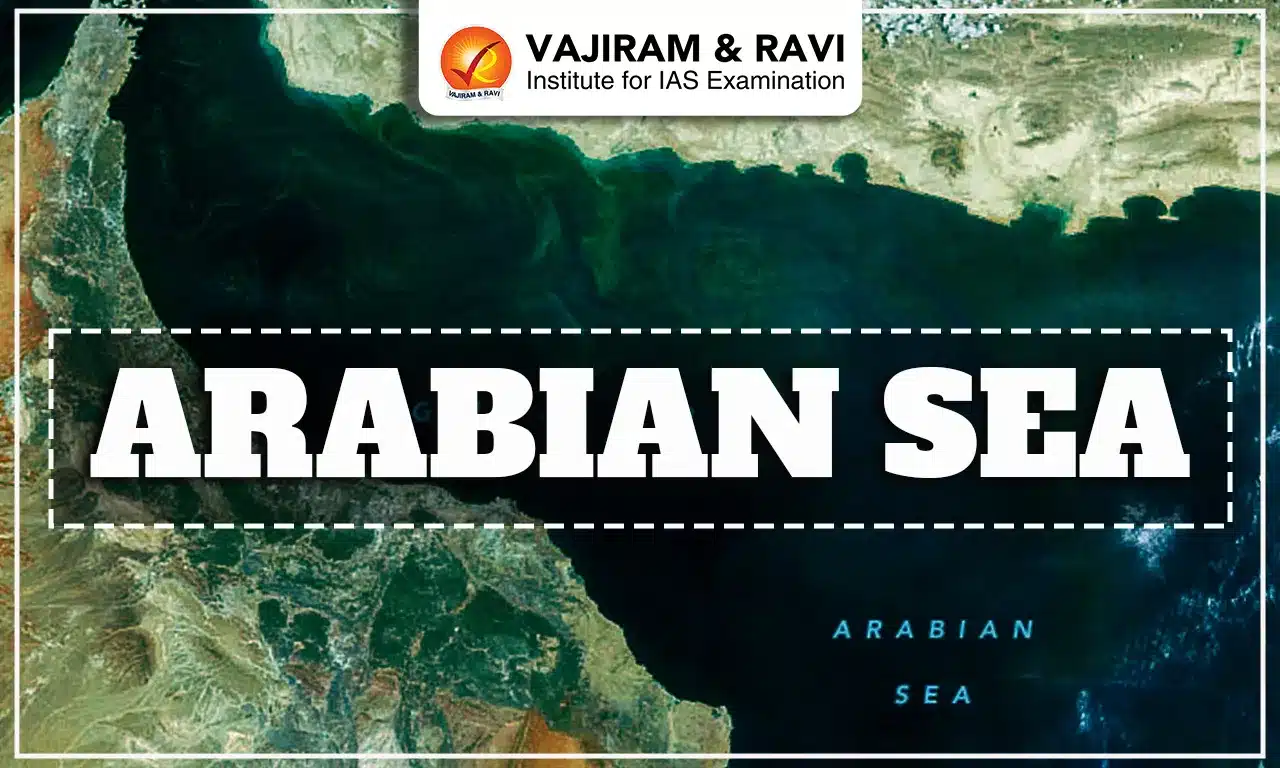
The Arabian Sea is a gateway of civilization, an artery of global trade and a strategic frontier of modern geopolitics. From ancient maritime silk routes to present-day oil shipping lanes, the importance of the Arabian sea has multiplied over the years. For India, the sea forms both a protective shield and an opportunity to link western seaboard with West Asia, Africa and beyond. In this article, we are going to cover the Arabian Sea, its location and boundaries, important islands and physical geography.
Arabian Sea
The Arabian Sea is an important subdivision of the northern Indian Ocean and holds immense historical, geographical and geopolitical significance. The sea is considered to be a lifeline for maritime trade since ancient times and continues to remain a hub for international commerce, regional security and ecological diversity. Its strategic location between the Arabian Peninsula and the Indian subcontinent makes it a joining point for civilizations, economies and naval powers.
Arabian Sea Location and Boundaries
Geographically, the Arabian Sea lies in the northwestern part of the Indian Ocean, bounded:
- North – by Pakistan, Iran, and the Gulf of Oman
- West – by the Arabian Peninsula, the Gulf of Aden, and the Guardafui Channel
- South – merging into the greater Indian Ocean
- East – by the Indian subcontinent, with extensions into the Gulfs of Khambhat and Kutch
It connects with other important water bodies through natural gateways:
- Gulf of Aden- linking to the Red Sea via the Bab-el-Mandeb Strait
- Gulf of Oman- opening into the Persian Gulf through the Strait of Hormuz
- Indian Ocean- towards the southern expanse
- Geographical Coordinates: 12°N – 25°N latitude and 51°E – 77°E longitude.
Arabian Sea Physical Geography
The Arabian Sea covers a huge area of 3.86 million km² with a maximum width of around 2,400 km and a depth reaching nearly 5,450 meters in some basins.
- The Indus River is the largest river draining into the Arabian Sea.
- It features two prominent branches: the Gulf of Aden in the southwest and the Gulf of Oman in the northwest.
- The region is characterized by high salinity levels and strong monsoon winds, which play a decisive role in shaping the climate and livelihoods of surrounding coasts.
Arabian Sea Significance
The Arabian Sea is not just a water body but a geostrategic and economic powerhouse:
- Trade & Commerce: Since the 3rd millennium BCE, it has been an important maritime trade route, especially for spice, silk, and textile exchanges during the Age of Sail. Today, it remains central to global shipping lanes.
- Energy Resources: The surrounding areas are rich in oil and natural gas, making it a critical zone for energy transportation and security.
- Strategic Importance: It houses several major naval bases and ports belonging to India, Iran, Oman, Pakistan, and even global powers like the US, ensuring its role in defense and geopolitics.
- Economic Support: The Arabian Sea sustains fisheries and coastal livelihoods, serving as a backbone for millions dependent on seafood exports.
- Cultural & Historical Relevance: It acted as a bridge for cultural exchanges between South Asia, the Middle East, and East Africa.
Arabian Sea Boundary Countries
The Arabian Sea is bordered by
- India
- Pakistan
- Iran
- Oman
- Yemen
- Maldives.
- Together, these nations share coastlines, economic zones, and shipping routes, reflecting both cooperation and contestations over maritime boundaries.
Arabian Sea Important Islands
The Arabian Sea is surrounded by many islands including:
- Lakshadweep Islands (India): A cluster of 36 islands, they are India’s smallest Union Territory and play a key role in India’s maritime security and tourism.
- Socotra (Yemen): Known for its unique biodiversity, it is a UNESCO World Heritage Site.
- Masirah (Oman): Strategically placed with a history of military significance.
- Astola Island (Pakistan): The largest offshore island of Pakistan, rich in marine ecology.
- Zalzala Koh (Pakistan): A temporary mud island formed after the 2013 earthquake, which later submerged.
- The Lakshadweep-Maldives-Chagos Archipelago together forms an important island chain in the central Arabian Sea.
Arabian Sea FAQs
Q1: Which country is the Arabian Sea in?
Ans: The Arabian Sea is not confined to one country; it borders India, Pakistan, Iran, Oman, Yemen, and the Maldives.
Q2: Which state of India touches the Arabian Sea?
Ans: The Indian states of Gujarat, Maharashtra, Goa, Karnataka, and Kerala touch the Arabian Sea.
Q3: Why is the Arabian Sea called so?
Ans: It is called the Arabian Sea because of its proximity to the Arabian Peninsula.
Q4: What is special about the Arabian Sea?
Ans: The Arabian Sea is special for being a historic trade route, rich in marine resources, and strategically vital for global shipping.
Q5: What is the deepest sea in the world?
Ans: The Philippine Sea is the deepest sea in the world, with a depth of about 10,994 meters in the Mariana Trench.
