
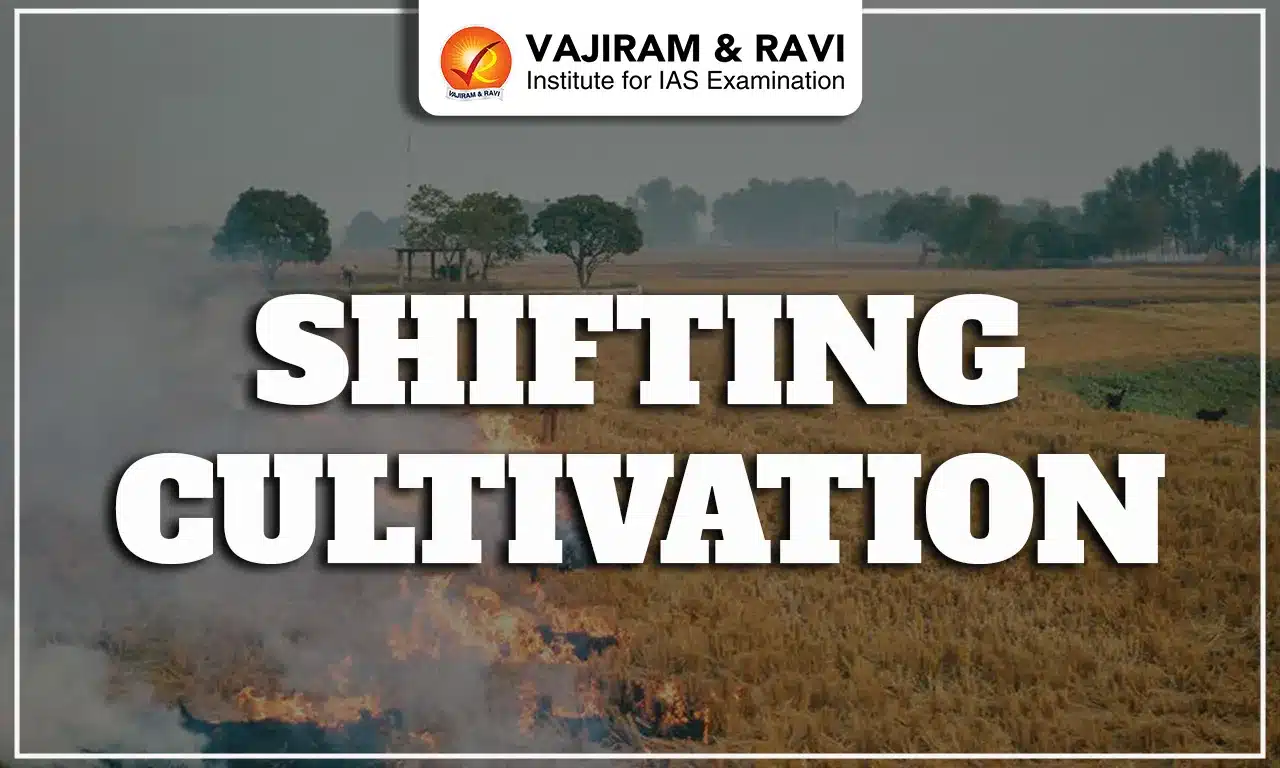
Shifting Cultivation, also referred as slash and burn or swidden farming is one of the oldest agricultural practices followed across the globe, including India. The method is based on a cyclical use of land, where the farmers clear and burn vegetation on small plots, cultivate crops for a limited period and later abandon the land to allow natural regeneration. While this helps sustain communities and shows deep rooted traditions, it also shows concerns about deforestation and soil degradation. In this article, we are going to cover shifting cultivation, its practicing methods, characteristics and types.
Shifting Cultivation
Shifting Cultivation is an indigenous farming technique in which forest patches are cut and burned to prepare land for cultivation, the nutrient rich ash makes the soil temporarily fertile, but is only able to support crop growth for only a few years. When fertility declines, the farmers move to new plots, leaving the old land barren to regain fertility naturally. This rotational cycle between cultivation and fallow makes it distinct from permanent farming and ties strongly with ecological rhythms.
Shifting Agriculture Practices
The Practice of Shifting Cultivation is a sequential process that involves many stages. These stages include:
- Farmers clear the land by cutting and burning vegetation, enriching the soil with released nutrients.
- Many crops such as cereals, tubers, pulses and vegetables are cultivated on fertile ground.
- After the harvest, the soil starts to lose nutrients and once the productivity decreases, the land is left fallow for many years.
- During this time, natural vegetation restores the soil fertility making sure it gets reused in the future. This cycle maintains a balance between human needs and ecological renewal.
Shifting Cultivation Characteristics
Shifting Cultivation has many unique features that combine sustainability and cultural continuity. It is a form of agriculture that supports biodiversity, uses traditional ecological knowledge and maintains soil fertility. These features include:
- Clearing and burning of small forest patches
- Dependence on fallow periods of soil recovery.
- Use of mixed cropping to make sure nutritional diversity is maintained.
- Rootedness in cultural heritage and community cooperation.
- Promotes self-sufficiency, food security and less dependence on external inputs.
- Balance between land use and natural regeneration.
Shifting Cultivation Challenges
Despite its ecological benefits, shifting cultivation has many challenges as well.
- These challenges include problems like soil erosion, fertility loss, nutrient depletion and soil compaction.
- On the other hand, climate-related constraints come up from unpredictable rainfall, altered seasons and pest attacks and extreme weather and drought.
- These factors threaten productivity and show the vulnerability of this practice to modern environmental changes.
Shifting Cultivation Types
The practice of shifting cultivation has different types across the world.. These examples include:
- Swidden Cultivation: Classical slash-and-burn farming with fallow regeneration.
- Milpa Farming: Mesoamerican system of maize, beans, and squash intercropping.
- Jhum Cultivation: Widely practiced in Northeast India with long fallow cycles.
- Taungya System: Integrates tree plantation with crop cultivation.
- Roca Cultivation: Practiced in South America, growing cassava and plantains.
- Ladang Farming: Southeast Asian rotational farming with diverse crops.
- Conuco Farming: Caribbean small-scale mixed cropping with biodiversity.
- Ray Cultivation: Amazonian practice of alternating crops and fallow cycles.
- Kumara Cultivation: New Zealand tradition of sweet potato farming.
- Chena Cultivation: Sri Lankan slash-and-burn with extended fallows.
Shifting Agriculture Importance
Shifting cultivation holds immense significance for indigenous communities. It sustains livelihoods while conserving cultural heritage and ecological balance. Its importance can be seen in the following ways:
- Maintains soil fertility and prevents permanent degradation.
- Preserves biodiversity and supports local ecosystems.
- Acts as a cultural identity marker tied to indigenous traditions.
- Provides food security through diverse and nutritious crops.
- Helps communities adapt to climate variability with resilience.
- Encourages local self-reliance and sustains rural economies.
- Reduces large-scale deforestation by rotating cultivation areas.
- Enhances soil nutrients through controlled burning.
- Facilitates intergenerational transfer of ecological knowledge.
Shifting Cultivation Advantages and Disadvantages
Shifting Cultivation has the following advantages and disadvantages:
| Advantages | Disadvantages |
|
Promotes biodiversity |
Causes deforestation |
|
ensures food security |
depletes fertility over time |
|
sustains culture |
labor-intensive |
|
enriches soil fertility. |
vulnerable to climatic and market fluctuations |
Regions in India Where Shifting Agriculture is Practiced
Shifting cultivation in India is concentrated in specific tribal and hilly regions. It is widely practiced in the:
- Northeast (Assam, Nagaland, Mizoram, Manipur, Meghalaya, Arunachal Pradesh, Tripura), Central India (Jharkhand, Odisha, Chhattisgarh, Madhya Pradesh)
- Western Ghats (Kerala, Karnataka, Maharashtra)
- Andaman and Nicobar Islands
- parts of the Eastern Himalayas (Sikkim, West Bengal)
- Tribal areas of Jammu and Kashmir
Shifting Cultivation FAQs
Q1: What is shifting cultivation?
Ans: Shifting cultivation is a traditional farming method where forest land is cleared, crops are grown for a few years, and then the land is left fallow for natural regeneration.
Q2: What are the benefits of shifting cultivation?
Ans: It maintains soil fertility, supports biodiversity, ensures food security, and preserves indigenous cultural practices.
Q3: What is Jhum cultivation?
Ans: Jhum cultivation is the local name for shifting cultivation widely practiced in Northeast India.
Q4: What are the different types of cultivation practices?
Ans: The main types include shifting cultivation, subsistence farming, intensive farming, extensive farming, terrace farming, plantation farming, and mixed farming.
Q5: What is mixed cropping?
Ans: Mixed cropping is the practice of growing two or more crops simultaneously on the same land to reduce risk and ensure better utilization of resources.
