
Chirality Latest News
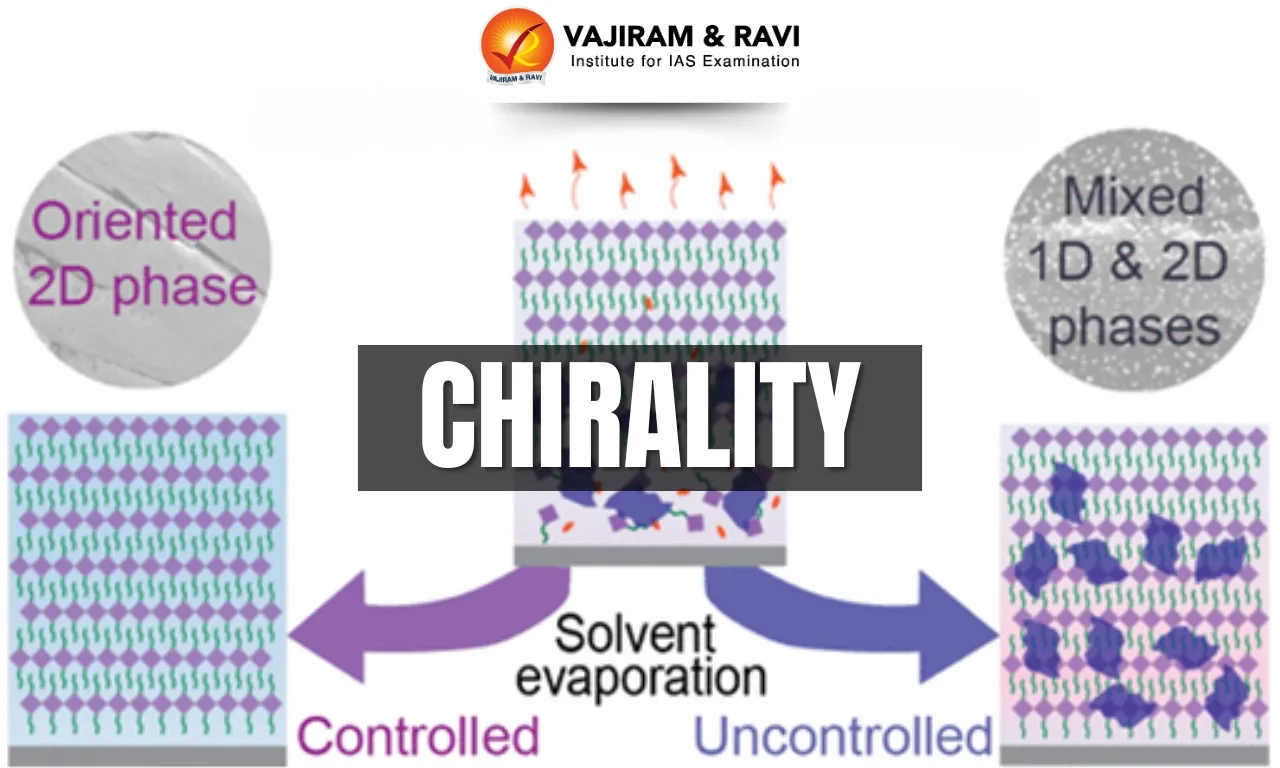
Recent work by researchers has provided critical insights into how chiral perovskite materials crystallize, unlocking the possibility of building high-performance devices with phase-pure chiral perovskite films.
About Chirality
- It is the property of an object being non-superimposable on its mirror image.
- It is found everywhere in nature, from spiral galaxies to the DNA in our cells.
Chirality’s Role in Material Science
- In materials science, chirality can enable unique light–matter interactions, such as controlling the spin of electrons or detecting circularly polarized light.
- These capabilities help futuristic technologies in quantum optoelectronics, advanced sensors, and spin-based computing.
- Example: Chiral materials can distinguish between left- and right-handed circularly polarized light and influence electron spin.
- Applications: Chirality is relevant for building devices such as circularly polarized light (CPL) detectors, spintronic components, and neuromorphic photonic synapses.
Why are Perovskites Game-Changers?
- Traditionally, most chiral materials studied have been organic in nature.
- These organic materials can interact with light effectively, but their poor electrical conductivity has limited their role in optoelectronic devices.
- On the other hand Halide perovskites bring together strong optical properties with efficient charge transport.
- When combined with chiral molecules, these low-dimensional halide perovskites can yield chiral perovskites that are both functionally versatile and structurally robust.
- Challenges: Making high-quality chiral perovskite films for devices requires precise control over how they crystallize – something that has remained poorly understood.
Source: PIB
Chirality FAQs
Q1: What do you mean by chirality?
Ans: Chirality is when a molecule does not coincide with its mirror image.
Q2: Can chirality exist in inorganic compounds?
Ans: Yes, chirality can also exist in inorganic and organometallic compounds, particularly in coordination chemistry.
