
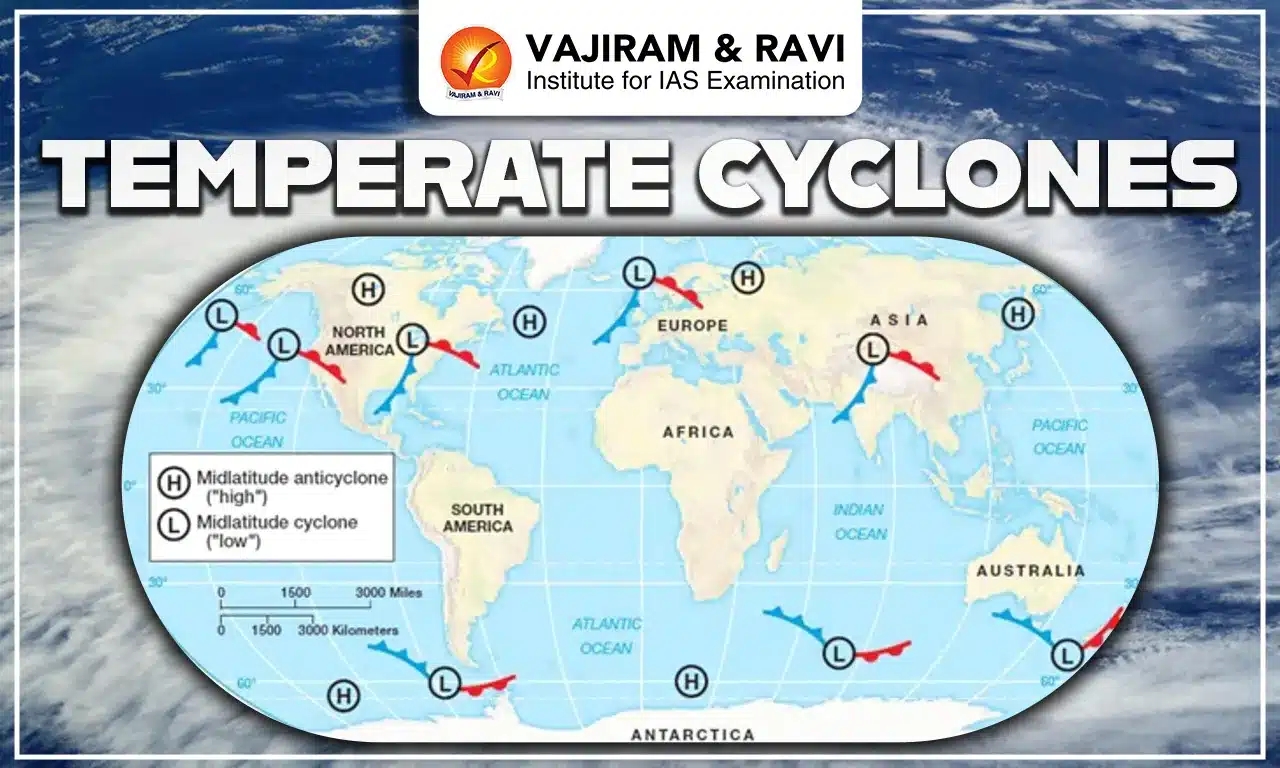
A Temperate Cyclones is a storm system that forms in the mid-latitudes, typically between 30° and 60° latitude. While similar to tropical cyclones, they differ in structure and formation. These cyclones usually develop from October to April, originating in regions such as the Gulf of Alaska, off the coast of Japan, or in the Southern Hemisphere. They create low-pressure areas and are more frequent during fall and winter, though they can occur at any time of the year.
Cyclones
Cyclones are localized low-pressure systems where air from surrounding areas converges. The Coriolis force deflects the moving air, giving the cyclone its characteristic spinning motion. In the Northern Hemisphere, cyclones rotate counter-clockwise, while in the Southern Hemisphere, they rotate clockwise. Isobars lines connecting areas of equal pressure are closely spaced and typically form circular or elliptical patterns around the cyclone.
Cyclones are generally classified into two main types:
- Temperate Cyclones
- Tropical Cyclones
Temperate Cyclones
Temperate Cyclones are significant atmospheric phenomena that influence weather in the mid-latitudes. They are also called extra-tropical cyclones, mid-latitude cyclones, or frontal cyclones. These systems are characterized by low pressure and are associated with cold fronts, warm fronts, and occluded fronts. Temperate cyclones play a vital role in global air circulation, helping redistribute heat and maintain the overall heat balance of Earth.
Temperate Cyclones Formation
The formation of temperate cyclones is explained by the Polar Front Theory proposed by Bjerkens and Bjerkens during World War I. The development occurs in four main stages which includes
| Temperate Cyclones Formation | |
|
Stage |
Description |
|
Stage I - Frontogenesis |
Two contrasting air masses converge along the sub-polar low-pressure belt. Cold air moves southward, warm air moves northward, forming a boundary with parallel but opposite winds. |
|
Stage II - Cyclogenesis |
Warm air pushes into the cold air region, and cold air advances into the warm air. A wave forms, initiating strong cyclonic circulation. |
|
Stage III - Mature Stage |
Cyclonic circulation intensifies. Warm air moves further into the cold region, cold air advances equatorward along the cold front. Cyclone reaches peak strength. |
|
Stage IV - Occlusion Stage |
Cold front overtakes the warm front, shrinking the warm air area. The two air masses mix, occluded front disappears, and the cyclone dissipates. |
Temperate Cyclones Characteristics
Extra-tropical cyclones are large storm systems that develop in mid-to-high latitudes, away from the tropics. They are characterized by a low-pressure center and the presence of both warm and cold fronts, typically forming along the polar front.
The development of an extra-tropical cyclone occurs in stages:
- Stationary Front Formation: Initially, the warm and cold air masses meet along a stationary front.
- Cyclonic Rotation: In the Northern Hemisphere, warm air from the south and cold air from the north converge. A drop in pressure along the front initiates counter-clockwise rotation, pulling warm air northward and cold air southward.
- Cloud and Rain Formation: Rising warm air over the cold air leads to cloud formation and precipitation. As the cold front advances, it forces the warm air higher, forming cumulus clouds.
- Occlusion and Dissipation: The faster-moving cold front eventually overtakes the warm front, lifting the warm air entirely. This process, called occlusion, signals the weakening and eventual dissipation of the cyclone.
Extra-tropical cyclones can form over both land and ocean, often spanning vast areas, and are significant contributors to mid-latitude weather, including storms and rainfall.
Also Read: Amphan Cyclone
Temperate Cyclone Movement
Temperate Cyclones, also known as mid-latitude or extra-tropical cyclones, are generally less organized than tropical cyclones. They typically move from west to east across continents, driven by prevailing westerlies.
In terms of rotation:
- Northern Hemisphere: Counter-clockwise around a low-pressure center.
- Southern Hemisphere: Clockwise around a low-pressure center.
These cyclones can occur at any time of the year, but they are most frequent between September and May, corresponding to the colder months in mid-latitudes. Temperate Cyclones are major contributors to storms, rainfall, and seasonal weather variations in these regions.
Temperate Cyclone Associated Weather
Temperate Cyclones rotate counter-clockwise in the Northern Hemisphere and are capable of producing a range of severe weather phenomena, including:
- Heavy Rain and Snow: Intense precipitation can lead to flooding and disruption of normal life.
- Thunderstorms and Hail: Convection within the cyclone can generate strong storms and occasional hail.
- Strong Winds: Gusty winds may damage buildings, uproot trees, and down power lines.
- Tornadoes: In some cases, these cyclones can spawn tornadoes, adding to the destructive potential.
- Coastal Effects: Cyclones moving near coastlines can create large waves, beach erosion, and flooding.
A notable example is Cyclone Sandy (2012), which caused extensive damage in the northeastern United States. Despite being called "temperate," these cyclones can occur in both tropical and temperate regions, affecting large areas with diverse hazards.
Differences between Temperate Cyclone & Tropical Cyclone
The table below highlights the key Differences between Temperate Cyclone & Tropical Cyclone. It compares their movement, area of impact, wind speed, formation conditions, and duration, providing a clear overview of the distinct characteristics of these two major types of cyclonic systems.
| Differences between Temperate Cyclone & Tropical Cyclone | ||
|
Feature |
Tropical Cyclone |
Temperate Cyclone |
|
Direction of Movement |
Moves westward from east to west. |
Moves eastward from west to east. |
|
Area Affected |
Impacts a relatively smaller region. |
Affects a substantially larger area. |
|
Wind Speed |
Winds are faster and more destructive. |
Winds are slower compared to tropical cyclones. |
|
Formation Conditions |
Forms only over warm waters above 26-27°C; dissipates on land. |
Can develop over both land and ocean. |
|
Duration |
Typically lasts up to 7 days. |
Can persist for 15-20 days. |
Temperate Cyclones FAQs
Q1: What are the temperate cyclones?
Ans: Temperate cyclones, or extratropical cyclones, are low-pressure systems in middle latitudes, forming along fronts with strong winds, clouds, and precipitation.
Q2: What is the difference between tropical zone and temperate cyclone?
Ans: Tropical cyclones form in tropical regions over warm oceans, fueled by heat; temperate cyclones form in mid-latitudes, driven by temperature contrasts between air masses.
Q3: Why do temperate cyclones move from west to east?
Ans: They follow the westerlies wind belt in mid-latitudes, which blows from west to east, guiding cyclones across continents.
Q4: Is there any temperate cyclone in India?
Ans: Yes, India experiences temperate cyclones rarely, mainly in northern regions during winter, associated with western disturbances in the Himalayas.
Q5: What are the two main types of cyclones?
Ans: Tropical cyclones (hurricanes, typhoons) and temperate/extratropical cyclones are the two main types, distinguished by origin, energy source, and location.

