
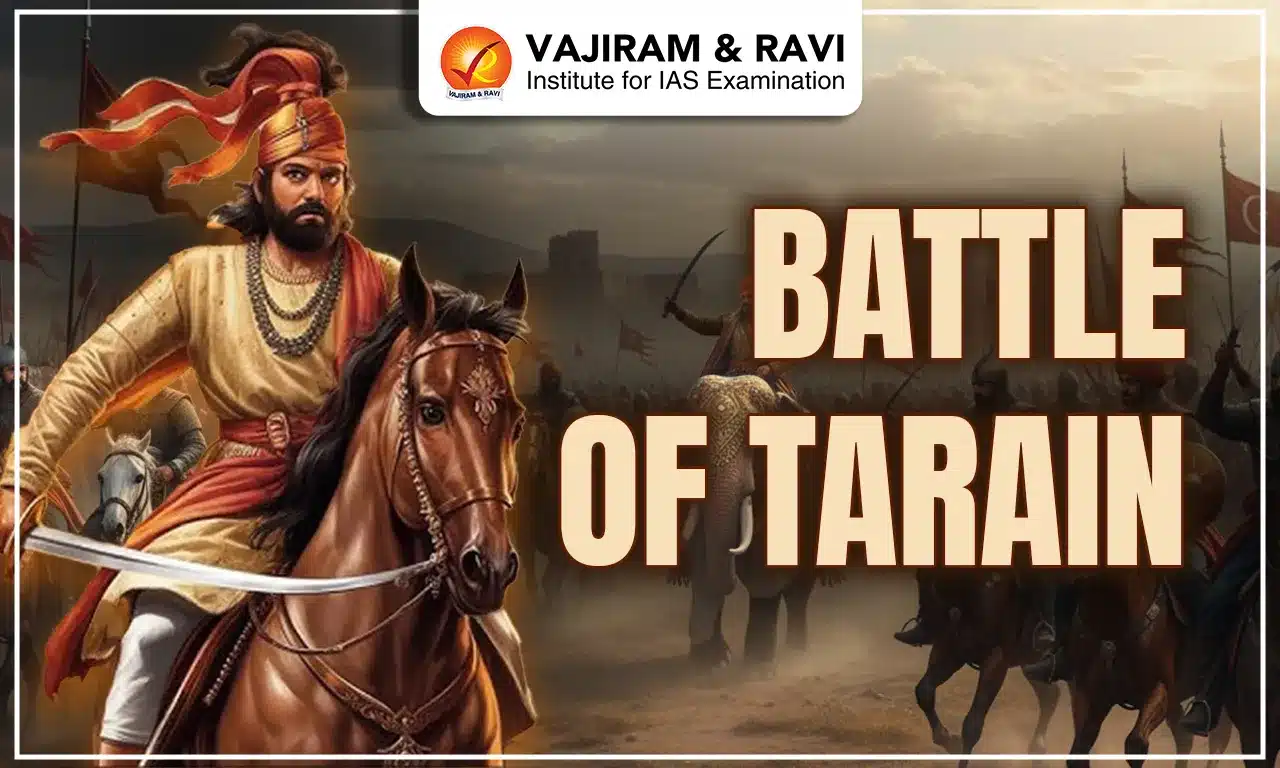
The Battle of Tarain is remembered as a turning point in medieval Indian history, fought in 1191 and 1192 between the Ghurid ruler Muizzuddin Muhammad Ghori and the Chauhan king Prithviraj Chauhan. These two clashes, fought near Tarain in present-day Haryana, reflected not just military strength but also the shifting political ambitions of the era. The first battle ended in victory for Prithviraj, but the second in 1192 saw Ghori decisively triumph, making the way for the establishment of Muslim rule in northern India.
First Battle of Tarain
The First Battle of Tarain (1191 CE) was a turning point in medieval Indian history. It was fought between Prithviraj Chauhan, the powerful Rajput king of the Chauhan dynasty, and Muhammad of Ghor, the ruler of the Ghurid Empire. The battle took place near Tarain (modern-day Taraori in Haryana) and symbolized the resistance of the Rajputs against foreign invasions. The conflict is remembered as a decisive clash that shaped the political landscape of North India during the late 12th century.
First Battle of Tarain Background
- The Rajputs and the Chauhan Dynasty: The Rajputs were a distinguished warrior class in medieval India, celebrated for their valor and code of honor. Among them, the Chauhan dynasty held considerable power in northwestern India. Prithviraj Chauhan, one of its most renowned rulers, governed the kingdoms of Delhi and Ajmer. He earned fame for his bravery, strategic acumen, and military skill.
- The Ghurids and Muhammad of Ghor: The Ghurids, originating from present-day Afghanistan, sought to expand their dominion into the fertile plains of northern India. Muhammad of Ghor, a prominent leader of the Ghurid dynasty, aimed to establish a stronghold in the Indian subcontinent. His expansionist ambitions ultimately brought him into conflict with Prithviraj Chauhan, setting the stage for the First Battle of Tarain (1191 CE).
First Battle of Tarain Causes
- Territorial Ambitions: Both Prithviraj Chauhan and Muhammad of Ghor sought to expand their control over northern India.
- Strategic Importance: Tarain’s location was crucial for trade routes and military operations, making it a highly contested region.
- Dynastic Conflicts: Rivalries between ruling dynasties fueled power struggles and competition for dominance.
- Resource Competition: Fertile land, water, and other vital resources intensified the conflict.
- Leadership Rivalry: Both leaders aimed to assert their authority and supremacy over the region.
- Prestige and Honor: Victory was tied to defending reputation and preserving the prestige of their respective dynasties.
- Alliance Systems: Formation of alliances created a polarized environment, escalating tensions.
- Historical Precedents: Lingering grievances and previous disputes influenced the decision to fight.
- Economic Interests: Control over trade routes and economic advantages added to the stakes.
- Social and Religious Factors: Differences in social and religious practices contributed to underlying tensions.
First Battle of Tarain War Preparations
-
- Initial Skirmishes: Rajputs, familiar with the terrain, launched surprise attacks on the Ghurid forces. They inflicted notable casualties, but Muhammad of Ghor successfully regrouped and countered these assaults.
- Main Engagement:
-
- Both armies clashed in the plains of Tarain.
- Rajput cavalry executed fierce charges aimed at breaking the Ghurid lines.
- Ghurid horse archers maintained distance attacks, causing heavy losses to the Rajputs and blunting their cavalry advantage.
First Battle of Tarain Events
Muhammad Ghori captured the fort of Bathinda, prompting Prithviraj Chauhan to gather his allies and confront him at Tarain in 1191. The Rajput army had around 50,000 soldiers, while the Ghurid forces were slightly smaller than the rumored 100,000. The Ghurids relied on skilled cavalry archers, whereas the Rajputs had more infantry and elephants, favoring close combat.
The battle began with Ghurid archers attacking the Rajputs from a distance, but Chauhan launched a sudden charge that caught them off guard. The Rajput infantry pursued the retreating archers to the Ghurid center, while their cavalry attacked from the flanks. Central Rajput elephants added to the chaos, disrupting the Ghurid ranks.
Muhammad Ghori attempted to rally his troops but was nearly killed by Rajput commander Govind Rai, and his bodyguard saved him. Seeing Ghori retreat, Ghurid morale collapsed, and the army fled. The Rajputs chased them for 40 kilometers before returning to besiege Bathinda, which fell in 1192.
Turning Points of First Battle of Tarain
A major Turning Points of First Battle of Tarain was the capture of Muhammad of Ghor by the Rajput forces. He was injured, fell from his horse, and was temporarily captured, causing confusion in the Ghurid army. He was later rescued by his troops, and the incident strengthened the Ghurids’ determination to fight.
The leadership of Prithviraj Chauhan was crucial to the Rajput success. He effectively coordinated the different Rajput contingents, inspiring his warriors and maintaining high morale. Despite internal rivalries, the Rajput confederation fought as a unified force under his command.
First Battle of Tarain Outcomes
The First Battle of Tarain concluded with a decisive victory for the Rajput confederation. The Ghurid forces, unable to withstand the Rajput assaults, retreated, and Muhammad of Ghor had to withdraw and regroup.
This victory gave the Rajput kingdoms a temporary reprieve from Ghurid invasions and bolstered Prithviraj Chauhan’s reputation as a strong ruler. However, the success was short-lived, as the Ghurids returned in 1192 CE for the Second Battle of Tarain, which had a different outcome.
Second Battle of Tarain
The Second Battle of Tarain, fought in 1192 near Tarain (modern-day Taraori, Haryana), was a clash between the Ghurid forces and the Rajput confederacy. This time, the Ghurids emerged victorious, signaling a major shift in medieval Indian history. The defeat significantly weakened Rajput power in North India and paved the way for a lasting Muslim presence, ultimately leading to the foundation of the Delhi Sultanate.
Second Battle of Tarain Background
After his defeat at the First Battle of Tarain in 1191, Muhammad Ghori returned to Ghazni, publicly shaming commanders who had shown cowardice and vowing to forgo all luxuries until he avenged his loss. Determined, he rebuilt his army with a focus on firepower, mobility, and discipline. Meanwhile, Prithviraj Chauhan, buoyed by his victory, became overconfident and neglected to strengthen his borders. He did, however, send proposals to neighboring kingdoms to assemble reinforcements in case of another Ghurid attack.
In the summer of 1192, Muhammad Ghori marched with 52,000 cavalry, half of his total forces. Upon reaching Peshawar, he reinstated the previously dismissed commanders, who rejoined his army. Shortly after the Rajputs captured Bathinda fort, Ghori recaptured it and demanded that Prithviraj Chauhan accept him as suzerain, a demand that was refused.
Prithviraj marched to confront Ghori again, though his army was smaller than expected due to prior deployments of his commanders. While contemporary sources exaggerate his forces at 500,000 men and 3,000 elephants, modern estimates suggest around 100,000 men and 300 elephants. As they faced each other at Tarain, Prithviraj sent a warning message to Ghori, offering him a chance to retreat. Ghori feigned agreement, asking to retain Bathinda and Multan while consulting his co-ruler brother.
Meanwhile, the Ghurids conducted reconnaissance and prepared a surprise attack. This ruse lulled the Rajputs into a false sense of security, leading them to neglect proper scouting. At dawn, the Ghurid army launched a night-time raid, neutralizing several war elephants. The Rajputs, unaccustomed to night attacks, initially struggled but eventually repelled the raiding cavalry. Pursuing them, they found the Ghurid forces fully arrayed for battle, the Second Battle of Tarain was about to begin.
Second Battle of Tarain Events
After his defeat in the First Battle of Tarain in 1191, Muhammad Ghori returned to Ghazni and took strict measures. He publicly humiliated and dismissed commanders who had performed poorly. Determined to avenge his loss, he renounced all luxuries and restructured his army, focusing on firepower, mobility, and discipline.
Prithviraj Chauhan, confident after his victory, believed in the superiority of his forces. He should have fortified his borders and secured alliances with neighboring kingdoms, but he did not. In the summer of 1192, Muhammad Ghori marched with 52,000 cavalry, half of his total army. Upon reaching Peshawar, he reinstated the previously dismissed commanders, who rejoined his forces.
A month after the Rajputs had captured Bathinda fort, Muhammad Ghori recaptured it. He sent a demand to Prithviraj Chauhan to accept him as suzerain, but Chauhan refused. Chauhan prepared to confront Ghori again, though his army was smaller than expected due to earlier deployments of his commanders. Contemporary sources exaggerate his forces, but modern estimates suggest fewer troops.
On the Tarain fields, Chauhan warned Ghori that he could leave peacefully or face destruction. Ghori pretended to negotiate, asking to retain Bathinda, while secretly preparing his army. The Ghurid forces analyzed the Rajput positions and planned a surprise attack. Chauhan, deceived into a false sense of security, neglected proper scouting.
At dawn, the Ghurid army launched a night attack on the Rajput camp, catching them off guard. The Rajputs, unaccustomed to night fighting, were initially shocked but managed to repel the first Ghurid cavalry assault. Soon, however, they realized that the Ghurids had already arranged their forces for a full-scale battle, the Second Battle of Tarain was about to begin.
Second Battle of Tarain Aftermath
Historical accounts differ on Prithviraj Chauhan’s fate. Some suggest he was captured and executed, while others indicate he was taken to Ajmer, where Muhammad Ghori planned to reinstate him as a Ghurid vassal. Ultimately, Prithviraj rebelled and was killed for treason. Regardless of the specifics, his kingdom fell to the Ghurid forces, who within a decade subjugated the entire Gangetic plain, extending as far as Bengal.
The Second Battle of Tarain holds great significance in the context of Turkish and Arab invasions of India. Though the Ghurid kingdom itself was short-lived, the Islamic presence it established left a lasting impact on the cultural and historical landscape of the Indian subcontinent.
Battle of Tarain FAQs
Q1: Who won the 2nd Battle of Tarain?
Ans: Muhammad Ghori defeated Prithviraj Chauhan in the Second Battle of Tarain (1192 CE), establishing Muslim dominance in northern India.
Q2: Who won the 3rd Battle of Tarain?
Ans: Historically, there were mainly two battles of Tarain; no widely recognized "third battle" exists in historical records.
Q3: Who won the First Battle of Tarain?
Ans: Prithviraj Chauhan defeated Muhammad Ghori in the First Battle of Tarain (1191 CE), temporarily halting Ghori’s invasion.
Q4: How many battles of Tarain are there?
Ans: There were two major battles: First (1191 CE, Chauhan victory) and Second (1192 CE, Ghori victory).
Q5: In which battle Muhammad Ghazni was defeated by Prithviraj Chauhan?
Ans: Muhammad Ghazni was not defeated by Prithviraj Chauhan; their encounters are largely separate. Prithviraj fought Muhammad Ghori, not Ghazni.

