
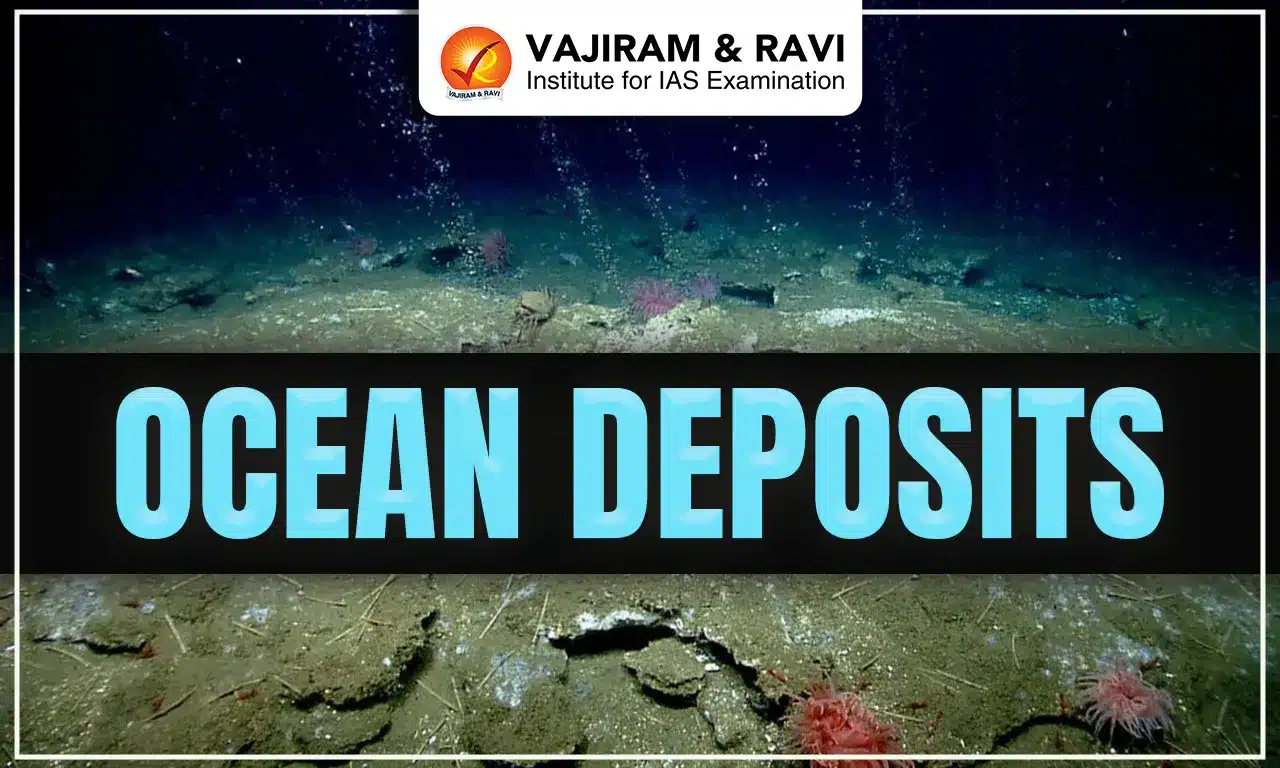
Ocean Deposits means natural accumulation of solid, liquid and gaseous materials present on Earth’s surface, within ocean waters or in the atmosphere. These deposits also known as marine deposits are formed by the process of marine deposition, where sediments or materials are gradually transported and laid down in different parts of the ocean. Over geological timescales, these deposits create layered sediments that preserve valuable records about the climate history of the Earth, biological activity and tectonic changes. In this article, we are going to cover Ocean deposits, its types, and significance.
Ocean Deposits
Ocean Deposits refers to the materials that get collected at the bottom of oceans due to natural processes. This includes biological matter like the remains of time marine plants and animals, inorganic matter like sand, clay and rocks and even dissolved minerals that precipitate out of ocean water. The collection of these materials form sediment layers on the seafloor, each acting as a chronological archive of the Earth’s geological and climatic history. Some deposits originate from land sources carried by rivers, winds or glaciers, while others are authentically marine, produced by organisms, chemical precipitation or even cosmic activity.
Ocean Deposits Types
Ocean deposits are divided on the basis of many criteria like location, depth and sediment composition. Ocean Deposits Types include:
1. Based on Location- Shelf Deposits
Shelf deposits occur on the continental shelf, the shallowest and most productive part of the ocean. They are subdivided into:
- Terrigenous Deposits: Formed by materials transported from land into the ocean through rivers, winds, glaciers, and coastal erosion.
- Biogenous Deposits: Derived from the remains of marine organisms, such as shells, corals, and plankton skeletons.
- Hydrogenous Deposits: Minerals precipitated directly from seawater, e.g., manganese nodules and phosphorites.
- Cosmogenic Deposits: Rare deposits formed due to cosmic material, such as micrometeorites settling on the seafloor.
2. Based on Depth
- Continental Shelf Deposits- Located in shallow waters along the shelf region.
- Found in the steep gradient zone, often comprising coarser materials transported downslope.
- Oceanic Basin Deposits – Located in the deepest parts of the ocean, mainly fine-grained sediments such as clays and oozes.
3. Based on Sediment Type
- Clastic Deposits – Formed by fragmented rock or sediment particles transported by rivers, glaciers, or winds into the ocean.
- Non-clastic Deposits – Composed of chemically precipitated minerals such as salts, phosphates, and carbonates, not derived from rock fragments.
Ocean Deposits Significance
Ocean deposits are important for the purpose of science, economy, and environmental studies. The study of Ocean Deposits in important because:
- Historical Record: Sediment layers preserve evidence of past oceanic and climatic changes.
- Ocean Currents Study: Deposits reveal patterns of current movement and marine circulation.
- Climate Reconstruction: They act as archives of past climate variations, helping predict future climate shifts.
- Carbon and Water Cycles: Deposits illustrate the role of oceans in regulating global biogeochemical cycles.
- Oceanography: Deposits provide insights into the interaction of oceans with the atmosphere, lithosphere, and hydrosphere.
Ocean Deposits and Climate Change
Ocean deposits are central to the study of climate change. Since oceans act as major regulators of Earth’s temperature, examining deposits like microfossils, corals, and marine sediments allows scientists to trace historic shifts in climate, ice ages, and warming phases. They also reveal how oceans absorb atmospheric CO₂ and buffer against global warming.
Ocean Deposits Examples
Examples of ocean deposits include:
- Rocks: Basalt, gabbro, granite in the oceanic crust.
- Minerals: Olivine, pyroxene, amphibole, manganese nodules, phosphorites.
- Sediments: Clay, silt, sand, and gravel transported from land.
- Biological Material: Remains of plankton, corals, algae, and other organisms that form biogenous oozes.
Ocean Deposits FAQs
Q1: What are ocean deposits?
Ans: Ocean deposits are naturally accumulated materials like sediments, minerals, and biological remains that settle on the ocean floor over time.
Q2: What are the deposits in the ocean?
Ans: Ocean deposits include terrigenous, biogenous, hydrogenous, and cosmogenic materials such as sand, clay, minerals, and remains of marine organisms.
Q3: What is the classification of ocean deposits?
Ans: Ocean deposits are classified based on location (shelf, slope, basin), depth, and sediment type (clastic and non-clastic).
Q4: What are clastic deposits?
Ans: Clastic deposits are ocean sediments made of rock fragments or particles transported by rivers, winds, or glaciers.
Q5: What are oceanic basin deposits?
Ans: Oceanic basin deposits are fine-grained sediments like clay and biogenous oozes that accumulate in the deepest parts of the ocean.
