
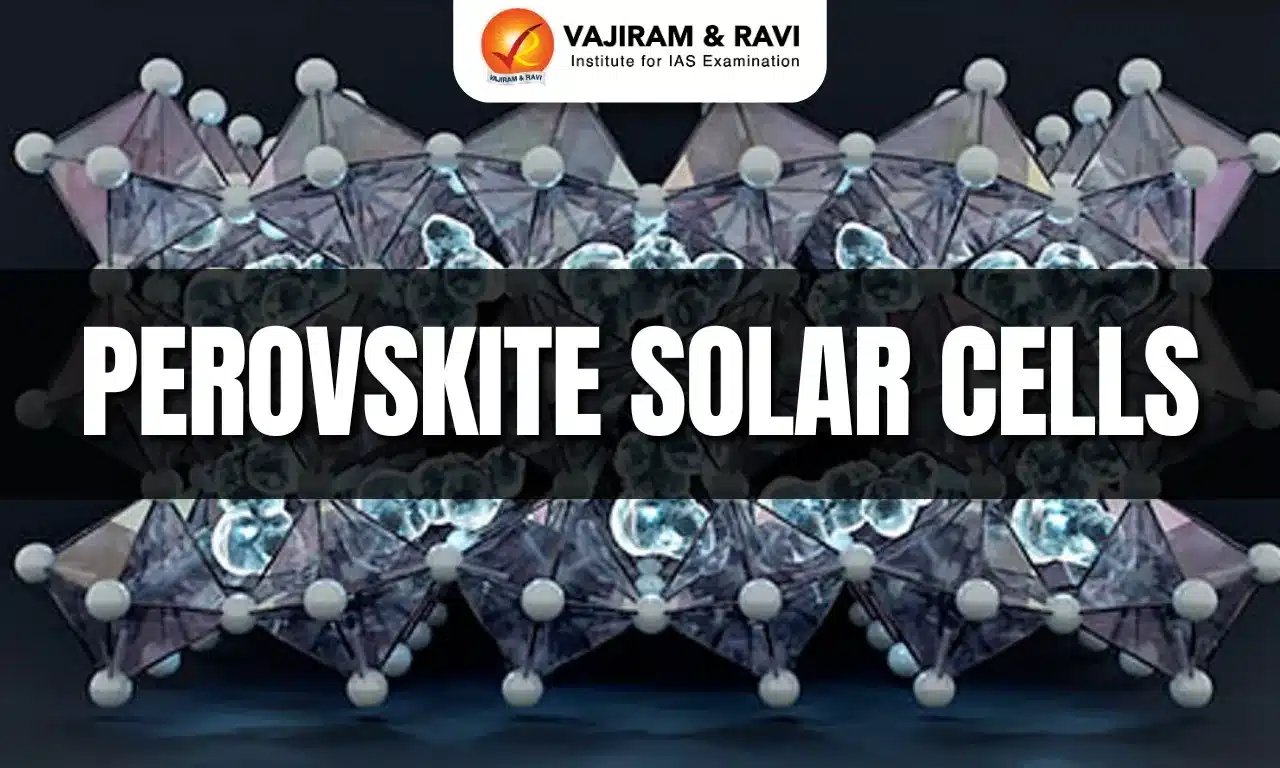
Perovskite Solar Cells Latest News
Swedish scientists at Chalmers University of Technology have used AI-enhanced simulations to solve the long-standing puzzle of halide perovskite instability.
About Perovskite Solar Cell (PSC)
- A Perovskite Solar Cell (PSC) is a type of thin-film photovoltaic device that uses perovskite-structured compounds (ABX₃) as the light-absorbing active layer.
- Perovskite Material:
- Named after the mineral calcium titanium oxide (CaTiO₃).
- General chemical formula: ABX₃, where ‘A’ and ‘B’ are cations and ‘X’ is an anion.
- In solar tech, it usually refers to metal halide perovskites: hybrid organic–inorganic compounds with a metal cation (Pb²⁺, Sn²⁺), halide anion (I⁻, Br⁻, Cl⁻), and organic cation (methylammonium, formamidinium).
- Advantages:
- High power conversion efficiency (PCE) (over 25% in labs).
- Thin, lightweight, and flexible → can be applied on windows, buildings, smartphones, and vehicles.
- Low-cost fabrication compared to energy-intensive silicon processing.
- Potential use in tandem solar cells with silicon for even higher efficiency.
- Efficiency Potential: It is known for high light absorption, excellent charge transport, and bandgap tunability and also achieved power conversion efficiencies (PCEs) above 25%, comparable to silicon cells.
Source: DTE
Perovskite Solar Cells FAQs
Q1: What is Perovskite?
Ans: Perovskite refers to materials with the crystal structure of calcium titanium oxide (CaTiO₃), discovered in 1839 in Russia. The general formula is ABX₃, where ‘A’ and ‘B’ are cations and ‘X’ is an anion.
Q2: What are Perovskite Solar Cells?
Ans: Perovskite Solar Cells are next-generation photovoltaic devices that use materials with a perovskite crystal structure to convert sunlight into electricity, offering higher efficiency and lower production costs than conventional silicon-based cells.
Q3: Why are Perovskite Solar Cells considered revolutionary?
Ans: They combine high power conversion efficiency, flexibility, and low production costs, making them suitable for coating surfaces like windows, rooftops, and electronic devices.
Q4: What is the main limitation of PSCs?
Ans: The biggest challenge is instability, they degrade rapidly under moisture, heat, and sunlight exposure. Additionally, the use of toxic lead raises environmental concerns.
