
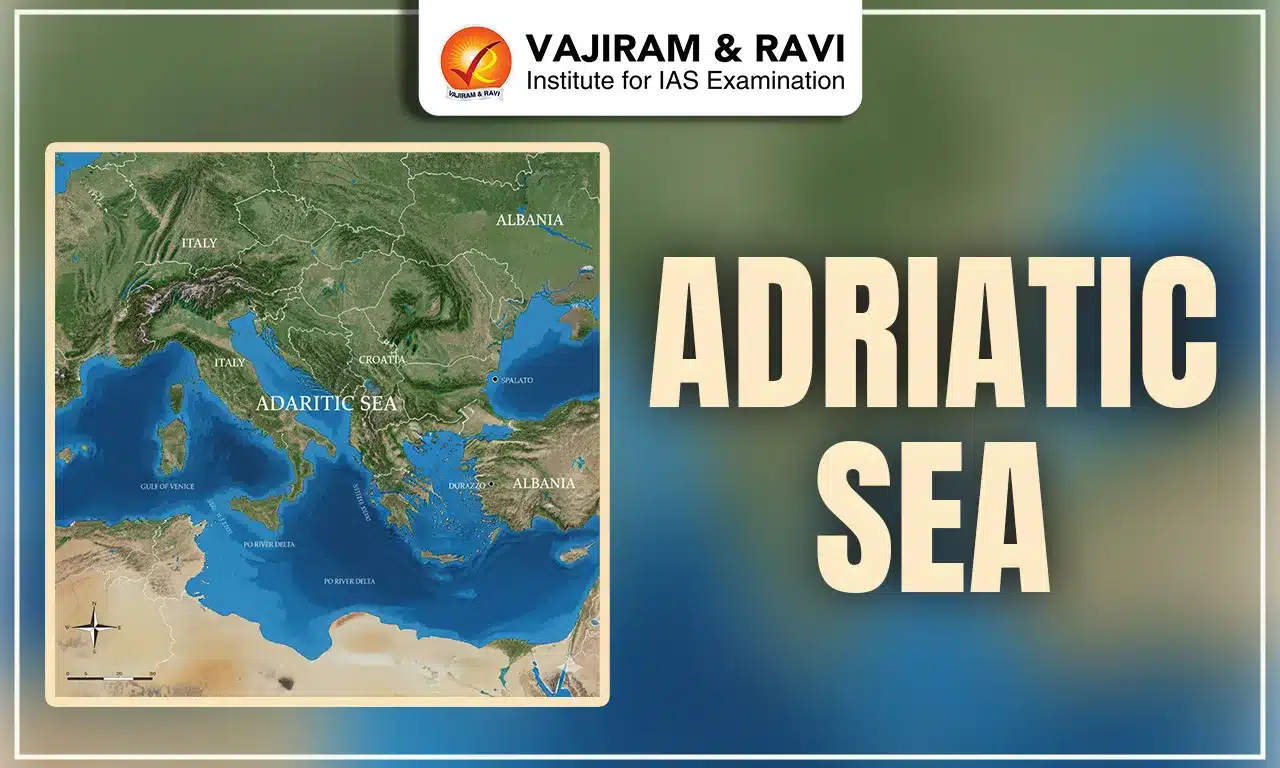
The Adriatic Sea is the northernmost arm of the Mediterranean Sea, stretching from the Strait of Otranto in the southeast to the Po Valley in the northwest, and lies between the Italian Peninsula and the Balkan Peninsula. In this article, we are going to cover the Adriatic Sea, its basins, islands and climate.
Adriatic Sea
The Adriatic Sea is a marginal sea of the Mediterranean, known for its rich cultural history, economic importance, and diverse ecological features. It stretches from the Strait of Otranto in the southeast, linking it to the Ionian Sea, up to the Po Valley in the northwest. This makes the Adriatic the northernmost arm of the Mediterranean Sea. Geographically, it acts as a natural divider between the Italian Peninsula on the west and the Balkan Peninsula on the east.
The Strait of Otranto, only about 72 km wide, is the narrow southern gateway of the Adriatic, connecting it directly to the Ionian Sea. Around its coasts, the sea borders six modern nations: Italy, Slovenia, Croatia, Bosnia and Herzegovina, Montenegro, and Albania. Furthermore, the Adriatic is dotted with around 1300 islands and islets, the vast majority of which are located along the eastern coastline, especially in Croatia.
Adriatic Sea Basins
The Adriatic Sea is divided into three main basins, each with distinct geographical and oceanographic features:
- The Northern Basin: This is the shallowest, with depths averaging only 40-45 meters, making it highly influenced by river inflows and coastal processes.
- The Middle Basin: Slightly deeper, it acts as a transitional area between the shallow north and the deep south.
- The Southern Basin: This is the deepest part, reaching a maximum depth of about 1233 meters.
Adriatic Sea Features
- A significant underwater ridge known as the Otranto Sill plays an important role by regulating water exchange between the Adriatic and the Ionian Seas.
- The Adriatic Sea has lower salinity levels compared to the rest of the Mediterranean because it receives almost one-third of the total freshwater inflow into the entire Mediterranean basin.
- Many important rivers contribute to this freshwater input, including the Po, Soča, Krka, Neretva, Bojana, Drin, and Vjosë.
- These rivers not only maintain the hydrological balance but also enrich the basin with sediments and nutrients, supporting vibrant marine ecosystems.
Adriatic Sea Bordering Countries and Geographical Location
The Adriatic Sea lies at the heart of Southern Europe, bordered by six countries:
- Italy to the west
- Slovenia
- Croatia
- Bosnia
- Herzegovina
- Montenegro
- Albania along the eastern coast
- At its southernmost end, the Strait of Otranto separates Albania’s Salento Peninsula from the “boot-shaped” Italian Peninsula.
- South of this strait lies the Ionian Sea, thereby placing the Adriatic within the broader Mediterranean marine system.
- The Adriatic is known by different names in local languages, such as Mare Adriatico in Italian, Jadransko More in Croatian, Bosnian, and Montenegrin, and Deti i Adriatikut in Albanian.
Adriatic Sea Islands
The Adriatic Sea is known for its islands over 1300 in total, most concentrated along the Croatian coast. Out of these, 1246 islands, islets, and rocks belong to Croatia.
- The largest islands are Cres and Krk, each covering an area of approximately 406 square kilometers.
- The tallest island is Brač, with its highest point, Vidova Gora, reaching 780 meters above sea level.
- Lošinj Island is separated from Cres by a narrow canal; in ancient times, the Greeks referred to Cres as Apsyrtides.
- Of these islands, 47 are permanently inhabited, with Krk, Korčula, and Brač hosting the largest populations.
- On the western side, Italy’s Adriatic islands are fewer and smaller, although historically significant Venice itself was famously built on 117 islands.
- According to the International Hydrographic Organization (IHO), the northern boundary of the Adriatic is marked at the Greek island of Corfu.
Adriatic Sea Climate
The Adriatic Sea experiences many climatic conditions due to its latitudinal stretch.
- Southern Adriatic: Has a hot-summer Mediterranean climate, with dry summers and mild, wet winters.
- Northern and Upper Adriatic: Has a humid subtropical climate, with wetter summers and colder winters compared to the south.
- Temperature variations can reach up to 20°C between seasons, and the sea is also shaped by two dominant winds:
- The Bora Winds: A cold, dry, and often violent wind blowing from the northeast, most intense near Trieste, Senj, and Split. Wind gusts can reach up to 180 km/h, making it one of the strongest winds in Europe.
- The Sirocco Winds: A warm, humid wind that carries Saharan dust across the sea, often resulting in rain mixed with sand particles, affecting visibility and weather conditions.
Adriatic Sea Economic and Cultural Importance
The Adriatic Sea has served as a major maritime route, allowing trade, cultural exchange, and strategic naval importance since ancient times. It plays an important role in the economies of bordering nations through:
- Tourism: Famous coastal cities like Dubrovnik, Split, Venice, and Trieste attract millions of visitors each year.
- Fisheries: The nutrient-rich waters support diverse marine life, forming the backbone of local fishing industries.
- Maritime Transport: Many ports along the Adriatic serve as important hubs for international trade.
Adriatic Sea FAQs
Q1: Which country has the Adriatic Sea?
Ans: The Adriatic Sea borders Italy, Slovenia, Croatia, Bosnia and Herzegovina, Montenegro, and Albania.
Q2: What is special about the Adriatic Sea?
Ans: The Adriatic Sea is unique for its low salinity, over 1,300 islands, and as a major link between Central Europe and the Mediterranean.
Q3: Is the Adriatic Sea warm or cold?
Ans: The Adriatic Sea is generally warm in summer and mild in winter, with regional variations in temperature.
Q4: What are the bordering countries of the Adriatic Sea?
Ans: The countries bordering the Adriatic Sea are Italy, Slovenia, Croatia, Bosnia and Herzegovina, Montenegro, and Albania.
