
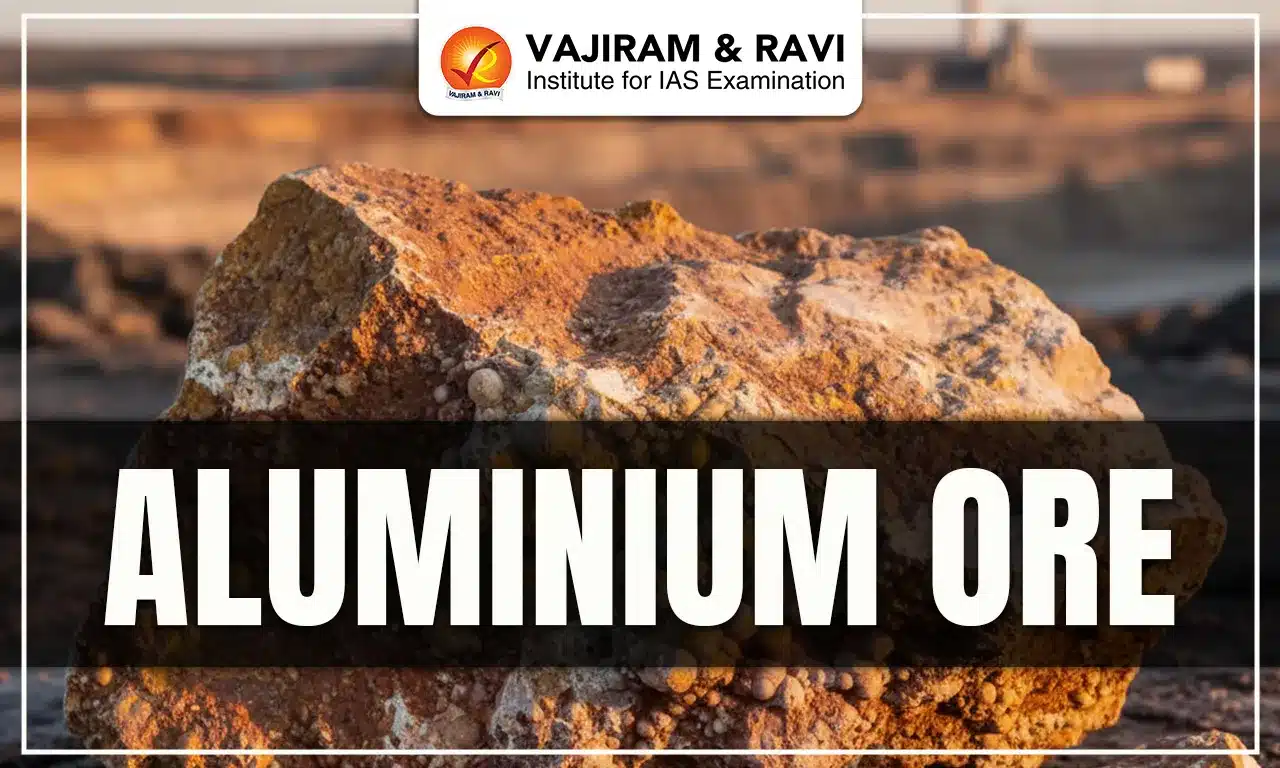
Aluminium Ore derived from bauxite, is one of the most abundant, versatile, and strategically important metals in the world. Its production is closely tied to energy availability and raw material reserves, making it a cornerstone of modern industry. For India, bauxite mining and aluminium production are not just industrial activities but also a matter of economic growth, energy planning, and resource management. In this article, we are going to cover Aluminium Ore, its processing, distribution and uses.
Aluminium Ore
Aluminium, one of the most versatile and widely used metals in the modern world, derives primarily from bauxite ore. Nearly all global aluminium production depends on bauxite, making it a mineral resource of great strategic and economic importance.
Bauxite is not a single mineral but a sedimentary rock composed mainly of aluminium-bearing minerals such as gibbsite, boehmite, and diaspore. It typically forms in tropical and subtropical regions where lateritic soils undergo intense chemical weathering, leading to the leaching of silica and concentration of aluminium oxides. Depending on the presence of iron oxides and impurities, bauxite exhibits colours ranging from white and grey to reddish-brown. With its earthy lustre, low specific gravity (2.0–2.5), and soft texture, it is a distinctive ore of global significance.
Processing of Aluminium from Bauxite
The transformation of bauxite into aluminium is a two-stage industrial process:
- Bayer Process: The raw bauxite is first crushed and treated with sodium hydroxide to separate aluminium hydroxide. This is then calcined (heated strongly) to produce alumina (Al₂O₃).
- Hall- Héroult Process: The alumina is smelted using electrolytic reduction, requiring enormous amounts of electricity, which makes aluminium one of the most energy-intensive metals to produce.
It takes 6 tonnes of bauxite to produce just 1 tonne of aluminium, reflecting the high raw material requirement of the industry. This also explains why aluminium smelting industries are often located in regions with abundant and cheap hydroelectric power (e.g., Canada).
Aluminium Ore Mining and Industry Challenges
Bauxite, being a bulky raw material, is preferably processed near mining areas to reduce transport costs. Since power costs account for 30–35% of aluminium production expenses, the industry’s viability depends on the availability of cheap electricity.
Globally, aluminium demand is rising by over 1 million tonnes annually, while supply grows only at about 0.5 million tonnes. In India, this imbalance creates a significant challenge, as setting up power-intensive smelters in resource regions is difficult due to infrastructural and environmental constraints.
What is Bauxite?
- Bauxite is a sedimentary rock with high aluminium content.
- Appearance is Reddish-brown, grey, or yellow.
- It is found mainly in tropical and subtropical regions.
- Bauxite is the primary source for aluminium production.
- About 90% of global bauxite is refined into alumina.
Global Distribution of Bauxite
The majority of bauxite reserves are concentrated in tropical and subtropical belts.
- Guinea : World leader in bauxite reserves and exports.
- Australia: Second-largest producer, with key mines in Weipa, Cape York Peninsula.
- China: Major consumer and importer for its large aluminium industry.
- Brazil: Rich deposits in the Amazon basin.
- USA & CIS countries: Limited reserves, found in Arkansas, Georgia, and the Urals.
Aluminium Ore Distribution in India
India ranks 7th in the world in bauxite reserves and is a major aluminium producer, contributing about 5.3% of global output. Production is highly concentrated in specific states:
- Odisha: The leading producer, accounting for over 50% of national output (Kalahandi & Koraput belt). Reserves: 1,370.5 million tonnes.
- Jharkhand: About 63.5 million tonnes, with high-grade ore in Lohardaga and Ranchi districts.
- Maharashtra: Nearly 10% of total output, mainly from Kolhapur district.
- Chhattisgarh: About 6% of production; Maikala ranges and Amarkantak plateau are key areas.
- Madhya Pradesh: Deposits in Amarkantak plateau, Maikala range, and Kotni (Jabalpur).
Other reserves exist in Andhra Pradesh, Kerala, Rajasthan, Uttar Pradesh, Jammu & Kashmir, and Goa
Aluminium Ore Advantages
Aluminium is regarded as a strategic metal, second only to iron and steel in industrial importance.
- Lightweight & corrosion-resistant: Ideal for transportation and construction.
- Versatile fabrication: Can be cast, machined, extruded, or rolled into foils.
- Recyclable: Retains its original properties and requires only 5% of the energy compared to primary production.
- Cost-efficient : Use of recycled aluminium reduces dependency on fresh mining.
Aluminium Ore Uses
Aluminium Ore is useful in many ways. These include:
- Transport: Aircraft, automobiles, ships, and rail coaches.
- Household & Packaging: Utensils, appliances, and aluminium foils.
- Infrastructure: Doors, windows, screens, and cladding.
- Electrical: Good conductor, used in transmission lines.
- Strategic Applications: Defence, nuclear industries, and aerospace.
Aluminium Industry in India Significance
- The Aluminium Industry in India is the fastest-growing metal industry. Aluminium consumption has increased almost 20 times in 60 years.
- The industry helps generate employment for over 800,000 workers and supports 4,000 SMEs.
- It plays a critical role in India’s industrial economy as a raw material for multiple sectors.
- The industry is supported by the National Mineral Exploration Trust to ensure raw material security.
Aluminium Ore FAQs
Q1: What are the three ores of aluminium?
Ans: The three main ores of aluminium are Bauxite, Cryolite, and Corundum.
Q2: Is cryolite an ore of aluminium?
Ans: Yes, cryolite is a minor ore of aluminium, though it is rare in nature.
Q3: What is the ore for aluminium?
Ans: The principal ore of aluminium is Bauxite.
Q4: Which state produces the maximum aluminium ore?
Ans: Odisha produces the maximum aluminium ore (bauxite) in India.
Q5: What is bauxite?
Ans: Bauxite is a sedimentary rock rich in aluminium oxides, and it is the chief ore of aluminium.

