
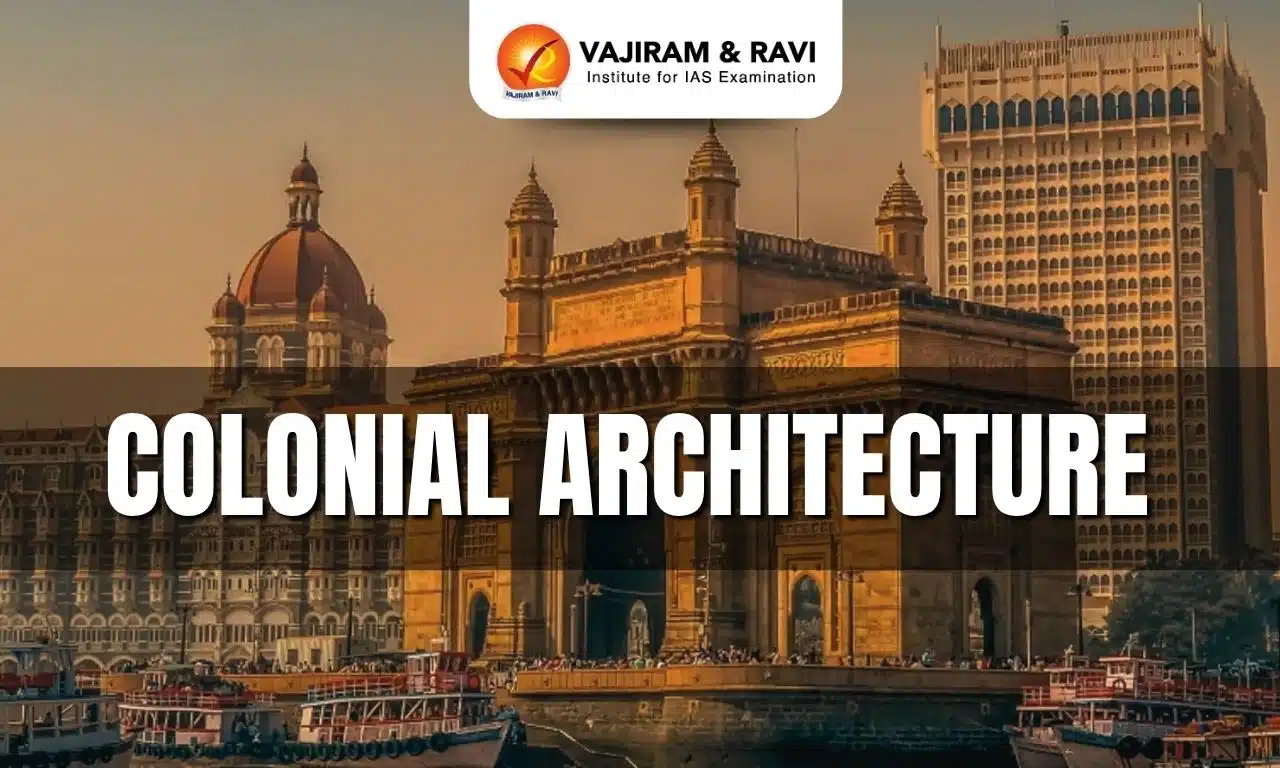
Colonial architecture in India refers to the diverse architectural styles and structures introduced and developed during the period of European colonial rule. This period, spanning several centuries, began with the Portuguese arrival in the 16th century, followed by the Dutch, French, and ultimately the British, who had the most interesting and lasting influence on Indian architecture. Each colonial power introduced distinct styles, construction techniques, and urban planning methods, leaving behind a rich legacy of architectural heritage that continues to shape the landscape of modern India. In this article, we are going to cover Colonial Architecture, its background, characteristics, different types of architecture and the post independent impact.
Colonial Architecture
Colonial architecture in India is not just about buildings; it is a reflection of political authority, cultural interaction, and adaptation to local conditions. While the Portuguese were responsible for ornate Baroque churches in Goa, the Dutch built utilitarian forts, the French emphasized urban planning in Pondicherry, and the British left behind monumental structures blending European and indigenous elements. These styles combined to form a unique chapter in India’s architectural evolution.
Colonial Architecture Background
By the 18th century, European powers had established their presence in India, initially through trade but eventually through political dominance. The Portuguese, Dutch, French, Danish, and British set up trading companies that soon transformed into centers of political authority. The Battle of Plassey in 1757 was a turning point, establishing the English East India Company as a major power and paving the way for British architectural dominance. Each colonial power contributed differently:
- Portuguese introduced Baroque and Iberian styles, focusing on churches, forts, and colorful residences.
- The Dutch emphasized practicality, constructing forts and warehouses near coastal settlements.
- French combined Parisian design sensibilities with tropical adaptations, introducing scientific city planning.
- The British created a wide range of public buildings, railway stations, and administrative complexes, evolving into the Indo-Saracenic style that blended Indian and Western traditions.
Colonial architecture was about showing authority and cultural superiority in the beginning. However, over time, it included local materials, climatic considerations, and even indigenous motifs, resulting in mixed styles that symbolized cultural negotiation between colonizers and the colonized.
Colonial Architecture Characteristics
Although every European nation had its own style, features of Colonial Architecture include:
- Symmetry and Balance: Most colonial structures focused on symmetrical layouts, with equal spacing and proportion on each side of a central axis.
- Geometric Shapes: Use of rectangles, squares, and circles in building plans reflected the European preference for order.
- Columns and Porticos: Influences of classical European architecture can be seen in Doric, Ionic, and Corinthian columns supporting porticos or porches.
- Rooflines: Gabled roofs, dormer windows, and steep pitches were common, particularly in hill stations like Shimla and Darjeeling.
- Use of Materials: Colonial powers used a mix of brick, wood, stone, and later, iron and concrete. Portuguese preferred brick, while the British often used sandstone and limestone.
- Simplistic Ornamentation: Early colonial buildings avoided excessive decoration, focusing on functionality. Later, Indo-Saracenic structures introduced more ornate features.
- Multi-pane Windows and Central Chimneys : Common in residential buildings, ensuring ventilation and heating efficiency.
- Urban Planning : French introduced Cartesian grids, while the British laid out civil lines and cantonments with orderly streets and open spaces.
These features, though derived from Europe, were adapted to Indian climatic conditions and local cultural influences.
Portuguese Architecture in India
The Portuguese were the earliest Europeans to establish colonies in India, particularly along the western coast. Their legacy is most prominent in Goa, Daman, Diu, and parts of Kerala. Features of Portuguese Architecture include:
- Iberian Style Churches : The Portuguese built several churches in Goa and Kerala, often in the Iberian and Baroque styles. St. Francis Church in Cochin (1510) is considered the first European church in India.
- Materials and Design: They extensively used brick, wooden roofs, and colorful interiors. Their buildings often combined simplicity with grandeur.
- Baroque Influence: The Portuguese popularized the Baroque style, characterized by dramatic contrasts, bold colors, and ornate facades.
- Patio Homes: They introduced the concept of patio-centered houses, reflecting Mediterranean influence.
Notable Structures:
- Sé Cathedral (1619, Goa): One of the largest churches in Asia, showcasing late-Gothic Portuguese design.
- Basilica of Bom Jesus (1604, Goa) : A UNESCO World Heritage Site housing the relics of St. Francis Xavier, famous for its Baroque style.
- St. Paul’s Church, Diu (1610) : Exemplifying Baroque elegance with detailed woodwork.
- Anne’s Church, Goa (1695): Known for its ornate façade.
- Fortresses like Diu Fort (1535) : Combined defense with religious structures.
Portuguese architecture remains deeply integrated into Goa’s identity, evident in colorful homes, chapels, and forts.
French Architecture in India
The French presence in India was concentrated in Pondicherry, Chandernagore, and parts of Andhra Pradesh and Tamil Nadu. Unlike the Portuguese, the French emphasized urban planning and order.
- Parisian Influence: Inspired by French Renaissance and Baroque models, with emphasis on elegance and proportion.
- Town Planning : Pondicherry is the finest example, with a Cartesian grid pattern of perpendicular streets dividing the city into sectors.
- Architectural Features: Tall shuttered windows, ornate archways, pastel-colored facades, and narrow street fronts.
- Public Spaces: Wide boulevards, town squares, and seafront promenades reflected European city planning principles.
Notable Structures:
- White Town in Pondicherry: Characterized by colonial villas with French balconies, arches, and gardens.
- Statue of Joan of Arc : Symbol of French cultural pride.
- Le Café and French Consulate : Blending local materials with European style.
The French left behind a unique legacy of harmonious city planning, which still distinguishes Pondicherry from other Indian towns.
Dutch Architecture in India
The Dutch had trading posts in Nagapattinam, Pulicat, and Kerala. Their architectural legacy is less grandiose but highly functional.
- Emphasis on forts, warehouses, and trading posts.
- Minimalist design with an emphasis on utility.
- Use of locally available materials for durability.
Notable Structures:
- Fort Dansborg (1620, Tamil Nadu) – A massive structure showcasing Dutch military architecture.
- Warehouses and bungalows near Cochin and Pulicat.
- Though their architectural impact was not as widespread, the Dutch left behind well-fortified trading centers that symbolize their mercantile priorities.
British Architecture in India
The British were the most influential colonizers, ruling India for nearly two centuries. Their architecture ranged from early neoclassical styles to Gothic revival and finally the Indo-Saracenic synthesis.
Early Phase: Neoclassical and Palladian Styles
- Inspired by Roman and Greek designs.
- Example: Writers’ Building in Kolkata.
Gothic Revival and Victorian Styles
- Pointed arches, stained glass, and cruciform ground plans.
- Example: Victoria Terminus (Chhatrapati Shivaji Maharaj Terminus, Mumbai) – A blend of Gothic revival with Indian motifs.
Indo-Saracenic Movement
A hallmark of late British architecture, blending Hindu, Mughal, and Western elements.
Key Features:
- Bulbous domes symbolizing the heavens.
- Cusped arches with floral and geometric motifs.
- Overhanging eaves (chhajja) for climate adaptation.
- Minarets and pavilions as decorative features.
- Vaulted roofs and Chhatris.
Notable Examples:
- Gateway of India, Mumbai (1924): Combining Islamic and Western motifs.
- Egmore Railway Station, Chennai: An Indo-Saracenic landmark.
- Rashtrapati Bhavan, New Delhi: Incorporating Mughal gardens with Western monumentalism.
The British also pioneered civic architecture like courts, universities, post offices, railway stations integrating function with grandeur.
Colonial Architecture Post-Independence Impact
After independence in 1947, Indian architecture transitioned toward modernism while still retaining colonial influences. Two schools emerged:
- Revivalist School: Continuing colonial traditions like Indo-Gothic and Indo-Saracenic styles.
- Example: Continued use of Victoria Memorial and Gateway of India.
- Modernist School: Moving towards modern, functional design.
- Le Corbusier designed Chandigarh, India’s first planned city, with geometric precision.
- Charles Correa emphasized climate-responsive and culturally sensitive designs.
- Laurie Baker pioneered low-cost, eco-friendly housing.
Thus, while colonial styles persisted in heritage buildings, modern India embraced new architectural languages.
Colonial Architecture Importance
Colonial Architecture is important due to many reasons:
- Cultural Fusion: Symbolizes the blending of European and Indian traditions.
- Urban Identity: Cities like Mumbai, Kolkata, Goa, and Pondicherry owe their distinct character to colonial structures.
- Heritage and Tourism: Landmarks like Goa’s churches, Pondicherry’s villas, and British-era railway stations are global tourist attractions.
Institutional Legacy: Many universities, courts, and government offices continue to function from colonial-era buildings.
Colonial Architecture FAQs
Q1: What is colonial architecture in India?
Ans: Colonial architecture in India refers to the styles and structures built by European powers like the British, Portuguese, French, and Dutch during their rule, blending European designs with local elements.
Q2: What is the importance of colonial architecture?
Ans: Colonial architecture is important as it reflects cultural exchange, showcases India’s colonial past, and continues to influence urban planning and heritage conservation.
Q3: Is India Gate a colonial architecture?
Ans: Yes, India Gate in New Delhi is an example of British colonial architecture built in the early 20th century.
Q4: What is the post-independent impact of colonial architecture?
Ans: Post-independence, colonial architecture influenced modern Indian designs, with many buildings repurposed for government, education, and cultural use.
Q5: How did Portuguese contribute to colonial architecture?
Ans: The Portuguese contributed by introducing Iberian and Baroque styles, seen in Goan churches like the Basilica of Bom Jesus and Sé Cathedral.
