
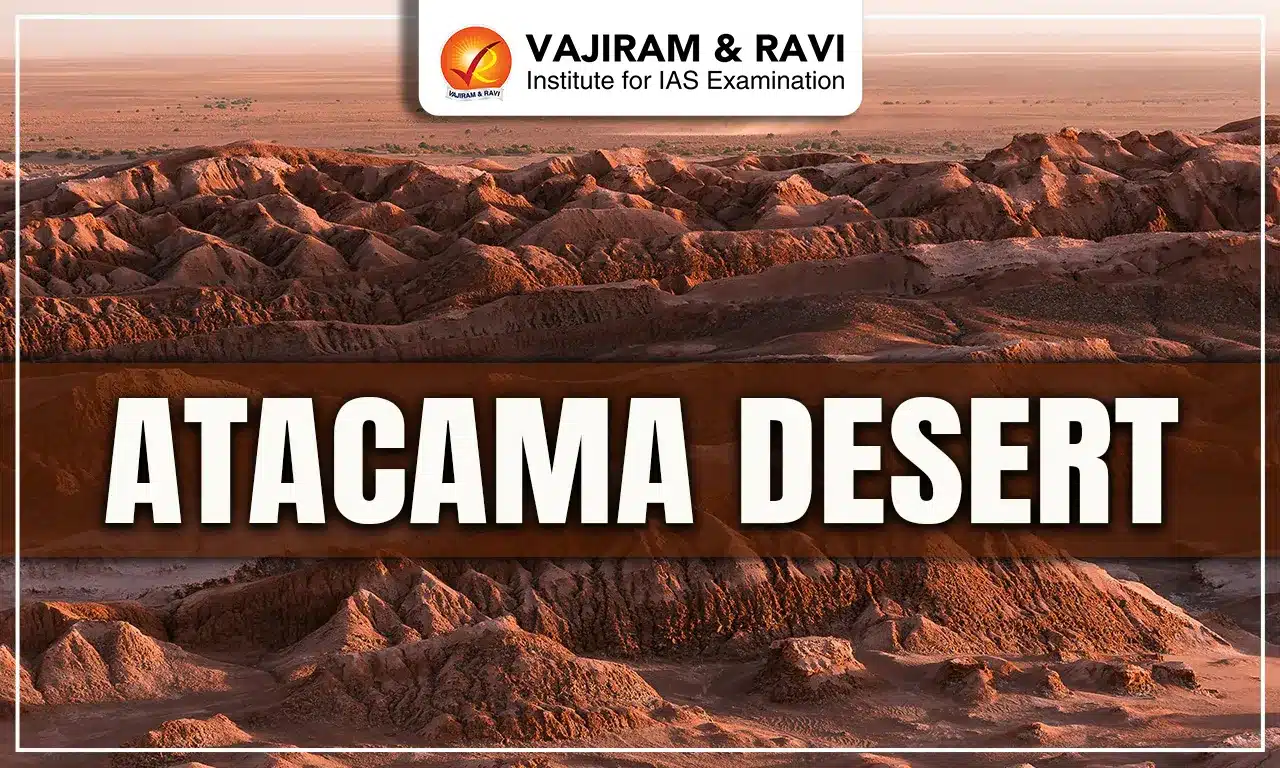
Atacama Desert Latest News
Scientists are studying a small, resilient flower Cistanthe longiscapa in Chile’s arid Atacama that could hold genetic clues to help crops withstand worsening drought conditions driven by climate change.
About Atacama Desert
- Location: It is the driest desert in the world, located in northern Chile.
- It is nestled between the Andes Mountains on the east and the Pacific Ocean on the west.
- It forms a continuous strip for nearly 1,000 km along the narrow coast of the northern third of Chile.
- Bordered by: It is bordered by Argentina, Peru, and Bolivia
- It also hosts 12 volcanoes, mainly located in the western outliers of the Andes.
- Rainfall: Average rainfall in this region is about 1 mm per year. Some locations within the desert have never had any rainfall whatsoever.
- Temperature: Temperatures are comparatively mild throughout the year. The average temperature in the desert is about 63 degrees F (18 degrees C).
- Natural Resources: This region has the largest natural supply of Sodium Nitrate, which can be used for producing fertilizers and explosives, amongst other things.
- Chinchorro Mummies: The oldest artificially mummified human remains have been found in the Atacama Desert.
What is Cistanthe longiscapa?
- It is a small, resilient flower known locally as “pata de guanaco,” blooms during rare rainfall events in the Atacama desert.
- It has the ability to switch between different types of photosynthesis, making it a model plant for extreme environments.
- Under stress from drought, intense sunlight or salinity, the plant activates a water-saving method known as Crassulacean Acid Metabolism (CAM) metabolism.
- When conditions improve, it reverts to the more common C3 photosynthesis.
Source: DD News
Atacama Desert FAQs
Q1: Why is the Atacama Desert considered unique?
Ans: It's the driest non-polar desert in the world.
Q2: What is notable about the soil in the Atacama Desert?
Ans: he soil in the Atacama Desert is similar to Martian soil, which is why NASA uses this desert as a testing ground for Mars missions

