
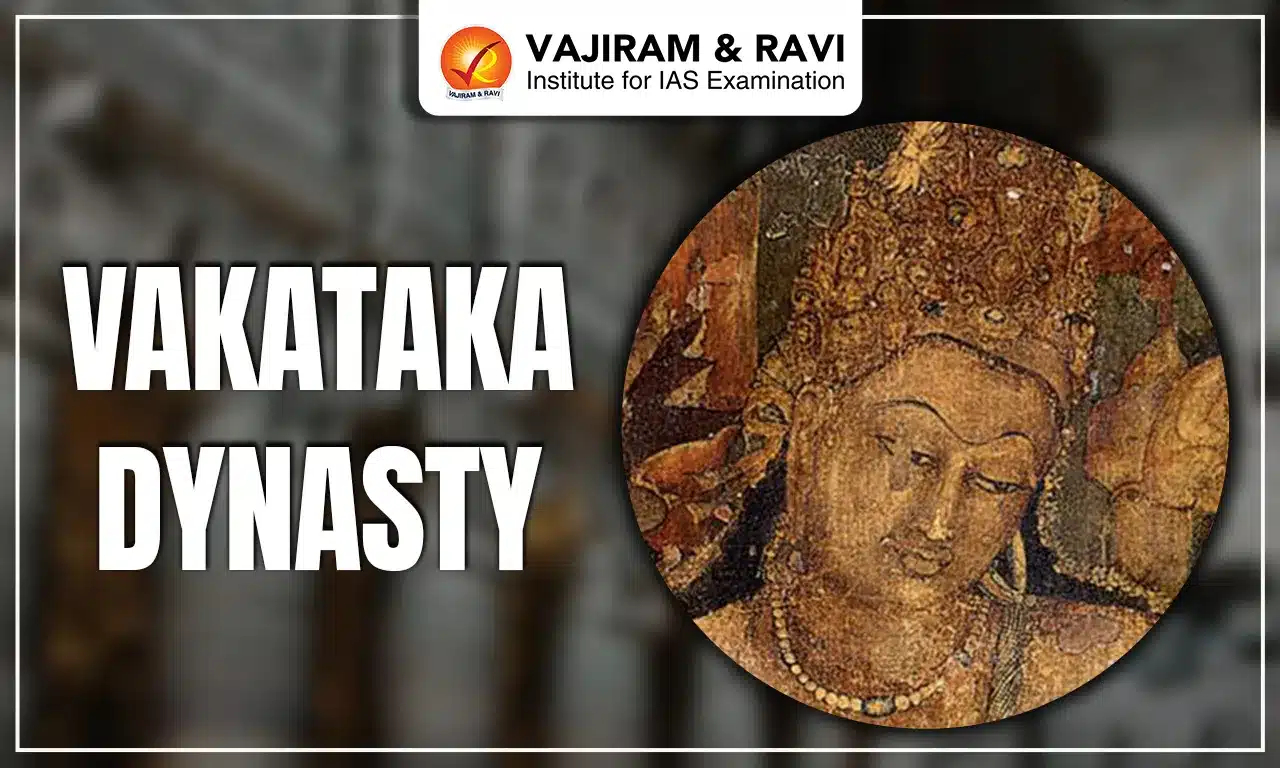
The Vakataka Dynasty was one of the most influential ruling houses in ancient India, flourishing in the Deccan region between the 3rd and 5th centuries CE. Emerging after the decline of the Satavahanas, the Vakatakas played an important role in shaping the political, cultural, and artistic landscape of peninsular India. Known for their close political and marital ties with the Gupta Empire, they stood as a link between northern and southern India during a formative period of classical Indian civilisation. Their remarkable patronage of art and architecture most notably the Ajanta Caves marked a golden era of cultural development in the Deccan. In this article, we are going to cover about the Vakatakas Dynasty, its origin, geography, rulers, branches, cultural achievements and decline of the Vakataka Dynasty.
Vakataka Dynasty
The Vakataka Dynasty occupies an eminent place in the annals of Indian history for its political significance and cultural patronage. Acting as a cultural bridge between North and South India, the Vakatakas ensured the diffusion of Gupta ideals into the Deccan. Their rule was marked by administrative efficiency, religious tolerance, and a deep appreciation of art and learning.
Under rulers like Pravarsena I, Prabhavatigupta, and Harisena, the dynasty achieved political strength and artistic brilliance. The splendour of the Ajanta Caves remains their most visible legacy, a timeless symbol of India’s spiritual and artistic excellence.
Although their power eventually waned due to internal discord and external threats, the Vakatakas left behind a legacy of cultural integration, architectural innovation, and artistic mastery that profoundly shaped the Deccan’s historical and cultural identity.
Vakataka Dynasty Origins and Rise
The Vakatakas succeeded the Satavahanas and rose to power around the mid-3rd century CE. They established themselves as the dominant power in central India and the northern Deccan plateau. Their reign lasted until the early 6th century CE, covering nearly three centuries of political influence and cultural patronage. Vindhyashakti was the founder of Vakataka Dynasty.
Inscriptions from the Ajanta Caves mention him as an “illustrious warrior” and the founder of the Vakataka line. His efforts laid the groundwork for the dynasty’s subsequent expansion under his successors.
The first great ruler of the dynasty was Pravarsena I, who transformed the Vakataka kingdom into a major empire. He was the first to assume the title of Samrat and successfully expanded his territory by defeating the Naga kings of central India. Under Pravarsena I, the Vakataka Empire became an important political entity, extending from the southern parts of Malwa and Gujarat to the Tungabhadra River in the south.
Vakataka Dynasty Geographical Extent of the Empire
The Vakataka Empire was vast and strategically located, controlling key regions of Central and South India. At its peak, it stretched from Malwa and Gujarat in the north to Tungabhadra River in the south. Its western borders reached the Arabian Sea, while in the east, it extended up to the borders of present-day Chhattisgarh.
This geographical expanse enabled the Vakatakas to control vital trade routes that connected northern India with the southern peninsula, promoting economic prosperity and cultural exchange. Their dominion also included important urban centres such as Nandivardhana (modern-day Nagpur), Vatsagulma (modern-day Washim), and Pravarapura (likely near Paunar).
Vakataka Dynasty Important Rulers and Political Developments
After Pravarsena I, the Vakataka Dynasty witnessed both consolidation and division. The Vakatakas eventually split into four branches, among which two- the Pravarpura-Nandivardhana branch and the Vatsagulma branch were the most important.
1. Pravarpura-Nandivardhana Branch
This branch, with its capital at Nandivardhana, played an important role in forging ties with the Guptas.
- Rudrasena II (380–385 CE) was one of its notable rulers who strengthened the Vakataka position by marrying Prabhavatigupta, the daughter of the Gupta emperor Chandragupta II (Vikramaditya). This marital alliance linked the two great empires of India that is the Gupta and Vakataka culturally and politically.
- After Rudrasena II’s early death, Prabhavatigupta ruled as regent on behalf of her minor sons, Divakarasena and Damodarasena (Pravarsena II), for nearly two decades (385-405 CE). Her reign brought the Vakatakas into close alignment with Gupta administrative and cultural practices, ushering in a period of stability and prosperity.
- Pravarsena II, one of the most celebrated kings of this branch, founded the new capital Pravarapura and issued numerous copper plate grants that shed light on the governance and land administration of his time.
- The last known ruler of this branch, Prithvisena II, was succeeded by Harisena of the Vatsagulma branch, marking the political unification of the dynasty under a single ruler before its decline.
2. Vatsagulma Branch
The Vatsagulma branch was founded by Sarvasena, the second son of Pravarsena I. Its capital was Vatsagulma, corresponding to modern-day Washim in Maharashtra. This branch produced some of the most illustrious rulers of the Vakataka line.
- Sarvasena, the founder, established the branch as a strong regional power.
- His successor, Pravarasena II (400-415 CE), was praised for his efficient and benevolent administration. The Cave XVI inscription at Ajanta lauds his virtues and his support for learning and religion.
- The dynasty reached its zenith under Harisena (475-500 CE), the most celebrated ruler of the Vakatakas. Harisena expanded the empire to include Avanti, Kosala, Kalinga, Andhra, and other adjoining regions. His reign was marked by peace, prosperity, and remarkable cultural achievements.
Vakataka Dynasty Cultural Contributions and Patronage
The Vakatakas were not only skilled administrators but also great patrons of art, architecture, and literature. Their reign witnessed a fusion of northern Gupta cultural ideals with Deccan artistic traditions.
1. Ajanta Caves
Their most enduring contribution of the Vakataka Dynasty to Indian art is the Ajanta Caves, located near modern Aurangabad, Maharashtra. These magnificent Buddhist rock-cut caves, containing chaityas (prayer halls) and viharas (monastic dwellings), flourished under the patronage of King Harisena.
The Ajanta murals and sculptures, depicting scenes from the Jataka tales and the life of the Buddha, represent the pinnacle of Indian classical art. The delicate brushwork, graceful figures, and spiritual depth of the paintings reflect both technical mastery and profound religious devotion.
2. Literature and Learning
The Vakatakas also encouraged Sanskrit literature and learning. Their close association with the Gupta Empire facilitated the spread of classical Sanskrit culture across the Deccan. Scholars, poets, and artists received royal patronage, contributing to the intellectual vitality of the era.
3. Architecture and Religion
Apart from Buddhist monuments, the Vakatakas supported Hindu temples and Brahmanical traditions. Their inscriptions reveal generous land grants to Brahmins and temples, reflecting a syncretic religious atmosphere where Buddhism and Hinduism coexisted harmoniously.
The architectural style developed during their reign influenced later dynasties such as the Chalukyas of Badami and Rashtrakutas, marking the Vakatakas as a crucial link in the evolution of Deccan architecture.
Vakataka Dynasty Administration and Economy
The Vakataka Dynasty rulers followed a well-organised system of administration influenced by both Satavahana and Gupta models. The empire was divided into provinces and districts governed by local officials. Land revenue was the primary source of income, while trade and agriculture ensured economic prosperity.
The many copper plate inscriptions issued during their reign provide valuable insights into land grants, taxation, and the social hierarchy. The Vakatakas Dynasty economic stability supported their grand architectural projects and sustained the flourishing of art and education.
Vakataka Dynasty Decline
The decline of the Vakataka Dynasty began soon after the death of Harisena. According to Dandin’s Dasakumaracharita, written around 125 years later, Harisena’s son, though gifted and learned, neglected statecraft and indulged in luxury. Taking advantage of this weakness, the ruler of Ashmaka, with the support of the Vanavasi king, invaded the Vakataka territory.
In the ensuing battle on the banks of the Varada River, Harisena’s son was betrayed by his own feudatories and killed. This internal treachery and external aggression led to the disintegration of the Vakataka Empire. Subsequently, the Chalukyas of Badami emerged as the dominant power in the Deccan, marking a new chapter in South Indian history.
Vakataka Dynasty FAQs
Q1: Who was the founder of the Vakataka dynasty?
Ans: The founder of the Vakataka dynasty was Vindhyashakti.
Q2: Where is the Vakataka dynasty located?
Ans: The Vakataka dynasty was located in the Deccan region, covering parts of Maharashtra, Madhya Pradesh, and Chhattisgarh.
Q3: Who was the successor of the Vakataka dynasty?
Ans: The Chalukyas of Badami succeeded the Vakataka dynasty in the Deccan region.
Q4: Where are the Ajanta Caves located?
Ans: The Ajanta Caves are located near Aurangabad in Maharashtra.
Q5: Where are the Ellora Caves?
Ans: The Ellora Caves are situated near Verul village, about 30 km from Aurangabad in Maharashtra.
