
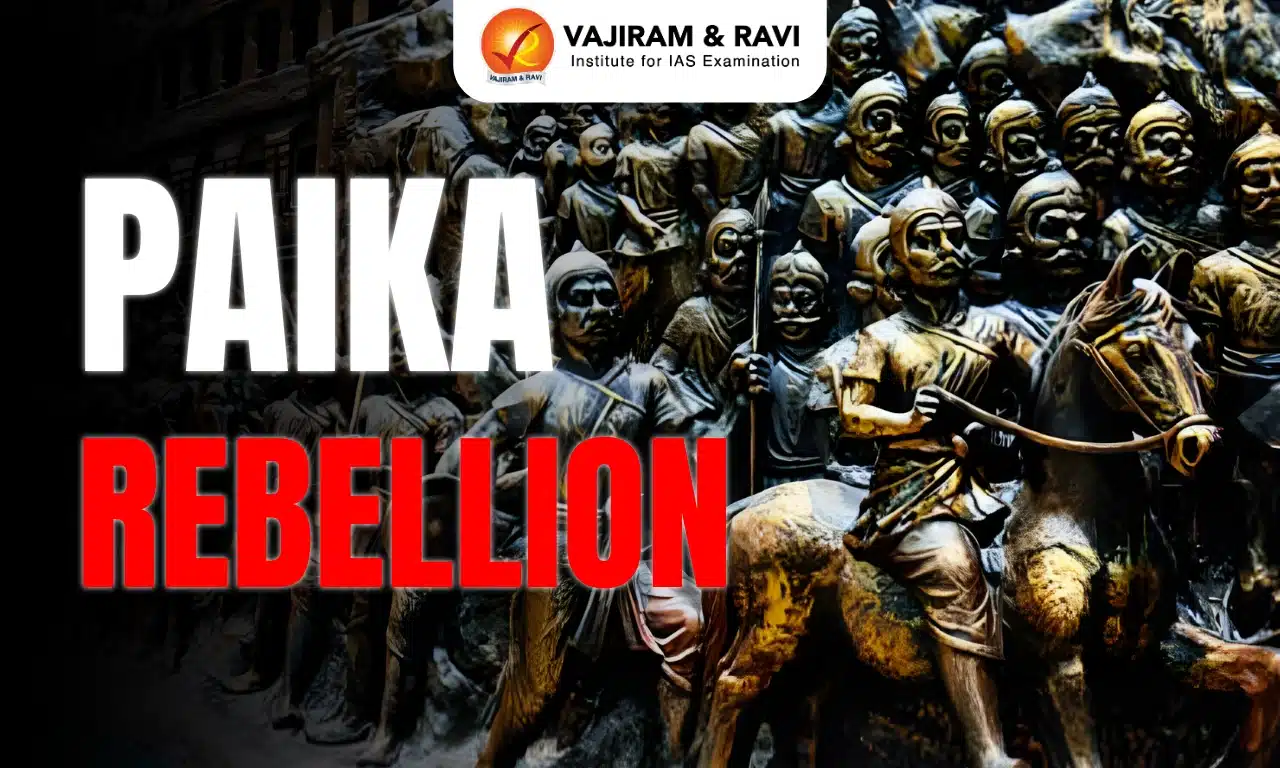
The Paika Rebellion, also known as the Paika Bidroha, was an armed uprising against British colonial rule in Odisha in 1817, led by Bakshi Jagabandhu Bidyadhar. Often overshadowed by the more widely known 1857 Sepoy Mutiny, this revolt is important as an early expression of resistance to colonial oppression. In this article we cover the Paika Rebellion, its history, causes, leadership, course, and outcomes of the Paika Rebellion, offering an understanding for both historical and contemporary perspectives.
Paika Rebellion
The Paika Rebellion was an armed revolt against the East India Company in Odisha, triggered by the overthrow of local power structures and the exploitation of the people by British administrators. It was primarily concentrated in Khurda, spreading to nearby regions including Puri, Banapur, and other parts of Odisha.
Who Were the Paikas?
The Paikas were a traditional militia community in Odisha. Before 1568, they primarily engaged in farming during peace and served as mercenaries in wartime, defending their territories and the king. For their military services, they were granted rent-free land by the rulers of Khurda.
The Paikas were organized into three hierarchical groups based on their military roles and the weapons they wielded:
- Paharis- Carried shields and swords (Khanda).
- Banuas - Experts in matchlocks and led expeditions.
- Dhenkiyas - Performed various auxiliary duties in the military.
The conquest of Odisha by the East India Company in 1803 dethroned the King of Khurda, Mukunda Deva II, and drastically reduced the prestige and privileges of the Paikas. This set the stage for widespread discontent and eventual rebellion.
Paika Rebellion Causes
The Paika Rebellion was fueled by a combination of economic, administrative, and social grievances, including:
- Currency System Changes: In 1808, the British replaced the traditional cowrie currency with metallic coins, requiring taxes to be paid in silver, increasing economic hardships for peasants and soldiers alike.
- Dethronement of the King of Khurda: The removal of Mukunda Deva II diminished the Paikas’ social standing and disrupted traditional governance structures.
- Revenue Policies: The East India Company introduced oppressive revenue policies, alienating zamindars, peasants, and local administrators.
- Salt Monopoly: British policies in 1804 restricted local salt production, harming coastal communities and raising prices for common people.
- Judicial Complexity: The new legal system was exploitative, with untrained officials and lawyers (vakeels) taking advantage of the populace.
- Administrative Corruption: Outsiders replaced experienced Odia officers, and local officials (amlas) engaged in private trade and profiteering, further marginalizing the Paikas.
- Military and Social Discontent: Loss of rent-free lands, diminished military privileges, and political interference by the British caused widespread resentment among the Paikas.
Paika Rebellion Important Leaders
The Paika Rebellion was led by Bakshi Jagabandhu, the former commander of the Khurda army. His leadership united Paikas across social and economic strata, forging a collective resistance against British authority.
Important leaders included:
- Raja Mukunda Deva II, the dethroned king of Khurda, who symbolized the traditional authority the Paikas sought to restore.
- Various zamindars and local leaders from Karipur, Mrichpur, Golra, Balarampur, Budnakera, and Rupasa, who provided organizational and logistical support.
The uprising had broad societal support, including feudal chiefs, paikrays, and common people, reflecting the deep-rooted discontent against colonial administration.
Paika Rebellion Courses
- The Paika Rebellion began in March 1817, with preparatory letters sent by Bakshi Jagabandhu to regional rulers like Ghumsar, Keonjhar, and Mayurbhanj, inviting them to join the revolt. Around 400 Kandha Chohars, equipped with traditional arms, reached Khurda, and were joined by local Paikas and Dalabeheras.
- On 1st April 1817, the Paikas attacked the Banapur Police Station, burned government offices, killed nearly 100 officials, and looted the treasury. The rebellion spread to Khurda, where the rebels set fire to government offices and engaged in widespread resistance.
- Although initially successful, the British forces regrouped and deployed stronger military contingents. Martial law was imposed, and the rebellion was gradually suppressed by May 1817. Rebels attempted guerrilla warfare, engaging in arson, dacoity, and attacks on revenue collection systems.
- Bakshi Jagabandhu and his followers were eventually forced to surrender. By 1825, the government had confiscated their properties, and guerrilla resistance ceased by 1826. Jagabandhu, who had become a symbol of Odisha’s resistance, passed away on 24th January 1829.
Paika Rebellion Outcomes and Significance
Despite its suppression, the Paika Rebellion had lasting impacts:
- Early Political Agitation: The revolt was one of India’s earliest organized resistances against British colonialism, preceding the 1857 Sepoy Mutiny by four decades.
- Administrative Adjustments: The British made some concessions, such as reductions in arrears and assessments, and fixed tenures were introduced for certain positions, reflecting recognition of the grievances.
- Social Mobilization: The rebellion inspired future resistance movements and demonstrated that colonial policies could unite diverse social groups against a common oppressor.
- Recognition Challenges: Despite its historical importance, official recognition as the “first war of independence” remains contested, reflecting broader debates about India’s early anti-colonial struggles.
- Martial Legacy: The Paikas’ military strategies, including the use of traditional weapons and guerrilla tactics, became an example of organized resistance in colonial India.
Paika Rebellion Recent Developments
In recent years, members of the Paika community have held rallies in Bhubaneswar, demanding official recognition of the Paika Rebellion as India’s first war of independence. While the government acknowledges its historical significance and the inspiration it provided to later revolts, it has stated that the Paika Rebellion cannot formally be classified as the first war of independence. Nevertheless, historians and local activists argue that the uprising set a precedent for collective resistance against British rule decades before the 1857 revolt.
Paika Rebellion UPSC
The Paika Rebellion of 1817 stands as a testament to the courage, resilience, and organizational skills of the Paika militia and the people of Odisha. While it was ultimately suppressed, the uprising challenged British authority, inspired subsequent revolts, and highlighted the deep socio-political discontent in early 19th-century India.
For UPSC aspirants, the Paika Rebellion offers not just a historical case study but also lessons on leadership, collective action, and the socio-economic underpinnings of resistance movements. Recognizing its importance helps understand the broader narrative of India’s struggle against colonial domination, emphasizing that the fight for independence was neither sudden nor isolated but evolved over decades through multiple regional uprisings.
| Also Check Other Posts | |
| Civil Uprisings Before 1857 | Velu Thampi Dalawa |
| Moplah Rebellion | Ramosi Rebellion |
| Poligar Revolt | Rampa Rebellion of 1922 |
| Alluri Sitarama Raju | |
Paika Rebellion FAQs
Q1: Who started the Paika Rebellion?
Ans: Bakshi Jagabandhu Bidyadhar, the military chief of Khurda, led the Paika Rebellion.
Q2: Which was the first revolt against the British in Odisha?
Ans: The Paika Rebellion of 1817 was the first armed revolt against the British in Odisha.
Q3: Why did the Paikas make an armed rebellion against the British?
Ans: They revolted due to loss of land, revenue oppression, dethronement of the Khurda king, and administrative exploitation by the British.
Q4: Who were the important leaders of the Paika Rebellion?
Ans: Bakshi Jagabandhu and Raja Mukunda Deva II were the key leaders, with support from local zamindars and feudal chiefs.
Q5: When did the Paika Rebellion end?
Ans: The Paika Rebellion was effectively suppressed by 1826, with Bakshi Jagabandhu surrendering and dying in 1829.
