
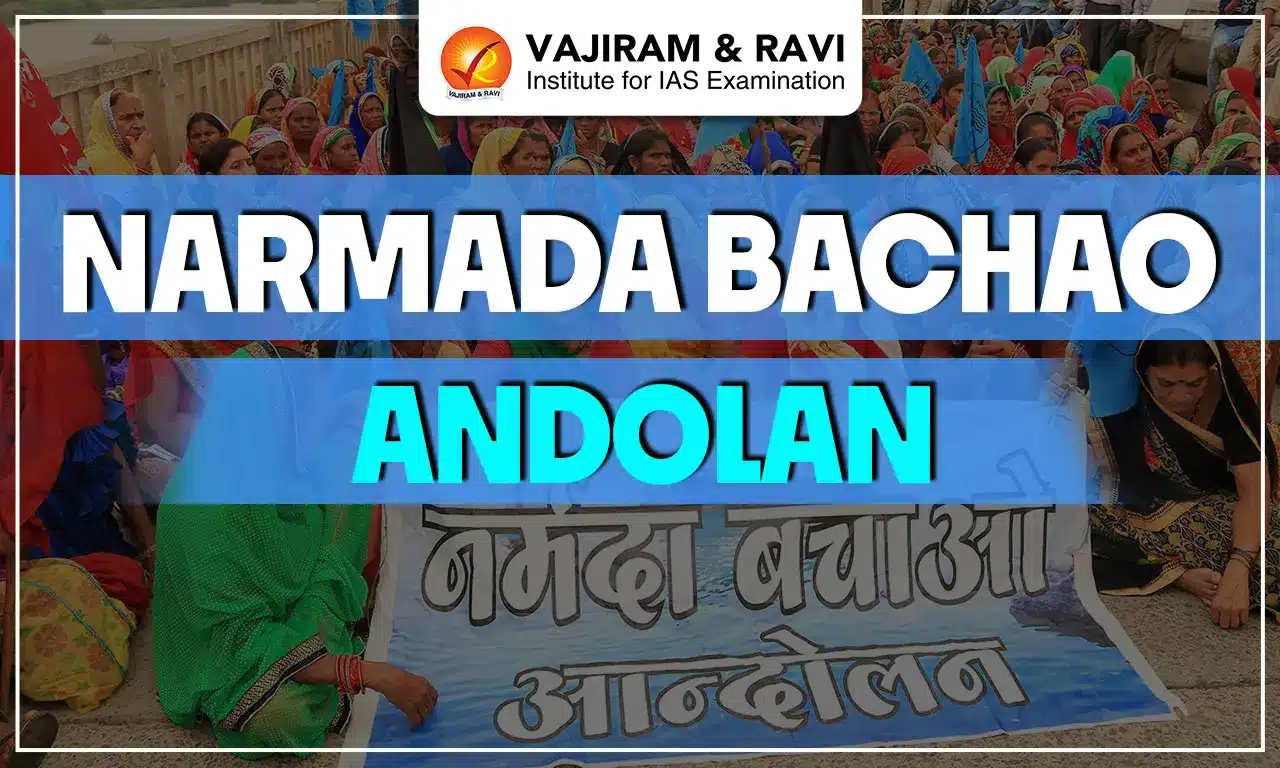
The Narmada Bachao Andolan, also known as the “Save the Narmada Movement,” is one of India’s most iconic social and environmental movements. Starting in the 1980s, it became a symbol of resistance against large-scale dam projects on the Narmada River, particularly the Sardar Sarovar Dam. The movement shows the struggles of thousands of tribal communities, farmers, laborers, and other marginalized groups who faced displacement due to these projects. Beyond advocating for the rights of affected communities, NBA brought environmental issues, ethical development, and social justice to the forefront, uniting people across Madhya Pradesh, Maharashtra, and Gujarat. In this article, we are going to cover Narmada Bachao Andolan, its origin, objectives, its leaders and its impact.
Narmada Bachao Andolan
The Narmada Bachao Andolan is one of India’s most enduring and influential social movements. It has brought attention to the delicate balance between development and human and environmental rights, showing that progress should not come at the cost of people and nature. While the Sardar Sarovar Dam stands as a testament to India’s engineering ambitions, Narmada Bachao Andolan makes sure that the voices of the displaced and the need for sustainable development are not forgotten. Through years of protest, legal battles, and awareness campaigns, NBA has shown that collective action, informed advocacy, and peaceful resistance can challenge powerful institutions and bring meaningful change. Its legacy continues to inspire environmental movements worldwide, proving that development without justice is incomplete.
Narmada Bachao Andolan Origin
The roots of the Narmada Bachao Andolan trace back to the 1960s when plans for the Sardar Sarovar Dam were first proposed in 1961 at Navagam, Gujarat. By the 1970s and 1980s, it became evident that the dam would submerge many villages, displacing tens of thousands of people and disrupting lives dependent on the river, forests, and farmland. Local resistance groups initially sprang up, which later merged to form the Narmada Bachao Andolan in 1985.
This marked the beginning of a sustained, peaceful struggle that combined grassroots mobilization with legal challenges, media advocacy, and public awareness campaigns. Narmada Bachao Andolan soon gained national and international attention for highlighting the human cost of large infrastructure projects and questioning the developmental model that prioritized industrial growth over social welfare.
| Year | Event |
|
1961 |
Proposal for Sardar Sarovar Dam |
|
1969 |
Narmada Water Disputes Tribunal (NWDT) established |
|
1979 |
NWDT issues award on water sharing and dam construction |
|
1985 |
NBA begins as a protest movement |
|
1989 |
NBA formally established; gains national attention |
|
1993 |
World Bank withdraws funding after Morse Commission report |
|
1994-1999 |
Dam construction halted due to legal and public pressure |
|
2000 |
Supreme Court allows conditional continuation with strict R&R guidelines |
|
2017 |
Sardar Sarovar Dam completed and inaugurated |
Narmada Bachao Andolan Objectives
The primary goal of the Narmada Bachao Andolan was to prevent the forced displacement of vulnerable communities without adequate rehabilitation and to make sure that development projects respect the environment and human rights. Key objectives included:
- Halting the construction of large dams causing mass displacement.
- Securing fair rehabilitation and compensation for affected people.
- Protecting the ecological balance of the Narmada Valley.
- Raising awareness about the environmental and social impacts of mega-dams.
- Holding global financial institutions, like the World Bank, accountable for funding projects without proper safeguards.
The movement focused on how development should not mean destruction, encapsulated in slogans such as “Vikas Chahiye, Vinash Nahin” (We want development, not destruction) and “Koi nahi hatega, bandh nahi banega” (No one will move, the dam will not be built).
Narmada Bachao Andolan Leaders
Narmada Bachao Andolan was not driven by a single individual but was a collective effort. However, many leaders became synonymous with the movement:
- Medha Patkar – Born on December 1, 1954, in Mumbai, Medha Patkar became the leading face of the NBA. With a master’s degree in social work from TISS, she dedicated her life to the Narmada Valley, bringing national and international attention to the plight of displaced communities. Her leadership style emphasized nonviolent protest and participatory mobilization of affected communities.
- Baba Amte – Renowned for his work with leprosy patients, Baba Amte joined NBA in the 1990s, lending his moral authority and visibility to the movement. Even at the age of 75, he lived among displaced families to protest the dam projects. His involvement underscored the humanitarian and ethical dimensions of the movement, highlighting that development cannot ignore human suffering.
- Local organizations such as the Narmada Dharangrast Samiti (Maharashtra), Narmada Ghati Navnirman Samiti (Madhya Pradesh), and Narmada Asargrast Samiti (Gujarat) also played pivotal roles through marches, rallies, hunger strikes, and Jal Satyagrahas (water protests).
Narmada Bachao Andolan Important Activities and Methods
The Narmada Bachao Andolan became known for its nonviolent approach. Its methods included:
- Peaceful protests and mass marches.
- Hunger strikes by Medha Patkar, Baba Amte, and other leaders.
- Legal battles and petitions in Indian courts.
- Awareness campaigns and media advocacy.
- The Narmada Jan Vikas Sangharsh Yatra in 1990, which traversed several states to highlight the issue.
These methods combined traditional grassroots activism with modern legal and media strategies, making NBA a multi-dimensional movement that could address social, environmental, and political dimensions simultaneously.
Narmada Bachao Andolan vs Union of India
A landmark case, Narmada Bachao Andolan vs Union of India (2020), highlighted the ongoing issue of rehabilitation. Petitioners argued that the 1987 environmental clearance lacked proper study and violated fundamental rights. They demanded an independent environmental review and better rehabilitation for affected families. The government countered that the project followed due process and was vital for water and power needs.
The Supreme Court emphasized balancing development with human rights, allowing the dam’s construction up to 90 meters while mandating strict compliance with environmental and rehabilitation conditions. The case reinforced NBA’s relevance in advocating for justice even in ongoing projects.
Narmada Bachao Andolan Impact
Though the dams were eventually completed, Narmada Bachao Andolan achieved important milestones that reshaped India’s approach to development projects:
Social Impact:
- Brought mass displacement into the national spotlight.
- Empowered local communities to voice concerns.
- Raised awareness about the social and environmental costs of development.
Legal and Policy Impact:
- Led to halts in dam construction between 1994 and 1999.
- Forced the World Bank to withdraw its funding in 1993.
- Influenced the formulation of better rehabilitation policies for displaced persons.
Environmental Impact:
- Initiated rigorous environmental assessments.
- Promoted sustainable and people-centric development practices.
- Highlighted the ecological consequences of large dams, including impacts on river ecosystems, forests, and biodiversity.
The success of Narmada Bachao Andolan showed that public participation and advocacy can shape government policies and hold international institutions accountable. It also inspired similar movements across India and globally, proving that peaceful, organized protest backed by evidence and mass support can influence large infrastructure projects.
Narmada Bachao Andolan Lessons and Legacy
The Narmada Bachao Andolan provides many lessons for environmental and social movements:
- People-Centered Development: Development projects should prioritize the well-being of local communities.
- Nonviolent Resistance: Peaceful protest combined with legal and media strategies can yield results even against powerful institutions.
- Environmental Awareness: Large infrastructure projects must consider ecological balance and long-term sustainability.
- Global Engagement: International funding agencies and policymakers can be influenced through awareness campaigns and advocacy.
The NBA remains relevant today, reminding policymakers that human rights and environmental protection must accompany development goals. The movement’s insistence on ethical, inclusive, and sustainable development continues to inform debates around dams, urbanization, and natural resource management in India and abroad.
Narmada Bachao Andolan Recognition
For its commitment to nonviolent struggle and social justice, Narmada Bachao Andolan received the Right Livelihood Award, often referred to as the “Alternative Nobel Prize.” Its work continues to serve as a benchmark for environmental activism, ethical development, and human rights advocacy.
| Also Check Other Posts | |
| Coastal Regulation Zone | Global Plastic Treaty |
| Nitrogen Cycle | Carbon Cycle |
Narmada Bachao Andolan FAQs
Q1: Who started Narmada Bachao Andolan and why?
Ans: Medha Patkar started the Narmada Bachao Andolan in 1985 to protest against large dam projects like the Sardar Sarovar Dam that displaced thousands of people and harmed the environment.
Q2: What is the Narmada Bachao movement 1985?
Ans: It is a people’s movement launched in 1985 to oppose displacement, demand fair rehabilitation, and protect the environment along the Narmada River.
Q3: What is Chipko movement and Narmada Bachao Andolan?
Ans: Chipko focused on forest conservation through tree-hugging protests, while Narmada Bachao Andolan focused on protecting the river and displaced communities from dam projects.
Q4: Who introduced Narmada Bachao Andolan?
Ans: Medha Patkar introduced the Narmada Bachao Andolan in 1985 as a grassroots movement for social justice and environmental protection.
