MAHA MedTech Mission

MAHA MedTech Mission

MAHA MedTech Mission Latest News

Recently, the Anusandhan National Research Foundation (ANRF), in collaboration with the Indian Council of Medical Research (ICMR) and the Gates Foundation, has launched the Mission for Advancement in High-Impact Areas (MAHA)-Medical Technology. 

About MAHA MedTech Mission

  • It aims to accelerate innovation in India’s medical technology sector, reduce reliance on high-cost imports, and promote equitable access to affordable and high-quality medical technologies.
  • The primary focus of the mission will be supporting the development and commercialization of high-quality, affordable, and innovative medical technologies. 

Key Objectives of MAHA MedTech Mission

  • Drive public health impact by supporting technologies that address priority disease areas and expand access to safe, high-quality care;
  • Ensure affordability and accessibility by supporting solutions that reduce costs; and
  • Enhance self-reliance and competitiveness by catalyzing indigenous MedTech development, manufacturing, and industry–academia collaboration.

Features of MAHA MedTech Mission

  • The Mission will provide funding support to Academic and R&D institutions, Hospitals, Startups, MSMEs, MedTech industry and collaborations between entities.
  • Funding: With milestone-linked funding of ₹5–25 crore per project (and up to ₹50 crore in exceptional cases), the Mission will support projects that bring impactful MedTech solutions to market.
  • The Mission will also provide enabling support through national initiatives such as;
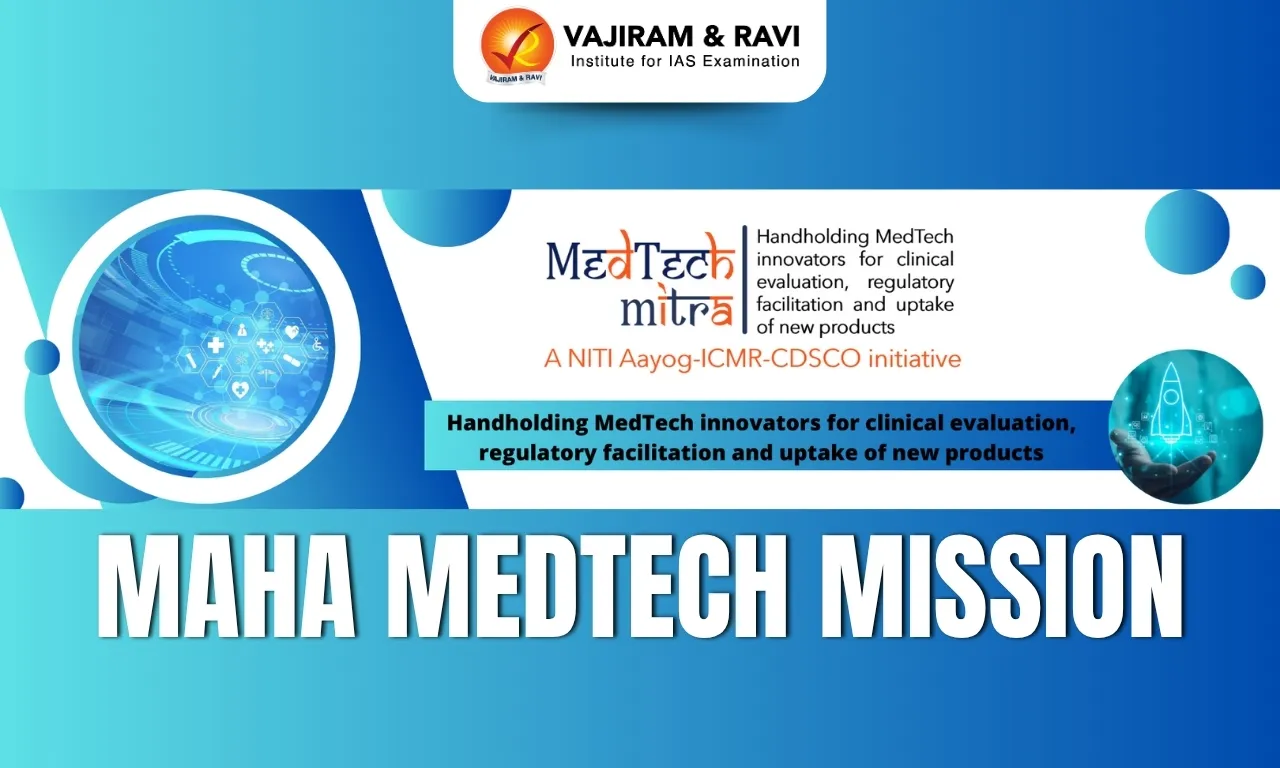
    • Patent Mitra (IP protection and technology transfer), MedTech Mitra (regulatory guidance and clearances), a Clinical Trial Network (for clinical validation and evidence generation), as well as mentorship from industry experts.
  • Total duration of the Mission: 5 Years

Source: PIB

MAHA MedTech Mission FAQs

Q1: What is the primary objective of the MAHA MedTech Mission?

Ans: To enhance healthcare equity through affordable and sustainable medical technologies.

Q2: Which organizations are collaborating on the MAHA MedTech Mission?

Ans: Anusandhan National Research Foundation (ANRF) and Gates Foundation

Pilot Whales

Pilot Whales

Pilot Whales Latest News

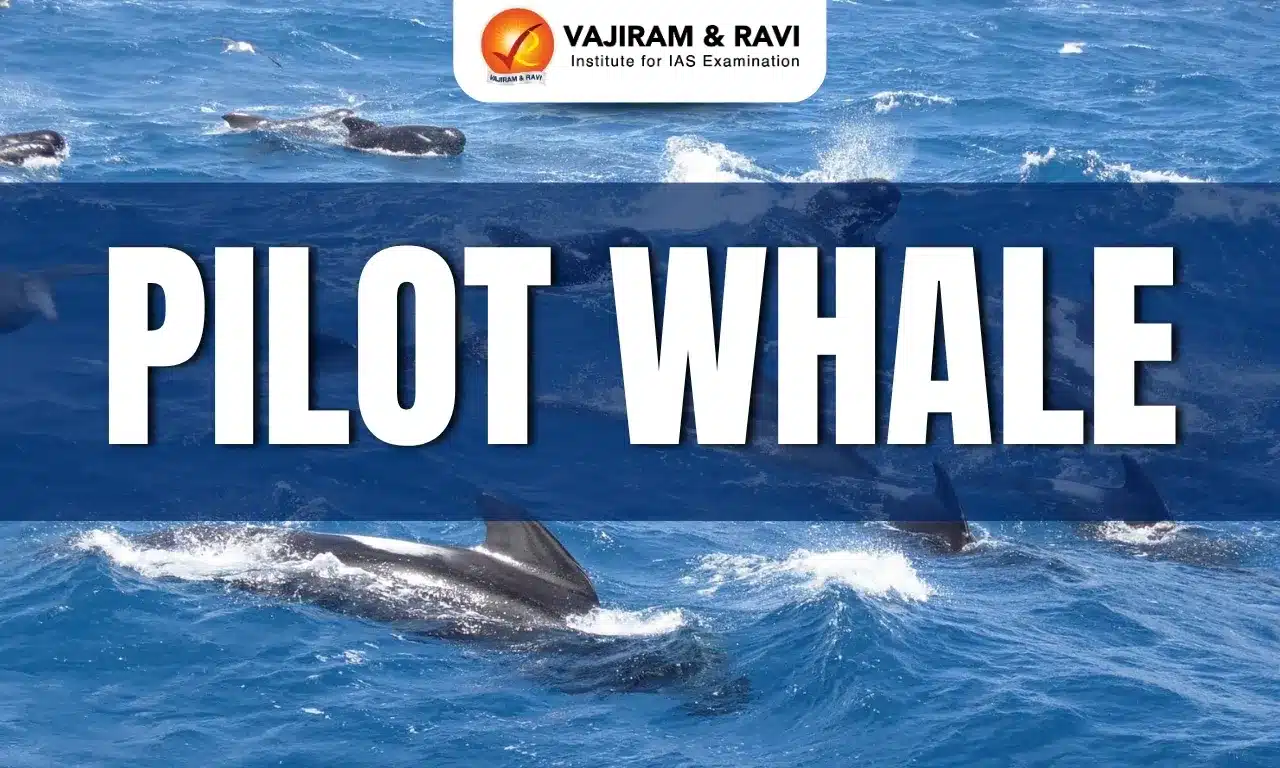
Recently, more than two dozen pilot whales have died after becoming stranded on a remote beach in New Zealand.

About Pilot Whales

  • Pilot whales are one of the largest members of the Delphinidae family.
  • There are two species of pilot whales: Short-finned pilot whales (Globicephala macrorhynchus) and Long-finned pilot whales (G. melas),
  • Habitat: Short-finned pilot whales found in tropical and warm-temperate waters, while long-finned species inhabit cold-temperate and sub-polar oceans.
  • Distribution: They are distributed in the Pacific Ocean, Atlantic Ocean and seas near Australia, New Zealand, Japan, and India.

Features of Pilot Whales

  • They are characterized by a round bulging forehead, a short beaklike snout, and slender pointed flippers. 
  • Both long-finned and short-finned pilot whales are about 4–6 metres (13–20 feet) long.
  • Males of both species are larger than females.
  • These whales live in groups numbering from dozens to hundreds or even thousands of individuals and feed mainly on squid.
  • These groups are based on matrilineal lines – meaning that calves stay with their mothers through adulthood. 
  • Conservation Status: IUCN: Least concern

Source: DD News

Pilot Whale FAQs

Q1: What is a distinctive behavior of Pilot Whales?

Ans: They are known for their complex social structures and group behavior.

Q2: Where are Pilot Whales commonly found?

Ans: In tropical and subtropical oceans

ICGS Ajit and ICGS Aparajit

ICGS Ajit and ICGS Aparajit

ICGS Ajit and ICGS Aparajit Latest News

Recently, the Indian Coast Guard (ICG) launched two advanced Fast Patrol Vessels (FPVs) — ICGS Ajit and ICGS Aparajit — at Goa Shipyard Limited (GSL).

About ICGS Ajit and ICGS Aparajit

  • These two vessels are the seventh and eighth in a series of eight indigenously built Fast Patrol Vessels (FPVs).
  • Built By:  The Goa Shipyard Limited (GSL).

Features of ICGS Ajit and ICGS Aparajit

  • Design:  52 metres in length and displacing 320 tonnes,
  • Propulsion: These vessels are equipped with Controllable Pitch Propellers (CPP) offering superior manoeuvrability and propulsion efficiency.
  • Roles: They are capable of multi-mission roles including fisheries protection, coastal patrol, anti-smuggling, anti-piracy and search & rescue operations, particularly around India’s island territories and Exclusive Economic Zone.

Key Facts about the Indian Coast Guard

  • It was formally established in 1978 by the Coast Guard Act, 1978 as an independent armed force of India.
  • Administration: The organization is headed by the Director General Indian Coast Guard (DGICG).
  • Nodal ministry: It operates under the Ministry of Defence.
  • Headquarter: New Delhi

Functions of Indian Coast Guard

  • Ensuring the safety and protection of artificial Islands, offshore terminals, installations and other structures and devices in any maritime zone.
  • Providing protection and assistance to fishermen in distress while at Sea.
  • Preservation and protection of our maritime environment including prevention and control of marine pollution.
  • Enforcement of Maritime Zones of India Act.

 Source: PIB

ICGS Ajit and ICGS Aparajit FAQs

Q1: What type of vessels are ICGS Ajit and ICGS Aparajit?

Ans: Fast Patrol Vessels (FPVs)

Q2: What is the primary purpose of ICGS Ajit and ICGS Aparajit?

Ans: To enhance India's maritime security and surveillance capabilities

Key Facts About Timor Leste

Key Facts About Timor Leste

Timor Leste Latest News

Recently, Timor Leste (East Timor) formally admitted to the Association of Southeast Asian Nations (ASEAN) in the group’s first expansion since the 1990s.

About Timor Leste

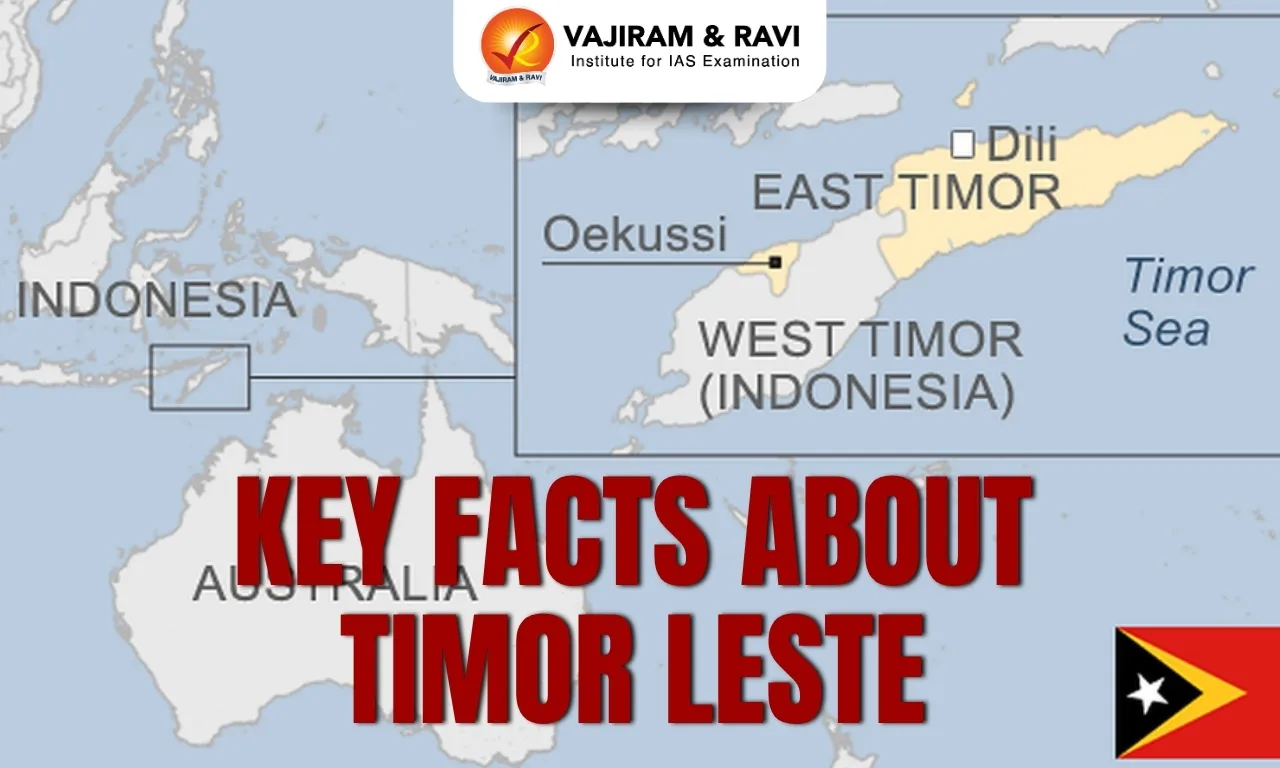
  • Timor Leste or East Timor is an island country in the Eastern Lesser Sunda Islands, at the southern extreme of the Malay Archipelago in Southeast Asia.
  • It also includes an exclave on this island's northwestern side that is bounded by West Timor of Indonesia.
  • It is bounded by the Wetar Strait in the north and the Ombai Strait in the northwest, Timor Sea to southeast and Western Timor to the southwest.
  • Climate and biodiversity: The area has a dry tropical climate and moderate rainfall. Hilly areas are covered with sandalwood.
  • Scrub and grass grow in the lowlands, together with coconut palms and eucalyptus trees.
  • Highest Point: Mount Tatamailau
  • Rivers: The most significant rivers are the Lakla, Lies and Seical.
  • Natural resources: Gold, petroleum, natural gas, manganese, marble
  • Population: Most of the people are of Papuan, Malayan, and Polynesian origin 
  • Capital City: Dili

Source: TH

Timor Leste FAQs

Q1: What is the capital of Timor-Leste?

Ans: Dili

Q2: What is the main source of revenue for Timor-Leste?

Ans: Oil and gas

SWAMIH Fund

SWAMIH Fund

SWAMIH Fund Latest News

The Reserve Bank of India will exempt a government-backed SWAMIH fund from its tightened rules for alternate investment funds (AIF).

About SWAMIH Fund

  • The Special Window for Affordable and Mid-Income Housing (SWAMIH) Investment Fund I was set up in 2019 to rescue stressed real estate projects by providing debt financing for stalled housing projects.
  • The Fund is sponsored by the Ministry of Finance, Government of India.
  • Fund Managed by: It is managed by SBICAP Ventures Ltd
  • It is a Category-II AIF (Alternate Investment Fund) debt fund registered with the Securities and Exchange Board of India.
  • The SWAMIH Fund is considered the lender of last resort for distressed projects for established developers with troubled projects.

Eligibility Criteria for Funding

  • Real estate projects must be registered under the Real Estate (Regulation and Development) Act (RERA) 2016.
  • The project must be classified as a non-performing asset (NPA) or be under insolvency proceedings.
  • The project should have been declared as a “stalled” or “delayed” project by a competent authority.
  • The fund is available only for projects that fall under the affordable and mid-income housing categories.

Source: ET

SWAMIH Fund FAQs

Q1: What does SWAMIH stand for?

Ans: Special Window for Affordable and Mid-Income Housing

Q2: What is the primary objective of the SWAMIH Fund?

Ans: To provide debt financing for stressed residential projects in the affordable and mid-income categories.

Kamlang Tiger Reserve

Kamlang Tiger Reserve

Kamlang Tiger Reserve Latest News

Arunachal Pradesh Deputy Chief Minister recently said the state government will develop a nature trail and an angling spot in the Kamlang Tiger Reserve area in the Lohit district to promote tourism and empower local communities.

About Kamlang Tiger Reserve

  • It is located in the southeastern part of Lohit District in Arunachal Pradesh near the border with Myanmar.
  • It is a part of the larger Eastern Himalayan Biodiversity Hot Spot.
  • It is named after the Kamlang River, which flows through the reserve and joins the Brahmaputra.
  • It is spread between the famed Namdapha National Park on its south and the Lang River on its north.
  • The western border is formed by the Lati River, while its eastern part is bordered by the Tawe River. 
  • The local inhabitants of the Sanctuary are known as Hishmi, Digaru, and Mizo. 
  • Landscape: It encompasses a diverse range of landscapes, including dense tropical forests, grasslands, rivers, and hills.
  • Climate: It enjoys a subtropical climate as it falls within the subtropical zone.
  • Vegetation: The vegetation types include moist evergreen tropical forests in the foothills and subtropical and temperate forests in higher elevations.
  • Flora: Common species of trees in the reserve include Ammora wallichi (Amari), Gmelina arborea (Gamari), Terminalia chebula (Hillika), Canarium resigniferum (Dhuna), and many others.
  • Fauna:
    • All four big cats, including the Snow Leopard, Clouded Leopard, Leopard and Tiger, are the common inhabitants. 
    • Certain endangered species, such as Himalayan Palm Civets, Leopard Cat, Slow Lories and Hoolock Gibbon, can also be spotted in the sanctuary.
    • Other species commonly found here are Giant and Flying Squirrels, Hornbills, Deer, Civets, Boar, Capped Langur, Stump Tailed Macaque etc.

Source: ET

Kamlang Tiger Reserve FAQs

Q1: Where is the Kamlang Tiger Reserve located?

Ans: It is located in the southeastern part of Lohit District in Arunachal Pradesh.

Q2: Kamlang Tiger Reserve lies close to the international border with which country?

Ans: Myanmar

Q3: The Kamlang River, after flowing through the reserve, ultimately joins which major river?

Ans: Brahmaputra

Q4: Kamlang Tiger Reserve shares its southern boundary with which famous national park?

Ans: Namdapha National Park

Lower Subansiri Hydroelectric Project

Lower Subansiri Hydroelectric Project

Lower Subansiri Hydroelectric Project Latest News

India’s largest hydroelectric project, the 2000-MW Subansiri Lower Hydroelectric Project, has begun its commissioning phase.

About Lower Subansiri Hydroelectric Project

  • It is a 2000 MW run-of-the-river hydro project being constructed on the Subansiri River, a tributary of the Brahmaputra.
  • It is located at Gerukamukh on the Arunachal Pradesh–Assam border.
  • It will be the single largest hydroelectric plant in India when completed.
  • The project is being developed by the state-run National Hydro Power Corporation (NHPC).
  • The construction of the project has been underway since 2005.
  • The project cost was met through 70% equity and 30% debt financing by the provision of a term loan. The central government is providing budgetary support as part of the equity component.

Lower Subansiri Hydroelectric Project Features

  • It consists of a concrete gravity dam, which will be 116 m high from the riverbed level and 130 m from the foundation. 
  • The length of the dam will be 284 m. The gross storage capacity of the reservoir will be 1.37 km3.
  • The powerhouse will comprise eight Francis-type turbines capable of generating 250 MW of electricity each. 
  • It will also have eight horseshoe-shaped headrace tunnels, eight horseshoe-shaped surge tunnels , and eight circular penstocks.
  • A tailrace channel (35 m long and 206 mwide) will take the water discharged by the turbines back to the river.

Source: TOI

Lower Subansiri Hydroelectric Project FAQs

Q1: The Lower Subansiri Hydroelectric Project is being constructed on which river?

Ans: It is being constructed on the Subansiri River, a tributary of the Brahmaputra.

Q2: The Lower Subansiri Hydroelectric Project is located on the border between which two states?

Ans: Arunachal Pradesh and Assam

Q3: What is the total installed capacity of the Lower Subansiri Hydroelectric Project?

Ans: 2,000 MW

Q4: What type of hydroelectric project is the Lower Subansiri?

Ans: Run-of-the-river project.

Indo-Tibetan Border Police (ITBP)

Indo-Tibetan Border Police

Indo-Tibetan Border Police (ITBP) Latest News

Prime Minister recently extended greetings to the Indo-Tibetan Border Police (ITBP) on its 64th Raising Day, commending the force for its unwavering dedication, courage, and humanitarian service in protecting the nation’s frontiers.

About Indo-Tibetan Border Police (ITBP)

  • It is a Central Armed Police Force functioning under the Ministry of Home Affairs, Government of India.
  • This force guards the 3,488 km long India-China border through 197 BOPs situated at altitudes ranging from 9,000 ft to 18,750 ft from Karakoram Pass in Ladakh to Jachep La in Arunachal Pradesh.
  • Background:
    • It was raised in 1962, in the wake of the Sino-Indian War of 1962, for deployment along India’s border with China’s Tibet Autonomous Region.
    • ITBP was initially raised under the CRPF Act. However, in 1992, parliament enacted the ITBPF Act, and the rules thereunder were framed in 1994.
    • In 2004, ITBP was declared as a full-fledged central armed police force under the Ministry of Home Affairs.
  • Motto: “Shaurya-Dridhata-Karma Nishtha” (Valour – Determination – Devotion to Duty).
  • Known as one of the most specialized mountain forces in the world, ITBP operates in some of the harshest and most remote areas, where temperatures can drop below -40°C.
  • ITBP trains its personnel in mountaineering, skiing, and tactical combat, in addition to maintaining readiness for disaster response and relief operations in the Himalayan region. 
  • It is headed by a Director General under the Ministry of Home Affairs.
  • Headquarter: New Delhi.

Source: DDN


Indo-Tibetan Border Police (ITBP) FAQs

Q1: The Indo-Tibetan Border Police (ITBP) functions under which Ministry?

Ans: Ministry of Home Affairs

Q2: The Indo-Tibetan Border Police (ITBP) primarily guards India’s border with which country?

Ans: China

Q3: What is the total length of the border guarded by the ITBP?

Ans: 3,488 km

Q4: What is the motto of the Indo-Tibetan Border Police (ITBP)?

Ans: Shaurya-Dridhata-Karma Nishtha

Rashtriya Vigyan Puraskar

Rashtriya Vigyan Puraskar

Rashtriya Vigyan Puraskar Latest News

The Centre recently announced the Rashtriya Vigyan Puraskar (RVP) — its Padma-style national awards for scientific achievement — with 24 individual awards and one team award.

About Rashtriya Vigyan Puraskar 

  • Modelled on the Padma awards, the Rashtriya Vigyan Puraskar is one of the highest recognitions in the field of science, technology, and innovation in India.
  • Objective: To recognize the notable and inspiring contribution made by the scientists, technologists, and innovators individually or in teams in various fields of science, technology, and technology­-led innovation.
  • Eligibility: 
    • Scientists/technologists/innovators working in government or private sector organizations or any individual working outside any organization, who have made distinguished contributions in terms of path-breaking research or innovation or discovery in any field of science, technology, or technology-led innovation shall be eligible for the awards. 
    • People of Indian Origin staying abroad with exceptional contributions benefiting the Indian communities or society shall also be eligible for the awards.
  • The awards shall be given in the following four categories:
    • Vigyan Ratna (VR) award will recognize lifetime achievements & contributions made in any field of science and technology.
    • Vigyan Shri (VS) award will recognize distinguished contributions in any field of science and technology.
    • Vigyan Yuva-Shanti Swarup Bhatnagar (VY-SSB) award will recognize & encourage young scientists up to the age of 45 years who made an exceptional contribution in any field of science and technology.
    • Vigyan Team (VT) award to be given to a team comprising three or more scientists/researchers/innovators who have made an exceptional contribution working in a team in any field of science and technology.
  • It shall be given in the 13 domains, namely Physics, Chemistry, Biological Sciences, Mathematics & Computer Science, Earth Science, Medicine, Engineering Sciences, Agricultural Science, Environmental Science, Technology & Innovation, Atomic Energy, Space Science and Technology, and Others.
    • The representation from each domain/field, including gender parity will be ensured.

Source: TH

Rashtriya Vigyan Puraskar (RVP) FAQs

Q1: What is the primary objective of the Rashtriya Vigyan Puraskar (RVP)?

Ans: To recognize notable contributions in science, technology, and innovation.

Q2: Who is eligible to receive the Rashtriya Vigyan Puraskar (RVP)?

Ans: Scientists, technologists, and innovators from both government and private sectors.

Q3: How many scientific domains are covered under the Rashtriya Vigyan Puraskar?

Ans: It shall be given in the 13 domains.

PM- Ayushman Bharat Health Infrastructure Mission (PM-ABHIM)

PM- Ayushman Bharat Health Infrastructure Mission (PM-ABHIM)

PM- Ayushman Bharat Health Infrastructure Mission (PM-ABHIM) Latest News

The Pradhan Mantri–Ayushman Bharat Health Infrastructure Mission (PM-ABHIM), launched in October 2021, has emerged as one of India’s largest healthcare initiatives aimed at strengthening the nation’s preparedness for future pandemics and health emergencies.

About PM- Ayushman Bharat Health Infrastructure Mission (PM-ABHIM)

  • Launched in 2021, PM-ABHIM is one of India’s largest pan-national programmes aimed at developing a resilient, accessible, and self-reliant public health system.
  • It is a Centrally Sponsored Scheme (CSS) with some Central Sector Components (CS), which has an outlay of Rs. 64,180 crores for the scheme period (2021-22 to 2025-26).
  • The Mission focuses on strengthening health infrastructure from the grassroots to the district level through the establishment and upgradation of Ayushman Arogya Mandirs (AAMs), Block Public Health Units, Integrated District Public Health Labs, and Critical Care Hospital Blocks in every district. 
    • These facilities aim to bridge service delivery gaps and ensure comprehensive primary, secondary, and critical care closer to communities.
  • PM-ABHIM also prioritises pandemic and disaster preparedness by expanding an IT-enabled, real-time disease surveillance network that integrates laboratories at block, district, regional, and national levels to detect, investigate, and prevent outbreaks effectively.
  • Additionally, it promotes health research and innovation, particularly on COVID-19 and other infectious diseases, by advancing the One Health approach, which recognises the interdependence of human, animal, and environmental health.
  • The Mission also aims to fill critical gaps in both urban and rural areas by creating Urban Health and Wellness Centres (AAM) in slum areas and converting Sub-Centres into AAMs.
  • Collectively, PM-ABHIM envisions a robust health ecosystem capable of withstanding future health emergencies while ensuring equitable and quality healthcare for all citizens.

Source: LOKMAT

PM- Ayushman Bharat Health Infrastructure Mission (PM-ABHIM) FAQs

Q1: When was the PM–Ayushman Bharat Health Infrastructure Mission (PM-ABHIM) launched?

Ans: 2021

Q2: What is the primary objective of PM-ABHIM?

Ans: To strengthen health infrastructure and build a resilient public health system.

Q3: What is the total financial outlay of PM-ABHIM for the period 2021–22 to 2025–26?

Ans: ₹64,180 crore

Q4: PM-ABHIM is implemented as which type of scheme?

Ans: It is a Centrally Sponsored Scheme (CSS) with some Central Sector Components (CS).

Google’s Willow Processor Demonstrates Verifiable Quantum Advantage

Quantum Advantage

Quantum Advantage Latest News

  • Recently, two landmark papers published in Nature by researchers from Google, MIT, Stanford, and Caltech claimed a verifiable demonstration of quantum advantage using Google’s Willow quantum processor. 
  • The studies mark a significant leap in the quest for practical quantum computing—showing that quantum systems can outperform classical supercomputers in specific computational tasks.

Working of Quantum Computer

  • Quantum computers exploit the wave-like behavior of particles at the subatomic level.
  • Using the principle of interference, quantum algorithms can amplify correct answers and cancel out wrong ones.
  • Quantum bits or qubits can exist in multiple states simultaneously (superposition), enabling massive parallelism compared to classical bits (0 or 1).

Study 1 - Decoded Quantum Interferometry (DQI)

  • The DQI algorithm:
    • The first paper introduced DQI — a quantum algorithm for optimization problems (finding the best solution among many possibilities).
    • It employs a quantum Fourier transform to manipulate interference patterns.
    • Constructive interference reinforces good solutions; destructive interference cancels poor ones.
  • Result:
    • DQI efficiently solved the optimal polynomial intersection problem, finding good approximations much faster than classical algorithms.
    • This demonstrated a potential quantum speed-up in optimization — crucial for applications like logistics, finance, and machine learning.

Step 2 - Measuring Quantum Information Scrambling

  • Meaning of scrambling:
    • Information scrambling describes how data initially stored in one qubit becomes distributed across all qubits in a system.
    • Like dye dispersing in water, information becomes hidden yet preserved within complex inter-particle correlations.
  • Experimental analogy:
    • Researchers simulated this by introducing a disturbance (“kick”) in a system and observing how information spread using Out-of-Time-Order Correlator (OTOC) measurements.
    • The faint, jumbled echo left after reversing the system’s evolution represented how deeply the information had been scrambled.
  • Key finding: Simulating these complex quantum circuits on a supercomputer would have taken over three years, while Willow completed it in about two hours, evidencing quantum advantage.

Verifiable Quantum Advantage

  • Verification:
    • Unlike Google’s 2019 Sycamore experiment on random circuit sampling—which couldn’t be fully verified—the Willow experiment solved a scientifically meaningful and verifiable physical problem.
    • The results can be cross-checked using classical computers or other quantum systems.
  • Limitations:
    • Researchers have not yet proven that no classical algorithm can eventually solve these problems equally fast.
    • Independent replication and real-world applications (e.g., physics, chemistry problems) remain the next milestone.

Connection with the 2019 Google Claim

  • In 2019, Google claimed “quantum supremacy” with its Sycamore processor, solving a random circuit sampling task in 200 seconds that would take classical supercomputers approx. 10,000 years.
  • However, the task had limited scientific relevance and statistical verification only.
  • The Willow experiments now represent a qualitatively stronger and verifiable advancement with physical interpretability.

Scientific and Technological Significance

  • These results are based on principles developed by Michel Devoret, 2025 Physics Nobel Laureate, and now Chief Scientist of Quantum Hardware at Google Quantum AI.
  • Quantum processors like Willow can assist in Hamiltonian learning — determining unknown parameters of physical systems by matching experimental and simulated data.
  • This advancement strengthens the foundation for quantum simulation, error correction, and scalable quantum architectures.

Way Forward

  • Error correction and stability: Developing techniques to manage decoherence and maintain qubit reliability.
  • Scalability: Expanding to thousands of error-free qubits to perform large-scale computations.
  • Verification frameworks: Establishing standardized benchmarking for validating quantum results.
  • Interdisciplinary applications: Extending algorithms to real-world physics, materials, and chemical modeling.
  • Public–private collaboration: Encouraging partnerships to accelerate quantum hardware and algorithm development.

Conclusion

  • The Willow quantum processor marks a decisive step toward practical quantum computing by demonstrating verifiable quantum advantage in solving meaningful physical problems. 
  • Though challenges remain in scalability and validation, these studies represent a major stride in transitioning quantum computing from theoretical promise to experimental reality — a development with profound implications for science, technology, and computational paradigms.

Source: TH

Quantum Advantage FAQs

Q1: What is meant by 'Quantum Advantage'?

Ans: Quantum advantage refers to a quantum computer performing a specific task faster than the best known classical computer.

Q2: How did Google’s Willow processor demonstrate quantum advantage?

Ans: Google’s Willow processor achieved it by solving optimization and information scrambling problems far quicker than top supercomputers.

Q3: What is the principle of interference in quantum computing?

Ans: Quantum interference allows constructive amplification of correct solutions and destructive cancellation of incorrect ones, enabling faster and more accurate computation.

Q4: What is 'Decoded Quantum Interferometry (DQI)'?

Ans: DQI is a quantum algorithm that uses quantum Fourier transforms to solve optimization problems efficiently, showcasing practical quantum speed-up.

Q5: What is 'quantum information scrambling'?

Ans: Scrambling is the process by which information spreads across qubits in a system.

India’s Makhana Revolution: How the Government Plans to Transform the Foxnut Industry

Makhana

Makhana Latest News

  • At a rally in Samastipur, Bihar, PM Modi described the newly inaugurated National Makhana Board as a “revolutionary step” for farmers.
  • Bihar, which produces nearly 90% of India’s makhana (foxnut), has been central to the government’s recent efforts to promote the industry through infrastructure support, branding, and exports.
  • The renewed focus on “makhananomics”—a term linking makhana to rural development—also carries a political dimension, aimed at appealing to local farmers and cooperatives ahead of the upcoming state Assembly elections.

Makhana: From Traditional Snack to Global Superfood

  • Makhana, or foxnut, is the dried seed of the prickly water lily (Euryale ferox), a freshwater plant native to South and East Asia
  • Recognised for its violet-white flowers and large prickly leaves, the plant thrives in ponds and wetlands.

India’s Makhana Hub: Bihar’s Mithilanchal Region

  • India’s makhana production is concentrated in Bihar, which accounts for around 90% of the country’s total output.
  • The key producing districts — Darbhanga, Madhubani, Purnea, Katihar, Saharsa, Supaul, Araria, Kishanganj, and Sitamarhi — lie in the Mithilanchal region, with the first four contributing nearly 80% of Bihar’s production.
  • According to the Indian Council of Agricultural Research (2020), makhana cultivation spans 15,000 hectares, producing about 10,000 tonnes of popped makhana annually.

A Superfood on the Rise

  • Once used mainly in ritual and festive settings, makhana has now emerged as a fitness and wellness food, thanks to its low-fat, high-nutrient profile. 
  • Nutritionists endorse it as a healthy snack, fuelling a surge in domestic and global demand.
  • Globally, the makhana market was valued at $43.56 million in 2023 and is projected to reach $100 million by 2033, according to Spherical Insights, underscoring its growing economic and export potential.

India’s Makhana Industry: Bihar Leads in Production but Lags in Value

  • Though Bihar produces nearly 90% of India’s makhana, the state remains a minor player in exports.
  • The largest exporters — Punjab and Assam — either process or repackage makhana sourced from Bihar, reaping the bulk of profits.

Lack of Processing and Export Infrastructure

  • Bihar’s underdeveloped food processing sector and poor export infrastructure prevent it from capitalising on the crop’s potential.
  • Most of its makhana is sold as raw material to food processing units (FPUs) in other states at low prices. 
  • These FPUs then add value through flavouring, roasting, and packaging, earning significantly higher margins.
  • As a result, farmers and the state government lose out on both income and tax revenue.

Fragmented Market and Low Farmer Returns

  • The makhana supply chain in Bihar is dominated by intermediaries, leaving farmers with a small share of the final market price.
  • With no organised market structure, producers are unable to negotiate fair prices despite high demand.

Low Productivity and Manual Labour Challenges

  • Makhana cultivation remains labour-intensive and inefficient.
  • Farmers sow seeds in ponds, then dive underwater to harvest them. Processing — including drying, roasting, and popping — is still done manually, increasing labour costs and limiting productivity.

Slow Adoption of High-Yield Varieties (HYVs)

  • Although agricultural institutes have developed high-yield varieties (HYVs) such as Swarna Vaidehi and Sabour Makhana-1, adoption remains low.
  • Traditional methods yield only 1.7–1.9 tonnes per hectare, compared to 3–3.5 tonnes achievable with HYVs, as per ICAR (2020).

Limited Mechanisation and Future Needs

  • Attempts to mechanise the harvesting process have failed due to the lack of efficient machinery suited to pond-based cultivation.
  • Experts stress that awareness drives and technological innovation are vital if Bihar is to move from a raw material supplier to a value-added makhana powerhouse.

Building a Makhana Ecosystem: Bihar’s New Push for Industry Growth

  • The newly established National Makhana Board, launched with an initial budget of ₹100 crore, aims to transform Bihar’s makhana industry through improved production, processing, value addition, and marketing.
  • Announced in the Union Budget 2024, the Board will train farmers, ensure they benefit from relevant schemes, and promote sustainable growth across the makhana value chain.

Mithila Makhana Gets GI Tag: Bihar Seeks MSP Support

  • In 2022, ‘Mithila Makhana’ earned a Geographical Indication (GI) tag.
  • Following this recognition, the Bihar government urged the Centre to introduce a Minimum Support Price (MSP) for makhana to ensure fair prices for farmers and promote the crop as a profitable, identity-based agricultural product.

Infrastructure and Export Vision

  • As per the officials, the Bihar government plans to create an integrated food processing ecosystem with new processing units, cold storage chains, and export facilities.
  • Upcoming cargo-enabled airports in Patna, Purnea, and Darbhanga are expected to play a key role in enabling direct makhana exports.

Need for Greater Investment and Accountability

  • Experts cautioned that the success of the initiative will depend on adequate financial commitment and consistent policy attention from both the Centre and the state.
  • Past efforts—such as the National Research Centre for Makhana established in Darbhanga (2002)—failed due to neglect. 
  • As of July 2024, the centre had only 10 employees against 42 sanctioned posts, no administrative staff, and no full-time director, highlighting the need for institutional focus and accountability.

The Road Ahead

  • For Bihar to truly harness its makhana potential, the government must bridge gaps in research, training, and infrastructure.
  • It should also focus on ensuring the new Makhana Board delivers real benefits to farmers and processors rather than becoming another underfunded bureaucracy.

Source: IE | IE

Makhana FAQs

Q1: Why is the government focusing on the makhana industry?

Ans: To develop Bihar’s makhana sector through improved processing, marketing, and export infrastructure, boosting rural income and employment.

Q2: Where is most of India’s makhana grown?

Ans: Nearly 90% of India’s makhana is produced in Bihar’s Mithilanchal region, with districts like Darbhanga and Madhubani leading output.

Q3: What are the key challenges facing makhana farmers?

Ans: Manual harvesting, low productivity, lack of mechanisation, poor processing infrastructure, and low market prices due to intermediaries.

Q4: What is the role of the National Makhana Board?

Ans: Launched with ₹100 crore, it aims to enhance value addition, provide farmer training, and build export-oriented infrastructure for makhana.

Q5: What initiatives support Bihar’s makhana brand?

Ans: ‘Mithila Makhana’ received a GI tag in 2022, and the state is seeking an MSP to ensure better prices for local farmers.

U.S. Clarifies $100,000 H-1B Visa Fee Rule – Explained

H-1B Visa

H-1B Visa Latest News

  • The U.S. government has clarified that the newly introduced $100,000 H-1B visa processing fee will apply only to new applications and not to extensions or status changes.

U.S. Clarifies H-1B Visa Fee Rule: Implications for Indian Professionals and Students

  • The United States Citizenship and Immigration Services (USCIS) has issued a major clarification regarding the controversial $100,000 H-1B visa processing fee announced in September 2025 by the Trump administration. 
  • The clarification, issued on October 20, 2025, provides relief to existing H-1B visa holders and applicants transitioning from other visa categories, including Indian students, who form the largest group of H-1B beneficiaries globally.
  • The clarification has eased anxieties within India’s technology sector, educational institutions, and the global business community, which had expressed concern that the earlier decision would make hiring foreign talent prohibitively expensive for U.S. companies.

About the Clarification

  • According to the USCIS, the $100,000 visa processing fee will now apply only to new H-1B applications submitted after September 21, 2025
  • Those seeking visa extensions, renewals, or status changes (for instance, from an F-1 student visa to an H-1B work visa) will be exempted from this fee.
  • In addition, the Department of Homeland Security (DHS) has been empowered to make exceptions in “extraordinarily rare circumstances” where the applicant is determined to serve the national interest and where no qualified American worker is available. 
  • Such cases will also be exempted from the fee if paying it could undermine the U.S.’s national or economic interest.
  • This clarification has been perceived as a policy softening in contrast to the earlier, more protectionist measures aimed at tightening immigration and limiting foreign worker inflows.

Rationale Behind the Policy Revision

  • The September 2025 announcement of the $100,000 H-1B visa fee had sparked widespread criticism from U.S. businesses, universities, and international trade bodies. 
  • The U.S. Chamber of Commerce argued that the fee was “unlawful” and contrary to the H-1B programme’s purpose of enabling U.S. companies to hire skilled global talent, particularly in STEM (Science, Technology, Engineering, Mathematics) fields.
  • Small and mid-sized enterprises feared that the fee would make it “cost-prohibitive” to employ foreign professionals, thereby undermining innovation and competitiveness. 
  • The Chamber also noted that the U.S. education system had “not kept pace with the needs of global businesses”, forcing industries to rely on foreign expertise, especially in technology, manufacturing, and engineering.
  • The decision to review and clarify the fee structure came amid mounting legal and political pressure on the Trump administration, which faced lawsuits from industry bodies and concerns from universities over declining foreign enrolments.

Impact on Indian Professionals and Students

  • The clarification brings significant relief to Indian professionals, who constitute over 70% of all H-1B visa holders in the U.S., largely employed in the IT and technology sectors.
  • For Indian students, the exemption is particularly important. Many pursue higher education in the U.S. on F-1 student visas, later transitioning to H-1B status to work for U.S. firms. 
  • The exemption eliminates a major financial hurdle that could have discouraged students from staying on to work in the U.S.
  • However, concerns remain. The administration has recently introduced a proposal to cap international student admissions to 15% of total university enrolments, with no more than 5% from any single country
  • Experts have warned that this cap could drastically reduce opportunities for Indian students to enter the U.S. education system, effectively limiting who can benefit from the visa rule change.

Broader Economic and Policy Implications

  • The H-1B clarification is viewed as an attempt by the U.S. government to balance domestic political priorities with economic realities
  • While there is a growing push for protectionist policies aimed at safeguarding American jobs, the country’s technology and healthcare sectors continue to rely heavily on skilled foreign workers.
  • According to the U.S. International Trade Administration (ITA), student arrivals from India fell by 44% year-on-year in August 2025, contributing to a 19% overall decline in foreign student inflows. 
  • This drop underscores the broader chilling effect of restrictive immigration measures on the U.S. economy and higher education sector.
  • Furthermore, India’s Department of Economic Affairs has warned that stringent visa regulations could disrupt future remittance flows and service trade surpluses, given the large Indian diaspora employed in the U.S.

Ongoing Concerns and Future Uncertainties

  • Despite the clarifications, experts caution that ambiguities persist
  • The American Immigration Lawyers Association (AILA) noted that there remains a lack of clear standards for determining fee exceptions. It warned that the U.S. government could announce new, abrupt policy changes, creating recurring uncertainty for businesses and applicants alike.
  • The broader U.S. immigration environment remains volatile, with debates over economic nationalism versus global competitiveness
  • The Trump administration’s stance reflects a long-term ideological shift toward prioritising domestic employment, even at the cost of slowing innovation in industries dependent on global talent.

Source : TH

H-1B Visa FAQs

Q1: What clarification has the U.S. made regarding H-1B visa fees?

Ans: The U.S. clarified that the $100,000 processing fee applies only to new H-1B applications, not to extensions or status changes.

Q2: Who will be exempted from paying the $100,000 visa fee?

Ans: Existing visa holders seeking renewals or switching from another category, such as F-1 students, are exempted.

Q3: Why was the initial fee announcement controversial?

Ans: It was criticised for making foreign hiring cost-prohibitive and harming U.S. industries reliant on global talent.

Q4: How does the clarification affect Indian students?

Ans: It removes a major financial hurdle for students transitioning from study to employment in the U.S.

Q5: What concerns remain despite the clarification?

Ans: Experts note continued ambiguity over exception criteria and fear of sudden future policy reversals.

Enquire Now