
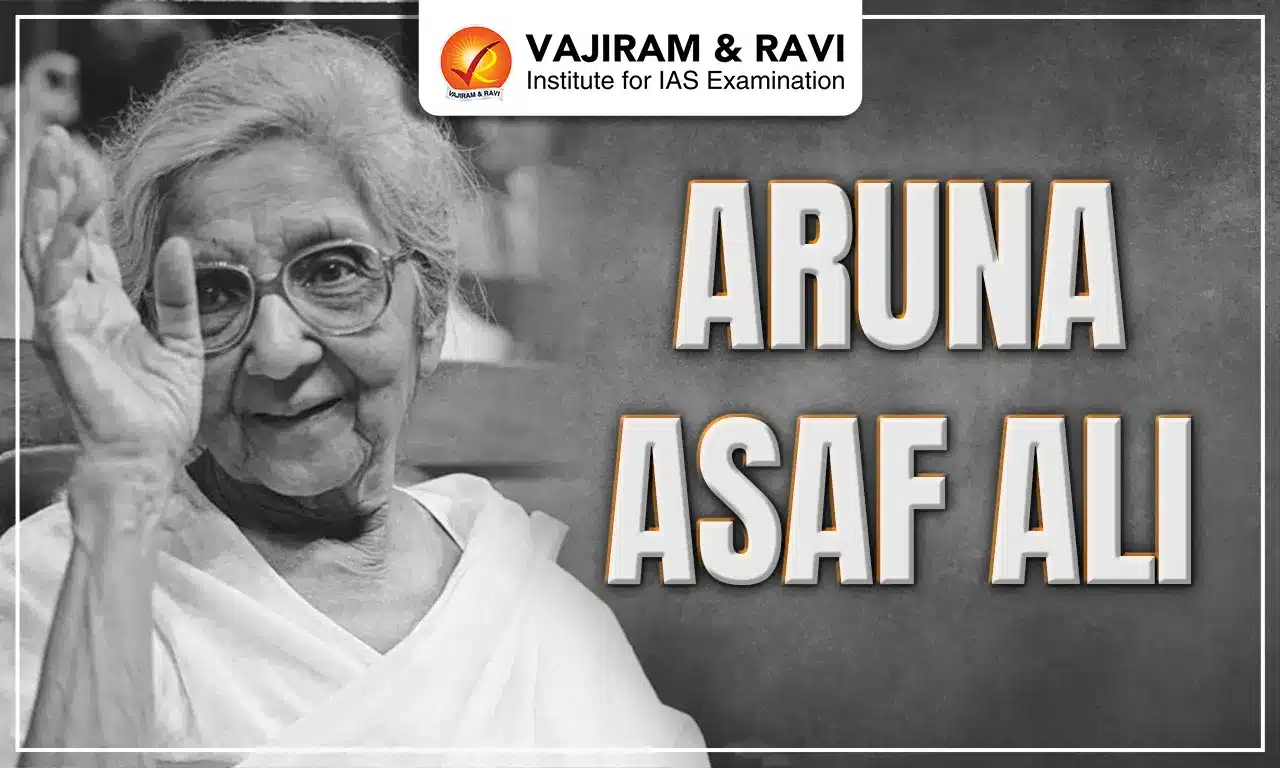
Aruna Asaf Ali was one of the most fearless women leaders of India’s freedom struggle, remembered for her pivotal role in the Quit India Movement of 1942. Her courage, leadership, and lifelong commitment to social justice earned her the title of the “Grand Old Lady of Indian Independence.” Aruna’s political journey reflects a blend of patriotism, women’s empowerment, and socialist ideals, making her an inspiring icon in India’s modern history.
Aruna Asaf Ali
Aruna Asaf Ali was born on 16 July 1909 in Kalka, Haryana, into a Bengali Brahmin family. Educated at Sacred Heart Convent, Lahore, she later became a teacher at Gokhale Memorial School, Calcutta. Her life took a significant turn after marrying Asaf Ali, a Muslim lawyer and freedom fighter, in 1928-a bold interfaith marriage that broke social barriers of the time. Influenced by her husband and contemporaries like Jawaharlal Nehru and Mahatma Gandhi, she joined the Indian National Congress and dedicated herself to the independence movement.
Aruna Asaf Ali Political Career
Aruna Asaf Ali’s entry into politics came through her active participation in the Civil Disobedience Movement (1930). She was arrested for hoisting the Congress flag at a public park in 1932 and became known for her defiance during imprisonment. However, her most historic act occurred during the Quit India Movement in August 1942, when she hoisted the Indian National Flag at the Gowalia Tank Maidan in Bombay, signaling the start of a nationwide civil uprising against British rule. This act made her a national symbol of resistance.
She went underground for several years, organizing underground radio broadcasts, distributing pamphlets, and coordinating revolutionary activities. Her leadership in mobilizing youth and women made her one of the most wanted leaders of the time by the British authorities.
Aruna Asaf Ali Contribution to the Freedom Movement
Aruna Asaf Ali’s contribution extended beyond symbolism; she played a crucial organizational role. Key highlights of her contribution include:
- Civil Disobedience Activism (1930-1932): Participated in protests against British laws and imprisonment of Congress leaders.
- Quit India Movement (1942): Hoisted the national flag at Bombay’s Gowalia Tank Maidan and inspired mass protests.
- Underground Resistance: Operated secret communications and inspired revolutionaries like Usha Mehta in underground radio movements.
- Socialist Advocacy: After independence, she worked closely with socialist leaders like Jayaprakash Narayan and Ram Manohar Lohia.
Aruna Asaf Ali Role in Post-Independence India
After independence, Aruna Asaf Ali remained committed to building a democratic and socially just India. Her post-independence work reflected her belief that political freedom must lead to social and economic transformation. Some of her major roles include:
- Delhi’s First Mayor (1958): She was elected the first female Mayor of Delhi and promoted urban development, public health, and civic welfare.
- Support to Socialist Movements: Advocated for land reforms, workers’ rights, and labor unionization.
- Women’s Empowerment: Continued her activism through organizations like the NFIW, promoting gender equality and political participation.
- Journalism and Education: Co-founded the weekly journal Link and the newspaper Patriot, providing a platform for progressive thought and political discussion.
Aruna Asaf Ali Philosophy
Aruna’s political thought evolved from Gandhian non-violence to a socialist worldview. Initially inspired by Gandhi’s principles of truth and non-violence, her underground activism during the Quit India Movement reflected a more militant and action-oriented approach. After independence, she supported the idea of a welfare state, emphasizing labor rights, women’s participation, and social equality.
She became one of the founding members of the National Federation of Indian Women (NFIW) in 1954, linked to the Communist Party of India (CPI), which focused on improving women’s economic and political conditions.
Aruna Asaf Ali Achievements
Aruna’s achievements remain a lasting legacy in India’s freedom and social movements. Her life reflected the synthesis of patriotism, socialism, and feminism, all rooted in the ideal of national service.
- Hoisting the Indian National Flag during Quit India Movement (1942)- a defining act of courage.
- Pioneering role as Delhi’s first woman Mayor.
- Advocacy for women’s political representation and labor welfare.
- Establishing NFIW to champion women’s rights and equal opportunities.
- Influencing India’s socialist and democratic discourse post-independence.
Aruna Asaf Ali Awards and Honours
Aruna Asaf Ali received numerous national honors for her contribution to India’s freedom and society. Her major awards include:
- International Lenin Peace Prize (1964) for promoting peace and friendship among nations.
- Jawaharlal Nehru Award for International Understanding (1991) for her role in social and political progress.
- Bharat Ratna (Posthumous, 1997)- India’s highest civilian honor recognizing her lifelong service to the nation.
- Padma Vibhushan (1992)- for distinguished service in public affairs.
Women Empowerment by Aruna Asaf Ali
Aruna remains a trailblazer in Indian women’s history. At a time when women’s public participation was limited, she defied stereotypes and became a leading figure in national politics. Her activism inspired thousands of women to join freedom movements and public life.
She later championed causes like equal pay, education for girls, and political inclusion. Her leadership within the National Federation of Indian Women made her a key figure in post-independence women’s movements, influencing feminist thought in India.
Aruna Asaf Ali Associations
In the 1950s and 1960s, Aruna Asaf Ali was closely associated with the Socialist and Communist movements in India. She saw socialism as a continuation of the freedom struggle, focusing on economic justice and equality.
She worked alongside leaders like E.M.S. Namboodiripad, P.C. Joshi, and Indrajit Gupta, participating in political campaigns that promoted peace, workers’ dignity, and cooperative reforms. Her journal Patriot became a voice for the Left-leaning intellectual discourse in India.
Aruna Asaf Ali Women Activist Safeguards
Aruna Asaf Ali’s struggle highlighted the need for constitutional protection for women and activists in India. After independence, India’s Constitution guaranteed fundamental rights under Articles 14, 15, and 16, ensuring equality, non-discrimination, and equal opportunities for women.
Her activism complemented the early constitutional and policy efforts toward women’s equality and rights. She remains symbolic of the intersection between constitutional equality and real-world activism.
Aruna Asaf Ali UPSC
Aruna passed away on 29 July 1996 in New Delhi. She continues to be remembered as one of the most fearless women of India’s freedom movement. Her memorial, the Aruna Asaf Ali Marg in Delhi, and her life story in history textbooks remind generations of her dedication.
Her name is synonymous with courage, intellect, and patriotism, serving as an enduring inspiration for civil rights movements and women leaders across India.
Aruna Asaf Ali FAQs
Q1: Who was Aruna Asaf Ali?
Ans: Aruna Asaf Ali was an Indian freedom fighter and social reformer known for hoisting the flag during the Quit India Movement.
Q2: When was Aruna Asaf Ali born?
Ans: She was born on 16 July 1909 in Kalka, Haryana, into a Bengali Brahmin family.
Q3: What was Aruna Asaf Ali’s contribution to Indian independence?
Ans: She led protests, organized underground resistance, and inspired women’s participation during the Quit India Movement of 1942.
Q4: Which major awards did Aruna Asaf Ali receive?
Ans: She was posthumously awarded the Bharat Ratna (1997) and Padma Vibhushan (1992) for her lifelong contribution to national service.
Q5: What organization did Aruna Asaf Ali establish for women’s rights?
Ans: She co-founded the National Federation of Indian Women (NFIW) in 1954 to advocate for gender equality and social justice.
