UPSC Daily Quiz 30 October 2025

UPSC Daily Quiz

The Daily UPSC Quiz by Vajiram & Ravi is a thoughtfully curated initiative designed to support UPSC aspirants in strengthening their current affairs knowledge and core conceptual understanding. Aligned with the UPSC Syllabus 2025, this daily quiz serves as a revision resource, helping candidates assess their preparation, revise key topics, and stay updated with relevant issues. Whether you are preparing for Prelims or sharpening your revision for Mains, consistent practice with these Daily UPSC Quiz can significantly enhance accuracy, speed, and confidence in solving exam-level questions.

[WpProQuiz 10]  

UPSC Daily Quiz FAQs

Q1: What is the Daily UPSC Quiz?

Ans: The Daily UPSC Quiz is a set of practice questions based on current affairs, static subjects, and PYQs that help aspirants enhance retention and test conceptual clarity regularly.

Q2: How is the Daily Quiz useful for UPSC preparation?

Ans: Daily quizzes support learning, help in revision, improve time management, and boost accuracy for both UPSC Prelims and Mains through consistent practice.

Q3: Are the quiz questions based on the UPSC syllabus?

Ans: Yes, all questions are aligned with the UPSC Syllabus 2025, covering key areas like Polity, Economy, Environment, History, Geography, and Current Affairs.

Q4: Are solutions and explanations provided with the quiz?

Ans: Yes, each quiz includes detailed explanations and source references to enhance conceptual understanding and enable self-assessment.

Q5: Is the Daily UPSC Quiz suitable for both Prelims and Mains?

Ans: Primarily focused on Prelims (MCQ format), but it also indirectly helps in Mains by strengthening subject knowledge and factual clarity.

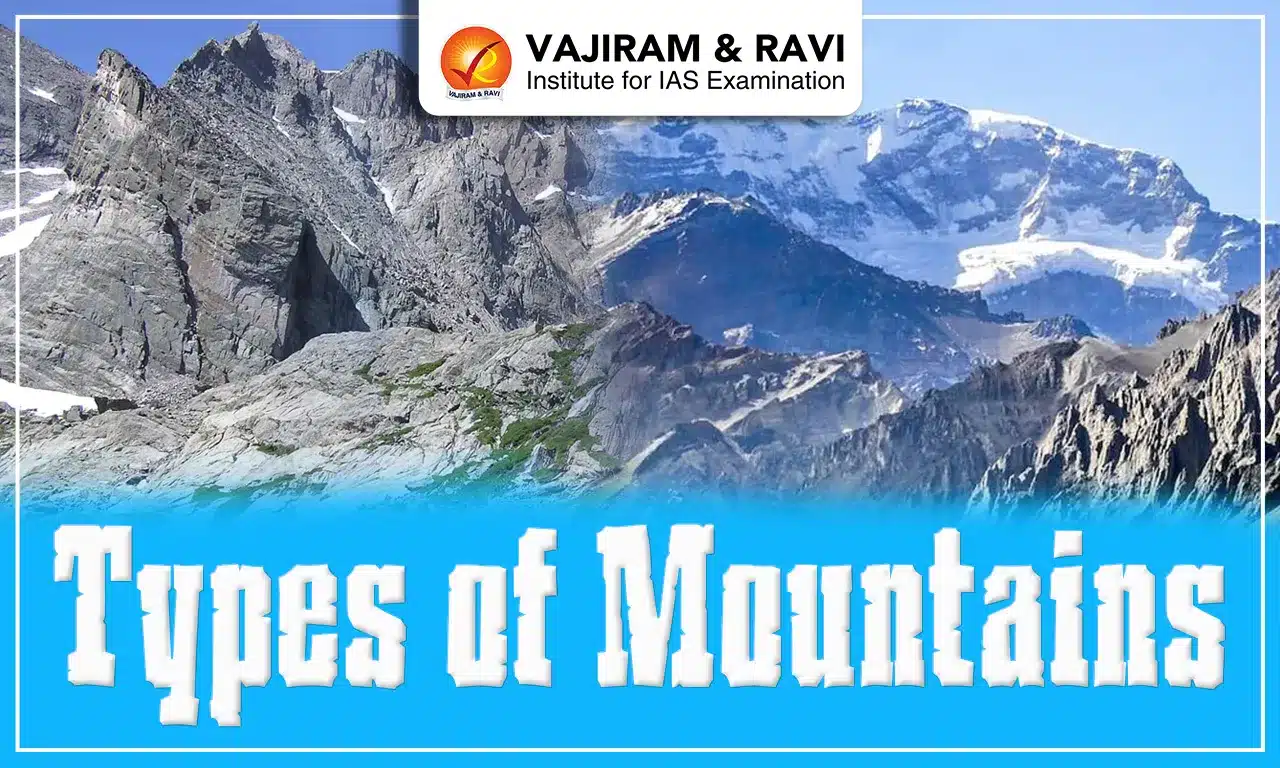
Types of Mountains, Classification, Examples, Characteristics, Location

Types of Mountains

Mountains are natural elevations of the Earth’s surface rising abruptly from their surroundings, often with steep slopes and significant height. They play a vital role in shaping the Earth’s climate, biodiversity, and human settlements. According to the United Nations Environment Programme (UNEP), mountains cover around 27% of the world’s land area and are home to nearly 15% of the global population. In India, major mountain ranges influence monsoons, rivers, and ecosystems, making them critical for geography and environment.

Types of Mountains

Mountains are classified based on their origin, formation processes, age, location, etc. The major types of mountains include Tectonic Mountains, Volcanic Mountains and Residual Mountains. Each type is formed due to distinct geological activities like plate movement, volcanic action, or erosion.

Read About: Mountain Passes in India

Types of Mountains Classification

The Mountains can be classified on the basis of several parameters. The major basis of classification is listed below:

  1. Types of Mountains Based on Location
  2. Types of Mountains Based on Mode of Origin
  3. Types of Mountains Based on Age of Origin 

Types of Mountains Based on the Location

Mountains can be classified according to their location of occurrence, which helps in understanding their geographical setting, climatic influence, and geological evolution. Broadly, they are divided into Continental Mountains and Oceanic Mountains. Continental mountains further include Coastal Mountains and Inland Mountains, while oceanic mountains are those that rise from the ocean floor. Each type exhibits unique features, formation processes, and global as well as Indian examples.

1. Continental Mountains

Continental mountains are formed on continental landmasses and represent the most common type of mountain systems on Earth. They play a major role in influencing continental climate, river systems, and biodiversity. These are of two major subtypes- Coastal Mountains and Inland Mountains.

(a) Coastal Mountains

Coastal mountains lie along the edges of continents, generally parallel to the coastline. They often act as barriers to moisture-laden winds, influencing rainfall patterns and the distribution of vegetation. These mountains are usually formed due to tectonic activity, subduction zones, or volcanic processes near plate margins.

  • Characteristics:
    • Located close to or along the sea coast.
    • Exhibit steep slopes on the seaward side and gentler slopes on the inland side.
    • Often associated with active fault lines and volcanic activity.
    • Rich in minerals and natural resources due to geological dynamism.
  • Examples:
    • Western Ghats (India): Stretching along the Arabian Sea coast, they influence monsoon patterns and are a UNESCO World Heritage Site for biodiversity.
    • Eastern Ghats (India): Older and more eroded, lying parallel to the Bay of Bengal.
    • Andes Mountains (South America): Formed due to the subduction of the Nazca Plate beneath the South American Plate.
    • Rocky Mountains (North America): Extending along the western coast, shaped by tectonic uplift and volcanic activity.
    • Atlas Mountains (Africa): Along the northwestern coast of Africa, representing folded mountain systems.
  • Geological Significance: Coastal mountains act as natural barriers protecting inland areas from sea winds and cyclonic activities. They also influence river systems by acting as water divides and serve as reservoirs for biodiversity and minerals.

(b) Inland Mountains

Inland mountains are situated in the interior regions of continents, far from coastal influences. They generally arise due to continental collisions, volcanic activity, or erosional remnants of older mountain systems. These mountains often determine the drainage patterns, climatic divisions, and human settlements within a continent.

  • Characteristics:
    • Located deep inside continental interiors.
    • Typically composed of older rock systems, often folded or faulted.
    • Play a vital role in defining river basins and watershed regions.
    • Experience extreme climates due to their distance from oceanic moderation.
  • Examples:
    • Himalayas (India): The world’s youngest fold mountain system formed by the collision of the Indian and Eurasian plates.
    • Aravalli Range (India): Among the world’s oldest fold mountains, located in northwestern India.
    • Ural Mountains (Russia): A natural boundary between Europe and Asia, composed of ancient crystalline rocks.
    • Appalachian Mountains (USA): Ancient eroded mountains of eastern North America formed during the Paleozoic era.
    • Kunlun and Tien Shan Mountains (China): Interior Asian ranges shaped by the same tectonic forces as the Himalayas.
  • Geological Significance: Inland mountains play a key role in influencing continental climate, acting as barriers to air mass movement. They are also rich in minerals, forest resources, and hydropower potential. Their formation marks major tectonic events such as continental drift and plate convergence.

2. Oceanic Mountains

Oceanic mountains are those that rise from the ocean floor, often forming long chains known as mid-ocean ridges or volcanic island arcs. These are primarily formed by underwater volcanic activity, sea-floor spreading, or tectonic uplift. Although submerged, they shape oceanic currents, marine life distribution, and geological processes of the ocean crust.

  • Characteristics:
    • Located entirely below the ocean surface, though some peaks may emerge as islands.
    • Formed mainly by volcanic eruptions and tectonic divergence at mid-ocean ridges.
    • Composed of basaltic rocks rather than granitic continental crust.
    • Host hydrothermal vents that support unique marine ecosystems.
  • Examples:
    • Mid-Atlantic Ridge: A continuous underwater mountain range formed by the divergence of the Eurasian and North American plates.
    • East Pacific Rise: A major mid-ocean ridge located in the Pacific Ocean responsible for new oceanic crust formation.
    • Hawaiian Islands (USA): Volcanic peaks formed due to a hotspot in the Pacific Plate.
    • Ninety East Ridge (Indian Ocean): A linear underwater ridge formed by volcanic activity and tectonic movement.
    • Carlsberg Ridge (Arabian Sea): Part of the Indian Ocean ridge system, important for studying sea-floor spreading.
  • Geological Significance: Oceanic mountains play a crucial role in plate tectonics and earthquake distribution. They regulate oceanic circulation, influence global climate patterns, and provide insights into the Earth’s internal processes. Many underwater mountains also hold vast reserves of manganese nodules, polymetallic sulphides, and other mineral resources.

Types of Mountains Based on the Mode of Origin

Mountains are classified on the basis of their mode of origin into three major categories: Tectonic (or Original) Mountains, Circum-Erosional (Residual or Relict) Mountains, and Volcanic Mountains. This classification helps in understanding how various geological processes such as plate tectonics, volcanic activity, erosion, and folding shape the Earth’s surface. Each type represents a distinct stage of the Earth’s geomorphic evolution and contributes to regional topography, mineral wealth, and climatic influence.

1. Tectonic or Original Mountains

Tectonic mountains are formed by crustal movements and deformation caused by the interaction of lithospheric plates. They are also known as Orogenic mountains and represent regions of intense folding, faulting, and uplift due to compressional forces. These mountains are the most common and geologically significant on Earth.

Tectonic mountains are further classified into:

  • Fold Mountains
  • Block Mountains
  • Dome Mountains

(a) Fold Mountains

Fold mountains arise due to horizontal compression of the Earth’s crust, which bends and folds sedimentary rock layers into wave-like structures. They are typically located along convergent plate boundaries where two plates collide.

  • Characteristics:
    • Consist of parallel ridges (anticlines) and valleys (synclines).
    • Formed mainly from sedimentary rocks deposited in geosynclines.
    • Highly elevated, young, and seismically active regions.
    • Rich in minerals and serve as sources of perennial rivers.
  • Examples:
    • Himalayas (India): Formed by the collision of the Indian and Eurasian plates; still rising at ~5 mm per year (Geological Survey of India, 2022).
    • Alps (Europe): Created by the convergence of the African and Eurasian plates.
    • Andes (South America) and Rockies (North America) are also major fold mountain systems.

(b) Block Mountains

Block mountains, or fault-block mountains, form when large crustal blocks are displaced vertically along fault lines due to tensional forces. The uplifted blocks are called horsts, and the lowered regions are called grabens.

  • Characteristics:
    • Formed by faulting, not folding.
    • Exhibit steep slopes and flat-topped summits.
    • Usually found in regions of crustal tension and rifting.
    • Associated with earthquake activity due to fault movement.
  • Examples:
    • Vindhya and Satpura Ranges (India): Classic block mountains formed due to faulting in central India.
    • Black Forest (Germany) and Vosges Mountains (France): European examples formed by rift faulting.
    • Sierra Nevada (USA): Formed by normal faulting along the North American Plate.

(c) Dome Mountains

Dome mountains are created when magma intrudes between rock layers and pushes the overlying strata upwards, forming a dome-shaped structure. However, the magma does not reach the surface, and erosion later exposes the core.

  • Characteristics:
    • Rounded, dome-like appearance with steep slopes.
    • Often composed of granitic or metamorphic rocks.
    • Result from igneous intrusion rather than surface volcanism.
    • Generally small in areal extent compared to fold mountains.
  • Examples:
    • Velikonda Range (Eastern Ghats, India) shows dome-like structures.
    • Black Hills (USA) and Adirondack Mountains (USA) are classic examples of dome mountains.
    • Uluru (Australia) is an isolated monolithic dome.

2. Residual Mountains

Circum-erosional mountains, also known as Residual or Relict Mountains, are formed due to long-term erosion and denudation of pre-existing mountains. Wind, water, glaciers, and chemical weathering gradually wear away softer materials, leaving behind resistant rock masses that form rugged topography.

  • Characteristics:
    • Formed from remnants of ancient mountain systems.
    • Composed mainly of hard, resistant rocks like granite or gneiss.
    • Have rounded tops and low elevation due to prolonged weathering.
    • Represent old-age landforms with little tectonic activity.
  • Examples:
    • Aravalli Range (India): Among the world’s oldest mountain systems, formed during the Precambrian era (~2.5 billion years ago).
    • Nilgiri Hills (India): Residual highlands in southern India.
    • Appalachian Mountains (USA) and Pennines (UK): Once high fold mountains, now eroded to low ranges.
  • Geological Significance: These mountains reveal the ancient tectonic history of the Earth and serve as valuable sources of minerals, metals, and geological data on early crustal evolution.

3. Volcanic Mountains

Volcanic mountains are built by successive eruptions of lava, ash, and volcanic debris from a vent in the Earth’s crust. Over time, the accumulation of these materials creates a cone-shaped mountain. Such mountains are associated with divergent or convergent plate boundaries and hotspots.

  • Characteristics:
    • Conical shape with a central crater or vent.
    • Composed primarily of basalt or andesite rocks.
    • Many are active or dormant volcanoes with high geothermal potential.
    • Found both on continents and ocean floors.
  • Examples:
    • Mount Fuji (Japan): An iconic stratovolcano formed at the Pacific and Eurasian plate boundary.
    • Mount Vesuvius (Italy) and Mount Etna (Sicily): European volcanic mountains of historical importance.
    • Barren Island (India): India’s only active volcano, located in the Andaman Sea.
    • Mauna Loa (Hawaii): The largest shield volcano in the world.
  • Geological Significance: Volcanic mountains play a key role in crustal formation, mineral enrichment, and atmospheric evolution. They also influence local weather and soil fertility.

Types of Mountains Based on the Age of Origin

Mountains can also be classified based on the geological period during which they were formed. The age of mountains helps geologists and geographers understand the Earth’s tectonic history, the processes of orogeny (mountain building), and the landscape evolution over time. According to geological studies, especially data from the Geological Survey of India (GSI) and US Geological Survey (USGS), mountains are broadly classified into four major systems based on their age of origin: Precambrian Mountains, Caledonian Mountains, Hercynian (Variscan) Mountains, and the Alpine Mountain System.

1. Precambrian Mountains (>570 million years old)

The Precambrian mountains are the oldest mountain systems on Earth, formed before the Cambrian period, over 570 million years ago. These ancient ranges have undergone extensive erosion and weathering, leaving behind residual and relict formations. They represent some of the most stable geological structures and form the basement shields of continents.

  • Characteristics:
    • Extremely old and highly denuded.
    • Composed mostly of igneous and metamorphic rocks.
    • Represent the roots of ancient orogenies.
    • Generally low in elevation due to erosion over geological time.
    • Rich in metallic minerals such as iron, copper, and manganese.
  • Examples:
    • Aravalli Range (India): One of the world’s oldest fold mountains, dating back to the Precambrian era, extending across Rajasthan and Haryana.
    • Dharwar Hills (Karnataka, India): Part of the Peninsular Shield with rich mineral deposits.
    • Canadian Shield (North America): Represents the eroded roots of ancient mountain systems.
    • Brazilian Highlands and Western Australian Plateau: Other global examples of ancient mountain remnants.

2. Caledonian Mountains (About 400 million years old)

The Caledonian orogeny took place during the Silurian to early Devonian periods (approximately 400-450 million years ago). These mountains were formed due to the collision of ancient continental plates, resulting in large-scale folding and faulting. The name comes from “Caledonia,” the ancient name for Scotland, where these features are well developed.

  • Characteristics:
    • Formed during the closure of the Iapetus Ocean.
    • Moderately eroded due to their old age.
    • Found mostly in the Northern Hemisphere.
    • Composed largely of metamorphic and sedimentary rocks.
  • Examples:
    • Scandinavian Mountains (Norway and Sweden)
    • Scottish Highlands (UK)
    • Appalachian Mountains (Eastern USA)- their older parts show Caledonian features.
    • Dovrefjell Mountains (Norway)
  • Geological Significance: Caledonian mountains represent the first global-scale orogeny after the breakup of early continental plates, shaping the early continents of Laurasia and Baltica.

3. Hercynian or Variscan Mountains (About 250-300 million years old)

The Hercynian or Variscan orogeny occurred during the Carboniferous and Permian periods, around 250-300 million years ago. These mountains formed when the ancient supercontinents Laurasia and Gondwana began to converge, closing the Rheic Ocean.

  • Characteristics:
    • Formed by complex folding and faulting processes.
    • Moderately eroded, forming highlands and plateaus.
    • Rich in coal and mineral resources due to associated sedimentation.
    • Found primarily in Europe and parts of Asia.
  • Examples:
    • Vosges and Black Forest (Europe)
    • Ural Mountains (Russia)- forming a natural boundary between Europe and Asia.
    • Appalachian Mountains (USA)- the central parts show Hercynian reactivation.
    • Central Plateau of France (Massif Central)
  • Geological Significance: These mountains mark an important phase in Earth’s crustal evolution, linking ancient geological events to modern continental configurations.

4. Alpine Mountain System (<60 million years old)

The Alpine orogeny represents the youngest mountain-building phase, occurring during the Tertiary period (around 60 million years ago). These mountains are still tectonically active, with ongoing uplift and seismic activity. The term “Alpine” comes from the Alps of Europe, but this system includes several young fold mountains across the world.

  • Characteristics:
    • Formed by continental collision and subduction of major tectonic plates.
    • Steep, rugged, and high peaks with active glaciers.
    • Contain many of the world’s highest mountain ranges.
    • Geologically young, less eroded, and highly unstable.
  • Examples:
    • Himalayas (India, Nepal, Bhutan, China): Formed by the collision of the Indian and Eurasian plates, still rising at a rate of a few millimetres per year.
    • Alps (Europe): Created by the collision of the African and Eurasian plates.
    • Andes (South America): Formed by subduction of the Nazca Plate beneath the South American Plate.
    • Rocky Mountains (North America): Formed during the Laramide orogeny, part of the Alpine phase.
  • Geological Significance: The Alpine system is crucial for understanding plate tectonics, earthquakes, and volcanism. These mountains also regulate global climate, river systems, and human settlement patterns.

Mountains Importance

Mountains are crucial for ecological balance, water supply, and human livelihood. They regulate climate, house biodiversity, and act as natural barriers. Key Functions:

  1. Water Reservoirs: Source of 60% of world’s freshwater (UN Water, 2021).
  2. Climate Regulation: Influence wind patterns and rainfall.
  3. Biodiversity Hotspots: Contain nearly half of world’s biodiversity.
  4. Cultural Significance: Home to ancient civilizations and spiritual centers.
  5. Economic Value: Support tourism, minerals, and hydroelectric power.

Types of Mountains UPSC

Mountains, whether fold, block, volcanic, or residual, represent Earth’s dynamic geological processes and ecological diversity. From the majestic Himalayas to the ancient Aravallis, they influence weather, rivers, and biodiversity crucial for life. For India, sustainable mountain management is not only an environmental priority but also a key factor in long-term economic and ecological stability.

Types of Mountains FAQs

Q1: What are the main Classifications of Mountains?

Ans: Mountains are mainly classified based on location, mode of origin, geological structure, age, and composition of rocks. The major basis of classification is- Tectonic Mountains, Residual Mountains, and Volcanic Mountains.

Q2: What are the Types of Mountains based on Location?

Ans: Based on location, mountains are classified into Continental Mountains (Coastal and Inland) and Oceanic Mountains.

Q3: Which is the Oldest Inland Mountain Range in India?

Ans: The Aravalli Range in Rajasthan is one of the world’s oldest fold mountains, formed during the Precambrian era.

Q4: What are Oceanic Mountains?

Ans: Oceanic mountains are underwater elevations formed by volcanic activity or sea-floor spreading, such as the Mid-Atlantic Ridge.

Q5: How do Coastal Mountains affect climate?

Ans: Coastal mountains act as barriers to moist winds, causing orographic rainfall on the windward side and dry conditions on the leeward side.


Samriddh Gram Phygital Services Pilot Project

Samriddh Gram Phygital Services Pilot Project

Samriddh Gram Phygital Services Pilot Project Latest News

Recently, the Telecom Centres of Excellence (TCoE) has signed agreements with leading implementation partners to roll out the Samriddh Gram Phygital Services Pilot  project.

About Samriddh Gram Phygital Services Pilot Project

  • It is aimed at transforming rural India through a seamless integration of physical and digital services.
  • It is envisaged as a pioneering phygital (physical + digital) Services model integrating on-ground presence with robust digital infrastructure to empower rural citizens.
  • It leverages BharatNet connectivity to deliver essential services seamlessly and sustainably.

Features of Samriddh Gram Phygital Services Pilot Project

  • Under this initiative three villages have been identified namely, Ari & Umri in Madhya Pradesh, Narakoduru in Andhra Pradesh, and Chaurawala in Uttar Pradesh.
  • Each village will host a Samriddhi Kendra which will serve as an integrated digital service hub.
  • The Samriddhi Kendras will deliver a comprehensive suite of services:
    • Education & Skilling: Smart classrooms, AR/VR-based learning, and digital skilling aligned with government schemes/initiatives.
    • Agriculture: IoT-based soil testing, drone support, and smart irrigation systems.
    • Healthcare:  Teleconsultations, Health ATMs, and emergency care.
    • e-Governance: Assisted access to citizen services, documentation, and grievance redressal.
    • E-Commerce: Integration with ONDC and digital marketplaces for local entrepreneurship.
    • Financial Inclusion: Digital banking and payments
    • Connectivity Backbone: Strengthened BharatNet FTTH with a Village Area Network and public Wi-Fi hotspots.

Source: PIB

Samriddh Gram Phygital Services Pilot Project FAQs

Q1: What is the primary objective of the Samriddh Gram Phygital Services Pilot Project?

Ans: To deliver citizen-centric services through phygital infrastructure

Q2: Where is the Samriddh Gram Phygital Services Pilot Project being implemented?

Ans: Rural areas of India

CLAMP Portal

CLAMP Portal

CLAMP Portal Latest News

Recently, the Union Minister of Coal and Mines launched two digital platforms the KOYLA SHAKTI Dashboard and the CLAMP Portal

About CLAMP Portal 

  • The Coal Land Acquisition, Management, and Payment (CLAMP) portal is a unified digital solution for the coal sector.
  • It is aimed at streamlining land acquisition, compensation, and rehabilitation & resettlement (R&R) processes in the coal sector.
  • It serves as a centralized repository of land records, the portal ensures data integration, enhances accountability, and minimizes procedural delays.
  • Initiative of: Ministry of Coal
  • Advantages: CLAMP portal enhances transparency, efficiency, and inter-agency coordination in land management practices across coal PSUs.

Key Facts about Koyla Shakti Dashboard

  • It is a digital platform that integrates the entire coal value chain from mine to market on a unified interface.
  • The platform facilitates real-time coordination among coal companies, railways, ports, and end users, thereby enhancing operational efficiency and ensuring seamless coal logistics.
  • The platform acts as a comprehensive decision-support system, ensuring:
  • Seamless coordination among coal companies, railways, ports, and end users.
  • Transparency and accountability through data-driven monitoring.
  • Faster, smarter decision-making enabled by live analytics and digital dashboards.

Source: PIB

CLAMP Portal FAQs

Q1: What is the primary use of coal in India?

Ans: Power generation

Q2: Which type of coal is considered the highest quality?

Ans: Anthracite

Hemiphyllodactylus Venkatadri

Hemiphyllodactylus Venkatadri

Hemiphyllodactylus Venkatadri Latest News

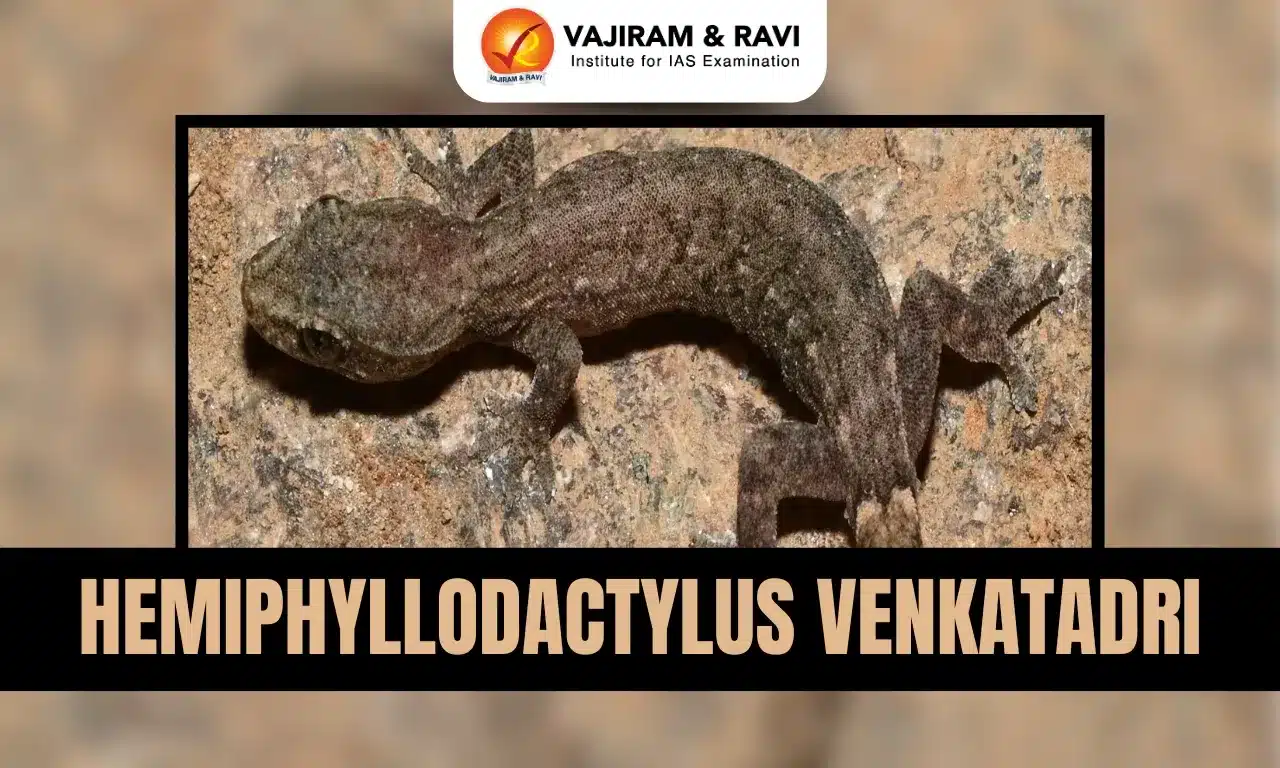
Recently, scientists from the Zoological Survey of India (ZSI) have discovered a new species of slender gecko and named it as Hemiphyllodactylus Venkatadri.

About Hemiphyllodactylus Venkatadri

  • It is a new species of slender Gecko belonging to the genus Hemiphyllodactylus.
  • It was discovered from Tirumala hill ranges within the Seshachalam biosphere reserve in Andhra Pradesh.
  • It derives its name from the sacred Venkatadri Hills.
  • It is the second slender gecko species recorded from Andhra Pradesh, after Hemiphyllodactylus arakuensis. 

Features of Hemiphyllodactylus Venkatadri

  • Venkatadri slender geckos are considered “small,” reaching just over 2 inches in length.
  • Their limbs are short, and they have “spurs” at the base of their tails.

Key Facts about Seshachalam Biosphere Reserve

  • It is also known as Tirupati-Kadapa hills are one of the major landscapes of Eastern Ghats of Southern Andhra Pradesh.
  • It was designated Biosphere Reserve in 2010. 
  • These ranges have typical gorges and gaps due to faulting and stream erosion resulting in discontinuous ranges.
  • The highest hill peak is Tellaralla penta.
  • It comprises famous sacred shrines collectively called as Tirumala hills are the abode of Lord Venkateswara or Balaji.

Source: TOI

Hemiphyllodactylus Venkatadri FAQs

Q1: What type of species is Hemiphyllodactylus Venkatadri?

Ans: Gecko

Q2: What is a Biosphere Reserve?

Ans: A designated ecosystem that conserves biodiversity and promotes sustainable development.

Transit Oriented Development

Transit Oriented Development

Transit Oriented Development Latest News

Delhi Development Authority’s (DDA’s) East Delhi hub is set to roll out India’ first transit-oriented development (TOD) project.

About Transit Oriented Development

  • It is an urban development strategy which aims to create the maximum possible numbers of houses, shops, offices and recreational spaces near public transport facilities.
  • The TOD approach puts public transportation at the centre of the urban development plan.
  • Objectives: To minimise use of personal vehicles, make commutes shorter, and reduce the cost of transport and exposure to pollutants.

Principles of Transit Oriented Development

  • Transit Hub: Neighbourhoods built around a TOD strategy are built around at least one major transit node such as a metro station or other rail systems, preferably combined with other modes of public transport such as a bus station and/ or an airport.
  • Multi-modal integration: Transfers between different modes of transport, such as switching from a metro to a city bus, should be a seamless process.
  • TOD hubs should also have open public spaces such as transit plazas and parks to increase street activity and foster a sense of community.
  • Pedestrian Friendly: These localities must also be friendly to pedestrians and cyclists, since one of the major thrusts of this approach is to take vehicles off the road.
  • Dense Mixed Use: TOD localities should be mixed-use, so that people can live, work, and relax within a small radius.

Advantages of Transit Oriented Development

  • To transportation agencies, it offers an additional source of non-ticket revenue.
  • For land-owning agencies and governments it appears as a mode of value-capture financing, which allows them to fund public projects through potential increases in land values resulting from these projects.

Source: IE

Transit Oriented Development FAQs

Q1: What is the primary goal of Transit-Oriented Development (TOD)?

Ans: To integrate land use and transportation planning

Q2: What is the benefit of Transit-Oriented Development (TOD)?

Ans: Reduced traffic congestion

Model Youth Gram Sabha

Model Youth Gram Sabha

Model Youth Gram Sabha Latest News

The Ministry of Panchayati Raj in collaboration with the Ministry of Education (Department of School Education and Literacy) and the Ministry of Tribal Affairs, will jointly launch the Model Youth Gram Sabha (MYGS) in New Delhi. 

About Model Youth Gram Sabha

  • It is a simulated forum for School Children to participate in mock Gram Sabha sessions.
  • It is a pioneering initiative to strengthen Janbhagidari and promote participatory local governance by engaging students in simulated Gram Sabha sessions.
  • It is an initiative based on the Model UN – an educational simulation of the United Nations – in schools across the country
  • Initiative of: It is an initiative of the Ministry of Panchayati Raj, in collaboration with the Ministry of Education and the Ministry of Tribal Affairs. 
  • Implementation: It will be rolled out across more than 1,000 schools nationwide, including Jawahar Navodaya Vidyalayas, Eklavya Model Residential Schools (EMRSs), and State Government Schools.

Key Features of Model Youth Gram Sabha

  • Students from classes 9-12 will play the roles of sarpanch, ward members, and village-level officials, including village secretary, Anganwadi worker etc.
  • They will hold mock meetings of the Gram Sabha, discuss various issues, and prepare the village budget and development plans.
  • The Panchayati Raj Ministry will also provide a support of Rs 20,000 to each school for holding the mock Gram Sabha

Source: PIB

Model Youth Gram Sabha FAQs

Q1: What is the Model Youth Gram Sabha?

Ans: A platform for youth to participate in local governance

Q2: What is the expected outcome of the Model Youth Gram Sabha?

Ans: Increased youth participation in local governance.

AmazonFACE Project

AmazonFACE Project

AmazonFACE Project Latest News

Scientists in Brazil have launched the AmazonFACE Project near Manaus, the largest city in the Amazon.

About AmazonFACE Project

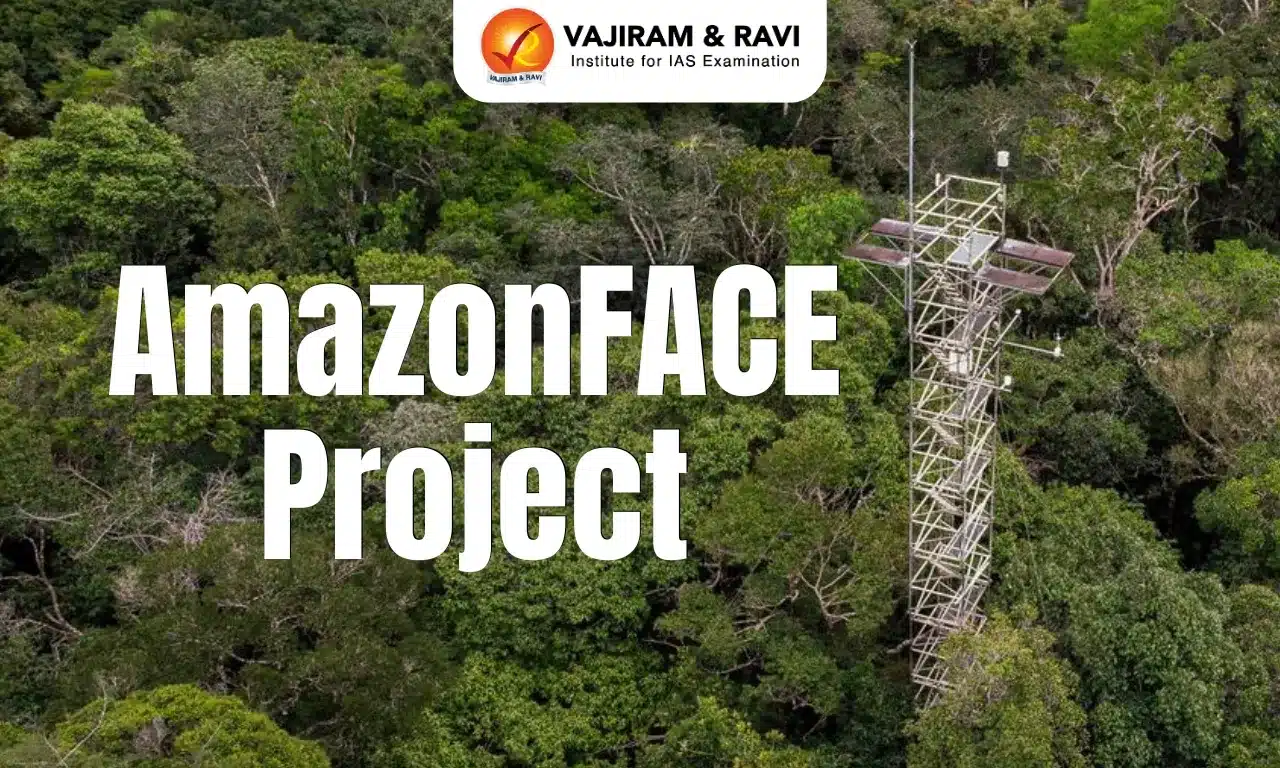
  • It is a field experiment that exposes mature tropical trees to projected future CO2 concentrations in an old-growth Amazon forest stand located near Manaus, Brazil. 
  • This is the first experiment in a natural forest of this size in the tropics.
  • Technology: The project uses Free-Air CO2 Enrichment (FACE) technology to increase understanding of the functioning of the world's largest tropical forest in light of climate change.
  • Supported by: The project is supported by Brazil’s federal government and the United Kingdom.

Working of  AmazonFACE Project

  • Six rings of steel towers loom above the jungle canopy, each surrounding groups of 50 to 70 mature trees.
  • Scientists will fumigate trees in three of the rings with carbon dioxide at levels simulating climate forecasts for coming decades, while the rest serve as control samples.
  • Sensors record the forest’s response to changing conditions like absorption of carbon dioxide, oxygen and water vapor release in response to rain, storms and sunshine every 10 minutes,

Source: DD News

AmazonFACE Project FAQs

Q1: What does AmazonFACE stand for?

Ans: Amazon Free-Air CO2 Enrichment

Q2: What is the primary objective of the AmazonFACE Project?

Ans: To investigate the effects of increased CO2 on Amazonian forests

Indi and Puliyankudi Limes

Indi and Puliyankudi Limes

Indi and Puliyankudi Limes Latest News

Recently, The Agricultural and Processed Food Products Export Development Authority (APEDA) has facilitated the first-ever air shipment of GI-tagged Indi Lime and Puliyankudi Lime to the United Kingdom.

About Indi Limes

  • Indi Lime is cultivated primarily in Vijayapura district of Karnataka.
  • It has received the Geographical Indication (GI) tag.
  • Features: It is known for its superior quality, zesty aroma, high juice yield and balanced acidity.
  • It has distinctive flavour and geographical uniqueness make it a hallmark of the region’s agricultural excellence.
  • Uses:  Along with its culinary applications, the lime is also valued in traditional medicine and cultural practices.

About Puliyankudi Lime

  • It is extensive lime cultivated in Puliyankudi, often referred to as the “Lemon City of Tamil Nadu,”
  • Features of Puliyankudi Lime: The Puliyankudi Lime, particularly the Kadayam variety, is characterised by its thin peel, strong acidity, high ascorbic acid content (34.3 mg/100g) and juice percentage of around 55%. 
  • It is rich in vitamin C and antioxidants.
  • Health Benefits: It supports immunity and digestion while offering exceptional flavour and quality.
  • It has officially received the Geographical Indication (GI) tag in April 2025.

Key Facts about Agricultural and Processed Food Products Export Development Authority

  • It was established by the Government of India under the Agricultural and Processed Food Products Export Development Authority Act passed by the Parliament in December, 1985.
  • Objective: To develop and promote the export of scheduled products.
  • Nodal Ministry: It works under the Ministry of Commerce and Industry.
  • Headquarters: New Delhi

Source: PIB

Indi and Puliyankudi Limes FAQs

Q1: What is the purpose of a Geographical Indication (GI) tag?

Ans: To identify the geographical origin of a product

Q2: What is the primary function of Vitamin C in the human body?

Ans: To support immune function and collagen production

Atlas Moth

Atlas Moth

Atlas Moth Latest News

An 'Atlas Moth' (Attacus atlas), recognised as the world's largest moth, has been recently discovered in Guddehalli in Karwar of Karnataka's Davangare district.

About Atlas Moth

  • It is a massive saturniid moth native to tropical and subtropical rainforest regions of Southeast Asia. 
  • Scientific Name: Attacus atlas
  • Distribution: It is widely distributed in Southeast Asia, including in Nepal, northeastern India, Bangladesh, Bhutan, southeastern China, Laos, Cambodia, Vietnam, and Taiwan.
  • Habitat
    • It is primarily found in tropical and subtropical rainforests.
    • They are cultivated in some areas for their silk called fagara, which is rough and woolly.

Atlas Moth Features

  • It is one of the largest moths in the world, with a wingspan of over 9.8 inches.
  • Their wingspans are also amongst the largest, reaching over 25 cm (10 in).
  • Females are slightly larger than males.
  • The wings of an atlas moth are a beautiful mix of brown, orange, white, and pink colors. 
  • They have clear, triangle-shaped "windows" on each wing. These windows look like they are made of glass. 
  • Like other moths in the family Saturniidae, adults do not have working mouthparts and only live for a few days to a week.
  • Atlas moths lives only 14-18 days.

Source: ETVB

Atlas Moth FAQs

Q1: What is the scientific name of the Atlas Moth?

Ans: Attacus atlas

Q2: In which type of habitat is the Atlas Moth commonly found?

Ans: Tropical and subtropical rainforests

Q3: What is the approximate wingspan of the Atlas Moth in inches?

Ans: 10 inches

Daily Editorial Analysis 30 October 2025

Daily Editorial Analysis

An Amended Constitution Bill, Its Contentious Issues

Context

  • The Constitution (One Hundred and Thirtieth Amendment) Bill marks a pivotal step in India’s effort to strengthen constitutional morality and political accountability.
  • The Bill seeks to amend Articles 75, 164, and 239AA to mandate the removal of Ministers, including the Prime Minister and Chief Ministers, if they remain in custody for thirty consecutive days for an offence punishable with five years or more of imprisonment.
  • While the proposal aims to uphold the integrity of public office, it has provoked widespread debate.

The Provisions of the Bill

  • Under the Bill, a Minister’s arrest and detention for thirty consecutive days would compel the President or Governor to remove them from office on the advice of the Prime Minister or Chief Minister.
  • If the Prime Minister or Chief Minister themselves are detained, they must resign or automatically cease to hold office.
  • The measure seeks to prevent accused Ministers from retaining power, thus reinforcing public trust in governance.
  • Yet, its reliance on arrest and custody duration as criteria for disqualification raises serious constitutional and procedural concerns, given the potential for abuse of discretionary powers by enforcement agencies.

The Discretionary Power of Arrest

  • The power to arrest, under Section 41 of the Code of Criminal Procedure (CrPC) and its counterpart Section 35 of the Bharatiya Nagarik Suraksha Sanhita (BNSS), is discretionary, not mandatory.
  • Courts have consistently reaffirmed this position:
  • In Joginder Kumar v. State of U.P. (1994), the Supreme Court held that no arrest should be made merely because it is lawful; it must be necessary and justified.
  • In Deenan v. Jayalalitha (1989) and Amarawati and Anr. v. State of U.P. (2004), courts clarified that the term may arrest empowers but does not oblige the police to arrest, depending on the nature and context of the offence.

The Contentious Provisions:  Detention, Bail, and the Problem of Thirty Days

  • The Bail Dilemma

    • The requirement that a Minister detained for thirty consecutive days must vacate office links political tenure to judicial timelines.
    • Though the Supreme Court has repeatedly held that bail is the rule, jail is the exception, in practice, bail decisions are influenced by factors like the gravity of the offence and the judge’s stance on liberty under Article 21.
    • This means a Minister could lose office before any judicial determination of guilt, contradicting the presumption of innocence. The thirty-day threshold therefore risks turning temporary detention into permanent political damage.
  • Default Bail and Procedural Inconsistency

    • The amendment also ignores default bail under Section 167(2) CrPC (or Section 187 BNSS), which grants bail if the investigation is not completed within 60 or 90 days.
    • Since the thirty-day limit falls well within this period, a Minister might be removed from office before acquiring the right to bail, rendering the provision procedurally inconsistent and arbitrary.
  • Special Statutes and Twin Conditions of Bail

    • The Bill’s scope covers offences under any law in force, extending to stringent statutes such as the PMLA (Prevention of Money Laundering Act), NDPS Act, and UAPA (Unlawful Activities (Prevention) Act).
    • These impose twin conditions for bail, the accused must prove they are not guilty and unlikely to reoffend.
    • Such provisions reverse the burden of proof, making bail within thirty days nearly impossible.
    • The Manish Sisodia case, where bail was granted only after 17 months under the PMLA, exemplifies this difficulty.
    • Consequently, the thirty-day benchmark could cause premature disqualification even before due judicial process concludes.

Political Implications and the Risk of Misuse

  • Arrest as a Political Tool

    • By linking ministerial survival to arrest and custody, the Bill risks converting the criminal process into a political instrument.
    • In a context where investigative agencies are often accused of bias, such provisions may facilitate targeted arrests against political rivals.
    • This undermines the principle of separation of powers and constitutional morality, replacing accountability with political expediency.
    • What is designed to enhance integrity could instead erode democratic fairness.
  • The Minister’s Dilemma

    • The Bill also places Ministers in a Hobson’s choice:
    • Either resign to secure bail, thereby surrendering office pre-emptively, or
    • Stay in custody and face automatic removal.
    • This dilemma creates administrative instability and penalises mere accusation, rather than proven guilt.
    • It risks reducing executive authority to the outcome of legal tactics, not democratic mandate.

Conclusion

  • The Constitution (One Hundred and Thirtieth Amendment) Bill reflects a well-meaning yet flawed attempt to promote ethical governance. Its intent.
  • Ultimately, true ministerial accountability cannot depend solely on legal triggers. It must arise from political ethics, transparent governance, and a citizenry committed to democratic values.
  • The Bill, in its current form, risks conflating political morality with punitive legality, thereby unsettling the delicate equilibrium between justice and politics in India’s constitutional framework.

An Amended Constitution Bill, Its Contentious Issues FAQs

 Q1. What is the main objective of the Constitution (130th Amendment) Bill?
Ans. The main objective of the Bill is to ensure political accountability by mandating the removal of Ministers who remain under arrest for thirty consecutive days for serious offences.

Q2. Why is the Opposition concerned about the Bill?
Ans. The Opposition fears that the Bill’s reliance on arrest and detention could be misused by enforcement agencies to target political rivals and destabilise Opposition governments.

Q3. How does the Bill conflict with existing bail provisions?
Ans. The Bill conflicts with default bail provisions under Section 167(2) of the CrPC because it sets a thirty-day limit for removal, which is shorter than the sixty- or ninety-day period required for bail eligibility.

Q4. Why is the thirty-day threshold considered problematic?
Ans. The thirty-day threshold is considered arbitrary because it does not account for judicial delays, bail complexities, or the stringent conditions under special laws like the PMLA and UAPA.

Q5. What are alternative safeguards?
Ans. Introducing judicial certification of prima facie guilt or an independent committee review before disqualification to prevent misuse of the provision.

Source: The Hindu


A Decade After Paris Accord, An Unstoppable Transition

Context

  • Ten years after the adoption of the Paris Agreement at COP21, the world faces a defining moment in its struggle against climate change.
  • Despite the global pledge to keep warming well below 2°C and strive for 5°C, emissions and temperatures continue to rise at alarming rates.
  • Floods, droughts, and heatwaves strike with increasing intensity, from Uttarakhand to Punjab and Jammu and Kashmir, reminding humanity that the climate crisis is no longer a distant threat but a lived reality.
  • Yet, amid these challenges, the Paris framework has changed the world’s trajectory, demonstrating that collective determination and multilateral cooperation can alter the course of history.

From a 5°C Future to a 2°C Pathway

  • Before 2015, the planet was heading toward a catastrophic 4°C–5°C of warming by the century’s end.
  • Through global commitment and cooperation, that curve has been bent downward toward 2°C–3°C.
  • This remains far from the safe zone identified by the Intergovernmental Panel on Climate Change (IPCC), yet it represents undeniable progress.
  • The shift proves that collective action works, and that multilateralism, though imperfect, remains essential.
  • The Paris Agreement’s success lies in its fairness, flexibility, and solidarity, enabling countries with different capabilities to contribute according to their national circumstances while sharing responsibility for the global good.

A Decade After Paris Accord: Transforming the Global Economy

  • The past decade has witnessed a turning point in global energy and economic systems. Ten years ago, fossil fuels were the cheapest and most competitive energy source.
  • Today, renewables such as solar, wind, and hydroelectric power are leading new waves of growth and employment.
  • This transformation marks a breakthrough for energy security, economic sovereignty, and environmental resilience.
  • Equally remarkable is the rise of electric mobility. What once seemed an elusive dream has become a worldwide phenomenon.
  • With electric vehicles accounting for nearly 20% of global new car sales, the transportation sector stands at the brink of a historic shift away from fossil fuels.

The Power of Partnership: The International Solar Alliance

  • Among the most inspiring achievements of the Paris decade stands the International Solar Alliance (ISA), conceived at COP21 through the collaboration of India and France.
  • What began as a visionary idea has evolved into a global coalition of over 120 countries, dedicated to making solar energy accessible to all. The ISA demonstrates how multilateralism can translate vision into action, fostering capacity building, financing mechanisms, and technological exchange.
  • India’s leadership within this alliance reflects its growing stature in the global green transition.
  • By securing 50% of its installed electricity capacity from non-fossil sources five years ahead of schedule, India shows that development and decarbonisation can advance together.

Priorities for the Next Decade

  • First, global ambition must rise sharply. Despite improvements, current pledges remain insufficient.
  • Nations must act decisively to reduce carbon emissions and preserve a liveable planet.
  • Second, the global transition must be just and inclusive, protecting the most vulnerable communities.
  • Investments in adaptation and resilience, through mechanisms such as the Green Climate Fund, the Loss and Damage Fund, and initiatives like CREWS—are vital to ensure that no nation or community is left behind.
  • Third, the protection of natural carbon sinks, forests, mangroves, and oceans, must become a universal priority.
  • These ecosystems, from the Amazon to the Sundarbans, are the planet’s best allies in absorbing carbon and safeguarding biodiversity.
  • Fourth, non-state actors must be empowered. Local governments, scientists, businesses, and citizens play decisive roles in translating ambition into tangible outcomes.
  • Their engagement transforms global commitments into visible, community-level results.
  • Fifth, science must guide the transition. In an era clouded by misinformation, defending the integrity of the IPCC and promoting climate education are essential to ensure that facts, not fear, shape global decisions.

Conclusion

  • A decade after Paris, the world’s climate journey stands at a crossroads between progress and peril.
  • The achievements of the past ten years reveal a powerful truth: when nations unite under shared purpose, transformation follows.
  • The Paris Agreement has redefined the global climate order, proving that multilateralism can deliver measurable change, that renewable energy can drive prosperity, and that adaptation and equity can coexist with ambition.
  • The future remains uncertain, but the direction is clear. The world has chosen a path toward sustainability, and that path, however demanding, is unstoppable.

A Decade After Paris Accord, An Unstoppable Transitions FAQs

Q1. What major change did the Paris Agreement bring to global temperature projections?
Ans. The Paris Agreement reduced projected global warming from about 4–5°C to approximately 2–3°C by the end of the century.

Q2. Why is the shift to renewable energy considered a turning point in the past decade?
Ans. It marks a turning point because renewable energy sources like solar and wind have become more competitive than fossil fuels, driving economic growth and sustainability.

Q3. How does the International Solar Alliance reflect global cooperation?
Ans. The International Solar Alliance shows global cooperation by uniting over 120 countries to promote solar energy access and support low-carbon development.

Q4. What are the five key priorities for the global community at COP30?
Ans. The five priorities are raising global ambition, ensuring a just transition, protecting natural carbon sinks, empowering non-state actors, and defending science against misinformation.

Q5. Why is the transformation initiated by the Paris Agreement described as “unstoppable”?
Ans. It is described as unstoppable because industries, governments, and communities have already embedded sustainability and green investments into long-term systems and policies.

Source: The Hindu

Daily Editorial Analysis 30 October 2025 FAQs

Q1: What is editorial analysis?

Ans: Editorial analysis is the critical examination and interpretation of newspaper editorials to extract key insights, arguments, and perspectives relevant to UPSC preparation.

Q2: What is an editorial analyst?

Ans: An editorial analyst is someone who studies and breaks down editorials to highlight their relevance, structure, and usefulness for competitive exams like the UPSC.

Q3: What is an editorial for UPSC?

Ans: For UPSC, an editorial refers to opinion-based articles in reputed newspapers that provide analysis on current affairs, governance, policy, and socio-economic issues.

Q4: What are the sources of UPSC Editorial Analysis?

Ans: Key sources include editorials from The Hindu and Indian Express.

Q5: Can Editorial Analysis help in Mains Answer Writing?

Ans: Yes, editorial analysis enhances content quality, analytical depth, and structure in Mains answer writing.

East Asia Summit

East Asia Summit

East Asia Summit Latest News

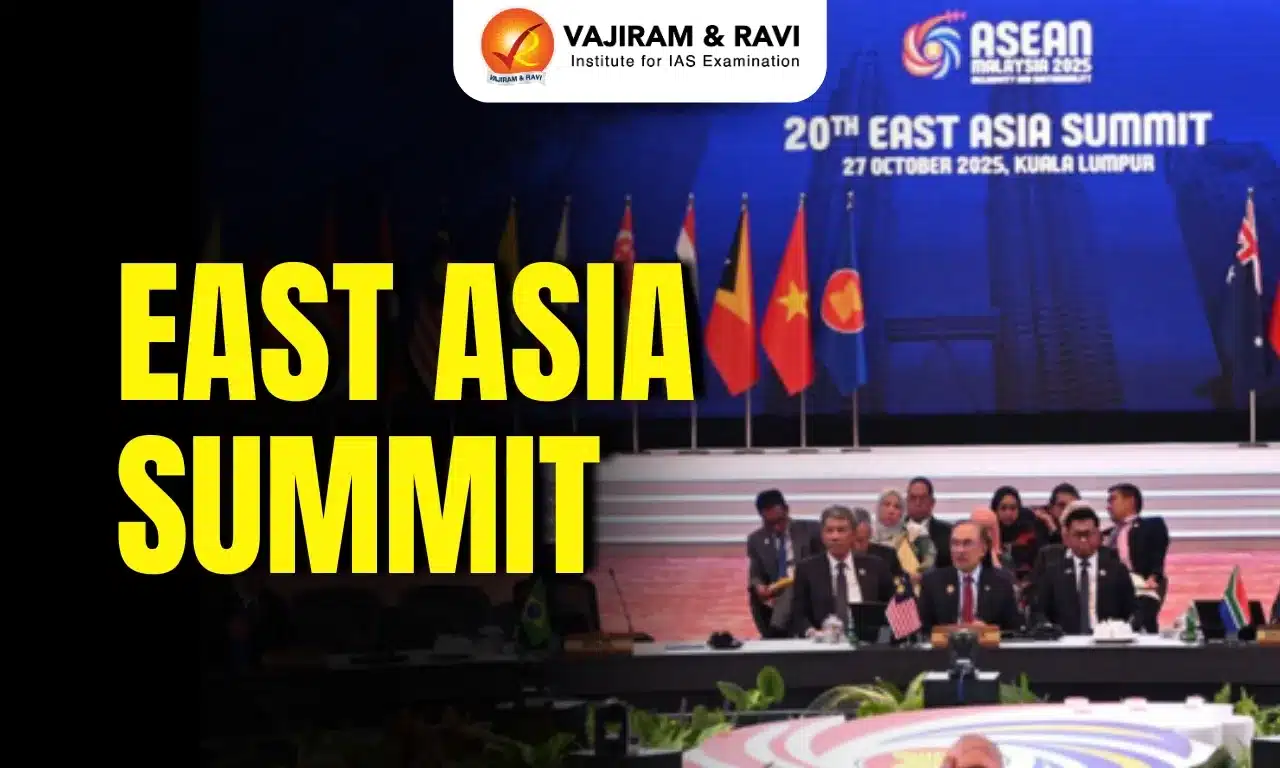
Recently, the 20th East Asia Summit has adopted the Kuala Lumpur Declaration.

About East Asia Summit

  • It was established in 2005 with the convening of the 1st Summit in Kuala Lumpur, Malaysia. 
  • Member countries: ASEAN Member States (Brunei, Cambodia, Indonesia, Laos, Malaysia, Myanmar, Philippines, Singapore, Thailand, and Vietnam), Australia, China, India, Japan, New Zealand, and the Republic of Korea, United States and Russia.
  • To become a member of the EAS, countries must;
    • Sign the ASEAN Treaty of Amity and Cooperation (TAC)
    • Be a formal dialogue partner of ASEAN
    • Have substantive cooperative relations with ASEAN
  • Six priority areas of regional cooperation within the framework of the EAS
    • Environment and Energy,
    • Education,
    • Finance,
    • Global Health Issues and Pandemic Diseases,
    • Natural Disaster Management, and
    • ASEAN Connectivity.

Source: News On Air

East Asia Summit FAQs

Q1: What is the primary objective of the East Asia Summit (EAS)?

Ans: To foster dialogue and cooperation on strategic, political, and economic issues

Q2: What was the primary focus of the 20th East Asia Summit?

Ans: Multilateralism and collective action for global peace and progress

Hastinapur Wildlife Sanctuary

Hastinapur Wildlife Sanctuary

Hastinapur Wildlife Sanctuary Latest News

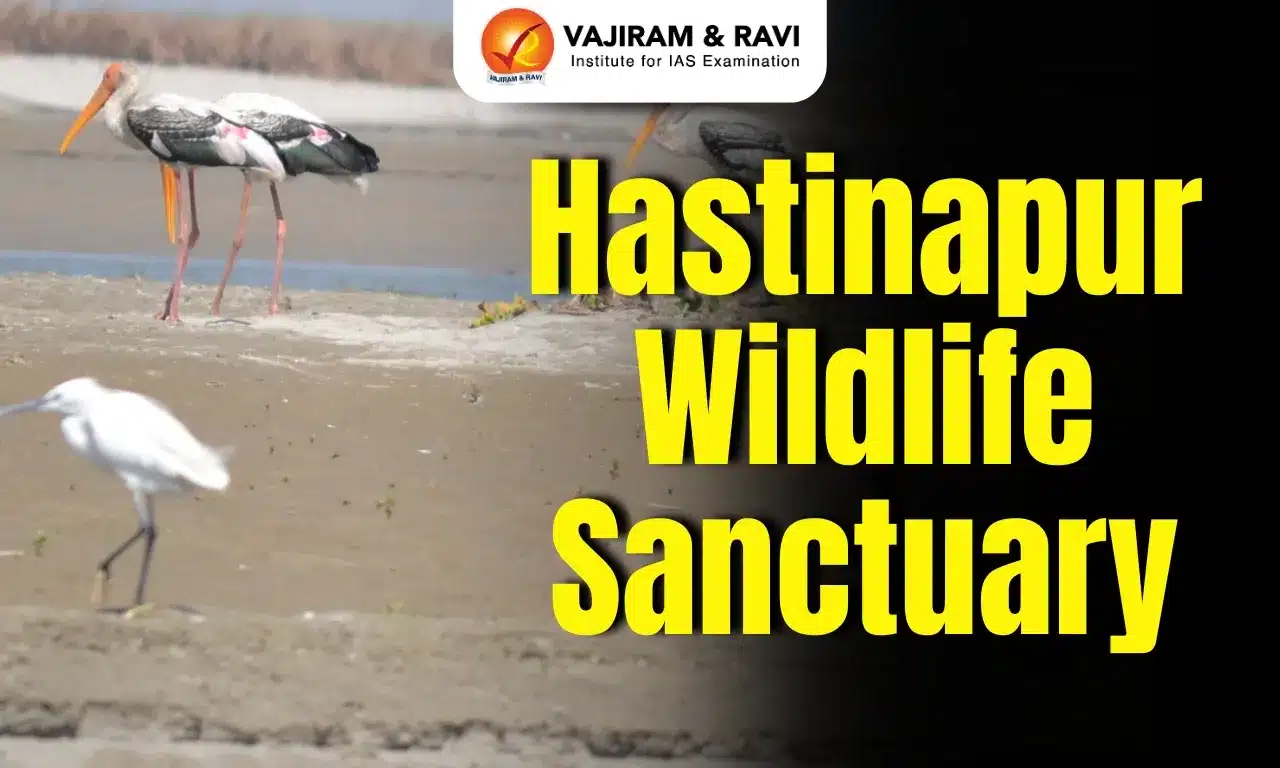
A forest department team has recently arrested four members of a gang allegedly involved in the illegal felling of khair trees in the Hastinapur Wildlife Sanctuary area.

About Hastinapur Wildlife Sanctuary

  • It is located in the Meerut District of Uttar Pradesh.
  • Established in 1986, it lies alongside the northern tip of the River Ganga, flowing through the districts of Muzaffarnagar and Bijnor.
  • It is situated near the mediaeval town of Hastinapur, which is of cultural importance. 
  • It is spread across an area of 2073 sq.km.
  • It is made up of a variety of environments, including marshes, grasslands, woodlands, and riverine ecosystems. 
  • The Ganges River and its tributaries flow through the sanctuary, contributing to its rich biodiversity.
  • Vegetation: The vegetation can be classified into tall wet grasslands, dry short grasslands, scrubs, and plantations.
  • Flora: Dominated by Sal (Shorea robusta), Sheesham (Dalbergia sissoo), Khair (Acacia catechu), and Jamun (Syzygium cumini) trees.
  • Fauna
    • It is home to the state animal, the Swamp Deer (Barasingha), as well as Hog Deer, Cheetal, Sambar, and the State Bird, the Saaras (Crane). 
    • It is a part of the “Asia Flyway” project, and many migratory birds, both local and foreign, flock in numbers near the numerous water bodies present in the region.
    • Under Crocodile Breeding Projects, baby crocodiles are released in the Ganga River near Hastinapur.
    • Under the aegis of the World Wide Fund (WWF), the Turtle Rehabilitation Program also has its centre near the Hastinapur Sanctuary.

Source: TP

Hastinapur Wildlife Sanctuary FAQs

Q1: In which state is the Hastinapur Wildlife Sanctuary located?

Ans: Uttar Pradesh

Q2: Uttar Pradesh

Ans: The Hastinapur Wildlife Sanctuary lies along which major river?

Q3: The Hastinapur Wildlife Sanctuary lies along which major river?

Ans: What is the total area of the Hastinapur Wildlife Sanctuary?

PM Modi Unveils India’s Maritime Vision at Global Maritime Leaders Conclave 2025

India Maritime Week 2025

India Maritime Week 2025 Latest News

  • PM Modi addressed the Maritime Leaders Conclave and chaired the Global Maritime CEO Forum at India Maritime Week 2025 in Mumbai. 
  • He welcomed participants from over 85 countries, noting the event’s evolution from a national forum in 2016 to a global summit. 

India’s Maritime Strength and Economic Potential

  • India’s 11,000 km-long coastline and 13 coastal states and Union Territories contribute nearly 60% of the national GDP
  • The nation’s 23.7 lakh sq km Exclusive Economic Zone (EEZ) attracts global investors, supporting 800 million residents in maritime regions.
  • The 38 countries of the Indian Ocean Region (IOR) account for about 12% of global exports.

India Maritime Week 2025 – A Global Maritime Showcase

  • India Maritime Week (IMW) 2025, held recently in Mumbai, is India’s premier global maritime event under the theme “Uniting Oceans, One Maritime Vision.”
  • The event aims to showcase India’s roadmap to becoming a global maritime hub and a leader in the Blue Economy.
  • This was the fourth edition of the summit. In 2016, the maiden India Maritime Week was held in Mumbai itself. Now, it has become a global summit. 
  • It served as a global convergence point for shipping, ports, shipbuilding, cruise tourism, and blue economy finance, driving collaboration for a sustainable maritime future.

PM Modi’s Address at India Maritime Week 2025: Key Highlights

  • PM Modi addressed the Maritime Leaders Conclave and chaired the Global Maritime CEO Forum at India Maritime Week 2025 in Mumbai.
  • During his address he highlighted India’s maritime transformation, global partnerships, and future ambitions for the blue economy.
  • Several MoUs worth lakhs of crores were signed, reflecting global confidence in India’s maritime capabilities.

India’s Vision for its Maritime Transformation

  • India is committed to transform its maritime sector through the Maritime Amrit Kaal Vision 2047.
  • This long-term vision rests on four strategic pillars:
    • Port-led development
    • Shipping and shipbuilding
    • Seamless logistics
    • Maritime skill-building
  • The goal is to position India as a leading global maritime power.

Major Achievements in India’s Maritime Sector (2024–25)

  • Vizhinjam Port, India’s first deep-water international trans-shipment hub, became operational, hosting the world’s largest container vessel.
  • Kandla Port launched India’s first megawatt-scale indigenous green hydrogen facility.
  • JNPT doubled its capacity with the start of Phase 2 of the Bharat Mumbai Container Terminal, marking the largest FDI in India’s port infrastructure.
  • India’s major ports handled record cargo volumes, showcasing unprecedented efficiency.

Next-Generation Reforms in Maritime Governance

  • Outdated colonial-era shipping laws replaced with modern legislation empowering State Maritime Boards, promoting digitization, and enhancing safety and sustainability.
  • The new Merchant Shipping Act aligns Indian regulations with global conventions, improving trust, ease of business, and investment climate.
  • The Coastal Shipping Act simplifies trade, ensures supply chain security, and promotes balanced coastal development.
  • Introduction of One Nation, One Port Process to standardize port procedures and reduce documentation.

Decade of Transformation under Maritime India Vision

  • Over 150 new initiatives launched under the Maritime India Vision.
  • Major ports’ capacity doubled, turnaround time reduced, and cruise tourism expanded.
  • Inland waterway cargo movement rose by 700%, and operational waterways increased from 3 to 32.
  • The net annual surplus of ports grew ninefold in ten years.

Efficiency and Global Recognition

  • Indian ports now rank among the most efficient in the developing world, outperforming many in the developed world.
  • Container dwell time reduced to under 3 days, and vessel turnaround time cut from 96 to 48 hours.
  • India improved its position in the World Bank’s Logistics Performance Index.
  • The number of Indian seafarers increased from 1.25 lakh to over 3 lakh, making India one of the top three seafaring nations globally.

Focus on Blue Economy and Green Growth

  • Emphasis on Blue Economy, sustainable coastal development, green logistics, and coastal industrial clusters.
  • Government prioritizing shipbuilding as a national growth driver, with a ₹70,000 crore investment to boost shipyard capacity, greenfield/brownfield projects, and maritime employment.
  • Large ships have been granted infrastructure asset status, enabling easier financing and reduced interest costs.

Visionary Maritime Heritage and New Port Projects

  • PM Modi recalled Chhatrapati Shivaji Maharaj’s maritime legacy, emphasizing that seas should be seen as gateways to opportunity.
  • Announced construction of a new mega port at Vadhavan, Maharashtra, part of India’s effort to quadruple port capacity and increase containerized cargo share.

Global Cooperation and Strategic Role of India

  • India aims to strengthen global supply chain resilience and become a “steady lighthouse” amid global uncertainty.
  • Highlighted India–Middle East–Europe Economic Corridor as a project redefining trade routes and promoting clean energy logistics.
  • Reaffirmed India’s commitment to empowering Small Island Developing States and Least Developed Countries through technology, training, and infrastructure.

Source: TH | PIB | IE

India Maritime Week 2025 FAQs

Q1: What is India Maritime Week 2025?

Ans: A premier global summit held in Mumbai to showcase India’s maritime progress, with over 85 countries participating under the theme “Uniting Oceans, One Maritime Vision.”

Q2: What did PM Modi announce at the Maritime Leaders Conclave?

Ans: He announced major reforms, new port projects, and a ₹70,000 crore investment to boost shipbuilding, green ports, and maritime employment.

Q3: What are India’s major achievements in the maritime sector?

Ans: India launched Vizhinjam Port, a green hydrogen facility at Kandla, expanded JNPT, and achieved record cargo handling at major ports.

Q4: What are the key reforms in maritime governance?

Ans: Outdated colonial laws were replaced with modern acts promoting digital port management, safety, sustainability, and ease of doing business.

Q5: What is India’s long-term maritime vision?

Ans: The Maritime Amrit Kaal Vision 2047 focuses on port-led growth, shipbuilding, seamless logistics, and skill-building to make India a leading maritime power.

China’s WTO Complaint Against India’s PLI Scheme – Explained

PLI Scheme

PLI Scheme Latest News

  • China has filed a formal complaint against India at the World Trade Organisation (WTO), alleging that India’s Production-Linked Incentive (PLI) schemes for batteries, automobiles, and electric vehicles violate global trade rules by favouring domestic products.

China’s WTO Complaint Against India’s PLI Scheme

  • China has formally filed a complaint with the World Trade Organisation (WTO) against India, alleging that several of India’s Production-Linked Incentive (PLI) schemes violate global trade rules. 
  • Beijing claims that these schemes, aimed at promoting the manufacturing of advanced chemistry cell (ACC) batteries, automobiles, and electric vehicles (EVs), provide subsidies contingent on the use of domestic goods, thereby discriminating against imported products, including those from China.
  • This dispute marks one of the most significant trade confrontations between India and China within the WTO framework in recent years, highlighting the broader tension between industrial policy ambitions and international trade rules.

Understanding the PLI Scheme

  • Launched in 2020, India’s Production-Linked Incentive (PLI) scheme is a flagship initiative designed to strengthen domestic manufacturing, attract global investment, and integrate India into global value chains (GVCs).
  • The scheme provides financial incentives to companies based on incremental sales of goods manufactured in India, aiming to make domestic industries globally competitive while fostering innovation and employment generation.
  • The three PLI schemes challenged by China are:
    • PLI for Advanced Chemistry Cell (ACC) Batteries: Encourages giga-scale battery manufacturing for EVs and energy storage systems.
    • PLI for the Automobile and Auto Components Sector: Promotes the development of Advanced Automotive Technology (AAT) products, including EV components.
    • PLI for the Electric Vehicle (EV) Ecosystem: Aims to attract major global EV manufacturers and reduce import dependence.

China’s Allegations Against India

  • China’s central argument rests on the claim that these PLIs amount to prohibited subsidies under the WTO’s Subsidies and Countervailing Measures (SCM) Agreement.
  • Beijing contends that:
    • The PLI schemes are “Import Substitution (IS) subsidies”, as they encourage companies to use domestically produced goods over imported ones.
    • For example, the PLI for the auto sector mandates a 50% Domestic Value Addition (DVA) requirement, while the ACC battery scheme stipulates a 25% DVA threshold for eligibility.
    • These conditions, China argues, discriminate against foreign inputs and are inconsistent with WTO rules that prohibit subsidies contingent upon the use of domestic over imported goods.
  • China maintains that such subsidies distort market competition and hinder its exports to India, particularly in sectors like EV batteries and automotive components, where Chinese manufacturers are global leaders.

WTO Rules on Subsidies and Trade Measures

  • Under WTO law, countries have the sovereign right to provide subsidies for industrial development. However, the SCM Agreement ensures that such subsidies do not cause unfair trade distortions.
  • Classification of Subsidies under WTO Law
    • Prohibited Subsidies: Those contingent upon export performance or on the use of domestic goods over imported goods.
    • Actionable Subsidies: Permitted subsidies that may still be challenged if they cause adverse effects on other WTO members.
    • Non-Actionable Subsidies: Subsidies for legitimate public objectives such as R&D or environmental protection (currently lapsed).
  • Import substitution (IS) subsidies fall under the prohibited category, as outlined in Article 3.1(b) of the SCM Agreement.
  • Additionally, India’s PLI schemes may also be examined under:
    • Article III.4 of GATT (National Treatment Principle): Prohibits countries from treating imported goods less favourably than domestic goods.
    • Article 2.1 of the Trade-Related Investment Measures (TRIMs) Agreement: Prohibits investment measures that are inconsistent with national treatment obligations, such as local content requirements.
  • However, experts point out that India’s PLI schemes link incentives to value addition, not necessarily to the use of domestic goods. 
  • Value addition can occur through innovation, local assembly, or supply chain integration, making China’s claims legally complex and open to interpretation.

India’s Likely Defence

  • Non-Contingency on Local Content: The Domestic Value Addition (DVA) benchmarks do not explicitly mandate the use of Indian goods; instead, they assess value creation within India, which can include imported components that undergo processing or transformation.
  • Developmental Objective: The schemes are part of India’s broader industrial and climate strategy, promoting green mobility, battery storage, and self-reliance — areas considered essential for sustainable growth.
  • Compliance with WTO Principles: India may argue that the subsidies are non-actionable, as they promote innovation, environmental sustainability, and technology diffusion — consistent with the WTO’s broader developmental objectives.

The WTO Dispute Process and Next Steps

  • Under WTO rules, the first step in dispute resolution is consultations between the parties. India and China will attempt to resolve the issue through diplomatic discussions.
  • If these consultations fail, the case will proceed to a WTO dispute panel for adjudication. 
  • However, the WTO’s Appellate Body, the final authority for appeals, has been non-functional since 2019 due to a U.S. veto on judge appointments.
  • This means that even if the WTO panel issues a ruling against India and India appeals, the case will remain in legal limbo, allowing India to maintain its PLI policies until the appellate system is restored.

Broader Implications for India’s Industrial Policy

  • The dispute highlights a broader tension between industrial policy and global trade rules
  • As countries increasingly adopt state-led incentives to promote manufacturing,  especially in sectors like semiconductors, EVs, and clean energy, disputes of this nature are likely to rise.
  • India’s PLIs are central to its “Make in India” and “Atmanirbhar Bharat” initiatives, aimed at reducing import dependence and building competitive domestic capabilities. 
  • Similar subsidy-driven strategies are being used by other economies, including the U.S. (CHIPS and Science Act) and the EU Green Industrial Plan.
  • Therefore, this WTO case will test how global trade rules adapt to the new age of industrial competitiveness and green technology promotion.

Source: TH

PLI Scheme FAQs

Q1: What has China complained about at the WTO?

Ans: China alleges that India’s PLI schemes for batteries, automobiles, and EVs provide prohibited subsidies favoring domestic goods.

Q2: Which specific PLI schemes are under dispute?

Ans: China has challenged India’s PLIs for ACC batteries, Advanced Automotive Technology products, and Electric Vehicle manufacturing.

Q3: What WTO laws does China claim India violated?

Ans: China cites violations of the SCM Agreement, GATT’s national treatment clause, and the TRIMs Agreement.

Q4: How might India defend its PLI schemes?

Ans: India is likely to argue that DVA requirements are not local content mandates and that the schemes promote sustainable industrial development.

Q5: What happens if the WTO panel rules against India?

Ans: India can appeal, but since the Appellate Body is non-functional, the dispute may remain unresolved, allowing India to continue its PLI schemes.

Global Investors Reimagine India’s Financial Sector

India’s Financial Sector

India’s Financial Sector 2025 Latest News

  • India’s financial landscape is undergoing a major transformation as global giants — from Emirates NBD, Blackstone, Zurich Insurance, SMBC, Abu Dhabi’s IHC to Bain Capital — are acquiring significant stakes in Indian banks, insurers, and NBFCs. 
  • This marks a new phase of foreign capital infusion into a sector once considered over-regulated and closed, highlighting a strategic shift amid capital liberalisation.

Evolution of India’s Financial Sector

  • From protectionism to liberalisation:
    • Historically, India’s financial sector was tightly regulated with limited foreign participation.
    • Gradual policy reforms by the Reserve Bank of India (RBI) and the government have allowed greater foreign ownership - 
      • Up to 100% in insurance companies.
      • Up to 74% in private banks (with approval).
  • Examples
    • Fairfax (Canada) was given special approval to hold a majority stake in CSB Bank for five years — a deviation from the 40% foreign cap, considering it a strategic revival investment.
    • Foreign portfolio investors (FPIs) hold 48.39% stake in HDFC Bank, the second largest bank in the country. 

Recent Big-Ticket Investments

  • Blackstone Inc, the world’s largest alternative asset manager, has acquired a minority stake of 9.99% in Federal Bank Ltd for Rs 6,196 crore.
  • Bain Capital will be investing Rs 4,385 crore to acquire an 18.0% stake on a fully diluted basis via preferential allotment of equity and warrants in Manappuram Finance.
  • Dubai-based Emirates NBD announced a $3 billion acquisition of a 60% stake in RBL Bank, making it one of the largest foreign takeovers in India’s financial sector. 
  • Japan’s SMBC acquired about 25% in Yes Bank, investing over $1.6 billion.
  • Zurich Insurance bought a 70% majority stake in Kotak General Insurance for $670 million. 
  • Abu Dhabi’s International Holding Company also entered the fray with a nearly $1 billion investment in Sammaan Capital (formerly Indiabulls Housing), an NBFC.
  • These deals mark the largest wave of foreign takeovers in India’s financial history.

Why Global Giants Are Investing

  • Robust growth fundamentals:
    • India’s economy is growing at 6.8% (RBI estimate).
    • The banking sector generated $46 billion net income (2024) with 31% YoY growth — higher than global average (McKinsey report).
    • Credit growth is driven by small businesses, retail and housing sectors.
  • Structural strengths:
    • Low corporate leverage and focus on secured retail lending.
    • India presents a vast, untapped and rapidly expanding financial market with over 400 million underbanked population, and a vast informal credit system.
    • Digital infrastructure (UPI, Aadhaar, Jan Dhan) enables penetration and cost-efficient service delivery.
  • Global context:
    • Stagnation in developed markets (US, Europe).
    • China’s tightening regulations and geopolitical risks have diverted capital toward India.
    • India offers scale, political stability, demographic advantage, and credible regulation.

Regulatory Approach and Market Valuation

  • The RBI maintains a “positive but cautious” stance, ensuring fit-and-proper ownership and domestic control.
  • Despite high performance, Indian banks remain undervalued — indicating market scepticism about long-term sustainability.
  • The measured liberalisation of ownership ensures capital inflow while keeping regulatory sovereignty intact.

Post-Crisis Sector Cleanup

  • Past decade challenges: IL&FS and DHFL collapse, Yes Bank rescue, and NBFC liquidity crisis.
  • Reforms implemented:
    • Insolvency and Bankruptcy Code (IBC) for resolution.
    • RBI’s supervisory tightening and bad-loan cleanup.
  • Result: Mid-sized banks and NBFCs have become stable and attractive acquisition targets.

Opportunities and Strategic Advantages

  • Global investors gain immediate access to licenses, branch networks, and customer bases — saving years of setup.
  • For India, it brings foreign capital, innovation, and best practices in risk management and governance.
  • Aids India’s march toward becoming a $7 trillion economy by early 2030.

Risks and Concerns

  • Financial sovereignty: Majority foreign ownership could shift strategic control offshore. Policy alignment during crises may not match domestic priorities.
  • Exposure to global shocks:
    • Rising global interest rates or liquidity tightening could lead to capital withdrawal, straining domestic credit flows.
    • Lehman Brothers collapse (2008) serves as a reminder of global contagion risk.
  • Competitive distortions: Foreign-owned entities may access cheaper global capital, disadvantaging domestic banks under tighter norms.
  • Need for regulatory clarity: Larger and complex deals call for clearer frameworks on foreign control thresholds and compliance protocols.

Way Forward

  • Maintain calibrated liberalisation — attract capital while preserving regulatory autonomy.
  • Develop a comprehensive framework for foreign ownership limits and voting rights.
  • Strengthen macroprudential oversight to insulate from global volatility.
  • Encourage domestic capital formation through sovereign and retail participation.
  • Promote financial inclusion to reduce reliance on foreign investors in credit delivery.

Conclusion

  • India’s financial sector stands at a turning point — transitioning from protectionism to global integration. 
  • The surge in foreign investments underscores international confidence in India’s macroeconomic fundamentals, digital infrastructure, and regulatory credibility.
  • However, balancing openness with sovereignty will define India’s success in becoming a $7-trillion, financially independent economy.
  • The challenge for policymakers lies in ensuring that this capital inflow strengthens, rather than compromises, India’s financial stability and autonomy.

Source: IE

India’s Financial Sector FAQs

Q1: What does the recent wave of foreign acquisitions in India’s banking and insurance sectors reflect?

Ans: It marks India’s transition from protectionism to a globally integrated financial system, balancing capital inflow with regulatory sovereignty.

Q2: What factors attract global financial institutions to invest in India’s banking and NBFC sectors?

Ans: Robust GDP growth, digital infrastructure, underbanked population, post-crisis sector cleanup, and strong regulatory oversight.

Q3: What are the risks to India’s financial sovereignty arising from increasing foreign ownership in domestic banks and insurers?

Ans: Majority foreign stakes can shift strategic control offshore, expose India to global liquidity shocks, and distort competition.

Q4: What role does the RBI play in maintaining a balance between foreign capital inflow and financial sector stability?

Ans: RBI ensures a cautious liberalisation approach through fit-and-proper clearances, ownership disclosure, capital adequacy enforcement, and oversight.

Q5: In what ways can India leverage foreign investment in financial services?

Ans: By channeling foreign capital toward inclusion, innovation, and credit expansion while strengthening domestic regulation.

Property Rights of Minors in India

Property Rights of Minors

Property Rights of Minors Latest News

  • Recently, the Supreme Court ruled that a person can reject a property sale made by their guardian after turning 18 if it was done without court approval.
  • The court said this can be done either by filing a case or through actions—for example, reselling the property—within the legal time limit.
  • The bench of Justices Pankaj Mithal and Prasanna B. Varale clarified that a formal lawsuit is not always necessary, reaffirming that a minor’s property rights can be protected by their clear conduct showing refusal of the sale.

Laws Governing Property Rights of Minors

  • Property transactions involving minors are regulated by three key laws:
    • The Indian Contract Act, 1872
    • The Hindu Minority and Guardianship Act, 1956
    • The Guardians and Wards Act, 1890

Minors Cannot Enter into Contracts

  • Under Section 11 of the Indian Contract Act, only adults of sound mind can enter into valid contracts.
  • Any contract made by a minor is void from the beginning (void ab initio). This means it cannot be enforced by or against the minor.
  • Exceptions:
    • If the contract benefits the minor or provides necessities like food or education, the cost may be recovered from the minor’s property.
    • A guardian can enter into a contract only if it benefits the minor.
    • A minor cannot be a business partner but may receive profit shares under a valid agreement.

Restrictions on Guardian’s Power to Sell Property

  • Under Section 8 of the Hindu Minority and Guardianship Act, 1956, a natural guardian can manage a minor’s property only for their benefit.
    • The guardian cannot sell, mortgage, gift, or lease immovable property without court approval.
    • If such a sale happens, Section 8(3) makes it “voidable at the instance of the minor”, meaning the minor can cancel it after turning 18.
  • Similarly, Section 29 of the Guardians and Wards Act, 1890 also says a guardian needs court permission to dispose of a ward’s property.

How a Minor Can Challenge the Sale After Majority

  • When a guardian sells property without permission, the law allows the now-adult person to challenge it.
  • Traditionally, courts held that a formal case must be filed to cancel such a sale.
  • However, in Abdul Rahman v. Sukhdayal Singh (1905), the court ruled that filing a suit is not always necessary — a clear act of repudiation, like reselling the property, is enough to show rejection.

Time Limit for Challenging Such Sales

  • According to the Limitation Act, 1963, the person has three years after turning 18 to challenge or reject a property sale made by their guardian without court approval.

Background of the Case

  • The dispute involved two small plots (No. 56 and 57) in Davanagere, Karnataka, bought in 1971 by a father in the names of his three minor sons. 
  • Acting as their natural guardian, he later sold both plots without obtaining mandatory court approval.
  • After turning 18, the sons resold both plots to another person, leading to two separate ownership disputes.

What Happened in the Lower Courts

  • In the Plot 56 case, the High Court (2003) ruled that the sons’ resale amounted to a valid rejection of their father’s earlier sale. The ruling became final as it was not challenged.
  • In the Plot 57 case, the buyer filed a case in 1997 claiming ownership. 
  • The trial court dismissed the suit, holding that the father’s sale was voidable and had been repudiated when the sons sold it after reaching adulthood.

Appeals and High Court Ruling

  • The first appellate court and the High Court later reversed the trial court’s decision, saying the sons’ later sale was invalid because they had not filed a formal case to cancel their father’s sale.
  • The High Court declared the buyer as the rightful owner of Plot 57.

Supreme Court Appeal

  • This decision was challenged before the Supreme Court, which was asked to decide whether a person who was a minor at the time of sale must file a formal case to cancel the sale or can reject it by conduct after attaining majority.

Supreme Court on How Minors Can Reject Property Sales

  • The Supreme Court clarified how a person can repudiate (reject) a property sale made by their guardian without court approval once they become an adult.
  • The Court ruled that a minor, after turning 18, can reject such a sale in two ways:
    • By filing a formal case (suit) to cancel the sale deed, or
    • By clear conduct that shows they do not accept the earlier sale — for example, reselling the property or taking actions inconsistent with the guardian’s sale.
  • The Court said that once the person rejects the sale, it becomes void from the beginning, and the buyer gains no rights over the property.

Application in This Case

  • The Court observed that the sons, after becoming adults, sold the same property within three years — the period allowed under law. 
  • Their names still appeared in the revenue records, and the earlier buyers had never taken possession.
  • This conduct was enough to prove that the sons had repudiated their father’s sale, so no separate case was needed.

Source: IE

Property Rights of Minors FAQs

Q1: What did the Supreme Court rule about minors’ property rights?

Ans: Minors can reject a guardian’s unauthorized sale after turning 18, either through legal action or by actions showing clear disapproval.

Q2: Which laws govern property rights of minors in India?

Ans: The Indian Contract Act, 1872, Hindu Minority and Guardianship Act, 1956, and Guardians and Wards Act, 1890 regulate minors’ property transactions.

Q3: Can a guardian sell a minor’s property without permission?

Ans: No. Such sales without court approval are voidable, and the minor can cancel them upon attaining majority.

Q4: What is the time limit for challenging such sales?

Ans: Under the Limitation Act, 1963, a person has three years after turning 18 to repudiate a guardian’s unauthorized property sale.

Q5: How can a sale be repudiated without a court case?

Ans: The Supreme Court said clear acts—like reselling the property—within the limitation period are enough to show rejection of the guardian’s sale.

Enquire Now