
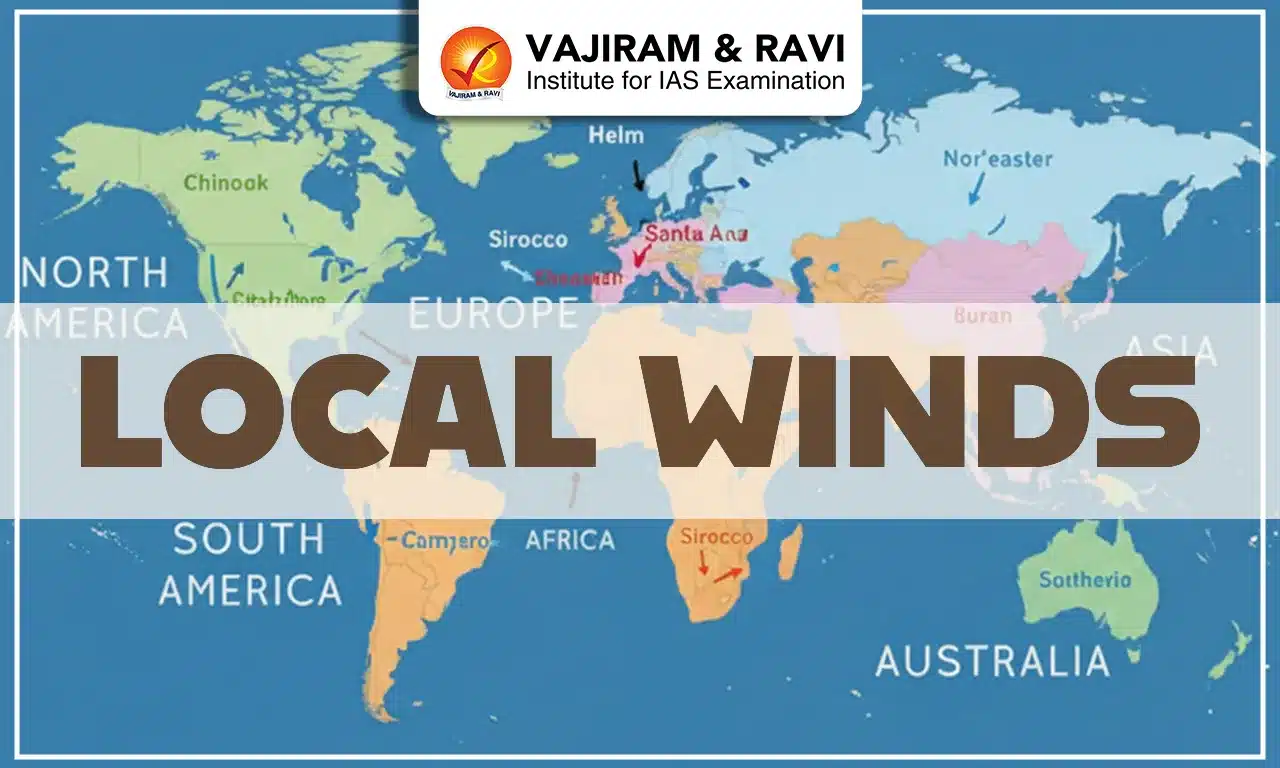
Local Winds are winds that blow over short distances and are shaped by geographic features such as mountains, valleys, coastlines, or deserts. Unlike global winds, which circulate over vast regions, local winds are temporary, predictable, and specific to a particular area.
They form due to differences in temperature and air pressure within a localized region, for example, between land and water or between high and low elevations. These Local Winds play an important role in influencing daily weather patterns.
Local Winds
Local Winds occur across the world and differ from global winds such as the trade winds or westerlies. They blow over small areas and usually last for a short period. Their direction and strength are influenced by local landforms, sea temperatures, and prevailing weather conditions.
These winds are especially common in coastal regions, mountain valleys, and deserts. They are generally predictable, often following regular patterns depending on the time of day or season. Farmers, fishermen, and travelers frequently rely on local winds for planning and safety.
Many Local Winds have distinct names and characteristics. Examples include the Loo in India and the Chinook in North America. These winds play a key role in shaping regional climates and daily weather patterns.
Local Winds Formation
Local winds are primarily shaped by temperature-driven pressure differences, terrain features, and surface characteristics such as vegetation and urban areas. These winds develop over specific regions and often follow predictable patterns:
- Temperature-Driven Pressure Gradients: Land heats and cools faster than water, giving rise to sea breezes during the day, when cool air moves from sea to land, and land breezes at night, when cool air flows from land to sea. Similarly, valleys and mountains produce valley breezes, as warm air rises up slopes during the day, and mountain breezes, when cool air descends at night.
- Topographic Influence: Slopes and elevation changes generate anabatic winds (upward-moving warm air) and katabatic winds (downward-moving cold air, such as the strong gusts in Antarctica). Mountain ranges can also force air to ascend and cool, producing Foehn winds warm, dry winds on the leeward side of mountains, exemplified by the Chinook in North America.
- Urban and Vegetation Effects: Cities create urban heat islands, where hot air rises from buildings, generating localized winds. Forested areas can produce katabatic winds as cooled air flows downward into valleys.
Local Winds Types
Local Winds vary based on direction, region, and season. Some of the most common types around the world include:
- Sea Breeze: Blows from the sea toward the land during the day. It brings cooler air, lowering temperatures in coastal areas.
- Land Breeze: Moves from land to sea at night. It is cooler and drier compared to the sea breeze.
- Valley Breeze: Occurs during the day as warm air rises from the valley floor and moves uphill.
- Mountain Breeze: Happens at night when cool air flows down slopes into the valley.
- Loo: A hot, dry wind in northern India during summer. It can cause heatstroke and damage crops.
- Chinook: A warm, dry wind on the eastern slopes of the Rocky Mountains. It quickly melts snow and raises temperatures.
Local Winds Examples
Some of the well-known Local Winds from different regions are:
| Local Winds Examples | |||
|
Name |
Nature of Wind |
Location/Region |
Effects/Impact |
|
Chinook |
Hot, dry |
Eastern slopes of the Rocky Mountains (North America) |
Rapid snowmelt, temperature rise, drying of soil |
|
Foehn |
Hot, dry |
The Alps (Europe) |
Warms the leeward side of mountains, reduces humidity, can trigger avalanches |
|
Mistral |
Cold, strong |
France and the Alps |
Lowers temperature, clears clouds, brings dry conditions |
|
Sirocco |
Hot, moist (sometimes dry) |
Sahara to the Mediterranean Sea |
Causes dust storms, high humidity, and discomfort |
|
Bora |
Cold, dry, gusty |
Eastern Europe to northeastern Italy, Slovenia, Croatia |
Sudden temperature drop, strong gusts, hazardous for shipping |
|
Harmattan |
Hot, dry, dusty |
West Africa |
Reduces humidity, carries dust, affects health and visibility |
|
Santa Ana |
Hot, dry |
Southern California |
Raises wildfire risk, heats the region, dries out vegetation |
|
Khamsin |
Hot, dry |
Egypt and the eastern Mediterranean |
Sandstorms, high temperatures, discomfort, affects agriculture |
|
Loo |
Hot, dry |
Northern India and Pakistan |
Heatwaves, crop damage, health risks like heatstroke |
|
Cape Doctor |
Dry, southeasterly |
South African coast |
Clears air pollution, dries vegetation, influences coastal weather |
Local Winds in India
The table below provides an overview of some of the most prominent Local Winds in India, highlighting their nature, regions of occurrence, seasonal patterns, and impacts. These winds play a significant role in shaping local weather and climate, influencing agriculture, daily life, and regional temperature variations.
| Local Winds in India | ||||
|
Name |
Nature |
Region |
Season |
Impact/Effects |
|
Loo |
Hot, dry, dusty |
Northern India (Indo-Gangetic plains) |
Summer (April–June) |
Causes extreme heat, discomfort, health risks like heatstroke |
|
Mango Showers |
Pre-monsoon rains, sometimes with thunderstorms |
Southern India (Kerala, Karnataka, Tamil Nadu) |
Late April–June |
Helps ripening of mangoes, signals onset of southwest monsoon |
|
Nor’westers (Kal Baisakhi) |
Violent thunderstorms with strong winds and hail |
West Bengal, Odisha, Assam, surrounding areas |
Pre-monsoon (April–May) |
Can damage crops and property; provides relief from summer heat |
|
Sea Breeze / Land Breeze |
Gentle winds: sea to land (day) and land to sea (night) |
Coastal areas (Mumbai, Chennai, Kolkata) |
Throughout the year, pronounced in summer |
Moderates coastal temperatures |
|
Aandhi |
Dust storms with strong winds |
Northern and northwestern India (Rajasthan, Punjab, Haryana, UP) |
Pre-monsoon (April–June) |
Reduces visibility, respiratory problems, hazardous for travelers |
Role of Local Winds in Weather and Climate Patterns
India experiences a diverse range of local winds due to its varied topography, coastline, and climatic zones. These winds are generally short-lived and region-specific, but they have a significant impact on local weather, agriculture, and daily life. From the scorching and dusty Loo of the northern plains to the cooling sea breezes along the coasts, and from pre-monsoon storms like Nor’westers to seasonal showers such as Mango Showers, local winds in India shape temperature, rainfall patterns, and even crop cycles across different regions.
Local Winds FAQs
Q1: What are the 4 types of local winds?
Ans: Local winds include land and sea breezes, mountain and valley winds, katabatic winds, and foehn/Chinook winds, varying due to topography and temperature differences.
Q2: What are local winds?
Ans: Local winds are winds blowing over short distances, influenced by terrain, temperature, and pressure differences, unlike global winds that follow planetary circulation patterns.
Q3: What are the local winds of India?
Ans: India’s local winds include Loo (summer plains), Mountain and Valley winds (Himalayas), Sea and Land breezes (coasts), and Foehn winds (Himalayan leeward side).
Q4: What are the 4 types of wind?
Ans: Winds are classified as local, seasonal (monsoon), global (trade, westerlies, polar), and periodic winds based on scale, duration, and origin.
Q5: What are category 4 winds?
Ans: Category 4 winds refer to cyclone classification on the Saffir-Simpson scale, with wind speeds 209-251 km/h causing severe damage.
