Exercise ‘Poorvi Prachand Prahar

Exercise 'Poorvi Prachand Prahar

Exercise 'Poorvi Prachand Prahar Latest News

India to hold tri-service exercise 'Poorvi Prachand Prahar in Mechuka, Arunachal Pradesh.

About Exercise 'Poorvi Prachand Prahar

  • It is a tri-service military exercise conceived as a forward-looking exercise, which will validate multi-domain integration across land, air, and maritime fronts.
  • It will be held in Mechuka, Arunachal Pradesh.
  • Aim: It is aimed at enhancing warfighting capabilities, technological adaptation, and operational synergy among the Army, Navy, and Air.
  • It refines interoperability, improves situational awareness, and validates command-and-control structures for joint missions.
  • Focus: The exercise focuses on multi-domain integration — across land, air and maritime domains — to enhance operational synergy, technological adaptation, and readiness for future conflicts.
  • The exercise involves coordinated employment of special forces, unmanned platforms, precision systems and networked operations centres operating in unison under realistic high-altitude conditions.
  • Previous Exercises: ‘Poorvi Prachand Prahar’ follows previous tri-service drills — ‘Bhala Prahar’ (2023) and ‘Poorvi Prahar’ (2024). 

Source: IE

Exercise 'Poorvi Prachand Prahar FAQs

Q1: Where is Exercise 'Poorvi Prachand Prahar conducted?

Ans: Arunachal Pradesh

Q2: What is the primary objective of Exercise poorvi Prachand Prahar?

Ans: It validates multi-domain integration across land, air, and maritime fronts.

National Beekeeping and Honey Mission

National Beekeeping and Honey Mission

National Beekeeping and Honey Mission Latest News

The National Beekeeping & Honey Mission (NBHM) launched in 2021 by the Government of India which is driving the ambitious "Sweet Revolution”.

About National Beekeeping and Honey Mission

  • It is a Central Sector Scheme launched by the Government of India.
  • It focuses on overall promotion and development of scientific beekeeping and the production of quality honey and other beehive products.
  • It is implemented through the National Bee Board (NBB).
  • Funding:  ₹500 crore for three years (2020–21 to 2022–23) and has been extended for another three years (2023–24 to 2025–26).
  • It is being implemented through 3 Mini Missions (MMs)
    • Mini Mission-I: Under this Mission, thrust will be given on production & productivity improvement of various crops through pollination assisted by adoption of scientific beekeeping;
    • Mini Mission-II: This Mission will concentrate on post-harvest management of beekeeping/beehive products including collection, processing, storage, marketing, value addition, etc.
    • Mini Mission-III: This Mission will concentrate on research & technology generation for different regions/states/agro-climatic and socio-economic conditions.

Objectives of National Beekeeping and Honey Mission

  • Income & employment generation: Promoting holistic growth of the beekeeping industry for providing livelihood support to farm and non-farm households.
  • Infrastructure Development: Developing additional infrastructural facilities for developing quality nucleus stock of honeybees, multiplication of stock by bee breeders and post-harvest and marketing infrastructures.
  • Quality Control: Setting up of state-of-the-art Labs for testing of honey & other beehive products at regional levels and Mini/Satellite Labs at district levels.
  • Traceability: To develop blockchain/ traceability system for of source of honey & other beehive products and using IT tools in beekeeping, including online registration, etc.;
  • Skill Development: To promote, develop and disseminate latest technologies and skill development in beekeeping industry for production of honey & other high value beehive products;
  • Institutional Framework: Strengthening beekeepers through collective approaches like SHGs, FPOs, and cooperatives.

Source: PIB

National Beekeeping and Honey Mission FAQs

Q1: What is the primary objective of the National Beekeeping and Honey Mission (NBHM)?

Ans: To develop the beekeeping industry and increase honey production.

Q2: Which ministry is responsible for implementing the National Beekeeping and Honey Mission (NBHM)?

Ans: Ministry of Agriculture and Farmers' Welfare

Gogabeel Lake

Gogabeel Lake

Gogabeel Lake Latest News

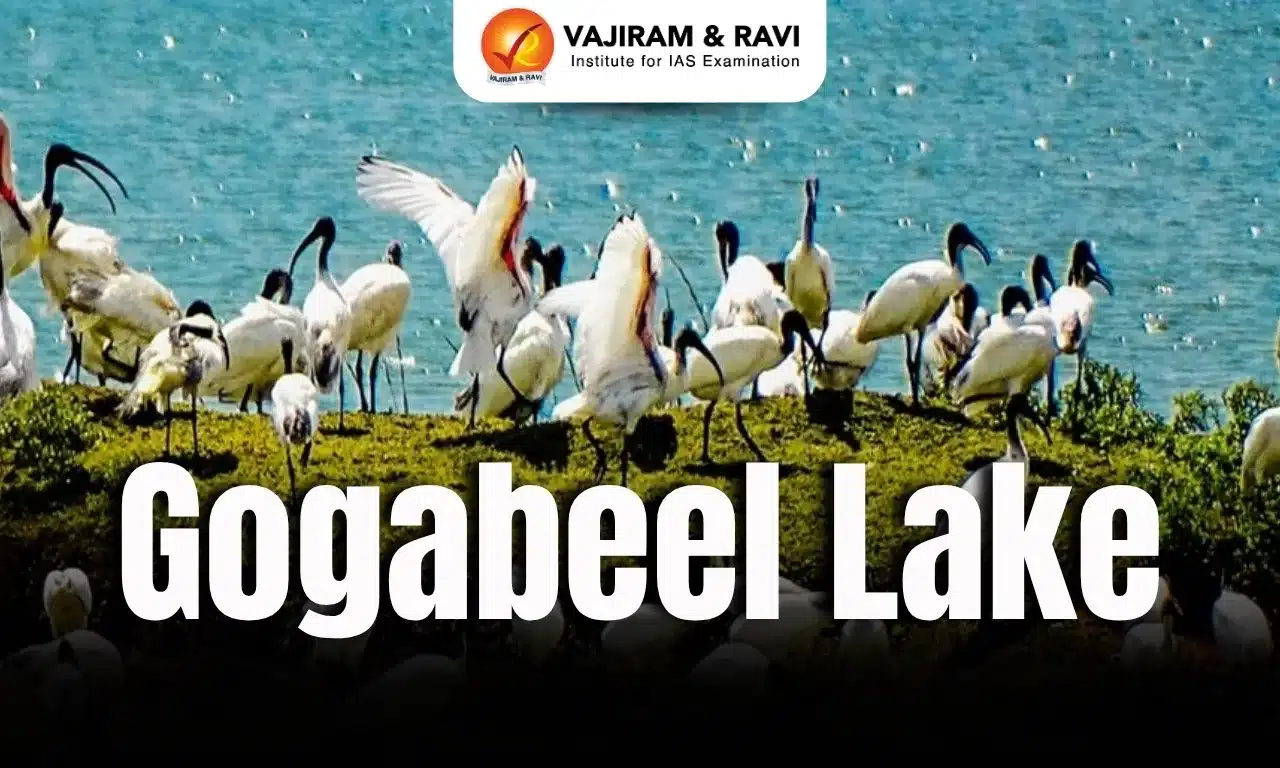
India’s one more wetland, Gogabeel Lake in Katihar district of Bihar, has got a tag of international importance as a Ramsar site.

About Gogabeel Lake

  • Location: It is a part of trans-Gangetic plains of land located in the state of Bihar.
  • Gogabil lake is an ‘ox-bow’ type of wetland.
  • It is flanked by the river Mahananda to the North-East and the river Ganga to the South.
  • It was declared Bihar's first ‘Community Reserve’.
  • Local cultural traditional festivals like Sirva, Adra , Chhat are observed in this wetland.

Flora and Fauna of  Gogabeel Lake

  • Flora: These natural landscapes consist of tropical dry deciduous forests.
  • Fauna: It provides wintering habitat to several migratory bird species and species of global conservation significance.
  • It is home to the Smooth Coated Otter (Lutrogale perspici lata) and Helicopter Catfish (Wa lago attu).
  • It serves as a breeding ground for Vulnerable fish species Walago attu.

What is the Ramsar Convention?

  • The Ramsar Convention was signed in 1971 is a landmark international treaty dedicated to the conservation and sustainable use of wetlands.
  • It aims to conserve and promote the wise use of wetlands through local, national, and international cooperation for sustainable development.

Source: TOI

Gogabeel Lake FAQs

Q1: What is the significance of Gogabeel Lake in Bihar?

Ans: It's Bihar's first community reserve.

Q2: What type of lake is Gogabeel?

Ans: Ox-bow lake

Water Lettuce

Water Lettuce

Water Lettuce Latest News

El Salvador’s Lake Suchitlan is overwhelmed by invasive water lettuce which is impacting thousands of families dependent on fishing and tourism. 

About Water Lettuce

  • Water lettuce is a free-floating aquatic weed found in tropical countries worldwide, including Asia, Africa and equatorial America.
  • It is also known as water cabbage, Nile cabbage, or shellflower.
  • Appearance: It is a floating aquatic herb that resembles a floating head of lettuce. It has white to tan, long and feathery roots that hang beneath the rosette of leaves.
  • It grows best on still or slow moving bodies of fresh water such as farm dams, reservoirs, lakes, rivers and creeks.

Why is it an Invasive Species?

  • It forms dense mats that clog waterways making boating, fishing, and other water activities impossible.
  • These mats also degrade water quality by blocking the air-water interface and greatly reducing oxygen levels which can result in fish die-off and the overall reduction of aquatic fauna and flora diversity.
  • Impact on Environment: It affects water flow, damages native ecosystems.

Source: Reuters

Water Lettuce FAQs

Q1: What is the scientific name of Water Lettuce?

Ans: Pistia stratiotes

Q2: What is a characteristic feature of Water Lettuce?

Ans: It has a rosette of leaves that float on the water surface.

Ramnami Tribe

Ramnami Tribe

Ramnami Tribe Latest News

Two members of the Ramnami tribe became emotional when the Prime Minister broke the protocol allowing them to adorn him with their traditional headgear- peacock feather crown- recently.

About Ramnami Tribe

  • The Ramnamis are a unique sect from Chhattisgarh, India, who tattoo the name "Ram" on their bodies and faces.
  • The Ramnami Samaj is a movement that came up in what is now central and northern Chhattisgarh in the 19th century as an act of peaceful resistance against the caste system in India that denied many of them entry to temples.
  • According to a popular legend, it was started by Parsuram Bhardwaj, the son of a low-caste sharecropper.
  • More than 100 years ago, the sect decided to tattoo their bodies and faces with the name of nirgun (unmanifest) Ram to show that Ram, or God, was omnipresent and everywhere.
  • In 1910, the Ramnami Samaj was taken to court by upper-caste Hindu groups over this unique practice, but they won the case and the right to inscribe Ram's name on their bodies, clothing, and living spaces.
  • Ramnamis emphasize worshiping Ram in any form, whether in saffron robes or with a shaved head. 
  • They prioritize gender equality and adorn themselves with ‘ghungroos’ and a crown crafted from peacock feathers. 
  • In Chhattisgarh, ‘ghungroos’ play a vital role in their dances and Bhajan performances. 
  • Their white attires were also decorated with the name of Ram, while the peacock feathers on their headgear held a rich mythological significance.
  • At one time, their population stood anywhere near 6 lakh, but it has come down to 100,000, with some estimates suggesting only 20,000 Ramnami remain.  

Source: DC

Ramnami Tribe FAQs

Q1: The Ramnami Tribe is primarily associated with which Indian state?

Ans: Chhattisgarh

Q2: The Ramnami movement emerged in which century?

Ans: 19th century

Q3: Who is regarded as the founder or initiator of the Ramnami Samaj according to popular legend?

Ans: Parsuram Bhardwaj

Q4: What unique practice distinguishes the members of the Ramnami Samaj?

Ans: Tattooing the name “Ram” on their bodies and faces.

Enshittification

Enshittification

Enshittification Latest News

The now-viral term ‘enshittification’ helped put a name to a change that internet users are noticing: the feeling that many of your digital experiences, transactions, and services are not improving with time but are actually becoming worse because of their makers’ updates.

About Enshittification

  • It is an informal word used to criticize the degradation in the quality and experience of online platforms over time, often due to profit-seeking behavior or monopolistic control.
  • In 2022, the Canada-born author, tech journalist, and activist Cory Doctorow coined the term “enshittification.” 
  • It is a way of naming the process through which internet platforms are being made deliberately worse for customers, by their decision-makers, until they decay completely. 
  • It is also used to refer to a range of symptoms that degrade your experience as an internet user or customer. 
    • Some examples include the insertion of advertisements, self-preferencing by tech companies, unfair bias in search results, once-free features becoming paid, genuine products being replaced with lower-value dupes, and more.

Source: TH

Enshittification FAQs

Q1: What is enshittification?

Ans: The deliberate decline in quality of online services for profit.

Q2: Who coined the term “Enshittification”?

Ans: In 2022, the Canada-born author, tech journalist, and activist Cory Doctorow coined the term “enshittification.”

Q3: What causes Enshittification, according to the concept?

Ans: Excessive profit-seeking and monopolistic control.

Negros Island

Negros Island

Negros Island Latest News

An earthquake measuring 5.8 in magnitude struck Negros Island, Philippines, recently.

About Negros Island

  • It is one of the Visayan Islands, central Philippines
  • It is the fourth largest and third most populous island in the Philippines.
  • It is a boot-shaped island that is 217 km long and 35 to 79 km wide.
  • It is separated from the island of Panay to the northwest by the Guimaras Strait and from Cebu Island to the east by the Tanon Strait. 
  • The island is bordered on the north and south by the Visayan and Sulu seas, respectively. 
  • A central mountain range runs through the entire island and is deeply dissected by erosion. 
  • The range contains Mount Canlaon, an active volcano that at 8,086 feet (2,465 metres) is the highest point in Negros. 
  • This island has a rugged mountain interior, underwater coral gardens, and beautiful beaches. 
  • The island’s major rivers are the Binalbagan, Ilog, Tolong, and Tanjay.
  • It is famed for its rich marine biodiversity and as the nation’s “Sugar Capital.”

Source: IE

Negros Island FAQs

Q1: Negros Island is located in which country?

Ans: Philippines

Q2: Negros Island is part of which island group in the Philippines?

Ans: Visayan Islands

Q3: Negros Island is separated from Panay Island by which strait?

Ans: Guimaras Strait

Q4: Which seas border Negros Island on the north and south, respectively?

Ans: Visayan Sea and Sulu Sea

Laokhowa Wildlife Sanctuary

Laokhowa Wildlife Sanctuaries

Laokhowa Wildlife Sanctuary

  • Civil society organisations and conservationists in Assam have urged authorities to declare the Roumari-Donduwa Wetland Complex within Laokhowa Wildlife Sanctuary as a Ramsar Site, citing its international ecological significance and rich avian biodiversity.

About Laokhowa Wildlife Sanctuary

  • It is located on the southern part of the Brahmaputra River in the Nagaon District of Assam.
  • It covers an area of around 70.13 sq.km.
  • It forms an integral part of the Laokhowa-Burachapori ecosystem and is a notified buffer of the Kazairanga Tiger Reserve.
  • It is a part of the Brahmaputra valley.
  • The sanctuary is surrounded by human-dominated areas on all sides except for the north. 
  • Flora: The vegetation composition of Laokhowa can be broadly categorized into alluvial grassland, alluvial forest, moist  deciduous forest, and tropical semi-evergreen forest.
  • Fauna
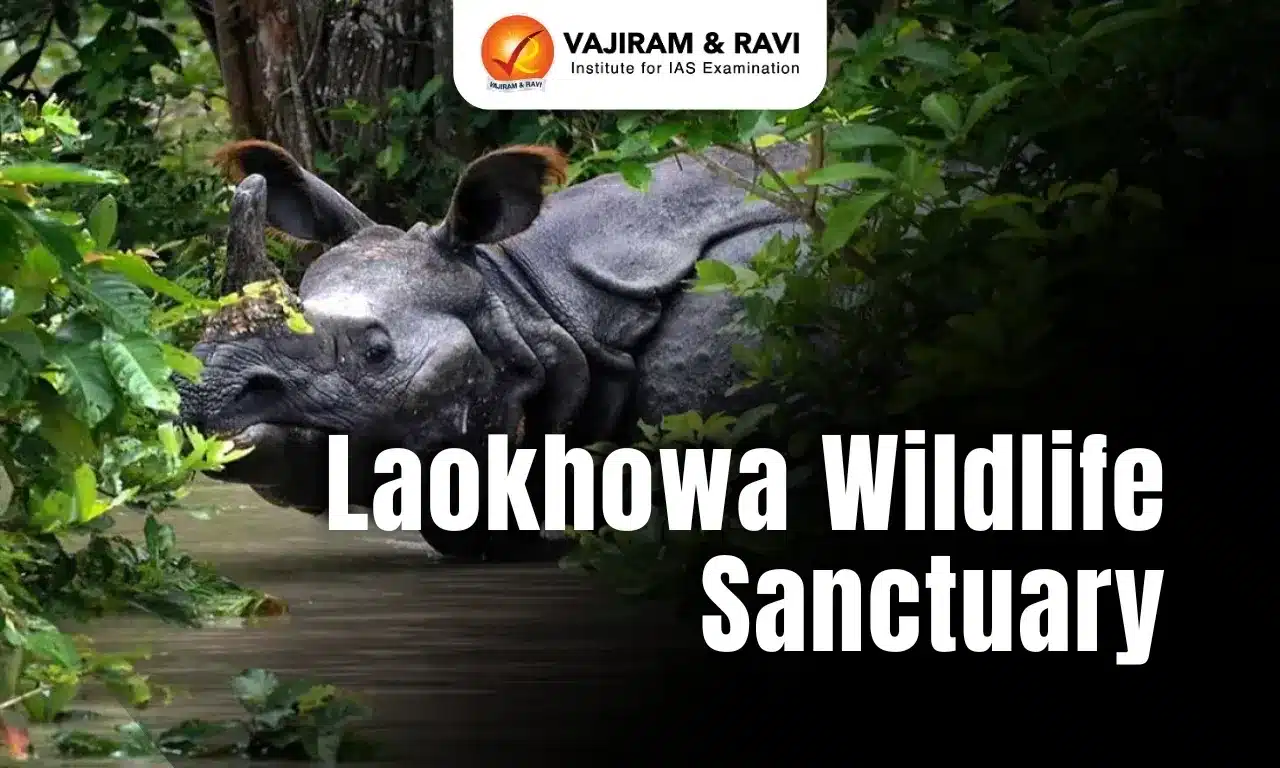
    • The sanctuary is home to the great Indian-one horned rhinoceros, elephants, royal Bengal tigers, Asiatic water buffaloes and more than 225 species of birds.
    • Some of the birds spotted here are the spot-billed pelican, little and large cormorant, egret, open-billed stork, brahminy kite, pond heron, etc.

Source: NM

Laokhowa Wildlife Sanctuary FAQs

Q1: Laokhowa Wildlife Sanctuary is located in which Indian state?

Ans: Assam

Q2: The Laokhowa Wildlife Sanctuary forms an integral part of which ecosystem?

Ans: It forms an integral part of the Laokhowa-Burachapori ecosystem.

Q3: What is the total area covered by Laokhowa Wildlife Sanctuary?

Ans: Around 70.13 sq.km

Q4: Laokhowa Wildlife Sanctuary serves as a buffer zone for which Tiger Reserve?

Ans: Kaziranga Tiger Reserve

Key Facts about Nigeria

Key Facts about Nigeria

Nigeria Latest News

The US President has ordered the Department of War to prepare for possible military action in Nigeria. 

About Nigeria

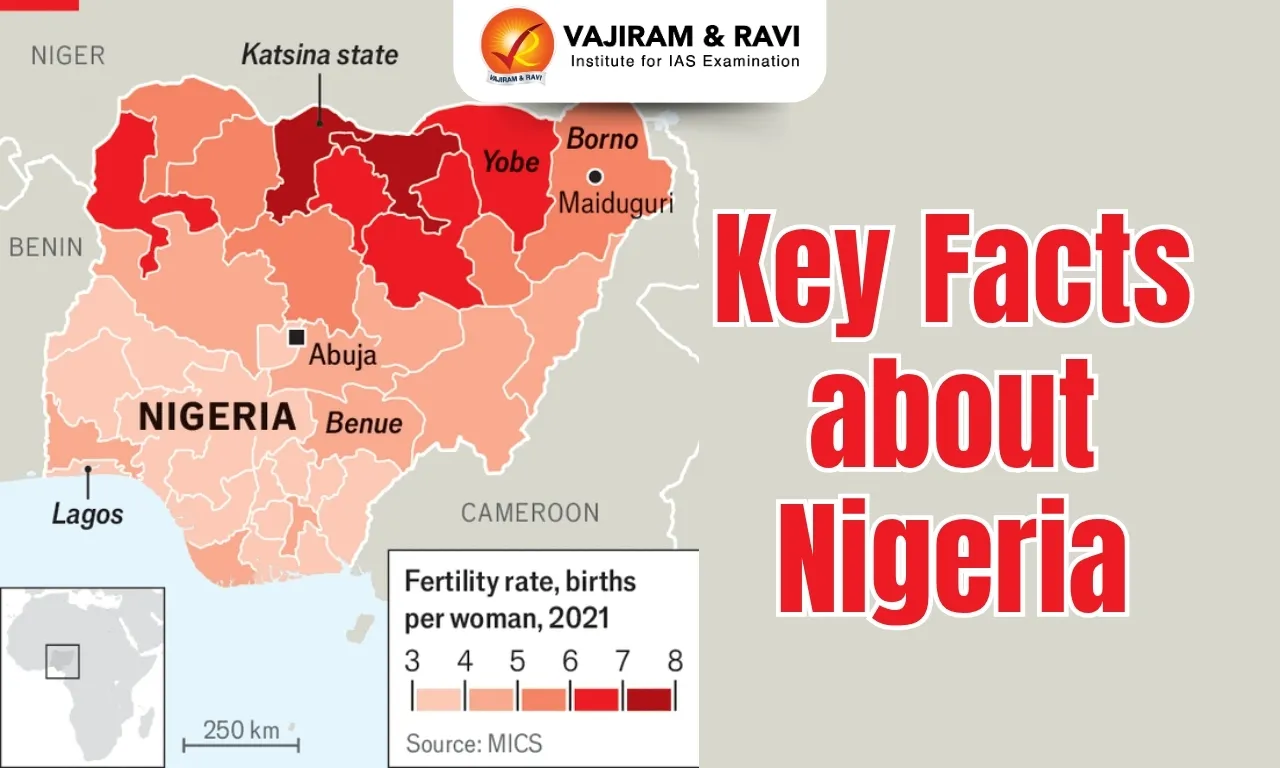
  • Location: It is a country located on the western coast of Africa. It is often called the “Giant of Africa.” 
  • Boundaries: It is bordered to the north by Niger, to the east by Chad and Cameroon, and to the west by Benin. It also has a coastline on the Gulf of Guinea.
  • It is also Africa’s most populous country.
  • Capital: Abuja

Geographical Features of Nigeria

  • Climate: Nigeria has a diverse geography, with climates ranging from arid to humid equatorial.
  • Drainage: The major drainage areas in Nigeria are the Niger-Benue basin, the Lake Chad basin, and the Gulf of Guinea basin.
  • River: The Niger River, for which the country is named, and the Benue, its largest tributary, are the principal rivers.
  • Major Mountain Range: Cameroonian Highlands
  • Natural Resources: It has abundant natural resources, notably large deposits of petroleum and natural gas.

Source: IE

Nigeria FAQs

Q1: Which countries share a border with Nigeria?

Ans: Niger, Chad, Cameroon, and Benin

Q2: What is the capital of Nigeria?

Ans: Abuja

Burevestnik Missile

Burevestnik Missile

Burevestnik Missile Latest News

The Russian President recently announced that Russia had tested its Burevestnik nuclear-powered cruise missile.

About Burevestnik Missile

  • The Burevestnik, whose name translates as “storm petrel“, is a ground-launched, low-flying cruise missile that is not only capable of carrying a nuclear warhead but is also nuclear-powered.
  • It was developed by Russia.
  • It is one of six strategic weapons that the Russian President introduced in a 2018 speech.
  • It is code-named ‘SSC-X-9 Skyfall’ by NATO.

Burevestnik Missile Features

  • It is powered by a small nuclear reactor, which heats up air to propel the missile forward.
  • Its nuclear propulsion gives the missile much longer range than traditional turbojet or turbofan engines that are limited by how much fuel they can carry.
  • That propulsion gives it virtually unlimited range, allowing it to loiter for days, circling the enemy’s air defenses and attacking from an unexpected direction.
  • The missile is also designed to fly at low altitudes, much lower than a conventionally powered cruise missile, which would make it harder for air-defence radar to detect.

Source: IE

Burevestnik Missile FAQs

Q1: The Burevestnik missile has been developed by which country?

Ans: Russia

Q2: What is the NATO code name for the Burevestnik missile?

Ans: SSC-X-9 Skyfall

Q3: The nuclear propulsion of Burevestnik gives what kind of advantage?

Ans: It has virtually unlimited range and endurance.

Enquire Now